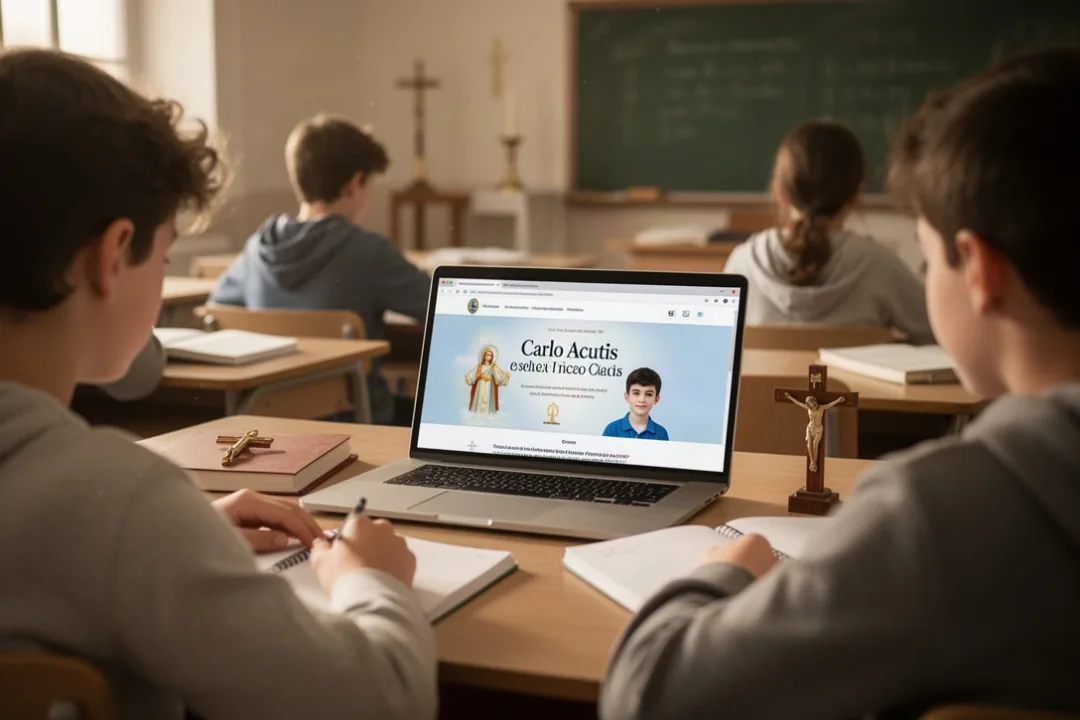
Carlo Acutis is widely recognized as the patron saint of the internet and digital evangelization.
He is also associated with computer programmers, young people, and those who want to use technology for a meaningful purpose. These descriptions reflect his life and influence, although the Church’s formal process for assigning patronages can be more specific than popular Catholic language suggests.
Who Carlo Acutis was and why he became associated with technology
Carlo Acutis was an Italian Catholic teenager born in London on May 3, 1991, and raised mainly in Milan. He died from leukemia on October 12, 2006, at age 15. Although his life was brief, people remembered him for his devotion to the Eucharist, ordinary kindness, and unusual ability with computers.
Carlo learned to work with computers at a young age and used that skill to create websites, videos, and online materials about Catholic faith. One of his best-known projects documented Eucharistic miracles from different places around the world. The collection was later displayed in churches and used in educational settings.
His example stood out because he did not treat technology as separate from faith. He saw the internet as a tool that could communicate the Gospel, explain Christian beliefs, and help people discover the lives of the saints. That combination led many Catholics to call him the “saint of the internet”, even before his canonization.
What Carlo Acutis is the patron saint of
Carlo Acutis is most commonly named as the patron saint of the internet. He is also frequently connected with digital evangelization, computer programmers, website creators, and young people. These associations come from the way he used his technical abilities in service of his faith.
The internet: Carlo is often invoked by people who want online communication to promote truth, faith, learning, and human dignity.
Digital evangelization: His work is an example of sharing Christian teaching through websites, video, graphics, and other media.
Computer programmers and technology workers: He used programming and digital design to support a religious project rather than treating technology as an end in itself.
Young people: His age, friendships, school life, and familiar interests make his example especially accessible to teenagers and young adults.
People seeking holiness in ordinary life: Carlo did not become known for living apart from society. He pursued faith while attending school, spending time with friends, and using modern technology.
The simplest answer is therefore the internet and digital evangelization. The other patronages describe groups and activities that naturally relate to his life. A parish, school, family, or individual may ask for his intercession in any of these areas.
Important distinction: “Patron saint of the internet” is a widely used description of Carlo Acutis, but it should not automatically be read as a single formal title covering every technology-related group. Popular devotion and official ecclesiastical designation are not always identical.
How to understand Carlo Acutis’s patronage step by step
His patronage makes more sense when you connect the title to the actions that shaped his reputation. The following points separate the historical facts from the broader devotional conclusions people draw from them.
Start with his practical skill. Carlo was comfortable using computers, creating digital content, and organizing information. His technical ability was not merely an incidental hobby.
Look at how he used that skill. He produced online material about Catholic subjects, particularly Eucharistic miracles. His work aimed to inform and encourage other people.
Consider his intended audience. Digital media allowed religious information to reach people beyond his local parish or school. That makes him a natural model for online outreach.
Connect the technology with his spiritual life. Carlo’s devotion to Mass, prayer, confession, and service gave his digital work a clear purpose. He did not present computers as substitutes for worship or community.
Apply the example carefully. Asking Carlo’s intercession can involve praying for wisdom in online communication, ethical use of technology, protection from harmful content, or courage to share faith respectfully.
This approach prevents the title from becoming a slogan detached from his life. Carlo is not remembered simply because he was young and knew how to use a computer. He is remembered because he brought technical creativity, religious conviction, and concern for other people together.
Why Carlo Acutis is called the patron saint of the internet
The internet is the most prominent association because Carlo used digital media for a specific religious purpose. He gathered information about reported Eucharistic miracles, arranged it in a structured collection, and helped make it available to a broad audience. The project showed how a modern communication tool could support religious education and personal reflection.
His example also differs from the way many people think about online activity. Carlo’s interest was not centered on popularity, personal branding, or constant entertainment. He treated technology as an instrument. That distinction explains why Catholic educators and youth ministers often present him as a model for responsible and purposeful internet use.
Calling Carlo the patron saint of the internet does not mean that every website or online conversation reflects his values. His example points toward truthfulness, moderation, respect, and service. It also invites people to ask whether their use of technology helps them become more attentive to God and other people or leaves them distracted and isolated.
Carlo’s example presents technology as a tool for sharing truth and serving others, not as a replacement for prayer, worship, or human relationships.
How digital evangelization fits Carlo Acutis’s story
Digital evangelization means communicating the Christian faith through digital channels. It can include websites, podcasts, online classes, social media, videos, livestreams, digital art, and educational resources. The medium changes, but the basic goal remains explaining the faith and inviting people toward a relationship with God.
Carlo’s work fits this description because he used the tools available to him to organize and communicate religious material. His project was not simply a collection of technical experiments. It was intended to help people learn about the Eucharist and take Catholic belief seriously.
His example can guide modern creators in several practical ways:
Use clear language instead of assuming that every reader already understands religious terms.
Check facts carefully before sharing claims about miracles, saints, history, or Church teaching.
Present religious subjects with respect rather than using shock, pressure, or sensationalism.
Make room for questions from people who are curious, doubtful, or unfamiliar with Christianity.
Remember that online communication should lead toward real human care, prayer, and community.
Carlo’s patronage therefore applies not only to professional technology workers. A person who maintains a parish website, records faith-based videos, designs religious graphics, teaches through an online course, or moderates a Catholic community may all see him as a fitting intercessor.
Why young people look to Carlo Acutis
Carlo’s age is central to his appeal. He lived as a student with friends, family responsibilities, and ordinary interests. His faith was not built around having an unusual public position. Instead, he tried to practice prayer, generosity, and moral responsibility within everyday life.
He is often presented to young people as evidence that holiness is not reserved for older adults, clergy, or religious professionals. Carlo enjoyed sports and entertainment, had a strong interest in computers, and understood the attractions of modern media. At the same time, he tried to set limits and keep his priorities centered on faith and service.
This does not mean young Catholics must copy every detail of Carlo’s personality or interests. His importance lies in the broader principle that age does not prevent a person from living with purpose. Students may ask for his prayers before an exam, during a difficult friendship, while making decisions about online behavior, or when trying to remain faithful in a secular environment.
Parents, teachers, and youth leaders also turn to Carlo because his story creates a bridge between traditional Catholic devotion and the experiences of contemporary teenagers. He can be introduced through discussions about media habits, peer pressure, service, prayer, and the search for meaning.
What Carlo Acutis taught about ordinary holiness
Carlo’s reputation is sometimes reduced to his computer skills, but his spiritual life was broader. Accounts of his life emphasize regular participation in the sacraments, devotion to the Eucharist, prayer, concern for people who were poor or lonely, and a willingness to help others. His technology use makes his story distinctive, but it is not the whole reason Catholics honor him.
His example suggests that holiness can grow through consistent choices in ordinary circumstances. A person does not need to abandon school, work, family life, or modern tools to seek a deeper relationship with God. The challenge is to use those parts of life with discipline and love.
That message matters when considering his patronage. Carlo is not a patron of technology because technology is automatically good. He is associated with it because he showed how a powerful tool could be directed toward learning, witness, and service. His life also raises questions about balance, attention, and the difference between using media and being controlled by it.
How Catholics can ask for Carlo Acutis’s intercession
There is no required formula for asking a saint’s intercession. Catholics may speak to God directly and ask Carlo to pray with them and for them. A short prayer can mention the particular need, such as wisdom in using technology, strength for a young person, or help in sharing faith with kindness.
A practical prayer routine might include these steps:
Name the intention. Be specific about the person or situation that needs prayer.
Ask for Carlo’s intercession. Request that he pray for the need before God.
Connect the prayer to action. Consider one responsible step, such as turning off a distracting app, correcting misinformation, or contacting someone who needs support.
Pray with the Church. You might attend Mass, read about the Eucharist, pray a decade of the Rosary, or speak with a priest or trusted Catholic mentor.
Remain open to the result. Asking for intercession is not a guarantee that a desired outcome will occur. It is an act of trust and a request for grace.
Someone working in software might ask Carlo for integrity and patience. A parent might ask for help guiding a child’s media habits. A student might ask for courage to live by Christian convictions online and in person. The prayer becomes more faithful to Carlo’s example when it leads to honest conduct and care for others.
Carlo Acutis’s status as a canonized saint
Carlo was beatified in Assisi on October 10, 2020, after the Catholic Church recognized a miracle attributed to his intercession. He was later canonized on September 7, 2025, making him a canonized saint of the Catholic Church and one of the first figures from the millennial generation to receive that recognition.
Canonization means that the Church formally recognizes Carlo as a saint and presents him as someone worthy of universal veneration among Catholics. It also permits his name to be included in the Church’s public liturgical life according to applicable rules. Canonization does not mean that every popular description attached to him automatically becomes an official patronage.
The distinction matters because people often use the phrase “patron saint of” in a broad devotional sense. Catholics may legitimately ask Carlo’s intercession for internet users, programmers, young people, and digital missionaries because those concerns clearly relate to his life. Formal patronage, however, depends on the Church’s recognized process and specific designations.
For a concise answer: Carlo Acutis is best known as the patron saint of the internet and digital evangelization, with strong associations with computer programmers and young people. His life shows how modern technology can be placed at the service of faith, learning, and charity.
What his patronage means for online life today
Carlo’s example gives online users a practical standard: use technology in ways that respect truth, human dignity, and attention. That may involve refusing to forward an unverified story, avoiding cruel comments, setting healthy limits on screen time, or using digital skills to help a parish, school, charity, or family.
It also means recognizing what the internet cannot provide. Online content can inform and connect people, but it cannot replace the sacraments, personal responsibility, face-to-face friendship, or the care of a local faith community. Carlo’s digital work was connected to a lived Catholic faith rather than separated from it.
For that reason, his patronage is relevant to more than computer experts. Anyone who uses a phone, social platform, website, or messaging service can reflect on his example. The central question is simple: Does the way you use technology help you seek truth and serve people?
Common symbols and feast-day connections
Images of Carlo often show him in casual clothing, sometimes with a laptop or other reference to his interest in computers. These symbols help people recognize the connection between his modern life and his religious mission. They also make him approachable to young people who may not immediately identify with traditional artistic images of saints.
His liturgical memorial is celebrated on October 12, the date of his death, which the Church understands as the day he entered eternal life. Parishes and schools may mark the occasion with Mass, prayer services, discussions about responsible technology, Eucharistic adoration, or charitable projects.
Some communities also connect Carlo with exhibitions about Eucharistic miracles. These displays reflect one of his major projects, but they should be approached with sound Catholic teaching and careful discernment. His reputation rests not on curiosity about extraordinary events alone, but on a life directed toward Christ, the Eucharist, prayer, and love of neighbor.
How to explain Carlo Acutis in one sentence
If you need a brief explanation, say: Carlo Acutis is a canonized Catholic saint widely recognized as the patron of the internet and digital evangelization, especially because he used computer technology to share the faith. You can add that he is also associated with young people and computer programmers.
That wording gives the clearest answer while preserving the important nuance. Carlo’s patronage is not a claim that technology is sacred by itself. It is a reminder that ordinary tools, including the internet, can be used with wisdom, discipline, compassion, and a desire to communicate what is true.
Frequently asked questions
Is Carlo Acutis officially the patron saint of the internet?
He is widely called the patron saint of the internet, and the title is strongly connected to his documented use of computers and websites for Catholic evangelization. However, popular patronage language can be broader than a formal declaration by Church authorities. The safest description is that Carlo is the best-known Catholic patron and model associated with the internet and digital evangelization.
Why is Carlo Acutis connected with computer programmers?
Carlo had a notable ability with computers and used programming, web design, and digital media to organize information about Eucharistic miracles. He did not use technology only for entertainment or personal recognition. His example connects technical work with service, ethical responsibility, education, and communication of faith, which is why programmers and other technology workers often ask for his intercession.
What can young people learn from Carlo Acutis?
Young people can learn that faith and ordinary modern life do not have to be opposites. Carlo attended school, had friends, enjoyed familiar hobbies, and understood technology while also practicing prayer, charity, and devotion to the Eucharist. His story encourages young people to use their abilities responsibly and to seek holiness through everyday choices rather than waiting for a different stage of life.
When is Carlo Acutis’s feast day?
Carlo Acutis’s liturgical memorial is observed on October 12, the anniversary of his death in 2006. Churches and schools may mark the day with Mass, prayer, Eucharistic adoration, educational events, or service projects. The date can also provide an opportunity to discuss his use of technology and how digital communication can support truth, faith, and care for others.

















Leave a Reply