Saint Olga of Kiev was a tenth-century ruler of Kievan Rus who governed as regent after her husband, Prince Igor, was killed. She is remembered for strengthening the state, seeking Christianity, and helping prepare the way for the later Christianization of Rus under her grandson Vladimir.
Olga was baptized in Constantinople, probably around 957, and received the Christian name Helen. Eastern Christian traditions honor her as Equal-to-the-Apostles, a title reserved for people whose work helped spread the Christian faith. Her feast day is commonly observed on July 11.
Olga lived during a formative period in the history of Kievan Rus, a federation of East Slavic and related peoples centered on Kyiv. The state connected trade routes running between the Baltic region, the Black Sea, Byzantium, and neighboring peoples. Political authority depended on military strength, tribute, personal loyalty, and control of important river routes.
Most details about Olga’s life come from the Primary Chronicle, a medieval record compiled later than the events it describes. The chronicle combines political history, oral tradition, dynastic memory, and religious interpretation. As a result, some stories about Olga may preserve historical memories while also presenting her as an especially clever and providential ruler.
She was married to Prince Igor, a ruler associated with the early dynasty of Kyiv. Their son, Sviatoslav, was still a child when Igor died. Olga therefore became regent, governing in her son’s name and exercising authority in a society where rulers were expected to lead armies, collect tribute, negotiate alliances, and protect the dynasty.
Olga’s importance does not rest only on her religious conversion. She also demonstrated that a woman could exercise sovereign power during a dangerous period of dynastic transition. Her government helped preserve the authority that Sviatoslav later inherited, even though he remained more closely associated with military campaigns than with Christianity.
At a glance: Olga is remembered for three connected roles: regent of Kievan Rus, an early Christian ruler in the dynasty, and the grandmother of Vladimir the Great, whose reign brought large-scale Christianization to Rus.
Olga’s rise to power after Igor’s death
According to the chronicle, Igor was killed by the Drevlyans, a neighboring people from whom he had attempted to collect tribute. The account says that he returned to demand more after already receiving payment. The Drevlyans captured and killed him, creating a political crisis for Kyiv and leaving Olga to protect her young son’s claim to the throne.
The chronicle describes a series of severe acts of revenge. In the story, Drevlyan envoys first came to propose that Olga marry their prince and join their political interests to hers. Olga had them carried in a boat to her court and buried alive in a pit. She then invited another group of prominent Drevlyans to a bathhouse, where they were trapped and killed.
Later, the chronicle portrays Olga as using further deception during a visit to the Drevlyan capital. She ordered pigeons and sparrows to be attached to burning materials and released, causing fires throughout the city. Modern readers should treat these episodes carefully: they are part of a medieval narrative that emphasizes Olga’s intelligence, determination, and control of justice, but the exact historicity of each detail cannot be established with certainty.
The violence in these stories can seem sharply at odds with Olga’s later Christian reputation. Medieval sources, however, often presented early rulers through several roles at once: warrior, judge, dynasty-builder, and religious patron. Olga’s revenge narratives communicate that she defended her family and reasserted Kyiv’s authority after a direct challenge.
Her response also had a political purpose. A weak regency could have invited rebellion, rival claims, or the breakup of the emerging state. By punishing the group responsible for Igor’s death and restoring tribute arrangements, Olga showed that the ruling house remained capable of enforcing its authority.
Her early rule can be understood through the practical responsibilities of a regent:
Protecting the succession: keeping Sviatoslav recognized as the lawful heir.
Managing tribute: making the collection of resources more predictable and politically sustainable.
Controlling local power: discouraging neighboring groups from treating the young prince’s minority as an invitation to revolt.
Maintaining diplomacy: dealing with Byzantine, Scandinavian, and regional interests around Kyiv.
Later tradition credits Olga with establishing more regular systems for tribute and administrative centers. The chronicle mentions designated collection points and related arrangements, although historians debate how much of this system can be securely attributed to her personally. Even with those limits, Olga is widely remembered as a ruler who brought greater order to the collection of resources.
Olga’s baptism in Constantinople
Olga’s conversion is one of the central events in her legacy. She traveled to Constantinople, the capital of the Byzantine Empire and one of the most influential Christian cities of the medieval world. The exact date is uncertain, but many historians place her baptism around 957, during the reign of Byzantine Emperor Constantine VII.
The Primary Chronicle presents the emperor as being impressed by Olga and describes a baptism in which she received the Christian name Helen. The narrative also says that she rejected a marriage proposal from the emperor on the grounds that he had become her spiritual father through baptism. This detail may reflect literary shaping, dynastic pride, or a traditional explanation for why a marriage did not take place.
Olga’s baptism had both religious and diplomatic significance. Christianity was the faith of the Byzantine court, and a ruler’s baptism could establish closer ties with the empire. It could also introduce new forms of literacy, law, architecture, artistic exchange, and political ceremony into a neighboring society.
Her conversion did not immediately make Kievan Rus a Christian state. The population followed a variety of religious practices, and Sviatoslav did not adopt his mother’s faith. Olga appears to have supported Christianity within the royal household and court, but the broader transformation of Rus took place later.
Byzantine Christianity was not simply a private belief system for a tenth-century ruler. It shaped imperial diplomacy and offered a network of church leaders, texts, ritual practices, and cultural models. Olga’s contact with Constantinople gave her access to a highly organized Christian civilization while she continued to govern a predominantly non-Christian realm.
The sources do not provide a complete account of Olga’s personal religious life. They do, however, portray her as committed enough to seek baptism and to encourage Christian teaching. Later Christian writers regarded her decision as an early sign that the ruling dynasty was moving toward the faith that would eventually define Rus.
Olga’s baptism mattered because it connected the ruling house of Kyiv with the Christian world before the mass conversion associated with Vladimir.
How Olga influenced Vladimir and the Christianization of Rus
Olga’s grandson Vladimir the Great became the ruler most associated with the Christianization of Kievan Rus. In 988, according to traditional accounts, Vladimir accepted Christianity and arranged for a public conversion centered on Kyiv. The event marked a major change in the religious and cultural direction of the state.
Olga did not carry out that mass conversion herself, and she should not be credited with an achievement that belonged to Vladimir’s reign. Her contribution was earlier and more indirect. She established a Christian presence within the ruling family and demonstrated that conversion could coexist with political authority in Kyiv.
Later accounts portray Olga as trying to persuade Sviatoslav to become Christian, but he resisted because of his military identity and concern about how his followers would respond. The sources may simplify a complicated family and political relationship. Still, the tradition preserves the idea that Olga’s Christianity was active rather than merely ceremonial.
Vladimir’s eventual conversion made Olga’s earlier decision appear prophetic to later church historians. From their perspective, she was the first major member of the dynasty to turn toward Christianity, while Vladimir completed the transformation she had helped prepare. This is why Orthodox tradition gives her the title Equal-to-the-Apostles.
Her influence may also have operated through memory. Royal families often used ancestors to explain and legitimize political change. By honoring Olga as a Christian predecessor, later rulers could present the baptism of Rus as part of a dynastic story rather than as an abrupt break with the past.
The relationship between Olga and Vladimir can be understood in several ways:
Family influence: Olga was an important elder within the ruling household and a Christian example close to Vladimir’s dynasty.
Institutional groundwork: her ties with Constantinople helped make Christianity familiar at the highest political level.
Dynastic continuity: Vladimir could present his conversion as fulfilling a direction already visible in the family.
Religious memory: later Christians remembered Olga as the first major step toward the baptism of Rus.
Her story also shows that conversion rarely happens through one decision by one ruler. Religious change involves households, political alliances, clergy, public rituals, education, and institutions. Olga’s baptism was an early royal conversion; Vladimir’s later actions made Christianity a public and state-supported religion across a much wider population.
Keep the timeline clear: Olga became Christian decades before Vladimir’s public conversion of Rus. Her role was foundational and influential, but she was not the ruler who carried out the mass baptism traditionally associated with 988.
What Saint Olga represents in Christian tradition
Orthodox Christians honor Olga as a saint because of her conversion, her support for Christianity, and her place in the history of the Church in Rus. Her title, Equal-to-the-Apostles, emphasizes the impact of her witness and influence rather than claiming that she was one of the original Apostles.
She is often associated with wisdom, leadership, perseverance, and conversion. These themes arise from the contrast between the determined ruler described in the revenge narratives and the Christian grandmother remembered by later tradition. Her life is therefore read as a story of political authority redirected toward a new faith.
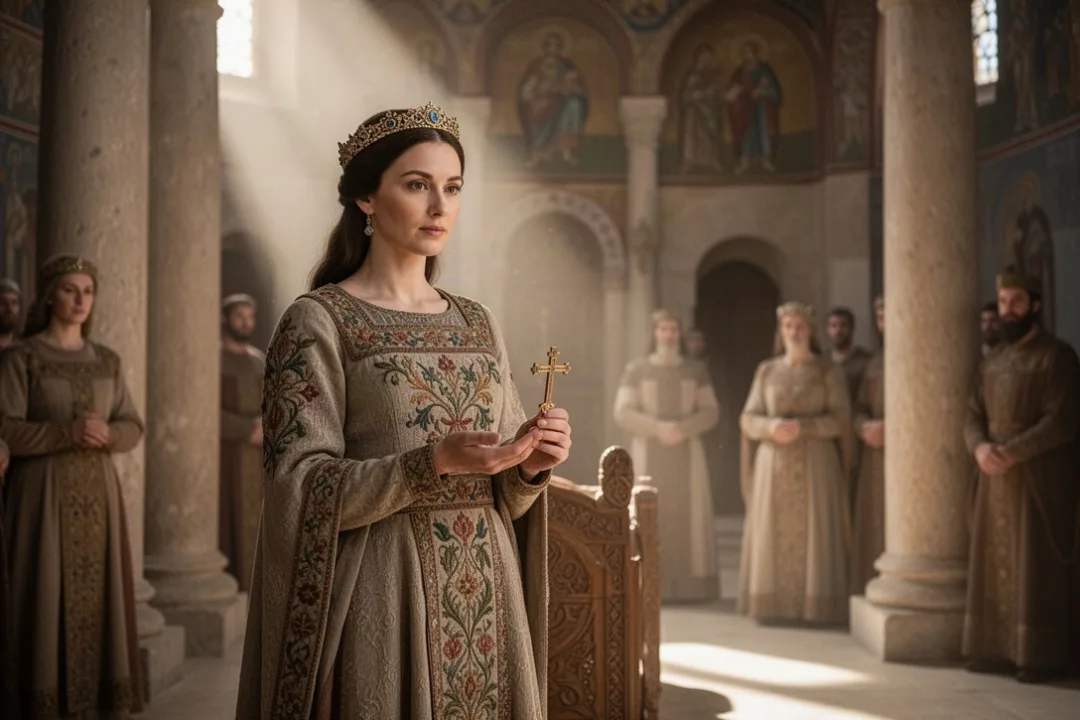
Church art commonly presents Olga as a crowned ruler holding a cross. The crown refers to her royal authority, while the cross identifies her Christian commitment. Images may also place her near Vladimir or show her with symbols associated with a Christian ruler. Artistic details vary by tradition, period, and region.
Her feast day is generally observed on July 11 in the Orthodox calendar. Some churches and calendars may use different forms of the date because of calendar differences. She is especially connected with Kyiv and with the Christian heritage of the Eastern Slavic world.
Devotion to Olga does not require treating every episode in the medieval chronicle as a literal transcript of events. Saints’ lives often preserve theological meaning through stories shaped by the concerns of later communities. Olga’s veneration rests on her historical place as an early Christian ruler as well as on the spiritual interpretation of her choices.
For many believers, her example has particular meaning because she lived between two worlds. She governed within a culture still shaped by pre-Christian traditions while reaching toward the Christian civilization of Byzantium. Her story suggests that faith, political responsibility, and cultural change can develop over time rather than appearing all at once.
Olga’s legacy has been interpreted differently across centuries and communities. Medieval church writers emphasized her baptism and connection to Vladimir. Historians have examined her administrative policies, diplomatic contacts, and place in the development of the Kievan state. Modern Ukrainians, Russians, and other East Slavic peoples may encounter her through distinct national, religious, and cultural narratives.
The name Olga itself reflects the region’s Scandinavian connections. It is related to the Old Norse name Helga, while her baptismal name Helen came from the Byzantine Christian world. The combination reflects the mixed cultural environment of early Kyiv, where Scandinavian, Slavic, Byzantine, and steppe influences met.
Her rule also challenges assumptions about women’s political power in the medieval period. Olga was not merely a temporary placeholder for a male ruler. She negotiated, punished rebellion, directed policy, traveled diplomatically, and protected her family’s authority. Her gender shaped the way later writers described her, but it did not prevent her from exercising real power.
At the same time, the sources should not be read as a modern biography. The Primary Chronicle was written later, and the authors had religious and dynastic reasons for arranging events into a meaningful story. The record provides valuable evidence, but it requires comparison, caution, and attention to the difference between documented events and literary presentation.
Remembering Olga accurately means holding several truths together:
She was a capable political leader during a vulnerable succession.
Her revenge is central to the medieval account of her reign, but individual details may be legendary or stylized.
She was one of the earliest prominent Christian rulers in the dynasty of Kyiv.
Her baptism did not Christianize the entire population immediately.
Her influence helped create a dynastic and cultural setting in which Vladimir’s later conversion became possible.
Saint Olga of Kiev remains significant because her life links governance, diplomacy, family succession, and religious change. She ruled before Christianity became dominant in Rus, yet her decision to be baptized gave later generations a powerful symbol of the faith’s first royal foothold. Her story is remembered not as a simple tale of sudden transformation, but as an early turning point in the history of Kyiv and Eastern Christianity.
Frequently asked questions
Was Saint Olga of Kiev the first Christian ruler of Rus?
Olga is generally regarded as the first prominent Christian ruler of the Kievan dynasty, but Christianity already existed among some people in the region before her baptism. Her conversion made Christianity visible at the highest level of government. The later mass conversion of Kievan Rus is traditionally associated with her grandson Vladimir, not with Olga herself.
Why is Saint Olga called Equal-to-the-Apostles?
The title recognizes people whose missionary influence or support for Christianity had an impact comparable to that of the Apostles. Olga received it because she embraced Christianity, encouraged its presence within the ruling family, and helped prepare the dynastic setting for Vladimir’s later conversion of Rus.
Did Saint Olga really burn the Drevlyan city with birds?
The story appears in the Primary Chronicle, but historians cannot verify every detail. It may preserve a memory of a military action while also using dramatic storytelling to portray Olga’s cleverness and authority. The episode is best treated as part of a medieval historical narrative rather than as independently confirmed evidence.
Where is Saint Olga of Kiev’s feast day observed?
Orthodox churches commonly observe Saint Olga’s feast on July 11. The date can appear differently in communities using different church calendars. She is particularly honored in traditions connected with Kyiv, the history of Kievan Rus, and the Christian heritage of Eastern Europe.













Leave a Reply