If you have heard Saint Helen’s name connected with the True Cross, you may wonder who she was and how a woman from the Roman Empire became one of Christianity’s best-known saints. Saint Helen, also called Helena, was the mother of Emperor Constantine the Great and a prominent Christian patron in the fourth century.
Her life stands at the meeting point of Roman imperial history, Christian pilgrimage, and tradition. Historical records identify her as an influential woman who supported churches and traveled to the Holy Land late in life. Christian tradition especially remembers her for helping locate sites and relics associated with Jesus Christ’s Passion, including the cross on which Jesus was crucified.
Saint Helen was probably born around the middle of the third century, although the exact year and place of her birth are uncertain. Ancient writers associate her with Drepanum, a city in Bithynia on the southern shore of the Sea of Marmara. The city was later renamed Helenopolis in her honor.
She became the partner of Constantius Chlorus, a Roman military leader who later ruled as emperor. Their son, Constantine, was born around 272. Constantius and Helen were not married in the same way later Roman imperial marriages were recognized, and political circumstances eventually separated them. When Constantius became emperor, he married Theodora, the stepdaughter of Emperor Maximian.
Despite that separation, Constantine appears to have remained closely connected to his mother. After he became emperor in 306, he gave Helen an honored position at court. She received the title Augusta, or empress, around 324, and imperial coins were issued in her name. These honors show that she was not merely a private religious figure but a woman with substantial public status.
A useful distinction: the historical Helen is known from Roman and Christian sources, while many details about her early life come from later traditions. Her influence is well established, but not every story told about her can be verified with equal confidence.
How Helen became associated with Christianity
The timing and circumstances of Helen’s conversion are not completely clear. Some Christian accounts suggest that Constantine’s victory and later religious policies influenced her faith, while other traditions present her as a Christian before her son’s public support of Christianity. The surviving evidence does not provide a single, certain conversion story.
Constantine’s rise changed Christianity’s position within the Roman Empire. After the civil wars that brought him to power, he supported the Christian Church and helped end official persecution in territories under his control. Helen benefited from this new imperial environment, but her religious identity should not be reduced to her son’s policies.
Ancient Christian writers portray her as a devout patron who funded churches, assisted the poor, and visited places connected with Jesus’ life. Her reputation grew because she combined imperial resources with personal religious commitment. She was remembered not simply as Constantine’s mother, but as a woman who used her position to support Christian worship.
Eusebius of Caesarea, a bishop and historian who knew the imperial Christian world, describes Helen as deeply devoted to the faith. His account emphasizes her humility, generosity, and attention to churches. Because Eusebius wrote with admiration for Constantine’s family, readers should recognize that his portrait is both historically valuable and shaped by a favorable Christian viewpoint.
Why Saint Helen traveled to the Holy Land
According to ancient Christian tradition, Helen traveled to the Holy Land late in her life, probably in the 320s. Such a journey was demanding even for an empress. Travel involved long distances, uncertain roads, political planning, and physical hardship. Her pilgrimage therefore represented more than a ceremonial visit.
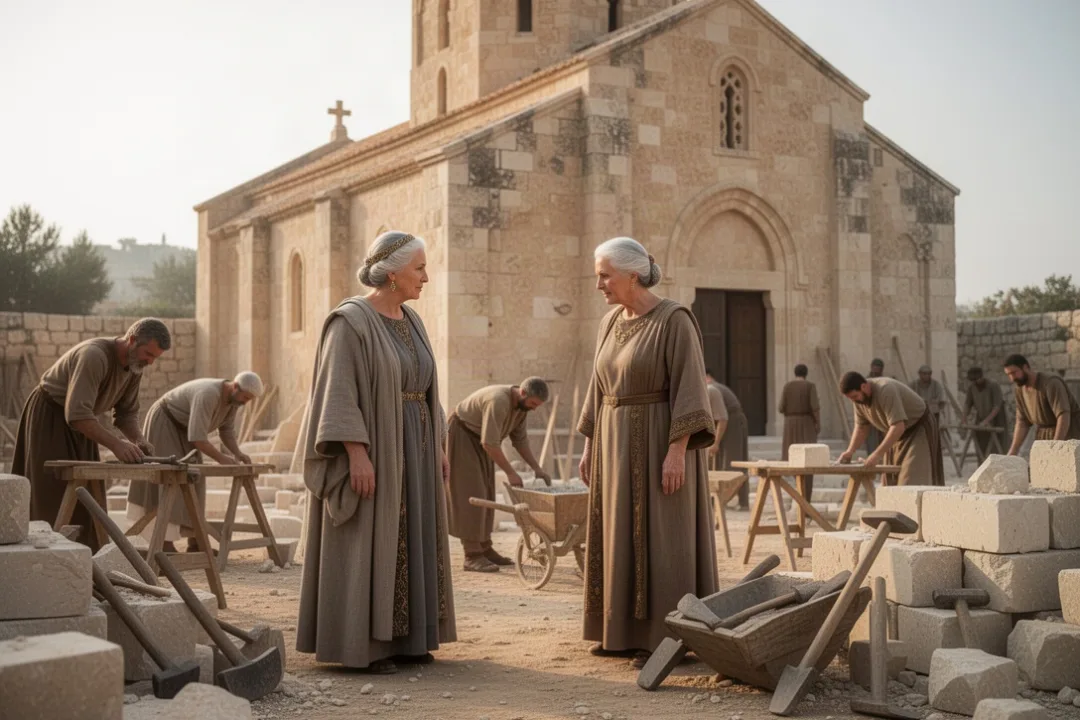
Helen’s journey took place while Constantine was sponsoring major church construction. The emperor ordered the building of a church at the site traditionally identified with Jesus’ tomb and resurrection. He also supported a church at Bethlehem, associated with Jesus’ birth, and a church on the Mount of Olives, associated with Jesus’ ascension.
Helen is especially linked with the Church of the Holy Sepulchre in Jerusalem. The church complex was built over locations that Christian communities had long associated with Calvary, where Jesus was crucified, and the tomb where he was buried. The building was dedicated in the fourth century and became one of Christianity’s most important pilgrimage destinations.
Tradition also connects Helen with the Church of the Nativity in Bethlehem and with holy sites around Jerusalem. Whether she personally directed every discovery attributed to her is uncertain, but her role in supporting sacred construction and pilgrimage appears in early Christian memory.
What Saint Helen supposedly found beneath Jerusalem
The most famous story says that Helen searched for the cross used at Jesus’ crucifixion. The story holds that the Roman authorities had buried or concealed the crosses after the crucifixion, and that Helen’s workers uncovered them near the site of Calvary.
According to later accounts, three crosses were found. Since Jesus was crucified alongside two other condemned men, the challenge was determining which cross was his. One version says that a seriously ill woman touched each cross and was healed when she touched the true one. Another version describes a dead person being restored to life through contact with the correct cross.
These stories explain the traditional identification of the True Cross. They are central to Saint Helen’s religious image, but they should be understood as accounts of Christian tradition rather than as independently proven details. The sources describing the discovery were written after the events they report, and their narratives differ in important ways.
The True Cross became one of the most significant relics in Christian history. Pieces associated with it were preserved and displayed in different churches. For believers, the relic represented the physical reality of Christ’s suffering and death. It was not treated as a magical object but as a material reminder of the Christian teaching that Jesus’ death is connected with salvation.
“The place of the cross” became, in Christian memory, not only a location of suffering but also a place of hope and resurrection.
What historians can and cannot confirm about the True Cross
Historical research can confirm that Christian communities in Jerusalem preserved and honored sites associated with Jesus during the fourth century. It can also confirm that Constantine sponsored major church buildings in those locations. The evidence is less certain when it comes to the exact discovery process and the identity of every relic later called part of the True Cross.
The first detailed surviving account of Helen’s discovery is associated with Cyril of Jerusalem, although the tradition developed over time and later writers added dramatic details. Some ancient accounts do not mention Helen at all, which has led historians to examine how her role expanded in later memory.
That uncertainty does not make the tradition meaningless. Religious traditions often preserve a community’s understanding of a place, object, or event through stories shaped across generations. In Saint Helen’s case, the tradition expresses the importance of Jerusalem as a Christian holy city and the desire to connect worship with the physical places of Jesus’ life.
It is also possible to hold two ideas together: the historical evidence for the exact relic is limited, and the story has had lasting spiritual and cultural importance. A careful account should distinguish between what is documented, what is plausible, and what belongs primarily to devotion.
Saint Helen’s churches, charity, and public influence
Helen’s significance did not depend only on the True Cross. Christian writers remember her for supporting churches and assisting people who were poor or vulnerable. As an imperial woman, she had access to resources that could fund buildings, clergy, travel, charitable distributions, and the care of sacred sites.
Eusebius describes her visiting churches and giving generous gifts. Although his account has a praising tone, it reflects a broader change in how Christian patronage worked after Constantine’s rise. Wealthy believers could now build basilicas, endow religious communities, and make Christian worship visible on a large public scale.
Helen’s example also mattered because women could exercise real religious influence through patronage. She did not preach from a pulpit in the way a bishop might, but she could shape the Christian landscape through financial support, pilgrimage, and building projects. Her role illustrates how imperial women participated in the growth of the early Church.
Her influence should not be imagined in modern terms. The Roman Empire was hierarchical, and Helen’s power came partly from her position within the imperial household. Yet she used that position in ways Christian writers considered worthy of remembrance: supporting worship, honoring sacred places, and giving to those in need.
Saint Helen and her relationship with Constantine
Helen’s son Constantine became the first Roman emperor to give substantial official support to Christianity. His religious policy was complex and changed over time, but his patronage helped create churches, councils, and legal conditions in which Christianity could expand publicly.
Helen’s reputation benefited from this relationship, but she was more than a symbolic extension of Constantine. Coins and titles show that she held her own imperial identity. Her pilgrimage and patronage also gave her a distinctive role within the Christian story.
Christian tradition often presents mother and son as a pair: Constantine supported the Church through imperial authority, while Helen sought sacred places and relics through devotion. This picture is simplified, but it explains why both figures became closely associated with the Christianization of the Roman Empire.
Constantine’s later baptism and Helen’s Christian devotion also contributed to the memory of an imperial family transformed by faith. Their story became especially powerful for Christians who saw public authority, family loyalty, and religious commitment working together.
When Saint Helen is celebrated
Saint Helen’s feast day differs among Christian traditions. In the Roman Catholic calendar, she is generally commemorated on August 18. Eastern Orthodox Christians commonly celebrate Saints Constantine and Helen together on May 21. Local churches and other Christian communities may observe her on different dates.
These feast days reflect different liturgical calendars rather than disagreement about her importance. In many settings, Helen is remembered with Constantine because their stories are closely connected. In others, the focus falls more directly on her pilgrimage, charity, and association with the True Cross.
Churches dedicated to Saint Helen can be found in many countries. She is also honored in places connected with the True Cross, pilgrimage, mining, and the discovery or preservation of sacred objects. In some traditions, her image shows her holding a cross or standing beside one, making the symbol immediately recognizable.
What Saint Helen symbolizes for Christians
Saint Helen is often associated with pilgrimage, the search for sacred truth, and the honoring of physical places connected with Christian history. Her story encourages believers to treat faith as something lived through action: traveling, giving, building, remembering, and serving.
The cross in her iconography represents more than the relic tradition. It points to the central Christian belief that suffering and death do not have the final word. By linking Helen with the cross, Christian art presents her as someone who helped bring the memory of Christ’s Passion into public worship.
She also symbolizes the religious influence of women who worked through patronage. Helen’s example shows that service can take different forms. Some people serve through teaching or ministry, while others use wealth, access, organization, or practical support to strengthen a religious community.
For many believers, her story carries a personal message about seeking what is sacred without assuming that every detail can be proved. The tradition invites reverence, while historical study encourages patience and honesty about the evidence.
Common mistakes when learning about Saint Helen
Saint Helen’s story has been retold for centuries, so several details are often presented too confidently. These practical checks can help you separate historical information from later devotional tradition.
Do not treat every legend as a documented fact. The discovery of the True Cross is a major tradition, but the exact details vary among ancient and later accounts.
Do not assume her birthplace is certain. Drepanum is strongly associated with her, but surviving sources do not provide a complete, uncontested biography.
Do not confuse Helena with other women in Roman history. She was the mother of Constantine and the former partner of Constantius Chlorus, not Constantine’s wife.
Do not reduce her identity to the relic story. Her church patronage, pilgrimage, charity, and imperial status are also central to her historical legacy.
Do not assume every relic fragment can be independently authenticated. Different churches preserve objects associated with the True Cross, but their histories and evidence vary.
Do not use one feast day for every Christian tradition. August 18 and May 21 are both important dates, but they belong to different liturgical contexts.
When researching her life, use three categories: documented history, early Christian testimony, and later devotional legend. Keeping those categories separate gives you a clearer and more respectful understanding of Saint Helen.
How to learn about Saint Helen responsibly
A reliable approach begins with the earliest available sources. Read accounts connected with Eusebius of Caesarea and early Jerusalem traditions, then compare them with later medieval legends and modern devotional biographies. This makes it easier to see which details appeared early and which developed over time.
You can also study the places associated with Helen. The Church of the Holy Sepulchre, the Church of the Nativity, and other pilgrimage sites reveal how Christian communities preserved memory through architecture. Buildings often provide evidence about worship and patronage even when the stories attached to them are not fully verifiable.
When visiting a church or museum displaying a relic connected with the True Cross, ask what is known about its provenance. A label may describe a local tradition, a medieval record, or a modern identification. Understanding that distinction does not diminish the spiritual meaning of the object; it clarifies the kind of claim being made.
Start with the historical person: learn about Helen’s relationship with Constantius Chlorus, Constantine, and the imperial court.
Examine early Christian sources: note what writers say about her faith, pilgrimage, buildings, and charitable gifts.
Separate early evidence from later additions: especially when reading dramatic stories about the discovery of the cross.
Visit the associated traditions through art and architecture: churches, mosaics, icons, and feast-day customs show how her memory developed.
Consider the spiritual meaning carefully: reflect on pilgrimage, service, and the cross without claiming more historical certainty than the evidence allows.
Why Saint Helen remains remembered
Saint Helen remains important because her story connects several aspects of Christian life. She was an imperial woman, a mother, a patron, a pilgrim, and a figure associated with one of Christianity’s central symbols. Few early Christian women are remembered through such a combination of public authority and personal devotion.
Her legacy also shows how history and faith interact. The historical record gives a solid outline: Helen lived within the Roman imperial family, received high status under Constantine, supported Christian projects, and traveled to the Holy Land. Tradition fills that outline with stories about the cross and sacred sites.
For Christians, those stories can inspire prayer and reverence. For historians, they raise questions about memory, relics, pilgrimage, and the development of Christian sacred geography. For anyone trying to understand late Roman Christianity, Helen offers a clear example of how one powerful woman helped shape the public life of the Church.
Her name continues to be spoken wherever Christians honor the cross, visit Jerusalem’s holy places, celebrate her feast, or remember the role that faithful patronage played in preserving religious communities. Saint Helen’s enduring image rests not on one story alone, but on the combination of historical influence, Christian devotion, and a tradition that has shaped worship for many centuries.
Frequently asked questions
Was Saint Helen the wife of Emperor Constantine?
No. Saint Helen was Constantine’s mother. She was associated with Constantius Chlorus before he became emperor, but he later married Theodora for political reasons. Constantine honored Helen at his court and gave her the title Augusta. Their family relationship explains why she is often remembered alongside Constantine, but she was not his wife.
Did Saint Helen really find the True Cross?
Christian tradition credits Helen with discovering the cross in Jerusalem, but historians cannot verify every part of the story. Ancient accounts differ, and the detailed narratives developed over time. The tradition remains central to Christian devotion and to the history of pilgrimage, even though the identity and provenance of individual relic fragments cannot always be established.
What is Saint Helen the patron saint of?
Saint Helen is commonly associated with the True Cross, pilgrims, archaeologists, and people searching for lost or hidden objects. Some of these patronages grew from the story that she located Christ’s cross in Jerusalem. Local traditions may assign her additional roles, so patronage lists can vary between churches and devotional sources.
Why are Constantine and Helen celebrated together?
Constantine and Helen are celebrated together because mother and son both played important roles in Christianity’s public development within the Roman Empire. Constantine supported the Church as emperor, while Helen became known for pilgrimage, church patronage, and the tradition of finding the True Cross. Eastern Orthodox Christians especially honor them together on May 21.
















Leave a Reply