St George is remembered primarily as an early Christian martyr who was killed for refusing to abandon his faith, probably during the persecution of Christians under the Roman emperor Diocletian.
The historical record about him is limited, and later writers surrounded his death with vivid stories of torture, miracles, conversions, and a dragon. Separating the likely history from the devotional legend does not make his story less meaningful. It shows how an early martyr’s memory developed as Christians honored his courage across the Roman world and, later, throughout Europe.
What the martyrdom of St George most likely involved
St George is generally placed in the early fourth century, a period when the Roman government sometimes demanded public loyalty to the traditional Roman religious system. Christians who refused to sacrifice to the Roman gods could be treated as disloyal because religious practice was closely connected with public order and imperial authority.
According to the broadest and oldest form of the tradition, George was a Christian serving as a soldier or military official. He openly identified himself as a Christian and refused to comply with an order that required him to renounce his faith. For that refusal, he was arrested, tortured, and executed.
The exact circumstances remain uncertain. Accounts differ about George’s rank, birthplace, place of arrest, and form of execution. The tradition most commonly places his death at Lydda, known in antiquity as Diospolis, in the region of Palestine. Lydda is now associated with Lod in modern Israel.
The central historical point: St George’s martyrdom rests on an early and widespread Christian memory of a believer executed for refusing to sacrifice or deny Christ. Many dramatic details belong to later versions of the story rather than securely documented history.
The date traditionally associated with his death is April 23. This date is observed as his feast day in many Christian communities, although churches may use different calendars or liturgical practices. The feast commemorates his witness rather than treating every detail in the later stories as historically verified.
Why Diocletian’s persecution matters to the story
The name of Diocletian is closely linked with St George’s martyrdom because the emperor’s reign included one of the most severe official persecutions of Christians in the Roman Empire. The persecution began in the early fourth century and sought to reinforce traditional religious observance across the empire.
Imperial orders could require the destruction of Christian meeting places, the surrender of sacred writings, or participation in public sacrifices. The enforcement was not identical in every province, and local officials did not always apply the orders in the same way. Even so, the period created the setting in which a Christian soldier or official could face a direct conflict between imperial duty and religious conviction.
Later accounts present George as someone with a promising position who chose suffering instead of compromise. That detail serves a clear religious purpose: the martyr was not portrayed as powerless or socially insignificant. He had something to lose, yet he treated faithfulness as more important than rank, safety, or advancement.
There is no reliable evidence that George personally confronted Diocletian in a dramatic public scene. The popular image of the emperor interrogating him, offering repeated chances to recant, and overseeing an elaborate series of punishments comes mainly from later martyrdom literature. These stories were written to strengthen devotion and encourage Christians facing pressure, not to provide a modern courtroom transcript.
What early evidence exists for St George
Unlike some better-documented Christian leaders, St George does not have a surviving biography that can be confidently treated as a contemporary historical account. The earliest evidence is stronger for the existence of his cult, or public veneration, than for the details of his personal life.
Christian communities remembered George as a martyr relatively early, and churches or shrines dedicated to him helped preserve that memory. Lydda became especially important because it was associated with his burial place or relics. Pilgrims visited such sites to pray, seek healing, and honor the saint’s witness.
Some early writers mention George in ways that confirm that he was regarded as a martyr, but they do not provide a complete, verifiable narrative. Later versions add biographical details such as his origin in Cappadocia, his service in the Roman army, and his family background. These details became standard in many retellings, although historians cannot confirm all of them from early evidence.
The distinction between evidence and tradition is useful:
Relatively consistent tradition: George was a Christian martyr associated with the early fourth century and the region of Lydda.
Widely repeated tradition: He served as a Roman soldier or officer and suffered under Diocletian.
Less certain details: His exact birthplace, military rank, route to Palestine, and precise method of execution.
Later legendary material: the dragon, the princess, repeated supernatural tortures, and mass conversions attributed to his example.
This does not mean that every traditional detail must be dismissed. Religious traditions often preserve meanings, local memories, and patterns of worship even when they cannot be verified in the same way as a dated inscription or official record. It does mean that responsible retellings should identify which parts are historical probability and which belong to devotional storytelling.
How the written martyrdom stories developed
The best-known account of St George’s death belongs to the group of Christian texts often called the Acts of Saint George or the Passion of Saint George. These writings circulated in different forms and were copied, translated, edited, and expanded over time.
In the narrative, George declares his Christian faith before a powerful ruler. He refuses to participate in pagan worship and is subjected to severe punishments. He survives through divine help, and the ruler’s court witnesses events that lead some people to accept Christianity. The story ends with George’s execution and the continuing honor given to his body or tomb.
Several features reveal the purpose of this literature. The martyr speaks with confidence, the persecutor represents worldly power, and physical suffering becomes a public demonstration of spiritual endurance. The narrative is designed to answer a question that mattered greatly to early Christians: how should a believer respond when obedience to God conflicts with commands from the state?
Some church authorities criticized or rejected particular versions because they considered the miracles too extravagant or the historical claims unreliable. That criticism helps explain why the tradition must be handled carefully. St George’s status as a martyr became firmly established, while the more elaborate narrative details remained matters of legend and devotion.
Which tortures are part of legend rather than secure history
Popular accounts describe George being stretched on a wheel, placed in a pit of lime, forced to drink poison, or exposed to other forms of torture. In several versions, he dies and is restored repeatedly before finally being beheaded. These scenes are memorable, but they should not be presented as documented facts.
The repeated tortures follow a pattern found in other Christian martyr stories. They emphasize that the martyr cannot be defeated by pain and that divine power protects or vindicates him. They also create a series of tests through which George’s faith appears increasingly steadfast.
Another recurring feature is the conversion of people who witness his suffering. Some narratives say that members of the royal household or large numbers of onlookers became Christians after seeing miracles. Such claims cannot be verified, but they express the belief that a martyr’s death could become a form of public testimony.
The final execution is generally described as beheading. Even here, the surrounding circumstances vary. One account may place the event in a city center, another near a place of worship, and another before a ruler. The differences show how the story was adapted for different communities and audiences.
How the dragon became connected with St George
The dragon story is not part of the earliest historical core of St George’s martyrdom. It became especially influential through medieval retellings, including versions associated with the Golden Legend, a widely read collection of saints’ lives compiled in the thirteenth century.
In the familiar story, a dragon threatens a city or kingdom. The people try to satisfy it with offerings, and eventually a princess is chosen or endangered. George arrives, confronts the creature, wounds or subdues it, and leads it away after the princess or the people accept Christianity.
The tale varies considerably. In some versions, George does not kill the dragon immediately but captures it and uses the event to teach the people. In others, the dragon is destroyed in battle. The story’s religious meaning is more stable than its details: goodness confronts destructive evil, courage protects the vulnerable, and faith rejects the demands of fear.
The dragon also connected George with older Christian ideas about overcoming evil. Medieval artists and writers often used monsters as symbols of sin, persecution, chaos, or paganism. As a result, George became a recognizable image of the Christian warrior who defeats a threat through courage and divine assistance.
Do not confuse the symbols: the dragon explains why St George is widely shown as a mounted knight, but it is not evidence that a historical soldier fought a literal dragon. The martyrdom tradition is older than the dragon legend.
What St George’s death means in Christian tradition
For Christians who honor him, St George is not primarily a figure of military conquest. His defining act is refusing to deny his faith under pressure. The story presents martyrdom as witness: the Greek word commonly translated as “martyr” is connected with the idea of testimony or bearing witness.
His example has several connected meanings. It represents loyalty to Christ, courage in the face of unjust authority, and hope that violence does not have the final word. The emphasis is not that suffering is desirable, but that a person should not be forced to call evil good or abandon conscience for personal safety.
Different Christian traditions express this meaning in different ways. In Eastern Christianity, St George is widely honored as a great martyr, and his feast may include processions, prayers, icons, and services at churches dedicated to him. In Western Christianity, he is often associated with knighthood, chivalry, military patronage, and the defense of the vulnerable.
These emphases can sometimes obscure the original religious focus. The dragon-slaying knight is visually powerful, but the martyr who stands before an empire is the deeper foundation of the tradition. His story is about moral resistance before it is about battlefield victory.
How artists represent the martyrdom and the dragon
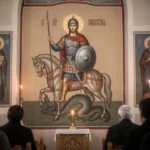
St George appears in several major artistic forms. The most familiar shows him on horseback, wearing armor, and striking a dragon with a lance. A princess or city may appear in the background. This scene usually refers to the medieval legend, not directly to the historical account of his execution.
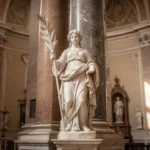
Other images show George standing as a martyr, holding a cross, a sword, a lance, or a palm branch. The palm is a traditional Christian symbol of martyrdom and victory over death. In icons, he may wear military clothing while presenting a calm, frontal expression that directs attention away from physical violence and toward spiritual steadfastness.
Scenes of his martyrdom may show the saint before a ruler, undergoing torture, or being led to execution. These images translate the written stories into visual form. They also remind viewers that the saint’s identity depends on his confession of faith, not simply on his role as a soldier.
When interpreting an image, consider its setting and symbols:
A horse and dragon usually point to the medieval legend of George as a protector and conqueror of evil.
A palm branch identifies him as a martyr who remained faithful through death.
A cross or military banner may represent Christian allegiance rather than a literal battle.
A ruler or execution scene connects the image with the persecution and martyrdom narratives.
A church, shrine, or tomb may refer to the community’s continuing veneration of his relics or burial place.
Common mistakes when explaining St George’s martyrdom
Clear explanations should preserve both the historical limits and the religious importance of the tradition. Several mistakes make the subject more confusing than it needs to be.
Presenting every legend as verified history. The dragon, miraculous resurrections, and mass conversions belong to later narrative traditions. Describe them as legends or devotional accounts.
Claiming that no evidence exists at all. The evidence for George’s biography is limited, but his early veneration as a martyr is an important historical fact.
Assuming “soldier” means a precise modern military rank. Sources differ about his position. “Roman soldier” or “military official” is safer than assigning an exact title without evidence.
Reducing the story to a battle against a monster. The older center of the tradition is his refusal to sacrifice and his acceptance of martyrdom.
Using the dragon to explain the entire feast. April 23 commemorates George as a martyr. The dragon is a later symbol that became attached to his reputation.
Ignoring differences among churches. Eastern and Western communities may use different calendars, services, artwork, and language when honoring him.
Assuming that uncertainty destroys religious meaning. A tradition can be spiritually significant while still containing details that historians cannot prove.
A careful retelling can use simple wording: “Christian tradition remembers George as an early fourth-century martyr, probably killed under Diocletian; later stories made him the dragon-slaying knight.” That sentence gives the reader the central fact, the historical caution, and the reason the familiar image looks different from the earliest account.
Where St George is honored today
St George has a broad geographic presence because devotion to him spread through Eastern Christian communities, the Byzantine world, Western Europe, and later Christian cultures around the globe. Churches, monasteries, military groups, cities, villages, and charitable organizations have adopted him as a patron.
He is especially associated with England, Georgia, Portugal, Catalonia, Ethiopia, and other places where local history and religious practice developed around his name. The exact form of celebration differs widely. Some communities hold liturgical services; others organize processions, public festivals, horse-related ceremonies, or visits to shrines.
His popularity also reflects the flexibility of the symbol. A martyr emphasizes religious fidelity. A mounted saint suggests protection and courage. A dragon fighter represents resistance to evil. A patron of soldiers can symbolize service, although the Christian tradition also calls that service to be governed by justice and restraint.
In every setting, the most responsible interpretation keeps the martyrdom older than the chivalric imagery. George became a knight in the imagination of medieval Europe, but the foundational memory is of a Christian who faced imperial power and would not renounce his faith.
How to remember St George’s martyrdom responsibly
A meaningful commemoration does not require certainty about every biographical detail. You can remember George by focusing on the values that the tradition places at its center: courage, honesty, conscience, compassion for those under threat, and faithfulness when refusal carries a cost.
If you are writing or teaching about him, identify the level of evidence as you go. Say “according to later tradition” before describing the dragon or the elaborate tortures. Say “the historical core is generally understood to be” when discussing the early martyr remembered under Diocletian.
It also helps to distinguish martyrdom from violence. George’s significance is not that he sought combat or glorified suffering. His witness comes from enduring persecution rather than using power to force belief. That distinction prevents the later warrior imagery from replacing the moral substance of the story.
For many believers, the feast of St George remains a time to pray for courage, protection, and faithfulness. For historians, it offers a case study in how the memory of an early martyr can grow through liturgy, pilgrimage, storytelling, art, and local devotion. Both perspectives can be held together when the known facts and later traditions are clearly distinguished.
Why the martyrdom remains the heart of the tradition
The stories surrounding St George changed as they traveled across languages and cultures, but the central pattern endured: a Christian stands before political and religious authority, refuses to deny what he believes, and accepts death rather than compromise. That pattern explains why his name remained powerful even when the historical record was incomplete.
The dragon made George memorable, and the knight made him a patron of rulers, soldiers, and communities. Yet the martyr made him a saint. His lasting importance rests on the conviction that faithful courage can outlast persecution, while the dragon remains a later visual expression of that conviction.
Frequently asked questions
Was St George a real historical person?
Most historians accept that an early Christian martyr named George was venerated by Christian communities, probably in connection with the early fourth century. The surviving evidence does not establish every part of his biography, however. His exact birthplace, military role, and circumstances of death remain uncertain, so his historical existence is more secure than the detailed stories told about him.
Did St George really kill a dragon?
The dragon episode is a medieval legend rather than part of the earliest evidence about George. It developed from stories that portrayed him as a protector who defeated evil and defended vulnerable people. The dragon is therefore best understood as a religious and cultural symbol, while the older tradition centers on George’s refusal to abandon Christianity.
When is St George’s feast day?
St George’s feast day is traditionally observed on April 23. Churches using different calendars may celebrate it on another civil date, and local customs can change how the day is marked. The feast honors George as a martyr and may include worship services, processions, prayers, or community celebrations.
Why is St George connected with England?
St George became England’s patron saint through medieval religious and royal traditions, especially as his reputation as a protector and Christian knight spread. His cross later became associated with England’s flag. This national connection is distinct from the original martyrdom tradition, which emerged much earlier in the eastern Mediterranean Christian world.
















Leave a Reply