Saint Patrick is remembered as Ireland’s patron saint, but the popular image of him includes far more legend than confirmed biography. He was probably born in Roman Britain, taken to Ireland as a teenager, and later returned as a Christian missionary. His own writings provide the clearest evidence about his life, although they leave many details uncertain.
Patrick did not personally convert every person in Ireland, and he was not the first Christian connected with the island. Christian communities already existed there before his mission. His importance comes from his role as a prominent missionary leader whose work helped Christianity become more established in parts of Ireland.
The holiday celebrated on March 17 combines several layers of history: Patrick’s religious memory, medieval stories about his miracles, Irish cultural identity, and celebrations created by Irish communities around the world. Understanding those layers helps separate the historical Patrick from the familiar symbols of shamrocks, snakes, parades, and green clothing.
Saint Patrick’s life in five historical stages
The surviving evidence does not provide a complete biography, but Patrick’s own words allow historians to outline a plausible sequence of events.
He grew up in Roman Britain. Patrick describes himself as the son of a man connected with local Roman civic and religious life. His exact birthplace is unknown, and several British locations have been proposed.
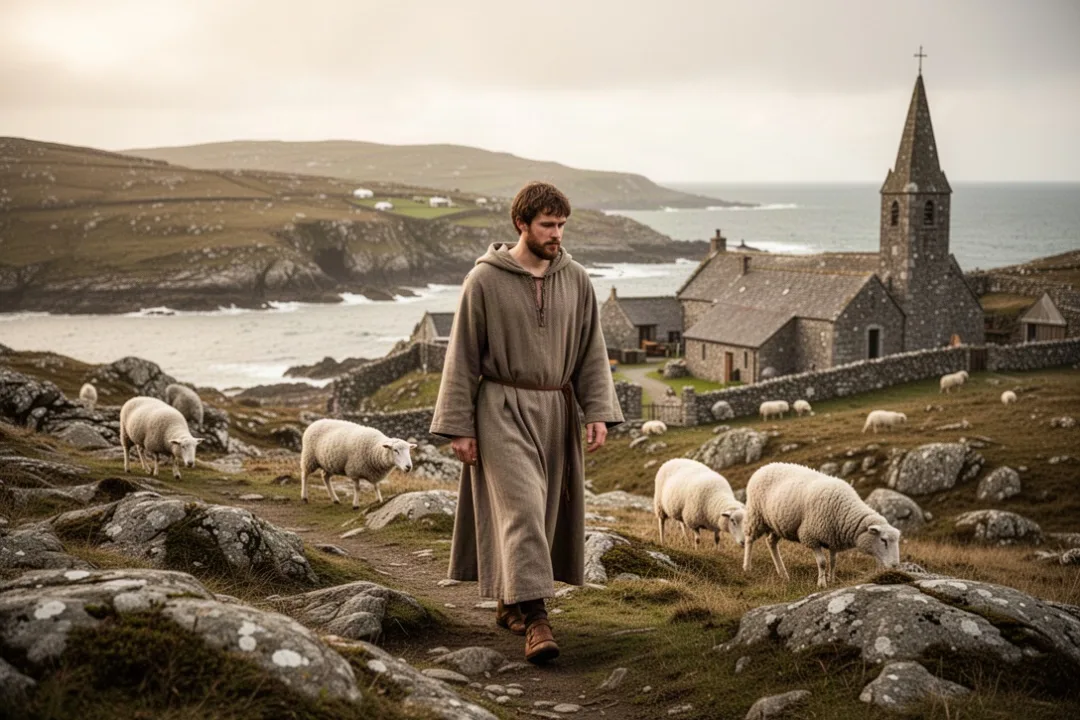
He was captured and enslaved in Ireland. As a young person, Patrick says that raiders seized him and brought him to Ireland. He spent years working as a shepherd before escaping or leaving.
He became deeply committed to Christianity. Patrick presents his time in captivity as a period in which his faith became central to his life. He later believed that God had called him to return to Ireland.
He trained for Christian ministry. After reaching Britain, Patrick studied and prepared for religious service. At some point, he returned to Ireland as a bishop or missionary.
He defended his mission in writing. His two surviving works reveal his beliefs, his sense of calling, and the opposition he faced. They also show a missionary who understood his work as serving people beyond his own homeland.
The central historical fact: Patrick’s own writings identify him as a Christian missionary who had been enslaved in Ireland and later returned there to preach.
Where Saint Patrick was born and what his background was
Patrick was not Irish by birth, according to his own account. He came from a region known as Britannia, which was under Roman rule during his youth. His exact birthplace remains unknown because the surviving sources do not name it clearly enough for historians to identify with confidence.
Patrick says his father, Calpurnius, was a deacon and a local official or landowner, while his grandfather, Potitus, was a priest. These details suggest that Patrick grew up in a Christian household with some social standing. Yet Patrick also admits that, as a young man, he did not take his faith seriously.
His background was shaped by the changing Roman world of the fifth century. Roman authority in Britain was weakening, and raids and political instability affected communities along the western coasts. Irish raiders crossing the sea could capture people and sell or keep them as enslaved workers.
Patrick’s story therefore connects Ireland and Britain through conflict as well as religion. His later mission was not a simple visit to a distant foreign country. It was a return to the place where he had suffered, made possible by a conviction that he had been called to serve the people who had once held him captive.
How Patrick became a Christian missionary
Patrick says that he was about sixteen when he was taken from his home. He spent roughly six years in Ireland, working as a shepherd. During that time, he prayed frequently and developed a much stronger religious life than he had known in his youth.
His account describes an escape after receiving a dream or inner summons. He traveled a long distance to a place where a ship was preparing to depart. Patrick eventually reached Britain and was reunited with his family, though he says they wanted him to remain safely at home.
Patrick then describes another call, represented in a dream by voices from Ireland asking him to return. The passage shows how he understood his mission: not as a personal ambition, but as a response to what he believed was a divine responsibility.
The historical details of his training are less clear. Patrick may have spent time in Gaul, the Roman region that included much of modern France, but this possibility comes mainly from later traditions and interpretation rather than a straightforward statement in his surviving works. He eventually became a bishop and went back to Ireland.
Two texts are especially important: the Confessio, sometimes called the Confession, and the Letter to the Soldiers of Coroticus. They are the earliest surviving writings associated with Patrick and offer more reliable information than legends recorded centuries later.
The Confessio explains his calling and humility
The Confessio is a spiritual defense of Patrick’s life and mission. He describes his sins, captivity, conversion, preaching, and dependence on God. The work is not a modern biography, so it does not provide a neat timeline or all the details readers might want.
Patrick repeatedly presents himself as an uneducated or unsophisticated man. Some of this language may reflect genuine insecurity about his Latin writing, while some may be a religious expression of humility. Either way, the text shows that he was aware of criticism and wanted to justify his work in Ireland.
He also describes the danger and difficulty of his mission. Patrick says he baptized thousands of people and ordained clergy, but the exact numbers and locations cannot be independently verified. His writing nevertheless indicates that he worked among communities beyond the boundaries of established Roman Christian society.
The Letter to Coroticus condemns violence and captivity
Patrick’s second surviving work is a forceful letter addressed to the soldiers or followers of a ruler named Coroticus. Patrick accuses them of raiding, killing, and carrying away newly baptized Christians. He calls on Christian leaders to reject association with the perpetrators.
The letter matters for several reasons. It shows Patrick acting as a defender of vulnerable converts, confirms that raiding and enslavement were part of the political environment, and demonstrates that Christianity in Ireland was connected to wider networks of bishops and communities.
It also complicates simplified images of Patrick. He was not merely a gentle figure from folklore. His writings show a determined religious leader willing to confront powerful people publicly when he believed Christians had been attacked.
What Saint Patrick actually did in Ireland
Patrick’s mission likely involved preaching, baptizing, organizing Christian communities, training or supporting clergy, and building relationships with local leaders. In fifth-century Ireland, Christianity did not spread through one centralized national institution. The island contained many local kingdoms and communities, so religious work depended on travel, personal connections, and protection from rulers.
Patrick probably worked in western and northern areas, although the exact boundaries of his mission are debated. His writings mention places and people, but they do not offer a complete map. Later stories assign him dramatic confrontations with kings and druids, yet those accounts were written long after his lifetime and cannot be treated as direct eyewitness history.
He was also one missionary among several Christian figures active in or connected with Ireland. Palladius is associated with an earlier mission to Irish Christians, and other local or foreign clergy may have worked in different regions. Patrick’s later prominence does not mean he acted alone.
Preaching: He presented Christian teaching to Irish communities.
Baptism: His writings say that he baptized converts.
Church organization: He supported clergy and local Christian communities.
Pastoral defense: He challenged violence against Christians in his letter to Coroticus.
Cultural adaptation: He worked in a society that had its own languages, customs, religious specialists, and political structures.
What remains uncertain about Saint Patrick
Patrick’s life is partly documented and partly obscured. Historians generally accept the broad outline of his story, but they cannot confirm every detail found in later biographies. His birth year, birthplace, date of arrival in Ireland, exact missionary base, and date of death are all uncertain.
Traditional accounts often place his death on March 17, usually in the fifth century. The date became his feast day, but the precise historical date is not securely established. Patrick may have died around the middle or later part of the fifth century, though even that broad estimate should be treated cautiously.
The question of where he was born has produced competing claims from Britain. Names in Patrick’s Latin writing can be interpreted in more than one way, and places changed considerably over time. A town that now claims Patrick as its native son may rely on a later tradition rather than direct evidence.
There is also no complete record of his daily life, appearance, family relationships, or interactions with specific Irish rulers. A responsible account distinguishes between what Patrick says, what early Christian writers report, and what medieval storytellers later added.
How the legends of Saint Patrick developed
Patrick’s reputation grew after his death as church writers composed biographies and collections of miracles. These works helped establish him as a major holy figure, but they also gave his story elements that are not found in his own writings.
Did Saint Patrick drive the snakes out of Ireland?
There is no reliable evidence that Patrick literally drove snakes from Ireland. Ireland has no native population of land snakes, and the snake story appears in later tradition. Snakes can also function as symbolic images of evil in Christian storytelling, which may have helped the legend become popular.
The story may represent Patrick overcoming pagan religion or spiritual danger in a symbolic way, but historians cannot identify one certain original meaning. It should be treated as folklore rather than a documented event.
Did Saint Patrick use the shamrock to explain the Trinity?
The shamrock is strongly associated with Patrick, but his own writings do not say that he used a three-leaf plant to teach the Christian doctrine of the Trinity. The story appears in later tradition. It may have developed because the plant’s three leaflets offered a simple visual comparison for one God understood through three persons.
The shamrock became a national and cultural symbol, especially in connection with March 17. Its familiar role reflects the creativity of later communities rather than a confirmed scene from Patrick’s ministry.
Did Patrick banish pagan religion from Ireland?
Later legends portray Patrick defeating druids and confronting pagan rulers in dramatic contests. These stories express the Christian belief that Patrick’s mission overcame older religious powers, but they cannot be confirmed as historical episodes.
Christianity spread gradually, and religious change rarely happens through a single confrontation. Local customs, political alliances, family networks, and the work of many clergy all likely influenced the process. Patrick’s mission should be understood within that longer transformation.
How Christianity and Irish society shaped each other
Patrick entered a society organized around local kingships, kin groups, agricultural communities, and oral traditions. Christianity brought new institutions, texts, rituals, and connections with churches beyond Ireland. At the same time, Irish Christians adapted the faith to local circumstances.
Monasteries later became important centers of worship, learning, manuscript production, and economic activity. Patrick himself should not automatically be credited with founding every major Irish monastery associated with him. Many of those connections belong to later centuries, when communities sought to honor him or link their origins to an influential saint.
The spread of Christianity also changed ideas about authority and identity. Bishops and clergy became part of local religious life, while Christian teachings introduced new expectations about baptism, worship, moral conduct, and relations between communities. Patrick’s letter shows that these ideals did not eliminate violence immediately; instead, Christian leaders argued over how baptized people should be treated.
Historical caution: Patrick helped establish Christianity in parts of Ireland, but he was not the sole Christian missionary, the first Christian on the island, or the documented author of every tradition later attached to his name.
Why Saint Patrick’s Day is celebrated on March 17
March 17 is traditionally observed as Patrick’s feast day, marking his remembered death. In Ireland, the day developed as a Christian religious observance and later became a major expression of Irish cultural identity. It is now celebrated by people with Irish heritage and by many others who participate in public events.
Religious observances may include church services, prayers, music, and community gatherings. Secular celebrations often include parades, Irish music, dancing, cultural festivals, and displays of green. The balance between religious and cultural elements varies by place and by family tradition.
The international reach of the holiday is closely connected with the Irish diaspora. Irish immigrants carried the feast and their cultural identity to cities across North America and elsewhere. Public parades became especially significant in communities where Irish people used shared heritage to build social and political visibility.
Green clothing and green decorations are modern symbols rather than documented signs used by Patrick himself. Blue has also been historically associated with Saint Patrick in some contexts, while green became more strongly linked with Ireland and Irish nationalism over time.
How to distinguish the historical Patrick from the traditional one
When you hear a story about Saint Patrick, ask what kind of source supports it. His writings are closest to his lifetime, while medieval biographies preserve religious traditions that may contain both historical memories and symbolic storytelling.
Historical evidence: Patrick’s Confessio and Letter to Coroticus, along with early references to his mission.
Strong traditional association: His role as Ireland’s patron saint and his feast on March 17.
Later legend: Driving out snakes, using the shamrock to explain the Trinity, and defeating pagan leaders in spectacular contests.
Modern cultural practice: Parades, green clothing, public festivals, and commercial celebrations.
This distinction does not require dismissing tradition. Legends can show how communities understood Patrick and what qualities they admired in him. They simply answer a different question from historical evidence: one concerns cultural meaning, while the other concerns what can be established about the past.
Saint Patrick’s lasting legacy
Patrick’s legacy rests on more than the popularity of a holiday. His writings are among the earliest surviving documents produced by someone connected with Ireland, and they offer a rare personal voice from the transition between the Roman world and the early medieval period.
His story also carries a powerful reversal. He arrived in Ireland first as a captive, then returned by choice as a missionary. In his own understanding, that return expressed forgiveness, religious conviction, and service. Modern readers may also recognize in his account the lasting effects of forced migration, trauma, and the complicated relationship between a person and the place where he suffered.
For Christians, Patrick is remembered as a missionary who trusted his calling despite opposition and personal limitations. For historians, he is a valuable witness to fifth-century Britain and Ireland. For Irish communities worldwide, he represents a cultural connection that has survived migration and changing political circumstances.
Saint Patrick was therefore both a real fifth-century person and a figure enlarged by centuries of memory. The historical man can be found most clearly in his own humble, urgent writings; the familiar saint emerged through the stories and celebrations that followed.
Frequently asked questions
Was Saint Patrick Irish?
No. Patrick’s own writing identifies him as a Christian from Roman Britain. He was taken to Ireland as a teenager and enslaved there for several years. He later returned voluntarily as a missionary, which is why he became so closely connected with Ireland despite not being born there.
Did Saint Patrick really use a shamrock to teach the Trinity?
The shamrock tradition is popular, but Patrick’s surviving writings do not mention using it as a teaching tool. The story developed later because the plant’s three leaflets provided an easy comparison for the Christian Trinity. It is a cultural tradition rather than a confirmed event from his ministry.
What are Saint Patrick’s original writings?
Two works are associated with Patrick: the Confessio and the Letter to the Soldiers of Coroticus. The first describes his faith, captivity, calling, and mission. The second condemns violence and the enslavement of Christians by followers of a ruler named Coroticus. Together, they are the main primary sources for his life.
Why is Saint Patrick’s Day celebrated on March 17?
March 17 is traditionally recognized as Patrick’s feast day and is associated with the date of his death. It began as a Christian observance and later became a worldwide celebration of Irish identity and heritage. Modern events may include religious services, parades, music, dancing, and community festivals.
















Leave a Reply