If you have heard the name Saint Brendan connected with an island, a voyage or a strange medieval map, you may wonder how much is history and how much is legend. The short answer is that Brendan was a real sixth-century Irish monk and abbot, while the famous story of his ocean journey developed through later religious literature.
Known as Brendan the Navigator, Brendan of Clonfert or Brendan of Birr, he belongs to Ireland’s early Christian tradition. Accounts describe a leader who founded or governed monasteries, taught disciples and traveled between religious communities. His best-known legend presents him as the leader of a small group of monks searching across the Atlantic for the “Land of Promise of the Saints.”
The voyage story should not be read as a straightforward travel diary. It is a spiritual adventure narrative filled with symbolism, biblical echoes and marvelous events. At the same time, its detailed descriptions of boats, islands, fasting, prayer and changing seas have led generations of readers to ask whether some part of the tale reflects genuine Atlantic travel.
Saint Brendan is traditionally said to have been born around the beginning of the sixth century in County Kerry, Ireland. Exact biographical details are difficult to establish because the surviving accounts were written long after his lifetime and often combine historical memory with devotional storytelling.
He is associated with two important monastic centers. Brendan of Birr refers to a different Irish saint, Brendan of Birr, who was connected with a monastery in County Offaly. The Brendan most often called the Navigator is associated especially with Clonfert in County Galway, where tradition says he established a major monastery.
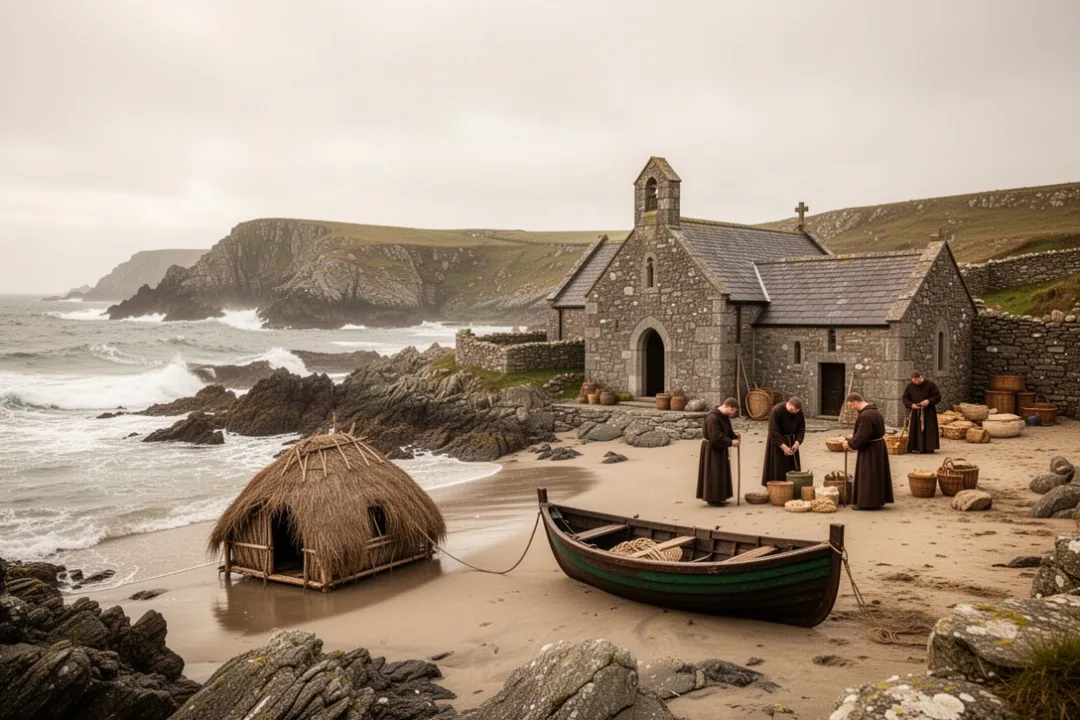
Early Irish monasteries were not only places for private prayer. They could include churches, dwellings, workshops, farms, guest facilities and schools. An abbot might supervise a large community, welcome travelers, organize work and preserve religious learning. Brendan’s reputation therefore reflects more than a single sea voyage: it also reflects the influence of a monastic founder and spiritual teacher.
Medieval sources place Brendan among the generation of Irish saints who helped spread Christian communities throughout Ireland and, according to tradition, beyond it. Stories connect him with journeys to other parts of Ireland, Scotland, Wales and possibly western Britain. Some of these journeys may preserve memories of real movement between religious settlements, but the evidence does not allow every traditional destination to be confirmed.
Historical distinction: Brendan was a real Irish monastic leader, but the surviving details of his life come mainly from later hagiography. That means the central person is historical even when individual episodes cannot be verified.
His reputation was shaped by the values associated with Irish monasticism: prayer, fasting, hospitality, study and missionary travel. Monks could leave familiar surroundings to establish new communities or seek spiritual guidance. Travel was therefore both a physical activity and a religious practice, especially when undertaken in search of a teacher, a holy place or a deeper experience of God.
Why Saint Brendan is called the Navigator
The title Saint Brendan the Navigator comes primarily from the medieval narrative commonly known in English as the Voyage of Saint Brendan. The Latin work is often called the Navigatio Sancti Brendani Abbatis. It was probably written several centuries after Brendan’s lifetime, and its author is unknown.
The narrative describes Brendan hearing about a distant island associated with the saints. He and a group of companions prepare for the journey by fasting, praying and building or obtaining a vessel suited to the Atlantic. The story then follows a recurring pattern: the monks travel, encounter an island or natural wonder, celebrate worship, endure a trial and continue their search.
The journey is not presented as ordinary exploration for wealth or political power. The monks are seeking a holy destination, and the voyage tests their trust, obedience and patience. Their progress depends on prayer and providence rather than on a fixed route controlled entirely by human skill.
Several episodes became especially memorable in European storytelling. The travelers encounter a great fish or whale that appears to be an island, spend time near a volcanic or fiery place, hear mysterious birds singing, and visit islands where the natural world seems to operate according to a sacred pattern. These scenes are best understood as part of a symbolic religious tale, not as confirmed reports of geography.
The story also emphasizes a repeated annual rhythm. The monks return to particular places at particular times, including a place associated with worship and celebration. This repetition gives the voyage a liturgical structure: the sea is not merely a barrier to cross but the setting for a disciplined cycle of prayer, waiting and renewal.
What the voyage represents
The central meaning of Brendan’s voyage is spiritual perseverance. The monks do not simply set out once and reach their destination quickly. They wait, suffer uncertainty, encounter danger and accept that the goal cannot be seized through force. The tale presents faith as a practice of faithful attention rather than a guarantee of immediate answers.
The sea can also be read as an image of the unknown. Medieval audiences understood the ocean as physically dangerous, but the story gives that danger a moral and spiritual dimension. The travelers must confront fear, hunger, isolation and temptation while remaining committed to their purpose.
For that reason, the narrative has appealed to readers far beyond the history of Irish monasticism. It can be read as a story about discernment: how people recognize a calling, prepare carefully, accept limits and continue when the route is unclear.
The boat represents a fragile human means of carrying out a difficult calling.
The changing islands suggest that spiritual experience may arrive in unexpected forms.
The repeated departures emphasize patience and perseverance rather than instant success.
The promised land points toward a destination that cannot be possessed like ordinary territory.
What history can and cannot confirm about Brendan’s voyage
Readers have long asked whether Brendan actually crossed the Atlantic and reached North America. The question gained particular attention because some details in the Voyage seem compatible with Atlantic environments, including islands, marine animals, volcanic activity and floating ice.
Still, resemblance is not proof. The narrative was shaped by biblical imagery, classical travel literature, Irish storytelling and Christian symbolism. Medieval writers could describe marvelous places using inherited motifs without having personally seen those locations. A whale that looks like an island, for example, fits the imaginative world of medieval literature whether or not the author witnessed anything similar.
The text’s date also matters. Brendan is traditionally placed in the sixth century, but the surviving Voyage was written later. A later author may have preserved older oral memories, reshaped them for a new audience or created episodes to communicate religious ideas. Scholars therefore treat the work as a valuable source for medieval spirituality and imagination, not as a reliable nautical log.
Some historians and navigators have pointed out that early boats could make demanding sea journeys. Irish monks may have used currachs, boats traditionally made with a flexible frame and a hide or skin covering. These craft were capable of coastal and, under suitable conditions, longer voyages, although any reconstruction of Brendan’s exact vessel remains uncertain.
In the twentieth century, explorer Tim Severin built and sailed a hide-covered boat inspired by descriptions of early Irish craft. His voyage demonstrated that a vessel of this general type could travel across parts of the North Atlantic. It did not prove that Brendan made the legendary journey or that the story identifies a specific American landfall.
Best answer to the Atlantic question: there is no firm historical evidence that Brendan reached North America. The voyage may preserve memories of real seafaring, but its surviving form is a religious legend rather than verified exploration.
Claims that Brendan discovered a particular island should therefore be treated carefully. Proposed locations have included the Canary Islands, the Azores, Iceland and parts of North America, but no identification has gained universal acceptance. The “Island of Saint Brendan” became a feature of some later maps, even though explorers never established that such an island existed.
This uncertainty does not make the story useless. It shows how medieval people combined geographical curiosity with religious meaning. The voyage records what its audiences imagined a holy journey across the world’s margins might look like. It also reveals how quickly a saint’s biography could become part of cartography, literature and popular memory.
How the Voyage of Saint Brendan is structured
The Voyage is sometimes read as if it were a single sequence of discoveries, but its structure is more deliberate than that. Brendan’s journey unfolds through repeated acts of preparation, departure, arrival, worship and departure again. This pattern gives the story a meditative quality.
Before sailing, Brendan and his companions prepare through fasting and prayer. The preparation signals that the voyage is not a private adventure undertaken on impulse. The community must be spiritually ready, and the travelers must accept discipline before they can begin.
Once at sea, the monks often rely on divine guidance rather than choosing every course themselves. This does not mean that practical skill disappears. They need food, shelter, a seaworthy boat and knowledge of weather and tides. The story places those practical needs alongside dependence on providence.
The encounters that follow often have a testing function. A barren island may expose hunger, while a threatening creature may test courage. A beautiful or peaceful place can offer rest without becoming the final destination. In this way, comfort and danger are both temporary.
The travelers also worship when they reach certain places. Their religious observances prevent the voyage from becoming a collection of disconnected marvels. Each stop becomes part of a larger discipline of praise, obedience and remembrance.
Major themes in the voyage narrative
Calling: Brendan responds to a sacred invitation rather than pursuing personal fame.
Community: The monks travel together, share hardship and depend on one another.
Hospitality: Food, shelter and welcome repeatedly shape the travelers’ survival.
Restraint: The monks must not treat every attractive place as their final home.
Patience: The promised destination appears only after a long period of waiting and obedience.
Wonder: Natural phenomena become occasions for awe instead of mere curiosities.
The story’s religious purpose becomes clearer when compared with other medieval saints’ lives. A saint’s biography often includes extraordinary events to show holiness, but the episodes also teach the audience how to respond to fear, temptation and uncertainty. Brendan’s ocean is therefore both a physical setting and a moral landscape.
Modern readers may also notice a tension between exploration and surrender. The monks move through unknown waters, yet they are not portrayed as conquering or claiming the places they see. Their task is to receive what is given, recognize its meaning and continue when the time comes.
Saint Brendan’s feast day, patronage and symbols
Saint Brendan’s feast day is generally observed on May 16. Calendars and local traditions may vary, so churches or communities honoring him can use their own liturgical customs. His feast provides an occasion to remember his monastic leadership as well as the voyage associated with his name.
Brendan is commonly connected with sailors, travelers, boats and seafarers. These associations arise naturally from the voyage tradition, although patronage can differ across regions and devotional communities. He may also be invoked by people facing an uncertain journey, a major transition or a responsibility that requires patience.
Religious art often presents him as an abbot or bishop, sometimes holding a book, a pastoral staff or a model of a boat. Other images emphasize the sea and the legendary whale. The visual details can vary, but they usually combine two aspects of his identity: spiritual authority and maritime adventure.
Common symbols connected with Saint Brendan include:
A boat: a sign of his legendary voyage and the risks of faithful travel.
The ocean: an image of the unknown and of trust beyond human control.
A monk’s habit: a reminder that his journey began within a life of prayer and discipline.
A whale or sea creature: a reference to one of the best-known episodes in the Voyage.
A pastoral staff: a symbol of his role as an abbot and spiritual guide.
These symbols should not be mistaken for evidence about the historical Brendan. They represent the way later Christians remembered him. Devotional art often compresses a complex life and a long literary tradition into a few recognizable images.
What Saint Brendan can mean for readers today
Saint Brendan’s story continues to matter because it addresses a familiar human problem: how to proceed when you have a serious purpose but cannot see the whole route. The legend does not promise that a faithful decision will remove danger. Instead, it presents preparation, community and persistence as ways to live with uncertainty.
His example can be especially meaningful when a journey is not primarily geographic. Changing careers, caring for a family member, moving to a new place or beginning a demanding spiritual practice can all feel like voyages into unfamiliar waters. Brendan’s tradition asks you to distinguish between restless novelty and a genuine calling.
The story also offers a corrective to the idea that every journey must end in public achievement. Brendan is remembered not because he claimed an empire or returned with wealth, but because he and his companions remained committed to prayer, discipline and a search for holiness.
A practical way to reflect on the Brendan tradition is to ask:
What purpose is guiding the journey you are considering?
What preparation would make that journey more responsible?
Which companions, mentors or communities can offer wise support?
What signs would tell you to pause, change course or continue?
Can you accept that progress may come through waiting rather than constant movement?
For Christians, Brendan can represent faithful movement through uncertainty. For historians, he offers a window into early Irish monastic culture and medieval storytelling. For readers interested in exploration, his legend shows how geography and imagination once worked together to describe the edges of the known world.
The most balanced way to remember Saint Brendan is to hold both parts of the tradition together. He was a historical Irish abbot whose life belonged to a demanding monastic culture, and he became the central figure in one of Europe’s most enduring sacred voyage stories. The legend is not weakened by that distinction; it becomes clearer and more meaningful when history, literature and devotion are allowed to remain distinct.
Frequently asked questions
Was Saint Brendan a real person?
Yes. Saint Brendan is generally understood to have been a real Irish monk and abbot who lived around the sixth century. He is strongly associated with the monastery of Clonfert. The difficulty lies in separating reliable biographical information from later devotional stories, since detailed written accounts of his life were produced well after the period in which he lived.
Did Saint Brendan actually reach America?
No surviving evidence proves that Brendan reached North America. His legendary voyage includes descriptions that some readers consider compatible with Atlantic travel, and modern boat experiments have shown that early Irish-style vessels could make long journeys. Those facts do not establish that Brendan made the voyage or identify any land he reached.
What is Saint Brendan the patron saint of?
Saint Brendan is traditionally associated with sailors, travelers, boats and seafarers because of the voyage legend connected with his name. In devotional practice, people may also look to him when beginning an uncertain journey or seeking patience and guidance. Patronage traditions can differ between churches and regions.
When is Saint Brendan’s feast day?
Saint Brendan’s feast day is generally celebrated on May 16. Local calendars and communities may observe the day differently, particularly where more than one saint named Brendan is commemorated. The date honors the Navigator most closely associated with Clonfert and the medieval voyage tradition.
















Leave a Reply