Saint George: History, legend, symbols, and traditions
Saint George: History, legend, symbols, and traditions
Saint George was a Christian martyr whose historical life is only partly known, but whose story became one of the world’s most recognizable legends of courage, faith, and protection.
For many Christians, Saint George is remembered as a soldier who refused to abandon his faith and was killed for it. For many others, he is best known as the mounted hero who defeats a dragon. These two parts of his identity are connected, but they did not emerge at the same time: the martyr belongs to early Christian tradition, while the dragon story developed through later medieval storytelling.
Who Saint George was according to historical tradition
The surviving evidence about George is limited, and some later stories contain details that historians cannot verify. He is generally associated with the late third and early fourth centuries, a period when Christianity faced persecution within the Roman Empire. Traditional accounts place his death at Lydda, an ancient town in the region now associated with Lod in Israel.
George is often described as a Roman military officer or soldier. According to the traditional account, he openly identified as a Christian and refused to carry out actions that conflicted with his faith. He was then imprisoned, tortured, and executed, becoming honored as a martyr.
The name George comes from the Greek Georgios, commonly connected with the meaning “worker of the land” or farmer. The name itself does not prove anything about his occupation. It does, however, help explain why Saint George later became associated with rural communities, agriculture, and seasonal celebrations in several places.
Historical caution: The broad tradition of George as an early Christian martyr is ancient, but precise details about his military rank, birthplace, imprisonment, and death vary among sources and are not all historically confirmed.
Why Saint George is associated with April 23
April 23 is widely observed as Saint George’s feast day in Western Christianity. The date is traditionally connected with the anniversary of his martyrdom, although the exact historical date of his death is not known with certainty.
In churches that use different calendars, the feast may appear on another date in the civil calendar. Eastern Christian communities may celebrate Saint George according to the Julian calendar or follow local liturgical customs. The date can also shift when the feast coincides with major celebrations such as Holy Week or Easter.
Saint George’s Day is especially prominent in England, where April 23 is associated with national identity and the red cross on a white field known as the Cross of Saint George. The date is also linked by tradition to William Shakespeare, whose birth and death are commonly commemorated on April 23, though the records are not equally precise for both events.
Celebrations vary widely. Some include church services, processions, meals, music, or public ceremonies. Others are quiet observances centered on prayer and remembrance. In communities where George is a patron saint, the day may be a local holiday or an occasion for honoring soldiers, farmers, travelers, or people facing hardship.
How the dragon legend became part of Saint George’s story
The story of Saint George and the dragon is a legend, not a documented episode from the historical record of George’s life. Its best-known form was popularized in medieval Europe through collections of saints’ stories, especially the work commonly known as the Golden Legend.
In the familiar version, a dragon terrorizes a town or kingdom. To keep the creature from attacking, the people provide animals and eventually choose a young woman by lot. George arrives, confronts the dragon, wounds or restrains it, and helps the people defeat it. The story often ends with the community accepting Christianity after witnessing his courage and trust in God.
Details differ from one retelling to another. In some versions, George kills the dragon immediately. In others, he captures it and tells the people that it will be destroyed only if they convert or accept Christian teaching. The woman he rescues may be called Princess Silene, but her name and role are not consistent across all traditions.
Medieval listeners generally understood the dragon as more than an animal. It could represent evil, violence, pagan opposition, temptation, or disorder. George’s victory therefore became a symbolic image of good resisting destructive power. The story was also shaped by older heroic traditions in which a warrior protects a community from a monstrous threat.
The dragon legend helped transform Saint George from a respected martyr into a widely recognized Christian knight. Artists could show the story in a single dramatic scene: a rider, a white horse, a lance, a dragon, and a rescued community. That clear visual language allowed the legend to spread across churches, manuscripts, banners, sculptures, and public monuments.
What the dragon represents in Christian symbolism
Saint George’s dragon is often interpreted as a representation of evil confronted directly. The point is not simply that a strong fighter defeats a dangerous animal. George is portrayed as acting for the protection of others, and his courage is connected to faith rather than personal glory.
The dragon can also symbolize fears that seem larger than any one person can overcome. In a town threatened by the creature, ordinary people are trapped by panic and repeated sacrifice. George’s arrival changes the situation because he refuses to accept fear as the final authority.
The rescued princess is sometimes treated as a symbol of innocence or a vulnerable community. Modern readers may also notice that older versions give her limited control over events. Contemporary interpretations often focus less on a warrior rescuing a passive victim and more on the broader themes of protecting the vulnerable, resisting cruelty, and confronting injustice.
Christian art may show George with a cross-shaped shield, a red cross on his armor, or a white horse. These details are not universal, and artistic conventions changed over time. The red cross can connect the saint to martyrdom and Christian identity, while the white horse often emphasizes his role as a mounted champion.
Saint George in Eastern and Western Christianity
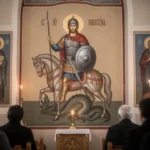
Saint George has a major place in both Eastern Orthodoxy and Western Christianity. Orthodox churches often call him the Great Martyr, emphasizing the suffering and steadfastness associated with his death. His icon frequently shows him riding a horse and striking a dragon with a spear.
In many Eastern Christian icons, the scene is carefully arranged as a theological image rather than a realistic battle painting. George may appear in bright clothing, surrounded by symbolic colors and architectural details. The dragon represents evil, while the saint’s posture and weapon point toward divine assistance rather than mere physical strength.
Western churches also honor George as a martyr and patron saint. Medieval Europe gave him an especially strong association with knighthood, military orders, and chivalric ideals. His image appeared on shields and banners because he represented bravery, loyalty, and defense of the community.
Different Christian traditions may emphasize different aspects of his story. One community may focus on martyrdom and prayer, another on the dragon legend, and another on a local history of protection. These interpretations do not always agree in detail, but they share the image of a person who remains faithful under pressure.
Countries, cities, and groups connected with Saint George
Saint George is the patron saint of England, but his importance is not limited to English history. He is also honored as a patron or protector in parts of Portugal, Georgia, Greece, Ethiopia, Serbia, Russia, and other countries and regions. His name appears in cities, churches, monasteries, military organizations, and civic traditions around the world.
Georgia has an especially strong connection with the saint. The country’s name in many languages is associated with Saint George, and his image appears in religious art and cultural traditions. The exact historical origins of that national association are complex, and the modern English name “Georgia” should not be treated as a simple translation of the saint’s name.
In England, the Cross of Saint George is a major national symbol. It appears on flags and is connected with public celebrations, sports supporters, and historical institutions. It should not automatically be confused with every red cross used by a military or charitable organization, because similar cross designs have different origins and meanings.
Saint George is also associated with soldiers, cavalry, scouts, farmers, riders, and travelers. In some communities, people ask for his intercession during danger or hardship. Local customs may include blessing animals, carrying icons, decorating churches, or gathering for a communal meal.
What Saint George’s symbols mean
The dragon: evil, oppression, danger, temptation, or destructive disorder.
The lance or spear: courage directed toward a clear moral purpose.
The white horse: the saint as a mounted protector and victorious champion.
The red cross: Christian identity, martyrdom, and the tradition associated with Saint George.
The shield: defense, loyalty, and protection of a community.
The princess or endangered town: vulnerable people who need protection from violence or injustice.
These symbols do not have one fixed meaning in every painting or culture. A red cross on a flag may refer to England, a military tradition, a church, or a local institution. The surrounding image and historical setting usually provide the best clues.
How artists depict Saint George
The most familiar artistic image shows Saint George on horseback, often wearing armor and thrusting a spear toward a dragon below. This composition became particularly popular in medieval and Renaissance art because it combined religious devotion, heroic action, and a recognizable moral story.
Some artists portray the saint as a young, idealized knight. Others emphasize his martyrdom by showing him standing before a ruler, enduring torture, or holding a palm branch. The palm branch is a traditional Christian symbol of martyrdom and victory over death.
Orthodox iconography often follows established conventions that are different from Western naturalistic painting. The dragon may be smaller, the horse may be shown in profile, and the scene may include a princess, a city, or an angel. The purpose is not always to create a dramatic fantasy scene; it is to present spiritual truth through a familiar visual language.
Modern artists sometimes reinterpret the story without a literal dragon. They may show George facing a battlefield, injustice, addiction, war, or social violence. In these works, the dragon becomes a way to represent a real human problem while preserving the saint’s association with moral courage.
Common mistakes when learning about Saint George
Treating every legend as biography: The dragon story is important to Saint George’s cultural identity, but it is not reliable evidence about the historical martyr.
Assuming the historical details are certain: His broad identity as an early Christian martyr is widely accepted in tradition, while details such as his rank and birthplace are less secure.
Calling him only an English saint: England is one of his best-known associations, but Saint George is honored across many Christian communities and countries.
Assuming April 23 is universal: Churches using different calendars or local liturgical practices may celebrate him on another civil date.
Confusing national symbols: The Cross of Saint George is not the same as every red cross appearing on a flag, badge, or organization.
Reducing the story to violence: Traditional interpretations emphasize faith, protection, self-sacrifice, and resistance to evil, not violence for its own sake.
Ignoring local traditions: A church, city, or country may have its own version of the celebration and its own interpretation of the saint.
Helpful approach: When researching Saint George, separate three layers: the early martyr tradition, the medieval dragon legend, and the later national or local customs built around his name.
Practical ways to learn about or observe Saint George’s Day
You can approach Saint George’s Day as a religious feast, a cultural event, or an opportunity to study medieval history. The most respectful choice depends on your own beliefs and the tradition of the community you are visiting.
Check the local calendar: A parish, monastery, or cultural organization may observe the feast on a date different from April 23.
Learn the community’s tradition: Ask whether the focus is worship, a procession, a national celebration, a neighborhood festival, or a memorial service.
Read the story critically: Compare an account of Saint George’s martyrdom with a medieval version of the dragon legend.
Look at the artwork’s setting: Identify whether an image comes from an Orthodox icon tradition, Western church art, heraldry, or modern popular culture.
Support a service project: If you want a practical observance, help protect vulnerable people or assist a local community organization.
Use symbols accurately: Confirm the meaning of a cross, flag, or emblem before presenting it as a Saint George symbol.
Families may tell a child-friendly version of the dragon story while explaining that it is a symbolic legend. Older children can compare how the dragon changes across countries and centuries. Adults may prefer to examine the story through church history, folklore, art history, or the development of national identity.
Saint George continues to matter because his story brings together several forms of memory. He is remembered as a martyr who endured persecution, a legendary knight who confronted a monster, a patron invoked in times of danger, and a national or local symbol used in public life.
His story also shows how traditions develop. A historical figure can gather new meanings as different communities retell his life, create images, celebrate feast days, and connect him with their own hopes and struggles. The dragon does not replace the martyr; it adds another layer to the way later generations understand him.
The most durable message is not that every danger can be defeated easily. It is that courage can be directed toward the protection of others, and that faithfulness may require resistance when fear, power, or violence demands surrender. That combination explains why Saint George remains recognizable far beyond the places where his feast day began.
Saint George’s legacy in modern culture
Modern references to Saint George appear in flags, churches, military insignia, literature, films, sports culture, and public monuments. Some uses are openly religious, while others draw on the broader idea of a heroic protector. The dragon image may appear in logos or civic art even when the original Christian meaning is not central.
His legacy can be read in both positive and critical ways. Many people see the saint as a symbol of service and moral courage. Others examine how medieval images of the knight and the dragon were later used to express national identity, military power, or cultural conflict. Both approaches can be part of a serious understanding of the tradition.
To understand Saint George fully, it helps to hold several distinctions together: history and legend, martyrdom and knighthood, religious devotion and national symbolism, and medieval storytelling and modern interpretation. His continuing importance comes from the way these layers remain connected without being identical.
Frequently asked questions
Was Saint George a real person?
Christian tradition and early references support the existence of a martyr named George, but historians cannot verify every detail in later biographies. His association with an early Christian martyr is much more secure than claims about his exact birthplace, military rank, or the events surrounding his death.
Did Saint George really kill a dragon?
The dragon belongs to a later medieval legend rather than the reliable historical record of George’s life. The creature functions symbolically, representing evil, oppression, danger, or destructive forces. The story became influential because it turned George’s courage and faith into a memorable image that could be understood across different cultures.
Why is Saint George England’s patron saint?
Saint George became connected with England through medieval devotion, royal and military traditions, and the spread of his cult across Europe. He was not originally an exclusively English figure. The red Cross of Saint George later became an important English national symbol, especially in flags and public identity.
Do all Christians celebrate Saint George on April 23?
No. April 23 is the commonly recognized feast day in Western Christianity, but churches using different calendars may observe the feast on another civil date. Local customs can also affect the celebration, especially when the date overlaps with Holy Week, Easter, or another major religious observance.














Leave a Reply