Saint Alban: Britain’s first recorded Christian martyr
Saint Alban: Britain’s first recorded Christian martyr
Saint Alban is traditionally remembered as the first recorded Christian martyr in Britain. According to the earliest surviving account, he was a resident of Verulamium, the Roman city now known as St Albans, who sheltered a Christian priest and was executed after refusing to renounce his new faith.
His martyrdom probably took place during a period of Roman persecution in the late third or early fourth century, although the exact year is uncertain. Saint Alban’s feast day is observed on June 22, and his story remains closely connected with St Albans Cathedral, the ruins of Verulamium, and churches throughout Britain and beyond.
Saint Alban appears in Christian tradition as a Roman-era inhabitant of Verulamium. The surviving stories do not provide a detailed biography of his childhood, family, occupation, or social status. They focus instead on one decisive act: he offered protection to a Christian priest who was being pursued by authorities.
At the time, Christianity was not always treated consistently across the Roman Empire. Some emperors permitted Christians to worship privately, while other periods brought official demands that citizens honor the Roman gods and the emperor. Local enforcement varied, but refusing a public religious command could be viewed as defiance of Roman authority.
According to the account preserved by the Venerable Bede, Alban had not originally been a Christian. He welcomed a priest into his home, helped him escape arrest, and listened as the priest prayed and taught. Alban was sufficiently moved by the priest’s faith that he became a Christian himself.
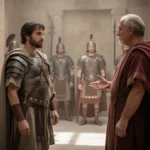
When the authorities searched Alban’s home, he put on the priest’s cloak and allowed the man to escape. The soldiers arrested Alban instead. This action explains why he is remembered not simply as a convert, but as a person who accepted danger in order to protect someone else.
The central point of the tradition: Alban’s story begins with hospitality. His decision to shelter a stranger led to conversion, and his conversion led him to accept punishment rather than betray the priest or abandon his faith.
The official who questioned him is commonly called the judge in English retellings. Alban was ordered to offer sacrifice to the Roman gods. He refused, identified himself as a Christian, and was condemned to death. The account presents his response as a deliberate choice rather than an accidental consequence of hiding the priest.
His name is sometimes explained through the Latin Albanus, a name associated with a person from Alba or with a Roman naming tradition. The meaning of the name does not establish his ethnicity or social background. Details that portray him as a particular kind of Roman official or wealthy landowner belong to later interpretation rather than securely documented history.
What the earliest accounts say about Saint Alban’s martyrdom
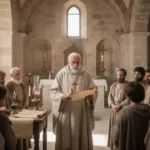
The most influential early narrative comes from Bede’s Ecclesiastical History of the English People, completed in the eighth century. Bede describes Alban’s arrest, conversion, trial, and execution, and places the event at Verulamium. His account became the foundation for the way generations of Christians understood the saint.
Bede wrote many years after the Roman persecution he described. That distance does not automatically make the account worthless, but it means the story should be read with care. The broad tradition may preserve older local memory, while some dramatic details may have been shaped through the retelling of a martyr’s story.
The date of Alban’s death is not certain. Many churches and historical summaries associate it with the persecution under Emperor Diocletian, often placing it around AD 304. Other interpretations allow for a somewhat earlier or later date. The evidence does not support treating a single year as beyond dispute.
The outline of the story is consistent across the main tradition:
A Christian priest seeks refuge from people trying to arrest him.
Alban conceals the priest and learns about Christian belief.
Alban changes places and clothing with the priest so the man can escape.
Alban is arrested and questioned by Roman authorities.
He refuses to make the required sacrifice and openly identifies as a Christian.
He is executed at or near Verulamium, becoming known as a martyr.
The priest is not named in Bede’s account. Later tradition calls him Amphibalus, but that name appears to have developed from a term for the cloak or mantle associated with the story. Later medieval writers treated Amphibalus as the priest’s personal name and created additional stories about his life and death.
Those later stories connect several locations around St Albans with Alban and Amphibalus. They describe the priest’s capture and martyrdom after Alban’s death, and they associate springs, hills, and roads with events in the narrative. These traditions are valuable for understanding medieval devotion, but they are not supported by the same level of early evidence as Alban’s basic story.
“He was the first of the British martyrs.”
This description reflects the way Bede and later Christian writers placed Alban within the history of Christianity in Britain. It does not mean that no Christian had suffered or died in Britain before him; it means that Alban is the earliest British martyr whose name and story became securely established in the written tradition.
One especially memorable part of the story concerns the river crossing. Bede says that Alban reached the place of execution after a miraculous event involving water and the crowd. In later retellings, the river becomes a visible sign that creation itself assists the martyr. Such details belong to the religious meaning of the narrative and should not be treated as ordinary geographical reporting.
How Verulamium became associated with Saint Alban
Verulamium was one of Roman Britain’s major towns. It stood near the modern city of St Albans in Hertfordshire, northwest of London, and had public buildings, roads, houses, shops, and religious sites. The town’s remains help explain why Alban’s story became attached to a specific place rather than surviving only as an abstract legend.
Roman Verulamium occupied a broad area near the River Ver. Visitors can still see sections of the Roman city walls, the theatre, and archaeological remains. The Verulamium Museum displays artifacts from the settlement, including mosaics and objects that show how people lived in Roman Britain. These remains provide the historical setting for the account of Alban.
The modern city’s name comes from Alban. The Roman settlement was called Verulamium, while the later religious community and town became associated with St Albans. Over time, the saint’s name shaped the identity of the place, its churches, its civic traditions, and the wider county landscape.
The exact location of Alban’s execution is traditionally identified with Holywell Hill. A well or spring at the site became part of local devotion, and the hill offers a strong geographical link between the cathedral area and the ancient city below. The tradition cannot be verified in every detail, but the location has remained important for centuries.
The cathedral stands on a hill above the Roman town. This physical arrangement allows visitors to see how Christian memory was layered onto an older Roman landscape. A Roman city, a medieval abbey, and a modern English town occupy the same general setting, with Alban’s story connecting them.
Local tradition also identifies a place where Alban was held before his execution. The site is associated with the Old Gorhambury area and with the route between Verulamium and the execution site, although the precise historical locations are debated. Signs and local landmarks preserve these traditions without proving every feature of the later narrative.
Several kinds of evidence help explain the saint’s continuing association with the city:
Written tradition: Bede places Alban’s martyrdom at Verulamium.
Archaeological context: Roman remains show that the town was a significant settlement capable of supporting public religious and civic life.
Continuous devotion: Christian worship at the site developed around the memory of the martyr.
Place names: St Albans preserves Alban’s name in the identity of the modern city.
Buildings and monuments: the cathedral and local wells, roads, and churches keep the story visible.
For visitors: Seeing Verulamium and St Albans Cathedral together gives the clearest sense of the tradition. The Roman ruins show the world Alban inhabited, while the cathedral shows how later Christians honored his memory.
What St Albans Cathedral reveals about Alban’s legacy
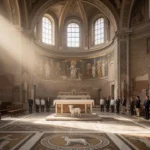
St Albans Cathedral is the most important surviving center of devotion to Saint Alban in Britain. It developed from a religious community established near the traditional site of his martyrdom. The present building is mainly medieval, but it represents a much longer history of worship at the location.
The cathedral is also commonly called the Cathedral and Abbey Church of Saint Alban. Its history includes Roman, Anglo-Saxon, Norman, and later English phases. A monastery associated with Alban was established in the early medieval period, and the Norman abbey church was begun after the Norman Conquest.
Construction of the Norman church began in the late eleventh century under Abbot Paul of Caen. The building used Roman brick and other materials recovered from the ruins of Verulamium. This reuse was practical, but it also created a visible link between the Roman town and the Christian shrine above it.
The cathedral’s architecture reflects changes made over many centuries. Its long nave, massive piers, medieval wall paintings, stained glass, chapels, and later repairs show that the building was not completed in one period. The structure has been adapted repeatedly as religious practices, communities, and patterns of worship changed.
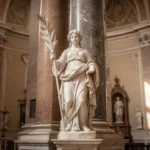
One of the cathedral’s central features is the shrine of Saint Alban. Medieval shrines often served as places where pilgrims could pray, remember a saint, and ask for spiritual help. Alban’s shrine has undergone damage, restoration, and reconstruction, yet it continues to mark the place where devotion to him is focused.
The cathedral also contains the shrine of Saint Amphibalus, reflecting the later tradition about the priest whom Alban sheltered. That pairing is significant: Alban is remembered for receiving the priest’s teaching, while Amphibalus is remembered for the encounter that led Alban toward Christianity.
When visiting the cathedral, you can look for several features connected with Alban’s legacy:
The shrine of Saint Alban in the cathedral’s eastern area.
The medieval fabric and reused Roman building material.
Painted wall decoration and carved details that reflect changing periods of worship.
The shrine associated with Saint Amphibalus.
Views and walking routes that connect the cathedral with the Roman remains.
The cathedral is not a museum piece frozen in the Middle Ages. It remains a working place of Christian worship, prayer, music, education, and community life. That continuing use matters because Alban’s memory has always been connected with public faith, not only with historical curiosity.
Why Saint Alban matters to Christians and communities today
Saint Alban’s story is often presented as an example of hospitality, conscience, and courage. He did not begin as a Christian leader. He was an ordinary person who encountered a vulnerable stranger, offered shelter, and then took responsibility for the consequences of his choice.
His example is especially associated with welcoming people who are afraid or displaced. The priest in the story is being hunted, and Alban’s first response is practical care: he gives the man a place to hide. The tradition therefore connects martyrdom with an earlier act of hospitality rather than presenting courage as something separate from everyday conduct.
Alban also represents the importance of conscience. The story does not portray him as seeking conflict with Roman authorities. Instead, he refuses a specific religious act that he believes would contradict his Christian commitment. His strength lies in accepting the cost of that refusal.
For churches, Alban’s story raises questions that remain relevant:
How should a person respond when official demands conflict with religious conviction?
What responsibilities come with offering shelter to someone in danger?
How can a community protect vulnerable people without turning their suffering into a symbol?
What does courage look like when it involves accepting consequences rather than winning an argument?
These questions should be handled thoughtfully. Alban’s martyrdom belongs to a very different legal and political setting from modern life. The Roman system, the nature of imperial religion, and the position of Christians in Britain cannot simply be mapped onto current events.
His story also matters beyond Christianity. Historians use it to study how communities preserve memory, how local places become sacred, and how written accounts shape a region’s identity. The development of St Albans shows how one martyr’s name can influence architecture, pilgrimage, education, public art, and local geography.
Saint Alban is honored in several Christian traditions, including the Anglican Communion and the Roman Catholic Church. He is also remembered in Orthodox Christian contexts and in churches named for him in other countries. His feast day, June 22, is an opportunity for worship services, processions, lectures, music, and community events.
Churches named after Alban often emphasize one or more parts of his story. Some focus on his status as Britain’s first martyr. Others highlight welcome, protection for refugees, Christian unity, or faithful witness under pressure. The dedication of a church can therefore reveal how a local congregation understands the saint’s example.
People interested in Saint Alban can honor his memory in practical ways:
Visit the Roman remains at Verulamium to understand the setting of his life.
Explore St Albans Cathedral and spend time at the shrine.
Read Bede’s account alongside later traditions, keeping the different dates and details separate.
Observe June 22 through prayer, worship, study, or a local feast-day event.
Consider the theme of hospitality by supporting work that protects people in danger or need.
It is possible to value the spiritual meaning of Alban’s story while recognizing the limits of the historical evidence. The exact year of his death, the full identity of the priest, and several details of the journey to execution remain uncertain. That careful distinction does not erase the tradition; it helps you understand how history, place, and faith have interacted over time.
How to distinguish history, tradition, and legend in Alban’s story
The most responsible way to discuss Saint Alban is to separate what is relatively secure from what developed later. There is a strong and longstanding tradition that a Christian martyr named Alban was killed at Verulamium. The details surrounding his conversion, trial, miraculous journey, and the later story of Amphibalus belong to different layers of evidence.
Historical evidence includes the existence of Roman Verulamium, the survival of early Christian writing about Alban, and the long continuity of Christian worship at St Albans. These facts create a credible setting for the tradition, but they do not prove every scene described in medieval versions.
Religious tradition gives the story its meaning. The priest’s disguise, Alban’s confession of faith, and his calm acceptance of death communicate ideas about discipleship and witness. Such narratives were often intended to teach and encourage as well as to record events.
Legendary development appears in later additions, including expanded accounts of Amphibalus, precise routes, miraculous signs, and local features identified with particular moments. These details can be culturally and spiritually important even when they cannot be independently confirmed.
Keeping these categories distinct prevents two common mistakes. One is dismissing the entire story because some details are legendary. The other is presenting every later detail as though it were established by contemporary evidence.
Saint Alban’s enduring importance rests on more than a single disputed date. His name links a Roman town, a medieval cathedral, a living city, and a Christian ideal of protecting another person at personal cost. That combination of place, memory, and moral meaning explains why he remains one of Britain’s best-known early saints.
Frequently asked questions
When is Saint Alban’s feast day?
Saint Alban’s feast day is June 22. Churches may mark it with a Eucharist or other worship service, a procession, music, educational events, or community activities. The date is associated with the traditional anniversary of his martyrdom, although the precise year of his death is uncertain.
Where was Saint Alban martyred?
Saint Alban was traditionally martyred at or near Verulamium, the Roman town that stood where St Albans developed in Hertfordshire, England. Holywell Hill is commonly identified with the execution site. The location is part of a longstanding local tradition, though archaeological evidence cannot confirm every detail of the account.
Was Saint Alban a Roman soldier?
The earliest account does not clearly establish that Alban was a Roman soldier. Later retellings sometimes assign him a military or official role, but those descriptions should not be treated as certain. What the main tradition does emphasize is that he was a resident of Verulamium who sheltered a Christian priest.
Why is Saint Alban associated with refugees and hospitality?
Alban is linked with hospitality because he sheltered a priest who was fleeing arrest. He then exchanged clothing with the priest, allowing him to escape while Alban faced the authorities. For many churches, this makes Alban an example of protecting vulnerable people and accepting personal risk to offer someone refuge.












Leave a Reply