Saint Polycarp was a second-century bishop of Smyrna, a Christian leader remembered for preserving apostolic teaching and facing martyrdom rather than renouncing his faith. He is honored as one of the earliest Christian martyrs whose life is described in detail by a surviving ancient account.
Polycarp is especially important because he connects the generation of the apostles with later Christian communities. His Letter to the Philippians offers practical guidance about Christian conduct, while the Martyrdom of Polycarp describes his arrest, trial, and death in Smyrna, a city in Asia Minor that is now İzmir, Turkey.
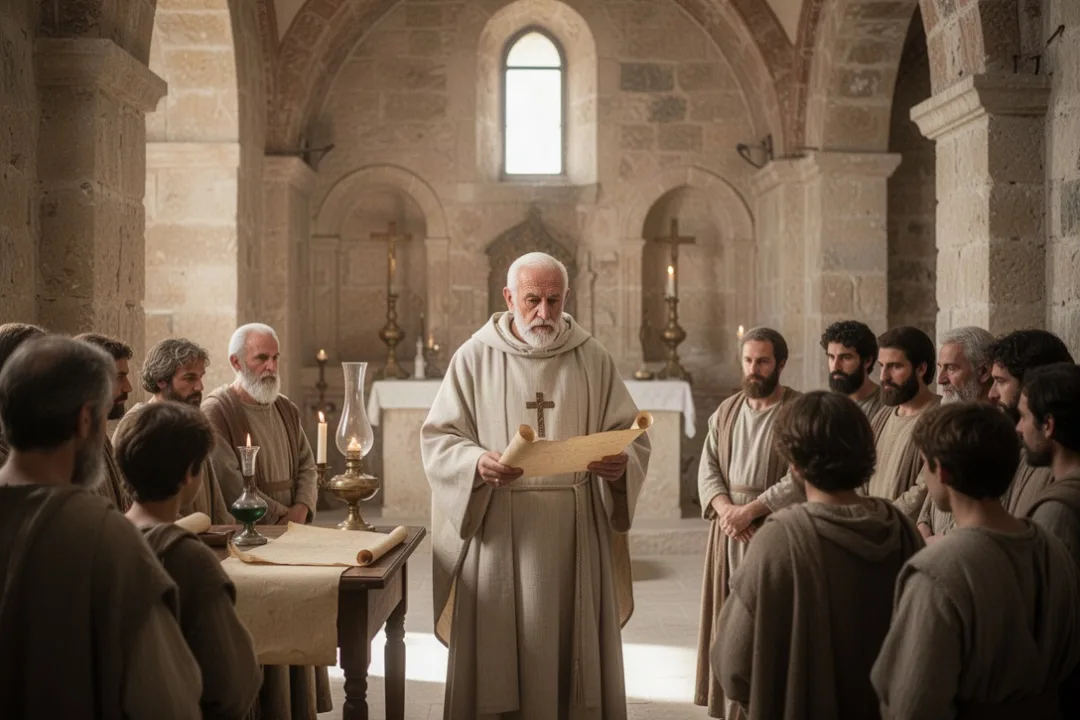
Polycarp served as the bishop of Smyrna, one of the prominent Christian centers in the Roman province of Asia. Early sources associate him with the apostle John and with other leaders who had personally received the teaching of the first Christian communities. For that reason, later writers describe him as an Apostolic Father, a term for Christian teachers connected closely to the apostles.
The name Polycarp comes from Greek and is commonly understood to mean “much fruit”. His historical importance, however, rests less on the meaning of his name than on his role as a trusted teacher. He helped preserve Christian beliefs and worship during a period when churches were still developing their structures and clarifying how they should respond to competing teachings.
Polycarp was not known primarily as a philosopher or political leader. His influence came through pastoral steadiness, personal relationships, and fidelity to the Christian message he had received. The surviving evidence presents him as a bishop concerned with truth, moral behavior, unity, prayer, and care for the wider church.
At a glance: Polycarp was bishop of Smyrna, an Apostolic Father, author of a surviving letter to the Philippians, and a martyr traditionally commemorated on February 23.
Polycarp’s connection to the apostles and early Christian teachers
The principal early witness to Polycarp’s connection with the apostolic generation is Irenaeus of Lyons. Writing later in the second century, Irenaeus said that he had heard Polycarp speak and remembered the bishop’s account of his conversations with people who had known Jesus’ apostles. Irenaeus presented Polycarp as someone who had received the church’s teaching directly from an earlier generation.
Irenaeus also connected Polycarp with John, traditionally identified in these sources with the apostle and Gospel writer. Modern readers should handle the exact details carefully because ancient authors did not always describe dates, relationships, and titles in the same way modern historians do. Still, the sources consistently place Polycarp close to the earliest post-apostolic church.
According to Irenaeus, Polycarp opposed teachings that he believed departed from the apostolic faith. One famous story describes Polycarp encountering Marcion, a teacher whose views about the Old Testament and the identity of the Christian God were rejected by the broader church. The story portrays Polycarp refusing to recognize Marcion as a faithful teacher.
Another tradition says Polycarp traveled to Rome to discuss the date of Pascha, or Easter, with Bishop Anicetus. They disagreed about the practice but maintained fellowship. This account is significant because it shows both the diversity of early Christian customs and the effort leaders made to preserve unity despite disagreement.
The meeting also helps explain Polycarp’s place in church history. He was not simply an isolated local bishop. He participated in conversations that involved churches across the Mediterranean and represented a living link between regional Christian practice and the inherited apostolic tradition.
What Polycarp taught in his Letter to the Philippians
Polycarp’s Letter to the Philippians is one of the earliest surviving Christian writings outside the New Testament. It was addressed to the church in Philippi, a community in Macedonia that appears in the New Testament and had maintained relationships with other Christian churches.
The letter is pastoral rather than theoretical. Polycarp does not present a systematic theology in the later academic sense. Instead, he urges Christians to practice faith, hope, love, patience, and self-control in ordinary relationships. He addresses several groups within the church, including widows, deacons, younger people, and married believers.
His advice to church leaders emphasizes integrity and service. Bishops and deacons should not be greedy, harsh, or careless with their responsibilities. They are expected to live in a way that gives credibility to their teaching and protects the church from scandal.
Polycarp also speaks directly about wealth and generosity. His teaching assumes that Christian discipleship affects the way people handle money, respond to the poor, and use authority. A leader who pursues financial gain at the expense of the community has failed not only administratively but spiritually.
The letter encourages Christians to respect civil authorities while remaining loyal to God. This reflects the complicated position of early Christians within the Roman Empire. They were expected to pray for rulers and behave peaceably, yet they could not treat the emperor or the state as objects of worship.
Polycarp repeatedly points readers toward perseverance under pressure. He refers to the suffering of earlier Christian witnesses and urges the Philippians to remain faithful. His concern is not fascination with suffering for its own sake. Rather, he sees endurance as a test of whether Christian convictions continue to shape a person when obedience becomes costly.
The letter also warns against false teaching and destructive behavior. Polycarp presents truth and moral conduct as connected. A person cannot claim to honor Christ while practicing deceit, greed, sexual misconduct, hatred, or contempt for fellow believers.
Major themes in Polycarp’s letter
Faithful leadership: Church officers should be trustworthy, disciplined, generous, and accountable.
Christian character: Believers should show patience, compassion, self-control, and honesty.
Care for vulnerable people: Widows and others in need should not be neglected by the church.
Respect and responsibility: Christians should live peaceably and honor appropriate civil obligations.
Resistance to false teaching: The church must preserve the apostolic message rather than adjust it to popular ideas.
Perseverance: Faithfulness matters most when fear, pressure, or suffering make compromise attractive.
Polycarp’s language reflects the New Testament closely, especially themes associated with Paul’s letters and other early Christian writings. His letter is valuable partly because it shows how early churches read and applied apostolic teaching before later theological vocabulary had fully developed.
Polycarp’s ministry in Smyrna
Smyrna was a prosperous coastal city with strong civic and religious traditions. Christians in the city lived among neighbors who participated in Roman public life and local religious customs. Their refusal to offer worship to the emperor or to the traditional gods could be interpreted as disloyalty or impiety.
As bishop, Polycarp would have been responsible for teaching, worship, discipline, pastoral care, and church unity. The church had to preserve its beliefs while also caring for members who faced social pressure, legal danger, poverty, illness, and internal disagreements.
His ministry took place before Christianity had public institutions or legal protection. Christian gatherings could attract suspicion, and local hostility could become dangerous when public opinion turned against believers. The sources do not suggest that every Christian faced persecution constantly, but they do show that the church could be vulnerable when accusations gained momentum.
Polycarp’s leadership appears to have been respected beyond Smyrna. Churches in the region treated him as a senior figure, and his relationships with leaders elsewhere show that early Christian communities were connected through letters, travel, shared teaching, and mutual support.
One example of this wider network involves Ignatius of Antioch, another early Christian leader who was taken to Rome for execution. Polycarp preserved or circulated several letters associated with Ignatius and sent correspondence to the Philippians. These exchanges reveal churches supporting one another even when their leaders faced imprisonment and death.
How Saint Polycarp died as a martyr
The account of Polycarp’s death appears in the Martyrdom of Polycarp, a document sent to the church in Philomelium and other Christian communities. It is often regarded as one of the earliest surviving Christian martyrdom accounts. The text combines historical memory, pastoral encouragement, biblical allusions, and theological reflection.
According to the account, authorities searched for Polycarp after other Christians had been arrested. He initially stayed outside the city, but he eventually chose not to flee further after being encouraged by a vision or dream. The narrative presents this decision as a deliberate act of trust rather than a desire to provoke authorities.
When the soldiers found him, Polycarp reportedly asked that they be given food and drink. He also requested time for prayer. The account emphasizes that he prayed for the Christian communities and for people throughout the world, showing the pastoral concern expected of a bishop even during a personal crisis.
The authorities brought him before the Roman official and urged him to renounce his faith. The demand commonly described in the account involved swearing by the emperor and cursing Christ. Polycarp refused to deny the one he had served for many years.
“Eighty and six years I have served him, and he has done me no wrong.”
This famous sentence is often quoted from translations of the martyrdom account. The wording and punctuation vary, and the passage’s exact meaning is debated. Polycarp may have been stating his age, the length of his Christian service, or a traditional expression of long devotion. The central point is clear: he regarded Christ as a faithful Lord and would not exchange that allegiance for safety.
The account says Polycarp was threatened with burning. It then describes extraordinary signs surrounding his death, including a fire that did not consume his body as expected. Because the document is a theological martyrdom narrative, readers should distinguish between its religious interpretation and details that can be independently verified.
After the fire, Polycarp was killed with a weapon. The narrative says Christians were permitted to gather his remains, and it presents the day of his death as a time for remembering his witness. The account does not treat Polycarp as a replacement for Christ. Instead, it places him among faithful servants who imitate Christ’s endurance.
Historians commonly place Polycarp’s martyrdom around 155 or 156 CE, during the reign of the emperor Antoninus Pius. The exact year has been debated, and some traditional chronologies differ. February 23 is the date associated with his commemoration in many Christian calendars.
Read the martyrdom carefully: The account is both a record of persecution and a work of Christian remembrance. It should be read for its historical evidence, but also with attention to its biblical language, theological purpose, and distinctive ancient storytelling.
What the martyrdom of Polycarp means for Christians
Polycarp’s martyrdom is often remembered as an example of steadfast confession. He did not seek suffering, insult the authorities, or treat death as a way to prove personal superiority. The account emphasizes that he lived quietly, prayed for others, and accepted danger when faithfulness required a clear answer.
His example also challenges shallow ideas about courage. Courage in the story includes practical wisdom: Polycarp temporarily withdrew from danger, accepted hospitality, prayed before arrest, and spoke respectfully. His final refusal was not impulsive. It was the result of a lifetime of commitment.
The story places special emphasis on memory. The Christian community preserved the account so later believers could remember Polycarp’s character and strengthen their own faith. Martyrs were honored not because death itself was desirable, but because their lives demonstrated loyalty, hope, and love under extreme pressure.
For many Christians today, Polycarp’s witness raises questions about conscience and public pressure. The pressure may not involve a legal demand to renounce Christianity. It can appear as pressure to hide convictions, excuse injustice, pursue success at any cost, or separate religious belief from everyday behavior.
His life also highlights the responsibility of church leaders. Polycarp is remembered not merely because he died, but because he taught, cared for people, preserved tradition, and served a community before his arrest. Martyrdom was the final act of a life shaped by ordinary faithfulness.
Saint Polycarp’s feast day and symbols
Saint Polycarp is commonly commemorated on February 23 in Western and Eastern Christian calendars, although local calendars and traditions can differ. The date honors the traditional day of his martyrdom rather than marking his birth.
In religious art, Polycarp is usually shown as an elderly bishop. Common identifying features include bishop’s vestments, a pastoral staff, a book, or flames. The book may point to his teaching and letter, while the flames refer to his martyrdom.
He is honored in the Catholic Church, Eastern Orthodox Church, Anglican traditions, and other Christian communities that remember the early martyrs and Apostolic Fathers. His commemoration may include readings from the martyrdom account, prayer for courage, and reflection on Christian unity.
Polycarp is sometimes associated with the wider group of martyrs of Smyrna. That phrase can refer either to Christians who suffered in the same period or to commemorations connected with Smyrna’s persecuted church. It should not be taken to mean that every named martyr died in exactly the same event.
Polycarp can be easy to oversimplify. A careful study keeps his biography, letter, martyrdom account, later traditions, and modern historical analysis in conversation with one another. The following habits help you read the sources responsibly.
Read the primary texts first: Start with the Letter to the Philippians and the Martyrdom of Polycarp before relying on short biographies.
Separate sources by type: Distinguish Polycarp’s own surviving letter, Irenaeus’s later memories, and devotional traditions that developed afterward.
Mark uncertain dates: Use “around 155 or 156 CE” rather than presenting a disputed year as certain.
Compare translations: Ancient Christian texts can differ in wording, paragraph numbering, and how names or titles are rendered.
Notice the audience: Ask whether a passage was written to instruct a church, preserve a martyr’s memory, defend doctrine, or encourage suffering believers.
Keep history and devotion together: Historical questions about the sources do not require dismissing the religious meaning the texts had for ancient Christians.
Study his ordinary ministry: Do not focus only on the dramatic arrest. His teaching, correspondence, prayer, and care for the church form the larger picture.
Common mistakes when discussing Polycarp
Calling him one of the Twelve Apostles: Polycarp belonged to the generation after the apostles and is remembered as an Apostolic Father.
Claiming that every detail is independently proven: The Martyrdom of Polycarp is an ancient source with theological aims, not a modern court transcript.
Confusing Smyrna with modern cities without explanation: Ancient Smyrna corresponds broadly to İzmir in present-day Turkey, but historical geography requires context.
Treating the Easter dispute as a complete division: Polycarp and Anicetus disagreed about practice yet maintained fellowship according to the surviving account.
Assuming all early Christians faced constant persecution: Conditions varied by place, time, officials, and local hostility.
Using the martyr story to glorify violence: Polycarp’s witness concerns faithful conscience and nonretaliation, not aggression toward opponents.
Ignoring his letter: His pastoral teaching offers a fuller picture than the dramatic story of his death alone.
Why Polycarp remains relevant to church life
Polycarp’s letter speaks to churches that need trustworthy leaders. It connects authority with character, restraint, generosity, and accountability. Leadership is not presented as status or control; it is a responsibility exercised for the good of the community.
His example also matters for Christian communities working through disagreement. The story of his meeting with Anicetus suggests that differences in practice need not automatically destroy fellowship. At the same time, Polycarp’s resistance to teachings he regarded as false shows that unity did not mean indifference to truth.
His concern for widows, the poor, and vulnerable members remains equally concrete. A church’s faith is visible in how it treats people who have little power or social influence. Polycarp’s teaching refuses to separate spiritual devotion from practical care.
Finally, Polycarp offers a durable picture of long obedience. The tradition remembers a dramatic final stand, but that stand makes sense only because it followed decades of worship, teaching, prayer, and service. His witness invites readers to consider how daily habits shape the decisions people make when their convictions are tested.
Primary writings connected with Saint Polycarp
Two texts are central for learning about Polycarp. The first is the Letter to the Philippians, written as pastoral correspondence and preserved through the early church. It is one of the clearest windows into Polycarp’s teaching and into the moral expectations of a second-century Christian community.
The second is the Martyrdom of Polycarp, which describes his final days and death. It was written by members of the Christian community connected with Smyrna and sent to other believers. The document uses biblical patterns and theological language, so it should be read both as a historical witness and as an act of communal remembrance.
Additional information comes from Irenaeus, especially his recollections of Polycarp and his testimony about the bishop’s relationship to earlier Christian teachers. Later writers add devotional details, but the closer a claim is to the earliest sources, the more carefully it can be assessed.
Taken together, these writings show a consistent portrait: Polycarp was a respected bishop who valued apostolic teaching, moral seriousness, prayer, unity, care for the vulnerable, and courage before authorities. They also show why he became such an important figure in the history of early Christianity.
Frequently asked questions
Was Saint Polycarp one of Jesus’ apostles?
No. Polycarp belonged to the generation after Jesus’ apostles. Early Christian writers connected him with apostolic teachers, especially John, so he is called an Apostolic Father. That title means he received and transmitted early Christian teaching in close succession to the apostles; it does not mean he was one of the original Twelve.
When is Saint Polycarp’s feast day?
Saint Polycarp is commonly commemorated on February 23 in many Western and Eastern Christian calendars. The date traditionally marks the anniversary of his martyrdom. Local calendars may assign different observances or include him with other martyrs of Smyrna, so a parish or denomination’s calendar remains the best guide for a specific service.
What did Polycarp write?
The main surviving work associated directly with Polycarp is his Letter to the Philippians. It discusses Christian conduct, church leadership, care for widows, resistance to false teaching, and perseverance. The Martyrdom of Polycarp is another essential source, but it is a community account of his arrest and death rather than a letter written by Polycarp himself.
Where was Polycarp martyred?
Polycarp was martyred in Smyrna, an ancient city in the Roman province of Asia. The city is associated with present-day İzmir in Turkey. His death is generally placed around 155 or 156 CE, although historians debate the exact year. The surviving martyrdom account says he was executed after refusing to renounce his Christian faith.












Leave a Reply