St. Blandina was a Christian slave who became one of the best-known martyrs of Lyon after refusing to renounce her faith around A.D. 177. Her story is remembered because it joined extraordinary courage with an ordinary, socially powerless life. Ancient Christians saw in her endurance a sign that faith did not depend on wealth, education, citizenship, physical strength, or social rank.
Blandina lived in the Roman city of Lugdunum, now Lyon, in Gaul. She was a Christian woman and an enslaved person, and the surviving account does not preserve many details about her family, age, or conversion. What it does preserve is the testimony of Christians who witnessed the persecution and sent a letter describing it to fellow believers in Asia Minor.
The account was later preserved by Eusebius of Caesarea in his Ecclesiastical History, especially Book 5, chapter 1. That source describes the persecution at Lyon and Vienne under the emperor Marcus Aurelius. Blandina appears among a group of believers arrested, interrogated, tortured, and killed because they would not participate in the religious practices required by Roman authorities.
Her name is often written St. Blandina, Saint Blandina, or Blandina of Lyon. She is commemorated in the Catholic Church with the martyrs of Lyon on June 2. Some Christian traditions also remember her more broadly as a witness to the courage of persecuted believers and to the dignity of people whom society treats as powerless.
The central idea: Blandina’s importance is not based on political influence or public status. Ancient Christians remembered her precisely because a woman who was enslaved could display remarkable spiritual courage and strengthen others.
The Roman world and the Lyon persecution
To understand Blandina’s martyrdom, it helps to understand the religious and political setting of the Roman Empire. Roman religion was closely connected with public life. Cities honored traditional gods, emperors could receive religious recognition, and public sacrifices often expressed loyalty to the community as well as devotion to a deity.
Christians worshiped one God and refused to sacrifice to the Roman gods or treat the emperor as divine. Their refusal could be interpreted as religious disloyalty, especially during periods of social tension. Christians were also accused of disturbing public order because they met separately, followed distinctive practices, and rejected some customary ceremonies.
The persecution at Lyon appears to have involved hostility from parts of the local population before the Roman authorities acted against the Christians. The surviving letter describes social pressure, arrests, public accusations, imprisonment, and trials. The precise legal process is difficult to reconstruct, but the result was severe: some believers were tortured, others died in prison, and several were executed in public spectacles.
Lyon was a significant city in Roman Gaul, with commercial, administrative, and cultural importance. Its Christian community included people from different backgrounds. The martyrs named in the ancient account came from varied social positions, and Blandina’s presence shows that the community included enslaved people as well as leaders and free citizens.
What happened to St. Blandina, step by step
The ancient narrative presents Blandina’s martyrdom as a series of stages rather than as one isolated event. Details are concentrated in the Lyon letter preserved by Eusebius. The following outline follows that account while distinguishing the broad historical picture from later devotional retellings.
Blandina was arrested with other Christians. Her enslaved status did not protect her from interrogation. The authorities treated her confession of Christian faith as a serious offense.
She was questioned and tortured. The account emphasizes that her physical suffering was severe. Those around her feared that she would not survive, yet she repeatedly affirmed that she was a Christian.
Her perseverance encouraged other believers. The ancient writer portrays her endurance as strengthening the Christian community, especially those who were frightened or facing their own trials.
She was taken into the arena with Ponticus. The young Christian Ponticus was also compelled to face torture and death. The account presents both of them as refusing to deny their faith.
Blandina was exposed to further violence. The narrative describes public abuse and the use of beasts and other methods of execution. Some details appear in a sequence that reflects the practices of Roman spectacles.
She died after repeated suffering. The source says that she was finally killed, and her body was treated as part of the authorities’ effort to prevent Christians from honoring the dead.
The source’s purpose was not to provide a modern courtroom transcript. It was a letter of remembrance written by Christians who interpreted the events through their faith. Even so, it is one of the most significant early accounts of a Christian persecution, and Blandina is one of its most vivid figures.
Why Blandina’s status as an enslaved woman matters
Blandina’s social position changes how her story is understood. In the Roman Empire, enslaved people lacked the legal independence enjoyed by free citizens. Their labor, movement, family relationships, and physical safety were controlled by others. A person in that position would normally have little authority in public life.
Yet the Lyon account gives Blandina a central role in the spiritual memory of the community. Her social condition did not make her faith invisible. Instead, the narrative portrays her as someone whose courage became a source of strength for free and enslaved Christians alike.
Her story also complicates simplistic ideas about ancient Christian martyrdom. The martyrs were not all prominent male leaders. The group included women, young people, enslaved people, immigrants, and people who occupied different levels of Roman society. Their shared identity as Christians crossed boundaries that normally divided the population.
There is also a personal dimension to the account. Blandina’s mistress, according to the ancient narrative, was a Christian. The source suggests that the mistress was concerned Blandina might not be able to endure the interrogation. That concern makes Blandina’s later courage more striking: she was not presented as someone whose strength was obvious to everyone from the beginning.
The main themes in Blandina’s martyrdom
Faithfulness under pressure
Blandina’s repeated confession of Christian faith is the core of the account. She was not remembered for winning a debate or defeating an opponent. She was remembered for remaining faithful while facing threats designed to make her abandon her identity.
For early Christians, martyrdom was not simply death for a cause. It was a witness, which is why the Greek word martys became associated with a martyr. Blandina’s body and words testified that allegiance to Christ mattered more to her than survival under coercion.
Strength that comes through weakness
The Lyon account repeatedly contrasts Blandina’s physical vulnerability with her spiritual endurance. She was described as weak or fragile in body, yet her suffering did not produce the result her persecutors expected. Instead of silencing her community, it encouraged others.
This theme connects with the New Testament’s broader teaching that God’s strength can be shown through human weakness. References such as 2 Corinthians 12 and 1 Corinthians 1:26–29 describe God’s work through people whom the world may regard as weak or unimpressive. Blandina’s story was read within that Christian framework.
Solidarity among persecuted believers
Blandina was not portrayed as an isolated hero. She belonged to a community that prayed, suffered, remembered its dead, and interpreted events together. The account links her courage with the courage of other martyrs, including Pothinus, Sanctus, Maturus, Ponticus, Attalus, and Alexander.
Her example therefore points toward mutual encouragement. People facing fear were strengthened by the faithfulness of others, and the community preserved their names so later Christians would not regard their suffering as forgotten or meaningless.
The dignity of people without social power
Ancient Christian memory frequently honored people whom Roman society ranked below citizens, officials, or wealthy patrons. Blandina became an especially clear example. Her story says that a person denied ordinary social power could still possess moral agency and spiritual authority.
That point should not be used to romanticize slavery or suffering. Blandina’s status was an injustice, and her torture was an act of violence. Remembering her properly means holding together both truths: she was oppressed, and she was not reducible to the oppression imposed on her.
What the ancient source says—and what it does not say
The most important surviving source for Blandina is the account of the Lyon persecution preserved by Eusebius. Eusebius wrote in the early fourth century, but he included a letter attributed to the churches of Vienne and Lyon. That letter is generally treated as an early witness to the events it describes.
The source tells us that Blandina was a Christian slave, that she endured torture, that she encouraged others, and that she died after public execution. It also gives the names of several fellow martyrs and describes the treatment of their bodies after death.
It does not provide a complete biography. There is no reliable account of her birth, childhood, occupation beyond her enslaved status, marriage, children, or exact age. Later images and devotional traditions may portray her in recognizable ways, but those artistic details should not be mistaken for historical information.
The source also uses the language of Christian testimony. It describes events not only to record what happened but to show the spiritual meaning that the community found in those events. Reading it carefully means respecting both aspects: it is valuable historical evidence, and it is also a religious document shaped by the convictions of its authors.
Reading tip: When a modern retelling adds precise details about Blandina’s appearance, family, or final moments, check whether the claim comes from the early Lyon account or from later tradition.
How Blandina’s final ordeal is described
The account of Blandina’s death includes several forms of public violence. She was exposed to torture, brought into the arena, and subjected to methods associated with Roman punishment and spectacle. The narrative describes her being fastened to a stake and later facing animals and other forms of abuse.
One reason the story is difficult to summarize in a single sentence is that the ancient account presents more than one stage of her suffering. The source says she survived earlier assaults, returned to imprisonment, and was later brought out again. Her death came after repeated attempts to break her resolve.
Ancient Christian writers often described martyrs’ deaths in detail because they wanted readers to understand the cost of public confession. Modern readers can recognize the historical importance of those descriptions while also acknowledging how disturbing the violence is. Blandina’s story should never be used to glorify cruelty or suggest that suffering itself is desirable.
The point of Christian remembrance is her faithful refusal to deny Christ, not the spectacle of her pain. Her martyrdom has meaning within the tradition because of her steadfastness, compassion for fellow believers, and hope in resurrection—not because torture is good or necessary.
St. Blandina’s place among the martyrs of Lyon
Blandina is remembered alongside a group rather than apart from it. Pothinus, the bishop of Lyon, was an elderly leader who died after imprisonment and abuse. Sanctus, a deacon from Vienne, endured interrogation. Maturus, Ponticus, Attalus, Alexander, and others also appear in the account of the persecution.
The group’s diversity matters. Some were community leaders, while others had no public office. Some were free, and Blandina was enslaved. Ponticus was described as young. Their stories show how persecution affected an entire Christian network rather than only its most visible representatives.
The martyrs of Lyon are commemorated liturgically in the Catholic calendar on June 2. Blandina is often given special attention because her story brings together several themes: the witness of women, the courage of the enslaved, the participation of ordinary believers, and the ability of a vulnerable person to encourage an entire community.
What Christians can learn from St. Blandina without misusing her story
Blandina’s example can be meaningful in several ways, but it should be applied with care. Her story is not a command to seek danger, accept abuse silently, or remain in an unsafe situation. Christian courage does not require a person to refuse legitimate protection or to treat violence as spiritually valuable.
Her witness can instead prompt thoughtful questions:
What convictions do you hold when pressure makes them costly? Blandina’s faith was not merely private preference; it shaped her public choices.
How do you treat people with less power? Her story challenges systems that judge human worth by status, freedom, wealth, or influence.
Whom does your courage help? The ancient account emphasizes that Blandina’s endurance strengthened people around her.
Can you distinguish courage from recklessness? Faithfulness includes wisdom, care for others, and respect for human life.
How do you remember people who suffered? The Lyon Christians preserved names and stories so that the dead would not disappear from communal memory.
These questions make Blandina relevant without flattening the historical distance between her world and ours. Her circumstances were shaped by Roman law, slavery, public religion, and forms of punishment that differ from most modern settings. The lasting principle is not that every believer must imitate every detail of her ordeal, but that integrity can survive even when institutions deny a person dignity.
Praying with the memory of St. Blandina
People who honor Blandina may ask for courage, perseverance, compassion for the oppressed, and fidelity during pressure. A prayer inspired by her life can remember Christians who face persecution today, people trapped in slavery or forced labor, prisoners, refugees, and anyone whose voice is ignored.
You might reflect on a short passage such as Hebrews 12:1, which presents faithful witnesses as encouragement for those still running the course of faith. You could also read Acts 7, which recounts Stephen’s martyrdom, or Revelation 2:10, which connects faithfulness under trial with hope in Christ. These references can be read in a Bible translation of your choice without treating Blandina as a replacement for Scripture.
A practical prayer exercise could follow these steps:
Remember Blandina by name. Picture her as a real person, not merely a symbol in a calendar.
Name people who lack protection. Pray for those whose labor, freedom, or safety is controlled by others.
Ask for truthful courage. Seek the strength to speak honestly without confusing courage with aggression.
Pray for communities under pressure. Include Christians and other religious minorities facing discrimination or violence.
Choose one act of solidarity. Support a trustworthy organization, learn about exploitation, or defend the dignity of someone treated unfairly.
This approach keeps devotion connected to ethical action. Remembering an enslaved martyr should lead Christians to oppose the dehumanization of people in the present, not merely admire a figure from the past.
How St. Blandina is represented in art
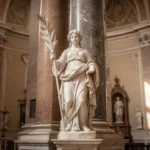
Artists often portray Blandina as a young or mature woman holding a palm branch, the traditional Christian symbol of martyrdom. She may also be shown with a cross, a stake, or an arena setting. These symbols communicate her identity as a martyr, but they are not all historical details recorded by the earliest source.
The palm branch represents victory through faithful endurance. In Christian art, it does not mean that death was considered a defeat or that violence was celebrated. It points to the belief that a martyr’s relationship with Christ was not destroyed by execution.
Images of Blandina can also make her social position visible by showing simple clothing or a humble setting. Such representations are devotional interpretations rather than portraits. No authenticated portrait from her lifetime is known, and the surviving written record does not tell us what she looked like.
Why St. Blandina still matters
St. Blandina remains memorable because her life brings historical, social, and spiritual questions together. She lived in a world where an enslaved woman could be treated as property, yet the Christian community remembered her as a person whose conscience and faith could not be owned by anyone else.
Her story also preserves the voice of a local Christian community during a period when Christianity lacked the public security it would gain centuries later. The church at Lyon did not remember only bishops or wealthy benefactors. It remembered a woman whose suffering and courage had made her impossible to overlook.
For Christians, Blandina can be a companion in prayer and a model of steadfastness. For historians, she is a significant witness to early Christianity, Roman persecution, women’s religious agency, and the experience of enslaved people in the ancient world. For anyone concerned with human dignity, her memory raises a direct challenge: social power may control a person’s circumstances, but it does not determine that person’s worth.
The most responsible way to honor her is to remember the facts carefully, reject romanticized descriptions of torture, and imitate the qualities the ancient account emphasizes: faithfulness, courage, solidarity, and concern for the vulnerable. Blandina’s name has endured because the people who knew her believed that even a person society tried to silence could become a lasting witness.
Frequently asked questions
When is St. Blandina’s feast day?
St. Blandina is commonly commemorated on June 2, together with the martyrs of Lyon. Calendar details can differ among Christian communities, so a parish or denomination may use a local observance. The date connects her memory with the wider group of Christians who died during the persecution at Lyon in the second century.
Was St. Blandina a slave?
Yes. The early account identifies Blandina as an enslaved Christian woman in Lyon. It also mentions concern from her Christian mistress about whether she could withstand interrogation. Her status is central to her memory because she became one of the most honored members of a community despite having little legal or social power.
Where can I read the earliest account of St. Blandina?
The principal surviving account appears in Eusebius of Caesarea’s Ecclesiastical History, Book 5, chapter 1. Eusebius preserves a letter associated with the churches of Vienne and Lyon. A modern translation with notes is helpful because the passage combines historical testimony with the community’s religious interpretation of persecution.
Is St. Blandina the patron saint of domestic servants?
Blandina is sometimes associated with servants, enslaved people, and people facing oppression because of her identity and martyrdom. However, patronage traditions are not uniform, and there is no single universally recognized official list covering every title attributed to her. Her strongest and most consistent association is with the martyrs of Lyon.

















Leave a Reply