St Agatha, also called Agatha of Sicily, is traditionally understood to have lived during the third century and died as a martyr in Catania. Her feast day is observed on February 5, especially in the Catholic Church. She is one of the early Christian women honored for remaining committed to her beliefs when the Roman authorities persecuted Christians.
Much of what people know about Agatha comes from later accounts of her martyrdom rather than from contemporary records. These accounts describe her as a young woman from a respected and wealthy Sicilian family who dedicated herself to Christ. Because the surviving stories combine historical memory, devotional tradition, and symbolic details, it is useful to distinguish the broad tradition from details that cannot be verified with certainty.
Agatha’s reputation has endured because her story brings together several themes: religious conviction, resistance to abuse, bodily suffering, and hope in danger. She is especially associated with Sicily, women facing violence, breast-related illnesses, nurses, bell makers, and protection from fire or volcanic disaster in some local traditions.
The central idea: St Agatha is remembered not because suffering is good in itself, but because her story presents courage, human dignity, and faithfulness in the face of coercion.
St Agatha’s life in the traditional accounts
The traditional story places Agatha in Sicily during a period when Christianity was not accepted by the Roman state. She is said to have been born into a prosperous family and to have chosen a life devoted to God. Some versions describe her as having made a private commitment to virginity, a form of dedication that was meaningful within early Christian communities.
According to the best-known account, a powerful Roman official named Quintianus desired Agatha and attempted to obtain her by force. The story says that when she refused him, he used his authority to punish her. Before her arrest, she was sent to a brothel or placed under the control of a woman named Aphrodisia, who was expected to persuade her to abandon her commitment.
Agatha resisted these efforts. The narrative then describes her arrest, interrogation, and imprisonment. Her refusal to surrender her beliefs became the reason given for the violence inflicted on her. The account portrays Quintianus as using the legal system and physical punishment to control her, making her story also one of resistance to sexual coercion and abuse of power.
The details of her family background, the exact circumstances of her arrest, and the sequence of events vary among sources. The broad tradition, however, remains consistent: Agatha was a Christian woman from Sicily who was killed because she would not renounce her faith.
What happened to St Agatha during her martyrdom
Agatha’s traditional martyrdom account includes severe torture. The most widely known detail is that her breasts were cut or mutilated. This violent image explains why later generations connected her with breast disease and with people whose bodies had been harmed through violence.
Some accounts say that St Peter or an angel healed her wounds while she was imprisoned. These episodes belong to the devotional tradition and are not historical details that can be independently confirmed. They express the belief that Agatha was spiritually sustained even when her body was attacked.
Another part of the story says that Agatha was placed on burning coals or tortured with fire. She is often shown carrying a small dish with her severed breasts, a symbol that can be difficult to view but is meant to identify her and recall her martyrdom. In respectful religious art, the object may look like small loaves, fruit, or rounded forms unless the viewer knows its meaning.
The traditional account ends with Agatha’s death in prison or after torture. Her tomb was associated with Catania, and devotion to her grew after her death. The exact historical development of the story is difficult to reconstruct, but her cult became firmly established in Sicily and later spread to other parts of Europe and the Americas.
How to understand St Agatha’s symbols and patronage
St Agatha’s symbols come directly from the stories told about her life and death. They help people recognize her in paintings, statues, church decorations, and prayer cards.
A platter or dish: This usually represents the bodily mutilation described in the martyrdom accounts.
Scissors or shears: These may refer to the torture associated with her breasts.
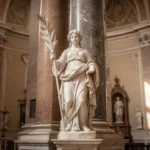
A palm branch: The palm is a traditional Christian sign of martyrdom and victory over death.
A veil or crown: These can suggest her consecrated virginity, purity, or status as a revered martyr.
Fire: Flames recall the punishment described in some versions of her story and her later association with protection from fire.
Breasts or breast-shaped loaves: These refer to the most recognizable part of her martyrdom tradition and to her patronage of breast health.
Because the imagery is connected to torture, it should be presented with care. For many people, St Agatha is not simply a figure associated with a shocking object. She is a companion in prayer for those living with cancer, undergoing surgery, recovering from assault, or facing illness and fear.
What St Agatha is the patron saint of
St Agatha is commonly named as a patron of breast cancer patients and people with breast disorders. She is also associated in different places with nurses, rape survivors, fire protection, earthquakes, volcanic eruptions, and bell makers. These patronages developed through different local customs rather than from one single official list that applies everywhere.
Her connection with breast illnesses comes from the account of her torture. Her connection with fire and earthquakes is especially strong in Sicily, where the people of Catania have long sought her intercession during eruptions of Mount Etna and other disasters. The association with bells is linked to local traditions and to the use of bells as signs of protection.
People may ask St Agatha’s intercession for themselves or for someone else. A person does not need to belong to a particular profession or illness category to pray with her. Her story can also be meaningful for anyone seeking strength after coercion, physical trauma, or a violation of personal dignity.
St Agatha’s feast day on February 5
St Agatha’s feast day is February 5. The date is observed in the Roman Catholic calendar, and local Christian communities may celebrate her with different liturgical or cultural customs. In Catania, her feast is one of the city’s most significant religious celebrations.
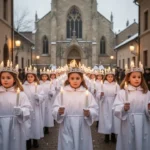
Celebrations in Catania can include processions, candles, flowers, music, special foods, and the carrying of a large silver reliquary or statue associated with the saint. The event brings together formal worship, local identity, family tradition, and public devotion. The scale and exact customs can change from year to year, but the focus remains on honoring Agatha and asking for her protection.
February 5 also gives churches and families an opportunity to pray for people with breast cancer or other serious illnesses. Some communities hold blessings, healing services, or educational events connected with women’s health. These practices should support medical care rather than replace it.
For health concerns: Prayer can provide comfort and community, but breast pain, a lump, skin changes, nipple discharge, or other symptoms should be discussed promptly with a qualified medical professional.
How to pray with St Agatha’s example
Prayer to St Agatha is often simple and personal. You can ask for her intercession while praying for healing, courage, protection from abuse, or strength during treatment. Catholic prayer commonly asks a saint to pray with or for the person, while directing worship to God.
A practical prayer routine can follow these steps:
Name the concern clearly. Mention the person, illness, fear, or situation that is weighing on you.
Ask for St Agatha’s intercession. You might ask her to pray for healing, endurance, wise medical care, or safety.
Pray for the people providing help. Include doctors, nurses, caregivers, counselors, family members, and advocates.
Make space for honesty. You do not need to hide anger, grief, fear, or exhaustion from God.
End with a concrete act of care. Schedule an appointment, contact a support service, visit someone, or rest when your body needs it.
A short prayer might ask God, through St Agatha’s intercession, to bring comfort to someone who is sick, courage to someone facing treatment, and protection to anyone experiencing violence. You can adapt the wording to your religious tradition and circumstances.
Some people pray a novena, which is a devotion practiced over nine days. Others light a candle, attend Mass, visit a church dedicated to Agatha, or keep an image of her nearby. These practices are meaningful when they lead toward compassion, responsible care, and trust rather than fear or superstition.
Many people connect with St Agatha because the account of her torture centers on the breasts. That connection can be emotionally powerful, but it can also be painful. Religious images that depict mutilation may comfort some people and distress others, particularly those who have experienced surgery, cancer, assault, or body-image changes.
There is no single correct way to approach her. A person may prefer an image of Agatha holding a palm branch rather than a platter. Another person may focus on her face, her clothing, or the candles used on her feast day. The most helpful symbol is the one that supports prayer and dignity.
Her devotion can also create opportunities for practical support. A parish or community honoring St Agatha might organize transportation to medical appointments, meals for families, financial assistance, support groups, or information about screening and treatment. Such acts express the compassionate purpose of devotion more fully than an image alone.
Offer to accompany someone to an appointment or treatment session.
Respect a patient’s privacy and do not ask for medical details unless they choose to share them.
Provide specific help, such as meals, child care, transportation, or errands.
Avoid promising that prayer will produce a particular medical outcome.
Encourage professional medical and mental health support when it is needed.
St Agatha’s story may also speak to people who have undergone mastectomy, reconstruction, radiation, or other procedures. Her traditional image does not define the worth of anyone’s body. Instead, many devotees see her as a figure who stands with people whose bodies have been exposed to pain, medical intervention, or violence.
St Agatha’s connection with Sicily and Mount Etna
Agatha is deeply connected with Catania, the Sicilian city traditionally identified as her birthplace or home. The city’s cathedral is dedicated to her, and her relics are honored there. Her presence is woven into local architecture, festivals, art, and public memory.
Her association with Mount Etna developed through the experience of a community living near an active volcano. According to local tradition, Agatha’s veil was carried toward a lava flow, and the flow stopped or changed direction. The story is part of religious tradition rather than a scientific explanation of volcanic activity.
It is possible to respect the spiritual meaning of this tradition without treating it as a substitute for geology, emergency planning, or official warnings. For Sicilians, the story expresses a relationship between the saint, the city, and the people who have repeatedly faced natural danger.
Her protection is also invoked against earthquakes and fire. These associations help explain why her feast may include public processions and prayers for the safety of homes, neighborhoods, and the wider community.
What historians can and cannot establish about St Agatha
Early Christian martyr stories were often preserved and developed through liturgy, preaching, oral tradition, and later written accounts. They were intended to honor the saint and encourage faith, not to function as modern biographies. As a result, historians must treat many details cautiously.
The existence of an early Christian cult dedicated to Agatha in Sicily is more secure than every detail in the dramatic martyrdom narrative. Her name, association with Catania, and long-standing veneration are central to the historical tradition. The exact dates, motives, legal procedures, and forms of torture are less certain.
That distinction does not make the devotion meaningless. Religious traditions often preserve memory through symbols and stories that communicate values as well as events. A careful reader can honor Agatha’s significance while recognizing that some elements belong to legend or devotional elaboration.
It is also helpful to avoid treating the suffering of a martyr as a reason to romanticize abuse. Agatha’s story should not be used to tell victims that they must remain silent, endure danger without help, or reject medical treatment. Her example is better understood as a witness to dignity and conscience, alongside a responsibility to protect people from harm.
Artists commonly portray Agatha as a young woman wearing a veil, crown, or richly colored robe. She may hold a palm branch, a cross, a book, a candle, or a platter. In some images, the platter contains two rounded shapes representing her breasts, while in others the symbol is less direct.
The choice of image affects how viewers experience the saint. A stark depiction of her injuries may emphasize the violence of martyrdom, while a peaceful portrait may emphasize prayer, endurance, and heavenly hope. Neither approach fully explains her significance on its own.
When selecting an image for a home, chapel, or hospital setting, consider the people who will see it. A symbol associated with trauma should be presented sensitively, particularly in spaces serving patients or survivors. Written explanations can help visitors understand the image without reducing Agatha to the details of her torture.
Ways to honor St Agatha respectfully
You can honor St Agatha through worship, education, service, or quiet remembrance. The most meaningful practice depends on your faith tradition and your connection to her story.
Attend a February 5 liturgy or a service dedicated to her memory.
Pray for people living with breast cancer, chronic illness, or physical pain.
Donate to a reputable cancer-support organization or a local domestic violence service.
Learn about the history of Christian women martyrs without presenting uncertain legends as proven facts.
Visit a church or museum with an image of Agatha and ask about its local history.
Prepare a simple meal or offer practical assistance to someone recovering from treatment.
Use her feast day as a reminder to support bodily autonomy, safety, and compassionate medical care.
For families, children, and classrooms, her story can be discussed in age-appropriate language. Focus on courage, conscience, justice, and care for people who are suffering. Graphic descriptions of torture are not necessary to explain why she is remembered.
Why St Agatha still matters
St Agatha remains important because her story speaks to several experiences that continue to affect people: illness, violence, pressure from those in authority, fear of disaster, and the search for spiritual strength. Her connection with Catania gives her devotion a strong local character, while her patronage has allowed people far beyond Sicily to see their own struggles in her story.
She is not a replacement for doctors, counselors, advocates, emergency services, or trusted friends. Instead, devotion to her can encourage people to seek help, accompany the vulnerable, and refuse to treat suffering as invisible. Her memory is strongest when prayer is joined to practical compassion and protection of human dignity.
On February 5 or any other day, remembering St Agatha can mean asking for courage while facing illness, standing beside someone whose body has been harmed, or choosing care instead of indifference. Her traditional story has survived because generations have found in it a call to remain faithful, courageous, and attentive to people in pain.
Frequently asked questions
Is St Agatha the patron saint of breast cancer?
Yes. St Agatha is widely honored as a patron saint of people with breast cancer and other breast-related illnesses. This connection comes from the traditional account of her torture. Devotion to her can offer emotional and spiritual support, but it should accompany—not replace—screening, diagnosis, treatment, and follow-up care from qualified medical professionals.
What day is St Agatha’s feast day?
St Agatha’s feast day is February 5. Catholic communities observe the date with Masses, prayers, processions, and local customs. Catania, Sicily, is especially known for its large celebration. Some churches may also hold services connected with healing, women’s health, or prayers for protection from fire and natural disasters.
Why does St Agatha carry a platter in religious art?
The platter usually shows the body parts associated with the traditional account of her torture. It is an identifying symbol, like the palm branch that represents martyrdom. Because the image refers to severe violence, churches and artists may present it in a restrained way or choose other symbols, such as a palm, veil, or cross.
Was St Agatha a real historical person?
Agatha’s long-standing Christian veneration and connection with Sicily are central parts of her historical tradition. However, many details of her life and martyrdom come from later devotional accounts and cannot be confirmed with the certainty expected of a modern biography. Her story is best approached by separating established tradition from dramatic details that may have developed over time.
















Leave a Reply