St. Paul Miki was a Japanese Jesuit brother and Catholic martyr who was crucified in Nagasaki on February 5, 1597. He was one of the Twenty-Six Martyrs of Japan, a group of Christians executed during a period of growing persecution under Toyotomi Hideyoshi.
Born in Kyoto around 1562, Paul Miki became a gifted preacher and evangelist. He is remembered especially for continuing to proclaim his faith from the cross, encouraging other Christians, forgiving his persecutors, and entrusting himself to Christ. The Catholic Church canonized him and the other twenty-five martyrs in 1862. His feast is celebrated on February 6.
Paul Miki was born into a Japanese family connected with the military class. His father, Miki Handayu, served as a minor samurai or military official, and the family lived in the Kyoto area. Paul was baptized as a child or young man, probably around 1580, during a period when Christianity was gaining a foothold in Japan.
The Christian faith had reached Japan through the Jesuit missionary St. Francis Xavier, who arrived in 1549. Missionaries and Japanese converts established Christian communities in several regions, particularly in areas where local rulers welcomed foreign trade or saw practical advantages in contact with Europe. The faith also attracted people who found the Christian message spiritually compelling, including members of the warrior class and ordinary townspeople.
Paul Miki received his education from the Jesuits and entered their formation. He became a Jesuit brother, rather than a priest, although he was preparing for priestly ministry when he was arrested. His abilities as a speaker made him one of the most effective Catholic preachers in Japan. He preached in Japanese and understood the religious and social setting of the people he served.
His ministry took place during a time of both opportunity and danger. Some Japanese leaders tolerated or supported Christianity, while others viewed it as a threat to political unity, local religious traditions, or national independence. Missionaries were also associated with Portuguese and Spanish merchants, which made Christian communities vulnerable to suspicion.
The central fact: St. Paul Miki is remembered not because he held political power, but because he remained faithful to the Christian message when public belief became dangerous. His witness joined preaching, courage, forgiveness, and solidarity with fellow believers.
Paul’s story is therefore larger than the account of one execution. It shows the development of Christianity in Japan, the cultural work of Japanese converts, and the cost that some believers paid when the government demanded religious conformity. He was not simply a European missionary’s assistant. He was a Japanese Christian leader who helped communicate the faith to his own people.
How Christianity reached Japan before Paul Miki’s martyrdom
Christianity began spreading in Japan in the sixteenth century, after Francis Xavier and other Jesuits arrived. The missionaries established schools, churches, residences, and charitable works. They learned Japanese customs and languages, although communication was difficult and the missionaries’ understanding of Japanese religious life developed gradually.
Many early Japanese Christians were baptized after hearing Christian preaching or forming relationships with missionaries. Some local lords accepted Christianity and permitted churches to operate in their territories. Their decisions could protect Christian communities, but they also meant that the faith was sometimes entangled with local politics and international trade.
The Jesuits depended increasingly on Japanese catechists and local leaders. These men and women taught prayers, prepared people for baptism, maintained Christian communities, and carried the faith into places where European missionaries could not remain. Paul Miki emerged from this Japanese Christian environment rather than standing outside it.
For several decades, the Church grew despite disagreements and restrictions. By the late sixteenth century, there were substantial Christian communities in parts of Japan. The movement included missionaries, catechists, members of the nobility, farmers, merchants, women, children, and religious communities.
Political circumstances changed after Toyotomi Hideyoshi consolidated authority over much of Japan. In 1587, Hideyoshi issued an order directing foreign missionaries to leave, although enforcement varied and Christianity did not disappear. The order reflected concerns about foreign influence and the possibility that Christian loyalties could weaken political control.
Hideyoshi did not immediately attempt to eliminate every Christian community. At different times, he allowed some missionary activity, tolerated Christian lords, or pursued relations with foreign merchants. This inconsistent policy created uncertainty. Christians could practice publicly in one place and face official pressure in another.
A sharper crisis followed in 1596 after a Spanish ship, the San Felipe, reached Japan. Reports about the ship’s cargo and the relationship between missionaries and Spanish expansion heightened official suspicion. Hideyoshi ordered the arrest of Christians in Kyoto and Osaka. The authorities selected both religious personnel and lay believers, apparently intending to make an example of them.
The arrested group included six Franciscan missionaries, three Japanese Jesuits, and seventeen Japanese lay Christians. Their ages, occupations, and backgrounds differed widely. Some were young; others were married or had children. Their diversity shows that the persecution affected a real Christian community rather than an isolated group of foreign visitors.
Missionaries: Several were members of the Franciscan order who had served in Japan.
Jesuits: Paul Miki and two other Japanese Jesuits represented the local Catholic mission.
Lay Christians: The group included catechists, interpreters, artisans, and ordinary members of Japanese Christian communities.
Children: Three of the martyrs were young boys who were associated with the Franciscan community and chose to remain with the Christians.
The prisoners were first condemned in the Kyoto area. As punishment and public warning, they were marched hundreds of miles toward Nagasaki, where a large Christian population lived. Along the route, their ears or noses were cut as a sign of disgrace according to commonly transmitted accounts, although historical descriptions vary in detail.
What happened to St. Paul Miki and the Twenty-Six Martyrs
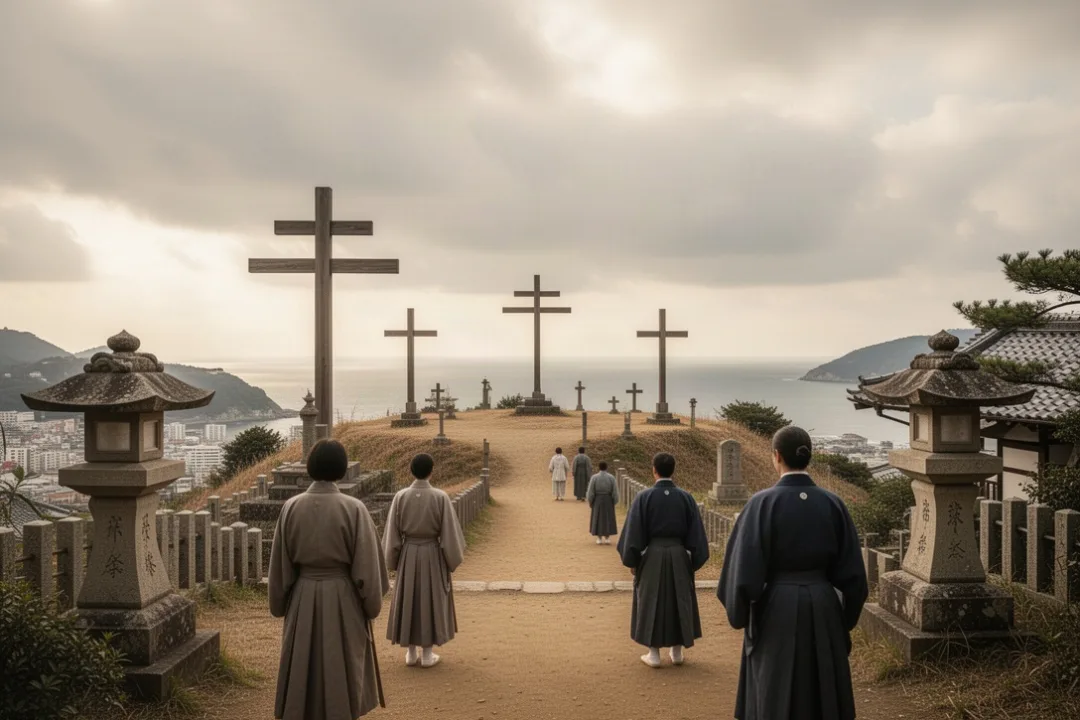
The prisoners reached Nagasaki in early February 1597. They were taken to a hill now known as Nishizaka, or the Hill of Martyrs. Twenty-six crosses had been prepared there. The execution method reflected the form of crucifixion used in Japan at the time, with victims fastened to crosses and killed by spears.
Paul Miki had not yet completed his studies for ordination. Even so, he was recognized as a preacher and a leader among the prisoners. The journey and imprisonment did not stop him from encouraging others. Accounts of the martyrs describe them praying, singing, and strengthening one another while they traveled toward their execution.
From his cross, Paul Miki preached to the people gathered around the hill. He defended the Christian faith and said that he was Japanese, a Jesuit, and about to die for the Gospel. He also rejected the idea that he had committed a crime deserving death. His message focused on Christ rather than on revenge against the officials carrying out the sentence.
Because translations and historical accounts differ, it is best to avoid treating every reported phrase as a verbatim transcript. The consistent point is that Paul used his final moments as an act of evangelization. He spoke publicly about his faith, encouraged the other martyrs, and faced death without renouncing Christianity.
His final witness was not silence forced by suffering; it was preaching offered from the cross.
On February 5, 1597, Paul Miki and the other twenty-five Christians were killed. The Church honors them together because they shared the same persecution and death. Paul is often named first among them because of his Jesuit identity and his prominent role in the final preaching.
The group’s deaths did not end Christianity in Japan. Instead, their witness became a lasting source of strength for Japanese Christians. Later persecution became even more severe under the Tokugawa shogunate, and many Christians practiced secretly. These hidden Christians, known as Kakure Kirishitan, preserved elements of Christian prayer and tradition for generations without regular access to priests.
The twenty-six martyrs were beatified in 1627 by Pope Urban VIII and canonized in 1862 by Pope Pius IX. Their canonization recognized the group as a whole, while Paul Miki became its best-known Japanese member. The site at Nishizaka later became an important place of pilgrimage and remembrance.
What St. Paul Miki’s example teaches Christians
Faith can be expressed through local leadership
Paul Miki’s life challenges the assumption that the early Catholic mission in Japan was mainly a foreign project. European missionaries played a major role, but Japanese Christians taught, organized, interpreted, and evangelized. Paul was formed within the Japanese Church and became one of its own public voices.
His example emphasizes the value of indigenous Christian leadership. A faith community becomes more deeply rooted when local believers can explain its beliefs in their own language, answer questions from their own cultural setting, and serve their neighbors through familiar relationships.
Preaching involves both words and conduct
Paul was known for preaching, but his witness did not consist only of spoken arguments. His conduct under arrest, during the march, and at the place of execution gave visible form to what he proclaimed. He showed that Christian preaching includes steadfastness, prayer, forgiveness, and care for others.
This does not mean that Christians should seek suffering or create unnecessary conflict. Paul’s martyrdom resulted from a government’s decision to punish Christians. The lesson is not to pursue danger, but to remain honest about one’s convictions when pressure makes silence or compromise attractive.
Martyrdom is connected with love, not hatred
Christian martyrdom is often misunderstood as a search for death. In the Christian tradition, a martyr is someone who bears witness to faith and accepts the consequences rather than denying it. Paul Miki did not attack his executioners or call for retaliation. His reported final message is remembered for its confidence in Christ and its goodwill toward others.
That distinction matters. Faithfulness is not the same as hostility. Paul’s witness joined firm conviction with the refusal to answer violence with hatred. His story can speak to people who face religious pressure, but it also warns against treating religious disagreement as permission for cruelty.
Christian communities depend on shared courage
The twenty-six martyrs did not all have the same role. Some were ordained or religious; others were laypeople. Some had formal education; others served through practical work. Their unity shows that the life of a Church depends on more than prominent leaders.
A catechist may teach children and prepare neighbors for Christian prayer.
A parent may preserve faith within a household during a period of public pressure.
A lay worker may support the Church through hospitality, translation, or material care.
A religious brother or sister may preach, teach, and accompany a community.
A young person may offer courage that strengthens older believers.
Paul Miki’s story belongs within this wider community. His leadership was real, but the witness of the group was collective. The martyrs supported one another, and their different backgrounds made the testimony more representative of the Japanese Church.
A practical reflection: Remembering St. Paul Miki can lead to prayer for Christians who face discrimination or persecution, respect for local Christian communities, and a willingness to speak about faith with both clarity and charity.
How Catholics remember St. Paul Miki today
St. Paul Miki’s feast day is February 6, the day after the anniversary of the martyrs’ deaths. Churches and Catholic communities may mark the feast with Mass, prayer for persecuted Christians, lessons about the history of Christianity in Japan, or reflection on the responsibilities of evangelization.
He is especially associated with Japan, Jesuit spirituality, missionaries, evangelists, and Christian martyrs. His image often shows him wearing the clothing of a Jesuit brother or standing near a cross. Artistic representations may also place him with the other twenty-five martyrs at Nishizaka.
The shrine and museum at Nishizaka in Nagasaki preserve the memory of the martyrs and their historical setting. Pilgrims visit to pray, learn about the persecution, and remember the long history of Japanese Christianity. The site also connects the sixteenth-century martyrs with the later Christians who preserved the faith through periods when priests and public churches were absent.
Devotion to Paul Miki does not require familiarity with every detail of Japanese political history. A person might turn to him when praying for courage, for the Church in Japan, for those who cannot worship openly, or for the grace to communicate Christian beliefs respectfully.
A simple way to observe his feast includes several practices:
Read about the Twenty-Six Martyrs and notice the different roles represented in the group.
Pray for persecuted Christians without reducing their experiences to statistics or political slogans.
Learn about Japanese Christianity, including the long witness of communities that survived without regular public ministry.
Examine your own speech by asking whether you explain your beliefs truthfully and treat those who disagree with dignity.
Support works of mercy and evangelization through your parish or a trustworthy Catholic organization.
St. Paul Miki can also help broaden the way Western Christians understand the global Church. Catholic history is not limited to Europe or to the experiences of European saints. Paul was Japanese, educated in Japan, and committed to serving Japanese people. His life demonstrates that Christianity took root in cultures far beyond its earliest Mediterranean settings.
His legacy remains especially meaningful because it includes both public courage and hidden endurance. The crucifixion at Nishizaka was dramatic and visible, but the faith of later Japanese Christians was often quiet and difficult to document. Together, these stories show that the Church can survive through public witness, family prayer, community memory, and patient fidelity.
St. Paul Miki died before he could complete the path to priesthood, but his unfinished plans did not make his ministry insignificant. He had already taught, preached, accompanied fellow believers, and made the Gospel intelligible in his own setting. His life is remembered as a complete Christian witness because faithfulness is measured by love and truth, not by how long a person lives or how much official status he holds.
Frequently asked questions
Was St. Paul Miki a priest?
No. St. Paul Miki was a Jesuit brother preparing for priestly ministry when he was arrested. He had already become a respected preacher and evangelist, however, and his knowledge of Japanese language and culture made him an important leader in the local Catholic community.
How many people were martyred with St. Paul Miki?
Twenty-five other Christians were killed with him, making twenty-six martyrs in all. The group included six Franciscan missionaries, three Japanese Jesuits, and seventeen Japanese lay Christians. Their different backgrounds show that the persecution affected both foreign missionaries and established Japanese Christian communities.
Where was St. Paul Miki crucified?
He was crucified on Nishizaka, a hill in Nagasaki now known as the Hill of Martyrs. The location became an important pilgrimage site and is associated with the Twenty-Six Martyrs Museum and Monument, which preserve the memory of the group’s witness.
Why is St. Paul Miki’s feast day February 6?
The Church celebrates St. Paul Miki and the Twenty-Six Martyrs on February 6, the day after their execution on February 5, 1597. The shared feast emphasizes their unity in suffering and their common witness to Christianity in Japan.











Leave a Reply