Perpetua and Felicity: Their story and lasting witness
Perpetua and Felicity: Their story and lasting witness
Perpetua and Felicity were Christian martyrs killed in Carthage in Roman North Africa, probably in the early third century. Perpetua was a young, well-born woman, while Felicity was an enslaved woman and expectant mother. Their surviving account, commonly called The Passion of Saints Perpetua and Felicity, preserves one of the earliest known Christian texts written from a woman’s perspective.
The two women were imprisoned with several other Christians after refusing to abandon their faith. Perpetua’s account describes family pressure, imprisonment, dreams, baptism, childbirth, and the final deaths of the group in the arena. Their story became influential because it brings together religious conviction, social inequality, motherhood, and public martyrdom in unusually personal detail.
Perpetua and Felicity lived in Carthage, a major city in the Roman province of Africa. The city had an established Christian community, but Christianity was not yet accepted by the Roman state. Christians could face legal danger when their beliefs led them to reject required public religious acts or to refuse participation in imperial cult practices.
Perpetua appears to have belonged to a comfortable and educated household. Her surviving narrative presents her as a young mother with a newborn son. It also shows that she had enough education to write or dictate a sophisticated account of her experiences. Her father is described as a pagan who loved her deeply but could not accept her decision to remain Christian.
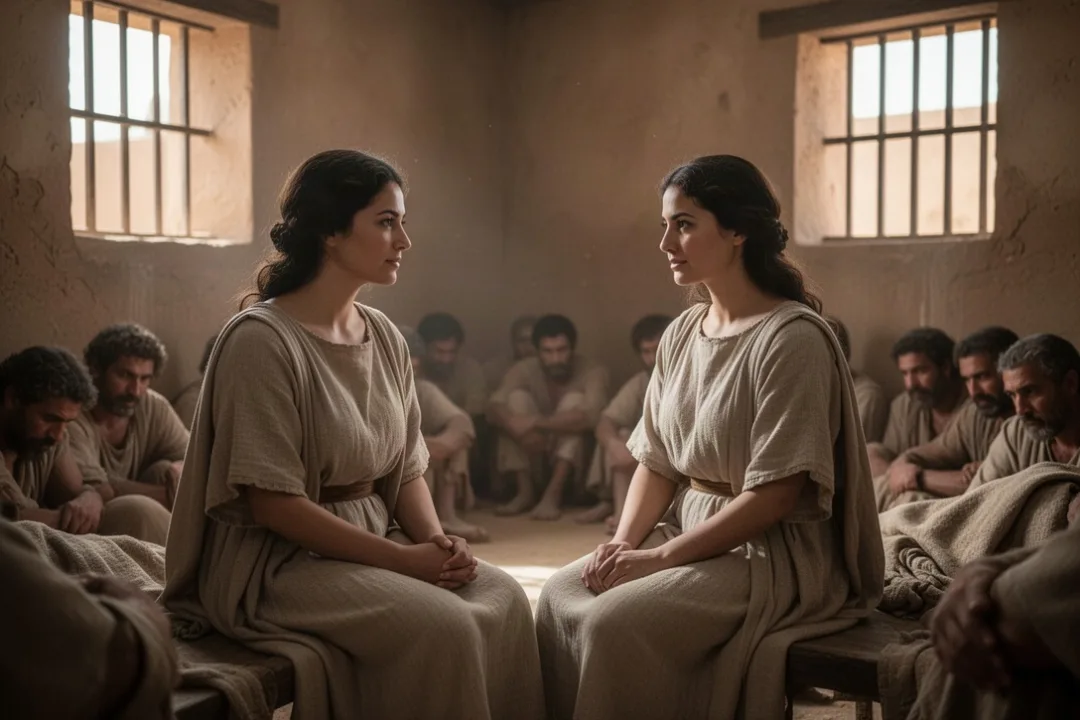
Felicity’s social position was very different. She was enslaved and pregnant when she was arrested. The account places her among a group of Christian catechumens, people receiving instruction before baptism or preparing to enter the church more fully. Her pregnancy created a practical legal problem because Roman authorities generally did not carry out an execution on a woman who was still pregnant.
The group included Perpetua, Felicity, Revocatus, Saturninus, Secundulus, and Saturus. Some were enslaved, and some may have been free. Saturus is presented as a teacher or leader who chose to share the danger of the others, even though he was not arrested at the same time. Their different backgrounds make the group notable: social rank did not erase their shared identity as Christians.
A useful distinction: Perpetua and Felicity are not the same person, and Felicity of Carthage should not be confused with other saints named Felicity, including Felicity of Rome.
The exact legal circumstances remain uncertain. Their deaths are commonly associated with the persecution connected to Emperor Septimius Severus, but the surviving narrative does not provide a complete legal record of the proceedings. It is safer to say that they were detained and condemned in Carthage because they would not renounce their Christian commitment.
What Perpetua’s prison account records
The central source for their story is a short work known in English as The Passion of Saints Perpetua and Felicity. It combines several voices. The opening and closing sections appear to come from an editor or narrator, while the middle portion is presented as Perpetua’s own prison account, followed by a section attributed to Saturus.
That first-person section is the feature that has drawn so much attention. Perpetua does not appear only as a distant example of holiness. She describes arguments with her father, the strain of separation from her infant, the conditions of imprisonment, and the dreams she understands as signs of what lies ahead. Her writing creates a direct impression of a person making decisions under intense pressure.
Her father repeatedly asks her to give up Christianity. In one memorable scene, he appeals to their family relationship and asks her to think of his feelings and her child. Perpetua recognizes his distress, but she continues to identify herself as a Christian. The conflict is not presented as simple hatred between generations; it is a painful disagreement between people who love one another but hold incompatible beliefs.
The narrative also describes Perpetua’s movement from a catechumen toward baptism. She and the others are baptized while in custody. In the account, baptism marks a decisive change in how she understands her imprisonment. The prison remains physically dangerous, but her spiritual identity becomes clearer and more settled.
Several dreams appear in Perpetua’s record. They include symbolic images of a contest and a struggle, and they are interpreted as indications that the prisoners will face suffering but will not be abandoned by God. The dreams should not be treated as a modern medical or psychological case study. Within the text, they function as visions of courage, identity, and anticipated victory.
The account also reveals practical details about confinement. Perpetua is distressed by the heat, crowds, and rough conditions. Her family is able to arrange better treatment for a time, and the prisoners’ supporters bring help. These details matter because they prevent the story from becoming an abstract tale of bravery. The prisoners experience discomfort, fear, hunger, grief, and dependence on others.
Perpetua’s relationship with her infant is one of the most moving parts of the narrative. She is allowed access to the child, who is still nursing. Once the baby is brought to her, she says that the prison becomes more bearable. The account presents motherhood as a source of physical responsibility and emotional pain, but also as one of the circumstances through which she experiences care and strength.
How Felicity’s pregnancy shaped the final events
Felicity’s story is shorter than Perpetua’s, yet it is central to the meaning of the group’s martyrdom. When the prisoners are condemned, Felicity is still pregnant. She fears that she will not be allowed to die with her companions because Roman practice generally delayed the execution of pregnant women until after childbirth.
Her concern is not simply a wish to avoid delay. The narrative portrays her as wanting to face the same trial as the others rather than be separated from them. The other prisoners also worry that Felicity will give birth after they have gone and will be left behind among people who do not share their faith.
According to the account, the group prays, and Felicity goes into labor. She gives birth to a daughter in prison before the scheduled execution. A Christian woman connected with the community is said to have taken responsibility for the child. The source does not provide a full later biography of the daughter, so claims about her subsequent life should be treated cautiously.
The narrative describes Felicity’s labor as painful, then contrasts it with the suffering expected in the arena. When someone comments that childbirth is difficult, Felicity responds in substance that her present pain is her own, while the suffering she is about to face will be endured with Christ’s help. The text uses this contrast to express a central Christian belief about strength received during persecution.
Modern readers may respond to Felicity’s story in different ways. Some see it primarily as an account of courage; others focus on the severe vulnerability created by enslavement, pregnancy, imprisonment, and forced separation from a newborn. Both perspectives are necessary. The source presents theological conviction, but it also exposes the unequal conditions surrounding the women’s lives.
Perpetua is portrayed as a freeborn woman with family status, education, and a young child.
Felicity is portrayed as an enslaved woman whose pregnancy affects when she can be executed.
Both women are treated as members of the same Christian group despite their different legal and social positions.
Their children remain part of the story, showing that martyrdom affected families as well as the condemned.
Read Felicity’s story with care: the ancient source honors her faith, but it does not erase the realities of slavery, childbirth, bereavement, or the lack of control she had over her circumstances.
Why the deaths of Perpetua and Felicity became a Christian witness
The prisoners were taken to a public arena during games associated with a civic celebration. The narrative describes attacks by wild animals and the deaths of some companions. Secundulus dies earlier in prison, according to the account, while the others are brought into the arena. The final stage of the execution involves a sword, carried out by an executioner.
Ancient accounts of martyrdom often use formal and theological language. The editor of Perpetua and Felicity’s story presents the deaths as a victory over fear and as evidence of Christian faithfulness. Yet Perpetua’s own section retains a strong human dimension. She thinks about her father and child, experiences physical distress, and describes dreams that help her understand what is happening.
The account also gives women an unusually prominent place in the story. Perpetua speaks with authority, interprets her own visions, and makes decisions that challenge her father’s wishes. Felicity’s pregnancy is not an incidental detail; it shapes the community’s experience of imprisonment and the timing of the execution. Their presence demonstrates that women were not merely observers in the early Christian movement.
This does not mean the text describes complete equality in every sense. Perpetua’s social advantages differ sharply from Felicity’s enslaved status, and both remain subject to Roman power. Still, the narrative gives them spiritual agency: they teach, pray, interpret events, encourage one another, and choose how to respond to coercion.
The text’s influence also comes from its unusual literary form. Readers encounter an individual voice rather than only a later summary. Perpetua’s account has been studied by historians, theologians, classicists, and scholars of women’s writing because it offers evidence about several subjects at once:
the experience of Christian imprisonment in Roman North Africa;
the role of baptism and catechesis before martyrdom;
the expectations placed on Roman daughters and mothers;
the social position of enslaved Christians;
the way dreams and visions shaped religious interpretation;
the development of Christian memory around martyrdom.
The work was read in Christian communities for generations. Its survival in several languages and manuscript traditions shows that it was valued well beyond the immediate setting of Carthage. It helped establish Perpetua and Felicity as models of steadfastness, while also preserving details that make them more than symbolic figures.
What Perpetua and Felicity mean to Christians today
Christians remember Perpetua and Felicity for their refusal to separate faith from public action. Their story is not mainly about seeking suffering. It is about what they did when authorities and family members demanded that they deny a central part of their identity. The account asks readers to consider conscience, loyalty, and the cost of religious commitment.
Perpetua is often remembered in connection with motherhood and the conflict between family expectations and personal conviction. Her story can be meaningful to parents who understand the pain of separation, although her circumstances should not be reduced to a simple lesson about choosing religion over family. She continues to care about her father and child even while refusing his request.
Felicity is remembered alongside Perpetua rather than as a secondary figure. Her presence challenges readers to notice how the early church’s memory includes a woman who was enslaved and pregnant. The pairing of the two saints can represent a community that crosses status divisions, while also inviting honest reflection on the inequalities that shaped their lives.
Many churches observe their shared feast day on February 7, although calendars and local traditions can vary. They are included among the early Christian martyrs commemorated in Western Christianity. Their names may appear in liturgical calendars, devotional writing, church art, and readings connected with witness and courage.
Artistic depictions commonly show Perpetua and Felicity together, sometimes with palm branches as symbols of martyrdom. Felicity may be shown with a child or in association with motherhood, while Perpetua may be shown as a young woman or with symbols connected to her martyrdom. Details differ across periods and denominations, and not every image reflects the historical record precisely.
Their story can also be approached outside devotional practice. Historians use it to examine the relationship between Roman law and local persecution, while scholars of literature study its shifting voices and narrative structure. Researchers of gender and slavery ask how the text represents women with different forms of power and vulnerability.
A careful reading avoids turning the women into flawless, distant icons. Perpetua feels fear and grief; Felicity faces physical pain and uncertainty; both depend on fellow prisoners and supporters. Their courage is compelling partly because the source allows readers to see the human cost behind the public image of a martyr.
How to read their surviving account responsibly
The text is a religious work, not a neutral courtroom transcript. It was preserved and shaped for Christian readers who believed martyrdom revealed divine grace. That purpose does not make it useless as historical evidence, but it means that each detail should be considered in relation to the author’s aims, literary structure, and theological language.
Perpetua’s first-person passages are especially valuable, yet scholars still discuss how the work was assembled and edited. The opening narrator introduces the account, Perpetua’s section follows, Saturus contributes his own vision, and the narrator returns for the description of the deaths. The final form therefore reflects more than one perspective.
Readers should also distinguish between what the text says and what later traditions add. The source provides important information about Perpetua’s child and Felicity’s daughter, but it does not offer complete biographies of either child. Later claims about their names, careers, or religious roles may belong to tradition rather than firm historical evidence.
A useful reading method is to ask several questions:
Who is speaking? Identify whether a passage comes from Perpetua, Saturus, or the narrator.
What kind of passage is it? Separate prison observation, dream narrative, theological interpretation, and public description.
What social pressures are visible? Pay attention to family, enslavement, pregnancy, legal status, and access to support.
What is the text trying to accomplish? Consider how it encourages Christian readers and shapes the memory of the martyrs.
Reading in this way preserves both dimensions of the work. It remains a sacred account for communities that honor the saints, and it is also a rare historical voice from a woman living under Roman rule. Perpetua and Felicity endure in memory because their story combines personal testimony with communal remembrance, giving later readers a record of faith that is intimate, contested, and profoundly human.
Frequently asked questions
When did Perpetua and Felicity die?
They are generally believed to have died in Carthage in the early third century, commonly associated with the persecution during the reign of Septimius Severus. The surviving account does not provide a complete date in the way a modern record would, so the broader period is more secure than a precise day or year.
Was Perpetua the mother of a baby when she was imprisoned?
Yes. The prison narrative presents Perpetua as nursing her infant son while detained. Access to the child briefly makes imprisonment more bearable, and separation from him becomes one of the most painful parts of her experience. The text does not provide a full later account of the boy’s life.
What happened to Felicity’s baby?
Felicity gave birth to a daughter in prison shortly before the group’s execution. The account says that a Christian woman took responsibility for the child, but it does not preserve a detailed biography or certain later history. Stories that provide additional details should be distinguished from the earliest surviving source.
Why is Perpetua’s prison diary historically important?
It is one of the earliest surviving Christian martyr accounts to include a substantial first-person section attributed to a woman. It offers rare details about family conflict, motherhood, imprisonment, baptism, dreams, and Christian identity in Roman North Africa. Its edited form also helps scholars study early Christian writing and memory.
















Leave a Reply