Joachim and Anne: Mary’s parents in Christian tradition
Joachim and Anne: Mary’s parents in Christian tradition
When you see Joachim and Anne named in a church calendar or religious artwork, you may wonder where their story comes from. The short answer is that Christian tradition identifies them as the parents of the Virgin Mary and therefore the maternal grandparents of Jesus. Their names and most details about their lives do not appear in the New Testament, but they became widely known through early Christian writings and centuries of devotion.
Joachim and Anne are remembered as a married couple who remained faithful to God while facing the pain of childlessness. In the traditional story, God answered their prayers with the birth of Mary, who would become the mother of Jesus. Their importance rests less on a detailed biography than on what they represent: trust during disappointment, faithful family life, and the generations connected to the incarnation.
The New Testament does not name Mary’s parents. The Gospels describe Mary’s role in the birth and early life of Jesus, and they mention some of her relatives, but they do not provide a family history that identifies her mother and father. The names Joachim and Anne come from Christian tradition outside the biblical text, not from a direct passage of Scripture.
This distinction helps explain why different Christians may speak about the couple in slightly different ways. Catholics and Eastern Orthodox Christians commonly honor Joachim and Anne as Mary’s parents. Many other Christians know the tradition but do not treat the later stories about them as part of the Bible or as historically verified biography.
Mary’s mother is sometimes called Anne, Anna, or Hannah, depending on the language and tradition. These forms are related through translation and naming customs. Joachim’s name also appears in forms such as Jehoiakim in some discussions, although devotional art and liturgical use most often refer to him as Joachim.
Keep the sources distinct: the Bible identifies Mary as the mother of Jesus, while the names Joachim and Anne come from early Christian tradition and later devotional writings.
The absence of their names from the New Testament does not by itself prove that the tradition is false, but it does set a limit on what can be claimed with confidence. We can say that the church has long remembered them as Mary’s parents. We should be more cautious about treating the traditional narratives as a complete historical record.
Their story also fits a pattern familiar in biblical family narratives: a couple experiences longing, prayer, and unexpected blessing. Readers may notice similarities with accounts involving Abraham and Sarah, Hannah, or Elizabeth and Zechariah. These similarities help communicate a spiritual theme, but they do not establish that every detail of Joachim and Anne’s story happened exactly as later accounts describe it.
How the tradition about Mary’s parents developed
The earliest substantial written account of Joachim and Anne appears in the Protoevangelium of James, a second-century Christian text also known as the Protevangelium of James. It is not part of the New Testament, but it had a significant influence on Christian tradition, especially in the East. The text presents an account of Mary’s birth and childhood that supplies details not given by the canonical Gospels.
According to this narrative, Joachim and Anne are a devout couple whose childlessness has become a source of sorrow and public shame. Joachim withdraws to the wilderness to fast and pray, while Anne grieves at home. An angelic announcement then brings them hope, and Anne gives birth to Mary.
The text goes on to describe Mary being dedicated to God and brought to the Temple as a young child. This episode became especially influential in Eastern Christian worship through the Feast of the Presentation of the Theotokos, also called the Entry of the Mother of God into the Temple. The feast is connected with Mary’s childhood rather than with a scene recorded in the New Testament.
Later writings expanded or adapted the same tradition. The Gospel of Pseudo-Matthew, a different noncanonical text, helped circulate related stories in the Latin-speaking West. Medieval preaching, religious drama, visual art, and popular devotion then gave Joachim and Anne a much larger place in Christian imagination.
The New Testament: names Mary and describes Jesus’ birth, but does not name Mary’s parents.
The Protoevangelium of James: provides the earliest widely influential written account of Joachim, Anne, and Mary’s birth.
Later apocryphal writings: develop additional scenes about Mary’s childhood and family.
Church tradition: preserves their names and honors them through feasts, prayers, art, and local customs.
“Apocryphal” in this context does not necessarily mean that a text has no religious or cultural value. It means the writing is outside the accepted biblical canon. Such texts can show how early Christians reflected on Mary’s life, but they should not be read in exactly the same way as the canonical Gospels.
What Joachim and Anne’s story means
The central theme is not simply that a child was born to an older couple. The story presents faithfulness before the answer arrives. Joachim and Anne are portrayed as people who continue to seek God even when their hopes appear delayed or impossible. For many believers, that makes them figures of patience in seasons marked by grief, infertility, uncertainty, or social pressure.
The couple also represents the role of family in the Christian story. Jesus’ public ministry begins in the Gospels with Mary, Joseph, and their relatives, but Christian reflection naturally asks about the household that formed Mary before the annunciation. Joachim and Anne provide a traditional answer: Mary came from a family shaped by prayer, generosity, and dedication to God.
That claim should not be misunderstood as a requirement that every family be perfect. The traditional account does not offer a practical formula for receiving everything you hope for. Instead, it gives believers a way to think about ordinary fidelity: keeping faith, caring for one another, and practicing generosity without knowing how events will unfold.
Joachim is often associated with fatherhood, work, and responsible provision. Anne is often associated with motherhood, prayer, and the patient care involved in raising a child. These associations come from devotional interpretation, not detailed biblical descriptions. They can be meaningful, but they should not reduce either person to a narrow stereotype.
Their story has particular significance for grandparents. Because Joachim and Anne are remembered as Jesus’ grandparents, they have become symbols of the way older generations pass on faith, memory, and moral formation. Grandparents may see their own vocation in teaching children to pray, preserving family stories, or offering steady love when parents and children are under strain.
A helpful reading: Joachim and Anne are honored not because the tradition gives us many verifiable facts about them, but because it places prayerful family life within the story leading to Christ.
Their witness can also speak to people whose family circumstances differ from the traditional picture. Someone who is single, childless, widowed, estranged from relatives, or grieving a child can still find meaning in their themes of hope and trust. Devotion to Joachim and Anne should offer companionship rather than create pressure or imply that suffering results from weak faith.
How Christians honor Joachim and Anne
In the Roman Catholic Church, Joachim and Anne share a liturgical celebration on July 26. The day is commonly known as the Memorial of Saints Joachim and Anne, Parents of the Blessed Virgin Mary. The date and title reflect the church’s public honoring of both figures together rather than a claim that the calendar preserves their exact historical birthdays or death dates.
In Eastern Orthodox Christianity, the couple is also honored liturgically. Their feast days may be observed separately in connection with the church’s calendar, and the Nativity of the Mother of God is traditionally linked with the celebration of Joachim and Anne. Orthodox services often call Mary Theotokos, meaning “God-bearer” or “Bearer of God,” and honor her parents as part of the story of her birth.
Local customs vary, but devotion may include attending worship, praying for families, asking their intercession, or reflecting on the responsibilities of grandparents. Some churches and communities are named for Saint Anne, and she has been especially honored in places where families seek her prayers for mothers, children, and those preparing for childbirth.
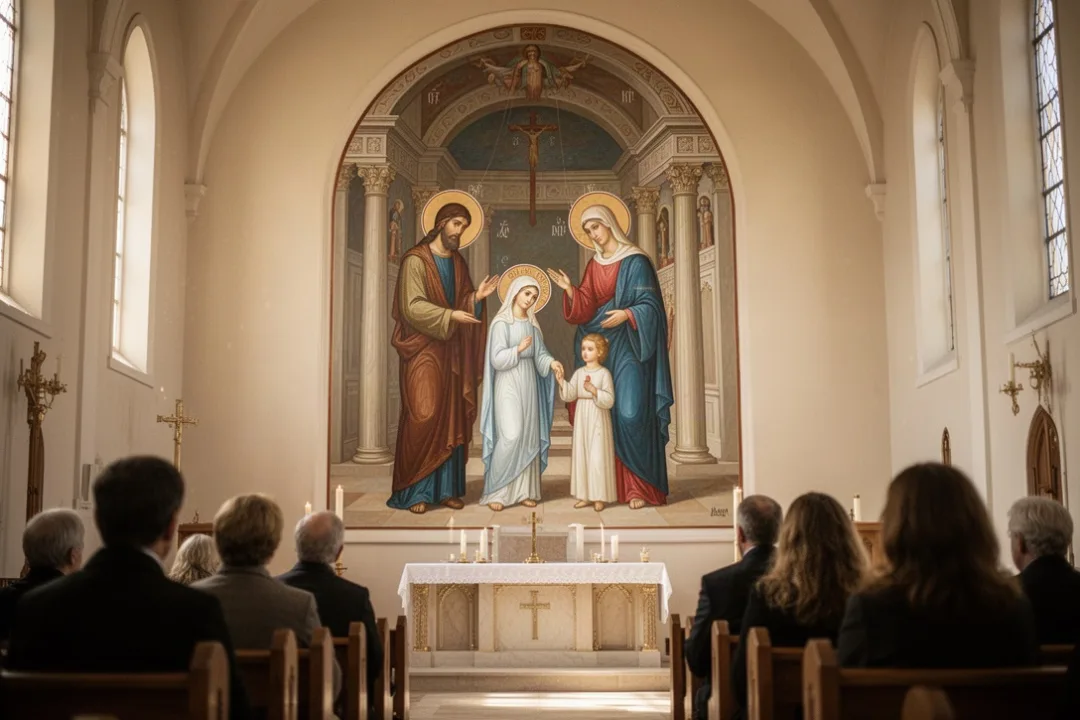
Joachim and Anne appear in many forms of Christian art. Common scenes include:
The meeting at the Golden Gate: a symbolic reunion after Joachim’s time away, followed by the news that Anne will conceive.
The birth of Mary: Anne is shown with the newborn Mary, often surrounded by women assisting the household.
Mary’s presentation at the Temple: Joachim and Anne bring their young daughter to be dedicated to God.
The family of Mary: Joachim and Anne appear with Mary and, in some later images, the child Jesus.
Saint Anne teaching Mary: Anne is depicted instructing a young Mary, often with a book representing religious learning.
Artists sometimes portray Anne holding Mary, or Mary holding the infant Jesus, in a layered image known in Western art as Saint Anne Trinitarian imagery. The arrangement is devotional and symbolic rather than a literal portrait of a scene described in Scripture. It emphasizes the generations through which the Christian story is understood.
People may pray to Joachim and Anne as intercessors, asking them to pray to God for particular needs. In Catholic and Orthodox theology, this does not mean treating saints as independent gods or as replacements for Christ. The practice is understood as requesting the prayers of faithful members of the heavenly church, much as someone might ask a trusted Christian friend to pray.
What can reasonably be said about their historical identity
There is no reliable surviving biography of Joachim and Anne from the period in which Mary and Jesus lived. The earliest written account was composed later than the events it describes, and its purpose was religious storytelling rather than modern historical documentation. As a result, historians cannot confirm the couple’s names, location, occupations, ages, or specific experiences from independent evidence.
That limitation applies to many people who appear at the edges of ancient religious history. A person can be deeply important in worship and tradition without having a surviving archive of records. Historical evidence and devotional importance are related but not identical categories.
Some traditional accounts describe Joachim as wealthy and generous, with a practice of dividing his goods among the Temple, the poor, and his household. They describe Anne as a devout woman who longs for a child. These details help shape the moral character of the story, but they should be presented as elements of tradition rather than established facts.
The story may also reflect the concerns of the communities that preserved it. Early Christians wanted to honor Mary’s holiness and to explain how she came into the world and was prepared for her role. The narrative about her parents answers those devotional questions while also using familiar biblical patterns of promised birth and divine care.
Respectful discussion therefore requires two forms of care. First, avoid dismissing the tradition simply because it is not in the Bible; it has shaped Christian prayer, art, and teaching for centuries. Second, avoid stating every apocryphal detail as if it were proven history. A careful phrase such as “according to tradition” accurately communicates the status of the material.
Joachim and Anne remain meaningful because they connect the grand story of salvation with a household that tradition portrays as ordinary, vulnerable, and prayerful. Before Mary became the mother of Jesus, she was a child raised within a family. That emphasis invites attention to the quiet work of care that often receives little public recognition.
Parents may look to them when they are trying to form children in faith while managing work, financial stress, illness, or conflict. Grandparents may find encouragement in their association with intergenerational faith. Couples experiencing infertility or a long period of waiting may relate to the story’s portrayal of hope amid disappointment, while remembering that religious devotion does not guarantee a particular outcome.
They can also prompt practical reflection. A family honoring Joachim and Anne might make time for shared prayer, visit an older relative, preserve stories about previous generations, or support a parent and child in need. These actions express the values attached to the couple more clearly than simply knowing their names.
A simple way to reflect on their example is to consider three questions:
How do you respond when an important hope is delayed? Their traditional story encourages honest grief without abandoning prayer.
What are you passing to younger generations? Faith is communicated through habits, stories, compassion, and example, not only formal instruction.
Which older people need your attention? Their memory can inspire practical care for grandparents, elders, and relatives who feel overlooked.
Joachim and Anne are therefore more than names attached to a gap in Mary’s biography. They are figures through whom Christians contemplate the holiness of family life, the dignity of patient endurance, and the importance of generations caring for one another. Their story is strongest when held with both devotion and historical honesty.
Frequently asked questions
Are Joachim and Anne mentioned in the Bible?
No. The New Testament does not name Mary’s parents. Joachim and Anne are identified through early Christian tradition, especially the second-century Protoevangelium of James and later writings. Christians who honor them generally understand their identity as part of church tradition rather than as information directly recorded in Scripture.
Were Joachim and Anne the grandparents of Jesus?
According to Catholic, Orthodox, and other longstanding Christian traditions, yes. They are regarded as Mary’s parents, making them Jesus’ maternal grandparents. The relationship is not documented in the New Testament, so references to them should be understood as traditional rather than independently confirmed historical information.
Why does Saint Anne have a special place in Christian devotion?
Saint Anne is associated with motherhood, family life, teaching, and patient faith. Because tradition identifies her as Mary’s mother, many Christians ask for her intercession for mothers, children, grandparents, and families. Churches and communities may honor her through feast days, prayer, charitable work, and artwork.
What is the feast day of Joachim and Anne?
In the Roman Catholic calendar, Joachim and Anne are commemorated together on July 26. Eastern Orthodox churches also honor them, with observances shaped by the Orthodox liturgical calendar. Dates and titles can vary by denomination, but both traditions connect their remembrance with Mary’s birth and family history.













Leave a Reply