Saint Anne: Mary’s mother and a beloved patron saint
Saint Anne: Mary’s mother and a beloved patron saint
Saint Anne is honored in Christian tradition as the mother of the Virgin Mary and the grandmother of Jesus. Although the Bible does not name her, generations of Christians have remembered her as a woman of faith whose family history points toward the birth of Christ.
Devotion to Saint Anne often centers on family life, patient hope, motherhood, and the faithful passing of belief from one generation to the next. She is especially meaningful to parents, grandparents, married couples, expectant mothers, widows, and people asking for help with family concerns.
Saint Anne is known as the mother of Mary, the woman who became the mother of Jesus. Her husband is traditionally called Saint Joachim. Together, Anne and Joachim are remembered as Mary’s parents and as an older couple who remained faithful while waiting for a child.
The names Anne and Joachim do not appear in the canonical books of the New Testament. The Bible tells the story of Mary’s role in salvation history but does not provide the names of her parents or a detailed account of her childhood. Christian tradition supplied those details through early writings and later devotional practice.
Anne’s place in Christian devotion therefore rests on a distinction worth keeping clear: she is not a biblical character described directly in Scripture, but she is a deeply established figure in Catholic, Orthodox, and other Christian traditions. Her story is received as part of sacred tradition and popular devotion rather than as a biography recorded in the Bible.
A helpful distinction: Christians may honor Saint Anne without treating every traditional detail about her life as a confirmed historical fact. Her spiritual importance comes from the role tradition gives her as Mary’s mother and from the virtues associated with her memory.
What early Christian tradition says about Saint Anne
The earliest widely known account of Anne and Joachim appears in a second-century Christian text commonly called the Protoevangelium of James. It is not part of the New Testament, but it influenced later Christian imagination, preaching, art, and devotion. The text presents Anne and Joachim as a devout couple who suffer because they have no child.
In that account, Joachim experiences shame and grief because his offering is not received favorably while he and Anne remain childless. He withdraws to the wilderness to pray and fast. Anne also laments her situation, but the story then turns toward hope when an angel announces that she will have a child.
The child is Mary. The account describes her birth as an answer to the couple’s prayer and gives her a special place in the history of salvation. It later portrays Mary being dedicated to God and brought to the Temple while still young. Christians should read these scenes as traditional devotional storytelling, not as passages from the Bible.
Other later writings and legends add details about Anne’s family background, marriages, or relatives. These accounts vary by region and denomination. Some traditions describe a wider family connection involving Mary’s relatives, but those details are not equally accepted and should not be presented as settled history.
Why Saint Anne matters to Christian families
Saint Anne’s appeal comes partly from her place at the beginning of Mary’s story. Before Mary appears in the Gospel accounts, Christian tradition imagines her being raised within a household shaped by prayer, trust, and devotion. Anne therefore represents the quiet influence of family life, especially the formation that happens long before a person’s public work becomes visible.
Her story also speaks to people who have experienced delayed hopes. The traditional account emphasizes a couple who pray through disappointment and social pressure. That does not mean every sorrow will end in the way a person wishes. Instead, Anne’s example encourages honest prayer, perseverance, and trust during uncertain seasons.
Grandparents often feel a particular connection with Saint Anne. She is remembered as the grandmother of Jesus, and her image can remind families that faith is transmitted through ordinary relationships: meals, conversations, stories, acts of care, and the example of older relatives. Her devotion gives grandparents a spiritual identity that is more than simply being family historians.
Parents may look to Anne when they are concerned about a child’s health, choices, education, friendships, or faith. Couples may ask her prayers when they are trying to build a stable home. People who are single, widowed, or separated can also find meaning in her story because devotion to a saint is not limited to one family circumstance.
Tradition most often connects Saint Anne with patience, fidelity, wisdom, tenderness, and perseverance. These virtues are not presented as dramatic achievements. They are seen in the steady work of building a household, enduring disappointment, welcoming a child, and preparing the next generation for a life of faith.
Patience: Anne is remembered by people waiting through difficult or uncertain circumstances.
Faithfulness: Her traditional story emphasizes continued trust in God despite disappointment.
Maternal care: She represents the daily work of protecting, teaching, and nurturing a child.
Wisdom: As Mary’s mother, she is associated with the guidance that helps a young person grow.
Family devotion: Her memory highlights the spiritual value of marriage, kinship, and intergenerational support.
Hope: Her story turns from sorrow toward gratitude without denying the pain that came before it.
These virtues can be practiced without copying every detail of an old legend. Someone honoring Saint Anne might show patience with a difficult relative, offer guidance to a child, visit an aging parent, or pray for a family member who has become distant. Devotion becomes meaningful when it shapes conduct, not only when it adds a name to a prayer list.
Saint Anne and Mary’s upbringing
The Gospels give limited information about Mary’s early life. They identify her as the mother of Jesus and present her response to God’s call, but they do not describe her parents or childhood in detail. Tradition fills this silence by imagining Mary as a child formed in a faithful home under the care of Anne and Joachim.
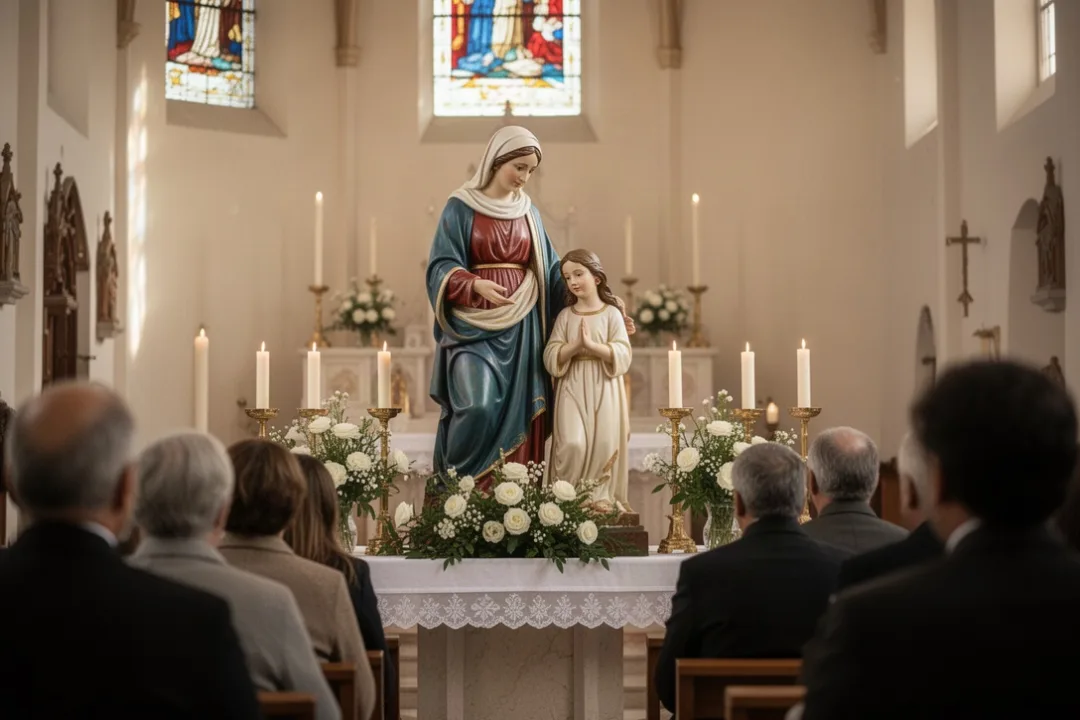
This tradition helps explain why Saint Anne is often shown teaching Mary. In many paintings and statues, Anne sits with a young Mary and points to a book, commonly understood as Scripture or religious instruction. The scene is symbolic: it expresses the passing of knowledge and faith from mother to daughter.
Christians should not treat such images as documentary evidence. They are visual theology rather than photographs of an event. The image communicates that Mary, like other human beings, received care and formation through a family, even though the Bible does not record those years in detail.
The relationship between Anne and Mary also gives dignity to hidden forms of service. A parent or grandparent may never receive public recognition, yet their patience and instruction can influence generations. Saint Anne’s place in devotion honors the people whose work is essential but often unseen.
How Saint Anne is represented in art
Artists portray Saint Anne in several recurring forms. The most familiar is Saint Anne teaching the Virgin Mary. Anne may hold a book while Mary stands or sits beside her. This image presents Anne as a teacher and Mary as a child receiving instruction.
Another common image shows Anne with Mary and the infant Jesus. This arrangement, sometimes called a family grouping, places three generations together. It emphasizes the connection between grandmother, mother, and child, while also directing attention toward Jesus as the center of Christian faith.
Saint Anne may also appear with Joachim, especially in scenes of their meeting, prayer, or the presentation of Mary. In some works, she is shown as an older woman, reflecting the tradition that Mary was born after a long period of childlessness. In others, her age is less pronounced and the focus is on dignity and maternal affection.
Common visual elements include a book, a lily, a doorway, or a temple setting. Their meanings can vary. A book may represent instruction and sacred learning; a lily may suggest purity; a doorway may symbolize a transition into a new stage of life. Not every object has a fixed meaning in every artwork.
Saint Anne’s feast days and religious observance
In the Roman Catholic Church, Saint Anne is celebrated together with Saint Joachim on July 26. The shared feast reflects their place as Mary’s parents. The date and liturgical customs can differ among Christian traditions, especially in Eastern churches, where Anne has her own commemorations within a different calendar and worshiping tradition.
A parish may mark the feast with Mass, a novena, a procession, a blessing for grandparents, or a community celebration. Some churches dedicated to Saint Anne hold special services for mothers and families. Local customs vary, so checking a parish calendar is more reliable than assuming every church observes the day in the same way.
You can observe the feast simply at home. Read a Gospel passage about Mary, pray for relatives, write to a grandparent, or share a meal that includes older and younger family members. The purpose is not to create an elaborate ceremony. It is to make room for gratitude, remembrance, and prayer for family relationships.
Set aside a few quiet minutes to thank God for people who shaped your faith.
Pray for grandparents, parents, children, and relatives facing hardship.
Share one family story that teaches courage, compassion, or trust.
Contact an older relative or someone who may be isolated.
Choose one practical act of care to carry into the following week.
What Saint Anne is the patron saint of
Saint Anne is traditionally invoked as the patron saint of mothers, grandmothers, women in labor, married couples, and families. She is also associated in various places with widows, homemakers, educators, miners, carpenters, and people seeking a spouse. Patronages can vary according to local history and custom.
Her connection with childbirth and motherhood comes from the traditional account of Mary’s birth. Her connection with grandparents follows from the belief that she was the grandmother of Jesus. Her association with education arises especially from artistic images of Anne teaching Mary.
Some occupations and locations claim Saint Anne as a patron because of a local church, guild, legend, or historical devotion. These associations should be understood as regional expressions of faith, not as a complete universal list recognized in exactly the same way by every Christian community.
People may ask Saint Anne’s intercession for many reasons:
Support during pregnancy, childbirth, or adoption.
Wisdom in parenting or grandparenting.
Healing of strained relationships within a family.
Strength for those grieving a child or facing infertility.
Guidance for young people making important decisions.
Companionship for older adults who feel forgotten or alone.
Intercession means asking a saint to pray with and for you; it does not mean treating the saint as a god. In Catholic and Orthodox practice, saints are honored as members of the Christian community who direct attention toward God. Christians from traditions that do not pray to saints may still study Anne as a figure of historical devotion and family faith.
Practical ways to honor Saint Anne without common mistakes
Devotion to Saint Anne can be sincere and simple, but it helps to avoid confusing tradition with Scripture or reducing a saint to a wish-granting figure. The following practices keep the focus on prayer, character, and family care.
Read carefully: Remember that Anne’s name and biography come from Christian tradition, not from a detailed biblical account.
Use accurate language: Say “tradition holds” or “Christians have long believed” when discussing details that cannot be verified from Scripture.
Pray for more than an outcome: Ask for patience, wisdom, courage, and compassion, not only for a specific result.
Include real action: Pair prayer with a phone call, visit, apology, meal, or practical help.
Respect different traditions: Catholic, Orthodox, and Protestant communities may understand the authority of Saint Anne’s story differently.
Do not make promises to God: A devotional practice should not become a bargain in which you expect a guaranteed favor.
Seek professional care when needed: Prayer can accompany medical, emotional, legal, or family counseling, but it should not replace appropriate help.
A common mistake is to assume that every story connected with Saint Anne has equal historical status. The Protoevangelium of James is an early and influential source, but it is not one of the canonical Gospels. Later legends may carry devotional meaning while still lacking reliable evidence.
For a balanced practice: Let Saint Anne’s traditional story lead you toward God, family responsibility, and compassionate action. Keep historical uncertainty separate from the genuine spiritual value the tradition may hold for you.
Prayers and devotions connected with Saint Anne
There is no single prayer that every Christian must use when honoring Saint Anne. A person may speak in ordinary language, use a parish prayer, pray a novena, or simply sit quietly and remember family members before God. The essential elements are honesty, trust, and attention to the needs of others.
A short personal prayer might ask God to give you Anne’s patience in family difficulties, wisdom in caring for others, and courage to remain faithful during a period of waiting. You could also ask Saint Anne to pray for a particular relative, while keeping the request directed ultimately toward God’s care and mercy.
A novena is a devotional practice involving prayer over nine days. People may use a published Saint Anne novena or create a simple pattern of prayer, reflection, and action. If you create your own, choose one family concern, a short period of silence, and one concrete act of kindness each day.
Families can also honor Saint Anne through a shared prayer at mealtime. Each person might name someone who needs support, share one reason for gratitude, or tell a story about a grandparent. Such practices make devotion accessible to children and connect religious observance with everyday family life.
Saint Anne in churches, communities, and family names
Churches dedicated to Saint Anne can be found in many countries and communities. A parish may take her name because of a local foundation, an immigrant population’s devotion, a religious order, or a long-standing connection with mothers and families. The name “Saint Anne” may also appear in schools, hospitals, shrines, towns, and charitable organizations.
Many people are named Anne, Anna, Ann, or a related form in honor of her or another saint with a similar name. A name alone does not prove a specific devotional connection, but family naming traditions often preserve memory across generations. A person named Anne may choose Saint Anne as a patron and celebrate July 26 with relatives.
Community celebrations can include food, music, religious services, fundraising, and acts of charity. The strongest celebrations usually connect festivity with service. Visiting the homebound, supporting new parents, helping a family in crisis, or preserving local history can express Saint Anne’s patronage more fully than decoration alone.
What Saint Anne can teach about hidden faithfulness
Saint Anne’s traditional story does not focus on public power or dramatic leadership. It presents a person whose importance is connected to faith lived within the family. That emphasis makes her relevant to anyone whose most meaningful work happens in private: raising children, caring for relatives, teaching, listening, or remaining present during a long period of uncertainty.
Her story also invites a more mature understanding of hope. Hope is not a guarantee that every desired outcome will occur. It can mean continuing to love, pray, and act responsibly when the future remains unclear. For people facing infertility, illness, grief, or family conflict, that distinction can make devotion more compassionate and less simplistic.
Remembering Saint Anne can also encourage respect for older adults. Grandparents are often treated as family support without receiving enough companionship or appreciation. A Saint Anne observance can become an opportunity to ask older relatives about their experiences, preserve their stories, and recognize the care they have given.
For children, Saint Anne offers an accessible picture of faith learned through relationship. A child may understand that religious life is shaped not only by formal lessons but also by the adults who model forgiveness, responsibility, prayer, and kindness. That lesson remains valuable even for families whose devotional practices are modest.
How to approach Saint Anne with historical and spiritual balance
Saint Anne occupies a distinctive place between biblical history and later Christian memory. The New Testament does not provide a biography of Mary’s mother, yet Christian communities have honored Anne for centuries. Holding both facts together allows you to appreciate her significance without claiming evidence that the sources do not provide.
Her story is most useful when it leads to deeper gratitude, stronger family bonds, patient service, and sincere prayer. You do not need to accept every later legend to find value in the tradition. You can honor the saint while acknowledging that some details belong to devotional literature rather than established history.
Whether you encounter Saint Anne in a church, a family heirloom, a work of art, or a feast-day prayer, her central image remains clear: a mother and grandmother remembered for the faith surrounding Mary’s early life. That memory continues to speak to people who believe that ordinary love and steady care can shape lives far beyond what anyone sees.
Frequently asked questions
Is Saint Anne mentioned in the Bible?
No. The Bible does not name Mary’s parents or describe Saint Anne’s life. Her name, marriage to Joachim, and the traditional account of Mary’s birth come from early Christian writings and later tradition. Christians may honor her as Mary’s mother while recognizing that these details are not part of the canonical biblical text.
When is Saint Anne’s feast day?
In the Roman Catholic Church, Saint Anne and Saint Joachim are celebrated together on July 26. Eastern Christian traditions use different calendars and may commemorate Saint Anne on other dates. Local parishes can also hold additional devotions, novenas, or community celebrations connected with her feast.
What do people pray to Saint Anne for?
People traditionally ask Saint Anne’s intercession for families, mothers, grandparents, pregnancy, childbirth, marriage, parenting, and guidance in difficult family situations. Some also turn to her during times of waiting, grief, infertility, or strained relationships. The prayer is understood as asking her to pray with them to God.
What is Saint Anne’s connection to Mary?
Christian tradition identifies Saint Anne as Mary’s mother and Saint Joachim as Mary’s father. The Bible does not provide details about Mary’s childhood, so stories about Anne teaching or raising her come from later Christian sources and artistic tradition. These accounts emphasize family formation, faith, and the influence of parents.











Leave a Reply