Saint Sebastian is traditionally remembered as a Christian martyr who served as a Roman soldier and died during the persecution of Christians under Emperor Diocletian. His feast day is celebrated on January 20, and he is especially known as a patron of archers, soldiers, athletes, plague victims, and people seeking protection from contagious disease.
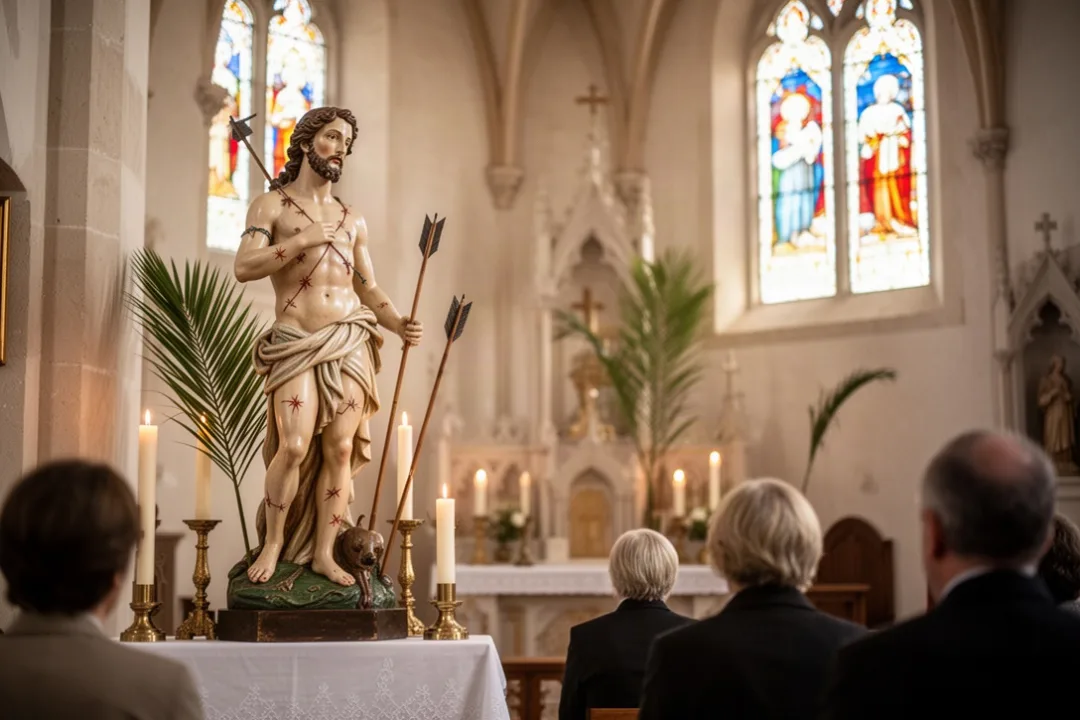
Artists usually portray him tied to a tree or column and pierced by arrows. That image represents an early attempt to kill him, not the whole story of his martyrdom: according to Christian tradition, Sebastian survived the arrows, confronted the emperor again, and was then beaten to death.
Who Saint Sebastian was according to Christian tradition
The surviving accounts of Sebastian come primarily from later Christian tradition rather than from contemporary Roman records. The oldest widely known written account is associated with Saint Ambrose of Milan, who referred to Sebastian in a sermon connected with the church community at Milan. Later biographies added more narrative details, and those accounts shaped the way Christians have remembered him.
Tradition places Sebastian’s birth in Narbonne, in Gaul, although he was raised in Milan. He eventually entered the Roman army. Some accounts say he became an officer in the imperial guard, a position that gave him access to the emperor and allowed him to encourage imprisoned Christians without immediately revealing his faith.
His military service creates a central feature of his story. Sebastian is remembered not as someone who rejected every connection with Roman public life, but as a Christian who used his position to support people facing persecution. The tradition says he visited Christians in prison, strengthened them spiritually, and helped them remain faithful under pressure.
These details should be read as part of a long devotional tradition rather than treated as independently verified biographical facts. The basic picture remains consistent: Sebastian was honored as a martyr, and his courage became more significant than the precise details of his military rank or birthplace.
Why Emperor Diocletian condemned Saint Sebastian
During the reign of Diocletian, the Roman Empire experienced periods of severe persecution against Christians. Imperial policy demanded public religious conformity, and Christians who refused certain sacrifices or acts of worship could face imprisonment, torture, exile, or execution. The intensity of persecution varied by place and time, but the early fourth century became one of the most dangerous periods for Christian communities.
According to the traditional account, Sebastian secretly supported Christians while holding a position close to the emperor. His actions were eventually discovered. Diocletian is said to have ordered Sebastian’s execution after learning that the soldier was a Christian and had encouraged others to remain loyal to their faith.
The story highlights a conflict between public authority and religious conscience. Sebastian’s military role could not protect him once his beliefs became known. His willingness to face punishment rather than deny those beliefs became the foundation of his reputation as a courageous witness.
Historical caution: Details about Sebastian’s rank, birthplace, and exact death are drawn from traditional accounts that developed over time. The Church’s devotion to him rests on his enduring reputation as a martyr, while individual biographical details may not be equally certain.
How Saint Sebastian survived the arrows
The best-known episode says that Sebastian was tied to a tree or column and shot with arrows by Roman soldiers. The attackers apparently believed he was dead and left him there. A Christian woman traditionally identified as Saint Irene of Rome found him, cared for his wounds, and helped him recover.
After regaining his strength, Sebastian did not flee the city permanently. Instead, the story says that he confronted Diocletian and openly criticized the persecution of Christians. The emperor then ordered a second execution, this time by beating. Sebastian’s body was thrown into a sewer or public drainage area, but another Christian, traditionally named Lucina, recovered and buried it.
This two-stage martyrdom explains why Sebastian’s image can seem unusual. The arrows are an important symbol, but they did not kill him in the traditional story. His survival turns the first attack into a sign of resilience, healing, and continued witness, while his later death establishes him as a martyr.
The account of Saint Irene also influenced Sebastian’s association with care for the sick. She is traditionally portrayed as a woman who treated a wounded prisoner with compassion. Although the details belong to hagiographic tradition, the episode gives the story a human dimension: Sebastian’s survival depended not only on courage but also on practical mercy from another believer.
Arrows are Sebastian’s most recognizable attribute. They make the violence of persecution visible, but their meaning is not limited to physical suffering. In religious art, the arrows can represent the many kinds of pain that people endure: illness, injustice, fear, public hostility, and threats against conscience.
Artists often show Sebastian standing upright, tied to a tree, with his body pierced but his expression calm. This pose does not necessarily suggest that he felt no pain. Instead, it communicates steadfastness under suffering. His body is vulnerable, yet the image presents his faith as unbroken.
Some paintings show only a few arrows, while others depict many. The number is generally artistic rather than a reliable historical detail. The tree, column, rope, and arrows function as visual symbols that help viewers recognize Sebastian and reflect on martyrdom.
Renaissance artists frequently represented Sebastian as a young, athletic male figure. This style reflects the artistic conventions of the period, including interest in the human body and classical proportions. It should not be taken as a precise portrait. No authenticated contemporary image of Sebastian is known to survive.
In some works, Sebastian looks upward toward heaven; in others, he appears absorbed in prayer or endurance. These differences guide the viewer toward related themes:
Faithfulness: remaining committed despite threats or punishment.
Healing: surviving injury and receiving care after violence.
Protection: seeking help during war, illness, or danger.
Witness: publicly standing for Christian belief when silence would be safer.
When Saint Sebastian’s feast day is celebrated
Saint Sebastian’s feast day is observed on January 20 in the Roman Catholic calendar. Churches and communities may mark the day with Mass, a procession, a devotional service, or a local festival. Customs vary widely because Sebastian became important in many regions, each adding its own expressions of devotion.
January 20 is also associated with Saint Fabian in the Roman Catholic calendar. Their shared feast day reflects an ancient liturgical pairing rather than a claim that they lived or died together. In some places, Sebastian receives the greater public attention because of his powerful image and his connection with protection from disease.
People may honor him by attending worship, lighting a candle, displaying an image, or praying for the sick and those exposed to danger. A feast day is not simply a historical anniversary. It gives a community a recurring opportunity to remember a saint’s example and connect it with present concerns.
Local celebrations can include blessings of homes, animals, crops, or community spaces, depending on regional custom. Such practices are not universal requirements. They are expressions of popular devotion that developed around Sebastian’s reputation as a protector.
What Saint Sebastian is the patron saint of
Saint Sebastian has a broad range of patronages. The most familiar include archers, soldiers, athletes, and victims of plague. These associations developed from different parts of his story and from the needs of communities that sought his intercession.
His connection with archers comes directly from the traditional arrow martyrdom. Archers’ guilds and military groups adopted him because arrows are the defining instruments in his story. His military service accounts for his patronage of soldiers, while his athletic appearance and reputation for physical endurance helped make him popular among athletes.
The association with plague became especially strong during epidemics in Europe. People sometimes believed that disease could spread through invisible arrows sent by divine judgment, drawing a symbolic connection between plague and the arrows shown in Sebastian’s body. Communities therefore prayed to him for protection, healing, or relief during outbreaks.
His patronage can include other groups and places as well. Depending on local tradition, he may be invoked by police officers, public safety workers, people suffering from contagious illnesses, and communities facing natural or social threats. These customs are not identical everywhere.
It helps to distinguish between official universal patronage and local devotional practice. A saint may be widely associated with a group without every association having the same formal status in every church or country. Local history often explains why a particular town, profession, or organization claims Sebastian as its protector.
Why Saint Sebastian became associated with plague protection
Sebastian’s connection with plague protection grew from a combination of visual symbolism, medieval religious practice, and local experience. The image of a body pierced by arrows resembled the way people imagined sudden illness entering a population. Since the plague could strike quickly and without an obvious cause, Sebastian’s own experience of being attacked from a distance offered a powerful visual parallel.
One famous tradition connects Sebastian with a plague outbreak in Pavia, Italy, where a church was reportedly dedicated to him after the disease ended. The details of the event and its dating are treated differently by historical sources, so the tradition should not be used as a precise medical or chronological record. It does show how communities connected Sebastian with deliverance from epidemic disease.
Praying to a patron saint during illness has a spiritual purpose, but it does not replace medical treatment. During any outbreak or personal health crisis, people should follow guidance from qualified health professionals and public health authorities. Devotion and practical care can coexist; one should not be presented as a substitute for the other.
For modern health concerns: Saint Sebastian’s patronage may provide spiritual comfort, but symptoms, exposure risks, and contagious diseases require appropriate medical advice, testing, treatment, and prevention measures.
Where Saint Sebastian appears in Christian art
Images of Sebastian appear in paintings, sculptures, stained glass, mosaics, devotional prints, and church decorations. The most common composition shows him tied to a tree or column, often wearing a simple cloth and pierced by arrows. Other works show him as a Roman soldier, standing beside weapons or wearing military clothing.
Some artists depict the moment when Irene discovers Sebastian alive. This scene shifts attention from punishment to compassionate care. It may include bandages, a kneeling helper, or a quiet interior, contrasting with the open violence of the arrow scene.
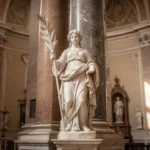
Another type of image shows Sebastian after death, sometimes with a palm branch. In Christian art, a palm branch commonly represents martyrdom and victory through faithful endurance. Its presence helps identify Sebastian as a martyr even when the arrows are not prominent.
The saint’s artistic popularity was particularly strong in Italy and throughout Europe. Renaissance and Baroque artists used his story to explore anatomy, movement, emotional restraint, and dramatic light. Churches also valued his image because it offered a recognizable focus for prayers during epidemics and other communal crises.
When you see a figure pierced by arrows in a Christian church, several clues can help identify him as Sebastian: a young male figure, a tree or column, a Roman setting, a martyr’s palm, or a nearby inscription. Not every image includes all of these features, and some depictions are stylized enough that identification requires local context.
How Saint Sebastian’s story can be understood today
Sebastian’s story continues to speak to people because it combines several concerns that remain familiar: pressure from authorities, care for prisoners, recovery from serious injury, fear of disease, and the difficult choice to act according to conscience. His example is not limited to the dramatic moment of martyrdom. It also includes the less visible work of encouraging others and receiving help.
For Christians, Sebastian may represent the duty to support people who are vulnerable or isolated. His traditional ministry to imprisoned believers can prompt reflection on how communities treat prisoners, migrants, the sick, and anyone whose voice is easily ignored.
His survival after the arrows also gives the story a different shape from accounts in which a martyr dies immediately. Sebastian is portrayed as someone who receives care, heals, and then chooses to continue his witness. That combination can be meaningful for people recovering from violence, illness, or persecution.
At the same time, his story should not be used to romanticize suffering. Christian devotion to a martyr does not require seeking danger or refusing reasonable protection. The practical lesson is better expressed through courage joined with wisdom: protect life, care for the injured, and remain faithful to conscience without treating harm as desirable.
Practical ways to honor Saint Sebastian and avoid common mistakes
People honor Sebastian in different ways, depending on their church tradition and personal practice. A meaningful observance does not need elaborate decorations or a large public event. It can focus on prayer, service, learning, or support for people facing illness and danger.
Attend a January 20 service or visit a church that keeps a memorial of Sebastian.
Pray for people who are sick, persecuted, imprisoned, or working in dangerous conditions.
Support a local health, emergency-response, veterans’, or community-care organization.
Study a painting or statue of Sebastian and consider how its symbols communicate courage and healing.
Ask a parish leader about local customs before assuming that a regional practice is universal.
A few common mistakes can lead to confusion. Sebastian’s image is familiar, but familiarity does not guarantee accuracy. Keep these points in mind:
Do not say the arrows killed him if you are describing the traditional account; the story says he survived the first attack and died later.
Do not treat every biography detail as verified history. Many dates, titles, and dramatic scenes come from later hagiography.
Do not confuse the saint with another Sebastian. Christian history includes other people with the same name, including Saint Sebastian of Aparicio, a much later figure.
Do not present prayer as medical treatment. Seek professional care for illness or suspected infection.
Do not assume every Christian community observes him in the same way. Calendar dates, titles, and public customs differ among traditions and regions.
If you are choosing an image of Sebastian for a church, home, classroom, or organization, identify the purpose first. A small devotional image may emphasize prayer and protection, while a historical display may need a caption explaining that the biography comes from tradition. Clear labeling prevents viewers from mistaking symbolic art for a contemporary portrait.
How to pray with Saint Sebastian’s example
Devotion to a saint generally means asking for intercession and reflecting on the saint’s example, not treating the saint as a divine power. A prayer connected with Sebastian may ask for strength in adversity, healing for the sick, protection for communities, or courage to defend people who are mistreated.
You can keep the practice simple. Begin by naming the person or situation that concerns you. Then ask for help through Sebastian’s intercession, remember the people who have cared for others under pressure, and identify one practical act of support you can offer.
A short prayer might ask God to grant steadfast faith, wise courage, and compassionate action through the intercession of Saint Sebastian. Christians from different traditions may use formal prayers, spontaneous words, or silent reflection. The form matters less than honesty, care for others, and respect for the beliefs of the community.
For someone who is sick, prayer can accompany treatment, rest, and support from family or friends. For someone facing injustice, devotion can accompany responsible advocacy and protection for those at risk. Sebastian’s traditional story points toward courage that serves other people rather than courage performed for its own sake.
What Saint Sebastian’s legacy means
Saint Sebastian’s legacy rests on a story of faith under persecution, recovery after violence, and care during crisis. The arrows explain his most recognizable image, but they do not define the whole saint. His tradition also remembers a soldier who encouraged prisoners, a wounded man who accepted help, and a martyr who continued to speak after surviving an attempted execution.
That combination explains his lasting popularity. Archers see their equipment in his story, soldiers recognize his military background, athletes identify with his physical endurance, and communities affected by disease remember his protective role. Different groups can approach the same figure through different needs without losing the central theme of faithful courage.
Whether encountered in a church statue, a feast-day procession, a Renaissance painting, or a private prayer, Sebastian invites reflection on how people respond to danger. His traditional example asks not only whether you can endure hardship, but also whether you will care for the wounded, support the vulnerable, and use your position to protect others.
Frequently asked questions
What is Saint Sebastian best known for?
Saint Sebastian is best known as a Christian martyr traditionally associated with the Roman army and the persecution of Christians under Diocletian. He is usually shown tied to a tree or column and pierced by arrows. According to tradition, he survived that attack, was cared for by Saint Irene, and was later killed after confronting the emperor again.
What is Saint Sebastian’s feast day?
Saint Sebastian’s feast day is January 20 in the Roman Catholic calendar. Churches and communities may mark it with Mass, prayer, processions, or local customs. The day is also associated with Saint Fabian in the Roman Catholic liturgical calendar, although the two saints are remembered for separate lives and traditions.
Why do people pray to Saint Sebastian during disease outbreaks?
Sebastian became associated with plague protection because his arrow-pierced body was linked symbolically with the belief that disease could strike like an invisible arrow. Medieval and early modern communities invoked him during epidemics. Today, prayer may offer spiritual comfort, but it should accompany—not replace—medical care and public health guidance.
Is Saint Sebastian the patron saint of athletes?
Yes. Saint Sebastian is widely regarded as a patron of athletes, along with archers, soldiers, and people affected by contagious disease. His athletic patronage developed partly from the way artists portrayed his strong, youthful body and partly from his reputation for endurance. The strength of this association can vary by country and local devotional tradition.












Leave a Reply