Saint Genevieve was a fifth-century Christian woman from Nanterre who became the patron saint of Paris. She is remembered for her prayer, courage, practical leadership, and care for people facing hunger and danger.
Her feast day is January 3. Catholics commonly ask for her intercession when seeking strength during a crisis, protection for a city or community, or faithfulness in ordinary responsibilities. Her story combines historical memory with longstanding traditions about the protection of Paris.
Genevieve was born around 422 in Nanterre, a settlement near Paris in Roman Gaul. The exact details of her early life are not known with certainty, but later accounts describe her as the daughter of Severus and Gerontia, members of a respectable Christian family.
Her life unfolded during a period of major change. The western Roman Empire was losing political control, towns were vulnerable to conflict, and Christian communities were developing new forms of leadership. Genevieve did not hold a military or political office, yet people came to rely on her spiritual judgment and practical determination.
According to her traditional biography, Bishop Germanus of Auxerre met Genevieve when she was still a child and recognized her religious seriousness. Around the age of fifteen, she received a form of consecration that committed her to a life of prayer and service while remaining among the people of her community.
That commitment did not remove her from daily life. She was associated with fasting, prayer, charitable work, and care for the poor. Accounts of her life portray her as someone who encouraged others to remain steady when fear or public criticism made that difficult.
Genevieve eventually became closely associated with Paris, then known as Lutetia. She likely spent much of her adult life there, helping to strengthen the Christian community and supporting people affected by shortages or political instability.
The central idea in her story: Saint Genevieve’s influence came less from formal power than from the trust she earned through prayer, courage, and concrete service to her neighbors.
The main written source about her life was composed after her death, and some episodes have the character of religious legend. That does not make her story meaningless, but it does mean that individual details should be read with care. The broad picture is clearer: Genevieve was an influential Christian woman whose memory became deeply connected with Paris.
How Saint Genevieve became the patron saint of Paris
Saint Genevieve is best known as the patron saint of Paris. Her connection with the city grew from traditions describing her role during two serious threats: the approach of Attila and the Huns in the mid-fifth century, and the later siege of Paris by Frankish forces associated with Childeric and Clovis.
The most famous episode concerns the year 451. As news spread that Attila’s army was moving through Gaul, some residents considered leaving Paris. Genevieve reportedly urged them not to abandon the city. She encouraged prayer, fasting, and trust rather than panic.
According to the traditional account, the people followed her direction, and the expected attack on Paris did not occur. Attila’s forces were defeated farther east in Gaul, at the Battle of the Catalaunian Plains. Modern historians treat the details of Genevieve’s speech and the exact sequence of events cautiously, but the story explains why she became remembered as a protector of the city.
Her protection was not understood only as a miraculous intervention. Genevieve’s example also shows how a community can respond to fear through shared discipline and mutual care. In later tradition, prayer was connected with practical action rather than used as a substitute for it.
Another important tradition says that Genevieve organized a river journey to obtain grain for Paris when food was scarce. Boats traveled along the Seine, and the group returned with supplies. The episode presents her as a leader who combined spiritual confidence with direct assistance for hungry people.
Genevieve was also associated with the defense of Paris during conflict with Childeric, the ruler of the Salian Franks, and later with the reign of his son Clovis. The historical details are difficult to separate from later storytelling. Still, these accounts consistently portray her as a trusted advocate for the city’s residents.
Prayer: She called people to fasting, worship, and perseverance during danger.
Courage: She spoke against panic when others believed escape was the only option.
Provision: She helped organize efforts to obtain food for people facing scarcity.
Community leadership: She used moral authority to unite people around shared responsibilities.
Over the centuries, Paris continued to turn to her memory during war, famine, disease, and public emergencies. Processions involving her relics became especially important when people prayed for protection. Her patronage therefore developed through a long relationship between a city and the woman it believed had defended it in a time of danger.
What Saint Genevieve represents in Christian devotion
Devotion to Saint Genevieve focuses on more than a single miracle story. She represents steadfast faith under pressure, especially when the future is uncertain and a person must serve others without knowing how events will unfold.
Prayer during public danger
Genevieve is often invoked for cities, families, neighborhoods, and other communities facing violence, disasters, disease, or severe disruption. Her story encourages people to pray for protection while also taking responsible steps to help those at risk.
For someone praying today, that might mean asking for wisdom for public officials, safety for emergency workers, food for displaced families, or courage for people who must remain in a difficult place. The devotion is not limited to Paris. Her example can be applied wherever people are trying to preserve peace and care for vulnerable neighbors.
Service to people in need
The stories about Genevieve repeatedly connect holiness with material acts of mercy. Food, shelter, encouragement, and organized assistance matter in her tradition. A person who honors her may therefore choose a practical response, such as donating groceries, checking on an isolated neighbor, or supporting a local relief organization.
This emphasis is especially meaningful because Genevieve’s reputation was not based on withdrawal from society. Her prayer was expressed through attention to real conditions around her. She is remembered as a woman who noticed public suffering and responded with the resources, influence, and courage available to her.
Faithful leadership without official status
Genevieve is also an example of lay Christian leadership. She was not remembered as a bishop or ruler. Her authority came from character, commitment, and the confidence of the people around her.
That aspect of her story can speak to parents, teachers, caregivers, volunteers, and community organizers. You do not need a public title to calm fear, encourage cooperation, or protect someone who is vulnerable. Her life suggests that consistent service can become a form of leadership.
Saint Genevieve is remembered not only for asking God to protect Paris, but for helping the people of Paris act with courage and compassion.
Her devotion also has a personal dimension. People may turn to her when they feel responsible for others, when a family is under stress, or when they need to remain patient during a prolonged difficulty. A prayer to Saint Genevieve can be as simple as asking for the strength to do the next necessary good thing.
Saint Genevieve’s feast day, symbols, and common prayers
The Roman Catholic Church observes Saint Genevieve’s feast day on January 3. The date is an opportunity to remember her life, celebrate Mass, pray for Paris and other communities, and renew a commitment to service. Local customs vary, and some churches may observe her with a special liturgy, devotional gathering, or procession.
Her feast comes shortly after Christmas, a season when Christian worship continues to emphasize the presence of Christ in human life. Genevieve’s example fits that setting because it directs attention toward faith expressed through generosity, courage, and care for people in need.
In religious art, Saint Genevieve is commonly shown with a candle. This symbol refers to traditions in which she remained prayerful through the night and to the idea of faith as a light during danger. She may also be portrayed with a shepherd’s crook, a book, or a church.
Another familiar image shows her holding a candle while a demon or unseen force tries to extinguish it. This scene comes from a legend about her perseverance in prayer. It should be understood as symbolic religious art rather than a historical photograph of an event.
Saint Genevieve may also appear with a medal or small cross, particularly in devotional settings. Images of her often emphasize modest clothing and a calm expression, reflecting the traditional view that her strength came from holiness rather than wealth or military power.
A prayer to Saint Genevieve does not need a fixed formula. You can address God directly and ask for Genevieve’s intercession. A prayer might include the following elements:
Name the people or community that needs help.
Ask for protection, wisdom, courage, and practical assistance.
Remember those who are poor, displaced, sick, or afraid.
Ask how you can contribute to the solution.
End with a commitment to act with patience and charity.
For example, you might pray: Saint Genevieve, faithful servant of God, pray for our city and for all who are in danger. Help us resist fear, care for those who suffer, and use our strength wisely. Ask God to give our leaders wisdom and our neighbors courage.
This wording is a devotional composition, not a required official prayer. Catholics may also use the Lord’s Prayer, a litany of saints, or a parish prayer approved for a particular feast. The most meaningful practice is one that joins honest prayer with responsible action.
A practical way to observe January 3: Pray for your community, learn about a local need, and make one concrete contribution such as a meal, donation, visit, or hour of volunteer service.
Relics, churches, and places connected with Saint Genevieve
Saint Genevieve’s memory is closely tied to several places in and around Paris. Nanterre, where she was born, remains associated with her early life. Paris became the center of her public legacy, and churches dedicated to her helped preserve that connection across centuries.
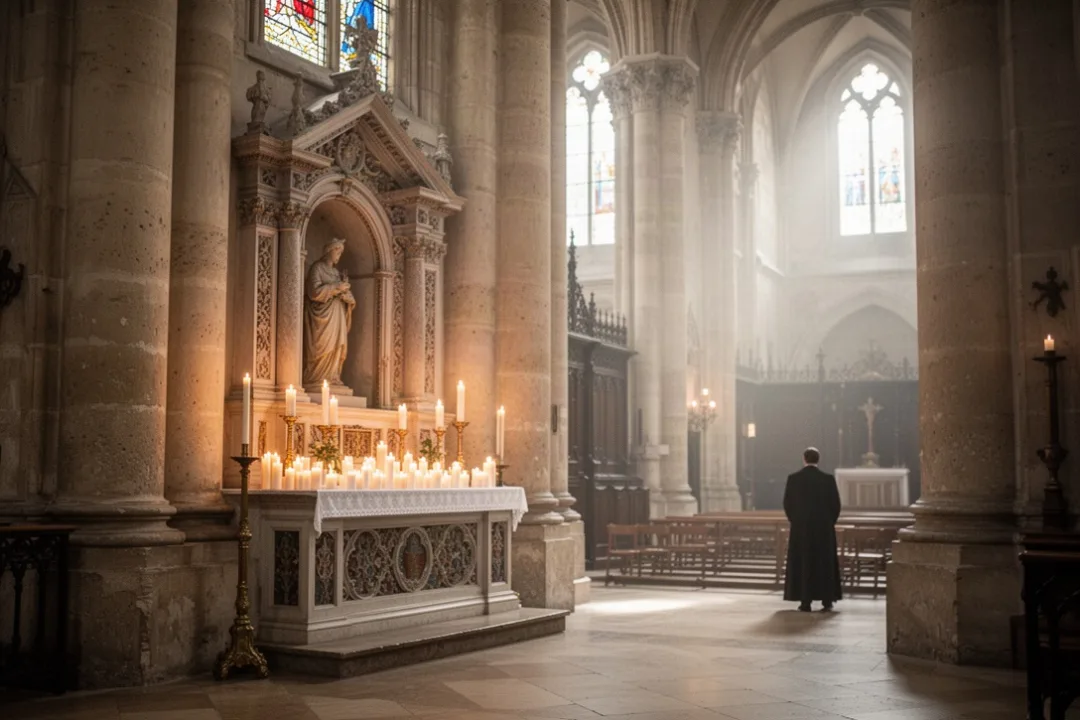
One of the most important sites is the church of Saint-Étienne-du-Mont in Paris. The church is associated with a shrine containing relics connected with Saint Genevieve. Visitors may also see artistic and architectural reminders of her role as the city’s patroness.
The history of her relics has been complicated. During the French Revolution, her principal shrine was disrupted and her relics were burned in a public act. Some remains were preserved, and later generations continued to honor them. Because relic histories can involve partial remains, transfers, and differing traditions, specific claims should be checked with the church or shrine responsible for them.
Before the Revolution, the Abbey of Sainte-Geneviève was one of the major religious institutions associated with her. The abbey was suppressed, and its buildings were largely removed or repurposed. The church now known as the Panthéon stands on the former site of the abbey church, linking modern Paris with the older religious history of the area.
The church of Saint-Étienne-du-Mont also has a wider historical significance. It stands near the Panthéon in the Latin Quarter and contains memorials and works of art associated with Parisian religious life. For visitors interested in Genevieve, the site offers a way to encounter both her devotion and the changing history of the city.
There are also churches and communities dedicated to Saint Genevieve outside France. The name appears in parishes, schools, religious institutions, and towns around the world. Some locations carry the name because French settlers or missionaries brought devotion to her with them.
One example is Ste. Genevieve, Missouri, a historic town founded by French settlers along the Mississippi River. Its name honors Saint Genevieve, although the town’s history should not be confused with the saint’s own life in fifth-century Gaul. The community reflects the way devotion to a patron saint can travel across languages, regions, and generations.
When visiting a church connected with Saint Genevieve, respectful questions can help clarify what you are seeing. Ask whether a displayed object is a relic, a reliquary, an image, or a later artistic representation. Churches may also provide information about feast-day services, processions, and the history of their devotion.
How to learn from Saint Genevieve today
Saint Genevieve’s story remains relevant because it addresses familiar human pressures: fear of invasion, scarcity, public uncertainty, and the responsibility to protect other people. Her response was neither passive nor reckless. She prayed, encouraged others, organized help, and accepted the burden of being trusted.
You can apply that pattern to ordinary circumstances. When a community experiences a crisis, begin by identifying what people actually need. A calm conversation, reliable information, transportation, food, childcare, or a safe place to stay may be more useful than a dramatic gesture.
Her example also offers guidance for private struggles. If you are caring for a sick relative, supporting someone through grief, or carrying responsibility at work, her story can encourage patient endurance without isolation. Prayer can help you remain grounded, while asking for assistance can make service sustainable.
For families: Set aside a few minutes on January 3 to pray for relatives and neighbors.
For parishes: Hold a service focused on protection, mercy, and care for the local community.
For students: Study how late Roman Gaul changed and how Christian communities responded.
For visitors to Paris: Explore Nanterre and Saint-Étienne-du-Mont with attention to both devotion and history.
For anyone facing fear: Ask what constructive action can accompany your prayer.
It is also helpful to distinguish between what is historically secure and what belongs to devotional tradition. Genevieve’s existence, her association with Nanterre and Paris, her consecrated life, and her long-standing reputation as Paris’s patron are central to her story. Specific speeches, miracles, and dramatic scenes may come through later accounts that express how communities understood her holiness.
That distinction does not weaken her significance. Saints are remembered not only through documents but through the practices, prayers, places, and works of mercy that continue after their deaths. Saint Genevieve’s legacy survives because generations of people have seen in her a model of faithful courage joined to public service.
For many people, the simplest way to honor her is to pray for the place where they live and then help someone nearby. That response reflects the heart of her tradition: seek God’s help, resist fear, and become part of the protection and care your community needs.
Frequently asked questions
What is Saint Genevieve the patron saint of?
Saint Genevieve is the principal patron saint of Paris. She is also invoked more broadly for protection during public danger, famine, illness, war, and other community crises. Because her traditional story emphasizes prayer combined with practical help, people may also seek her intercession when they need courage to care for vulnerable neighbors or remain faithful during prolonged hardship.
When is Saint Genevieve’s feast day?
Saint Genevieve’s feast day is January 3 in the Roman Catholic calendar. Churches may mark the day with Mass, devotional prayers, charitable activities, or local observances. Customs differ by parish and country, so the schedule for a particular celebration should be confirmed with the church or religious community hosting it.
Why is Saint Genevieve shown holding a candle?
The candle recalls traditional stories about Genevieve’s steadfast prayer and perseverance, including an account in which a candle’s flame was threatened but she continued praying. In Christian art, the image also symbolizes faith and hope remaining alive during danger. It is devotional symbolism rather than a universally verified historical scene.
Is Saint Genevieve connected to the town of Ste. Genevieve, Missouri?
Yes. Ste. Genevieve, Missouri, was named for Saint Genevieve by French settlers. The town’s name reflects devotion to the patron saint of Paris, but the community itself developed many centuries after Genevieve lived. Its local history belongs to French colonial America and should be distinguished from the saint’s fifth-century life in Gaul.
















Leave a Reply