Saint Adjutor was a Norman knight and later a hermit associated with Vernon in northern France. He is traditionally honored on April 30 and remembered as a patron of swimmers, boatmen, sailors, and people in danger of drowning.
Most accounts of his life combine historical tradition with stories of miraculous rescue. Adjutor is said to have taken part in the First Crusade, endured captivity, returned to Normandy, and spent his final years in prayer and solitude near the Seine.
Saint Adjutor is generally identified as Adjutor of Vernon, a medieval Christian from Normandy. Vernon lies along the Seine River in what is now the French department of Eure, a location that helps explain the saint’s lasting connection with water and river communities.
His name appears in several forms, including Adjutor, Adjutore, and French variants related to the same name. Older records and local traditions do not always agree on every detail, so accounts of his life should be read with some care. The broad outline remains consistent: he was associated with a noble or military family, became a crusader, returned from captivity, and eventually chose a life of religious withdrawal.
Medieval saints’ biographies often preserve spiritual meaning through memorable stories rather than modern-style documentation. In Adjutor’s case, the central themes are deliverance from danger, trust in God during captivity, and a deliberate turning away from worldly status. His story moves from the life of a warrior to the quiet discipline of a hermit.
Local devotion kept his memory alive in Normandy. Churches, chapels, place names, and oral traditions helped connect him with Vernon and the nearby river landscape. The saint’s reputation also traveled through communities whose daily work depended on safe passage across water.
At a glance: Saint Adjutor is traditionally associated with Vernon, the First Crusade, miraculous escape from captivity, hermit life, and protection from drowning. His feast day is commonly observed on April 30.
Saint Adjutor’s connection with the First Crusade
According to tradition, Adjutor joined the First Crusade, the military pilgrimage launched at the end of the 11th century after Pope Urban II called Western European Christians to aid the Byzantine Empire and seek control of Jerusalem. Accounts place him among the Norman participants who traveled east as a knight.
The crusading movement involved soldiers, nobles, clergy, pilgrims, and support personnel from many regions. A man such as Adjutor would have left behind his family, property, and social position for a dangerous expedition that involved long travel, disease, hunger, combat, and uncertain conditions.
Specific details about his role are difficult to verify. Later biographies sometimes describe him as a nobleman or military leader, but these descriptions may reflect devotional tradition rather than surviving contemporary evidence. The important point in the tradition is that Adjutor was not originally known as a secluded religious figure. He first belonged to the world of warfare and public duty.
His crusading experience becomes the turning point in his story. Rather than presenting victory or military honor as the final goal, the tradition emphasizes the suffering he encountered and the spiritual change that followed. Captivity, in particular, is portrayed as a trial that redirected his life.
Stories about Adjutor’s captivity vary in their details. He is said to have been taken prisoner during the crusading expedition and held under difficult conditions. In some versions, he was bound with chains or otherwise prevented from escaping.
His release is presented as an act of divine assistance. Tradition says that Adjutor prayed for help and was freed in a miraculous way, sometimes through the intervention of the Virgin Mary. The exact form of the miracle differs among retellings, but the message is consistent: physical captivity did not defeat his faith.
These stories should not be treated as a complete historical record of the crusade. They belong to the devotional memory surrounding the saint. Their purpose is to show courage under pressure and the belief that a person can be rescued from circumstances that seem impossible to escape.
After regaining his freedom, Adjutor is said to have made his way back to Normandy. The return journey itself would have been arduous, and the tradition treats his arrival home as a second kind of deliverance. He came back not simply as a surviving soldier, but as someone ready to reconsider the direction of his life.
Why Saint Adjutor became associated with water and drowning
Saint Adjutor’s patronage is closely tied to water rescue. He is invoked by swimmers, boatmen, sailors, fishermen, and people who fear drowning. This association may reflect both the geography of Vernon and the stories told about his return from the crusade.
One tradition says that Adjutor escaped or returned by water and that he used a miraculous sign to calm or control the river. Other accounts connect him with a dramatic incident involving the Seine. The details are not uniform, but the river is central to the saint’s local identity.
Vernon’s position on the Seine made the river part of everyday life. It served as a route for commerce and travel, while also presenting serious risks. Strong currents, changing water levels, storms, poorly built boats, and limited rescue equipment could turn an ordinary crossing into a life-threatening event.
For communities living beside the river, asking for a saint’s protection was not an abstract custom. It expressed concern for relatives who worked on the water, children learning to swim, travelers crossing by boat, and anyone caught in an accident. Saint Adjutor became a natural spiritual protector for those situations.
Swimmers may ask for his intercession before entering unfamiliar or dangerous water.
Boatmen and sailors may honor him as a guardian during river or sea travel.
Families may pray for relatives whose work involves water.
Rescue workers and caregivers may remember him when helping people in danger.
People recovering from frightening accidents may turn to his story as a sign of deliverance and renewed purpose.
His patronage does not replace practical safety. Life jackets, supervision, weather awareness, swimming instruction, and emergency training remain essential. Prayer and devotion can accompany responsible action, but they should never be used as a reason to ignore physical danger.
Safety first: Invoking Saint Adjutor can be meaningful for someone facing danger on the water, but spiritual practice belongs alongside swimming skills, proper equipment, supervision, and emergency procedures.
Adjutor’s life as a hermit near Vernon
After returning to Normandy, Adjutor is traditionally said to have renounced the privileges of his former life. He withdrew from military activity and chose solitude, prayer, and penance. This change reflects a familiar pattern in medieval Christian biographies: a person shaped by public achievement turns toward a hidden life devoted to God.
Adjutor’s retreat was associated with the area around Vernon and the Seine. Some local traditions place him near a wooded or rocky location where he lived as a hermit. The setting matters because it links his inner transformation with the same river landscape that later shaped his patronage.
A hermit’s life was not simply time spent alone. It usually involved regular prayer, fasting, manual work, and the discipline of resisting distractions. Hermits might also receive visitors who came for counsel or spiritual guidance. Although separated from ordinary society, they were often remembered as people who served others through prayer and wisdom.
For Adjutor, the move from knight to hermit can be understood as a response to the experiences of war and captivity. The tradition does not portray him as escaping responsibility. Instead, it presents him as recognizing that his deepest calling had changed.
This part of the story gives his devotion a broader meaning. A person’s identity need not remain fixed by past choices, social rank, or public reputation. Adjutor’s life is remembered as a movement from force to surrender, from worldly danger to spiritual discipline, and from military action to intercessory prayer.
The place connected with his memory
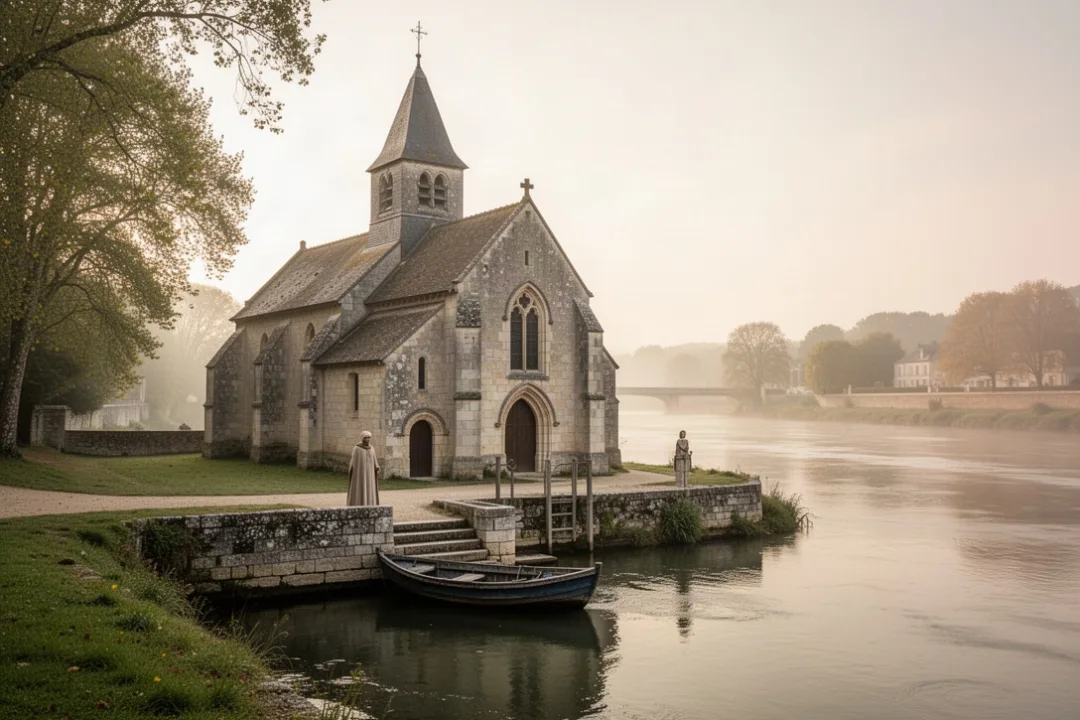
Local devotion has linked Saint Adjutor with a chapel or religious site in the Vernon area. The exact history of buildings dedicated to him can be difficult to separate from later restorations, changes in ownership, and regional traditions. Still, the continued presence of his name shows how strongly the saint remained part of local religious identity.
Places associated with a hermit often become destinations for prayer because visitors want to connect a physical landscape with the saint’s choices. A riverbank, wooded retreat, chapel, or spring can make an old story feel immediate. These locations also preserve memories that may not survive in written records alone.
When visiting a site associated with Adjutor, it is helpful to distinguish between documented history and devotional tradition. Both can matter, but they answer different questions. Historical evidence asks what can be established from records; devotion asks what a community has received, practiced, and handed on over time.
Saint Adjutor’s feast day and symbols
The feast day commonly assigned to Saint Adjutor is April 30. Feast days provide an annual opportunity to remember a saint’s life, ask for intercession, and connect personal prayer with the wider Christian community.
Observance can be simple. A person may attend Mass, say a prayer for people who work or travel on the water, visit a church dedicated to the saint, or spend time reflecting on the changes in Adjutor’s life. In a family setting, his feast day can also be a chance to discuss water safety and responsibility.
Artistic representations of Saint Adjutor often draw on the major episodes associated with him. He may be shown as a knight, recalling his crusading past, or as a hermit, representing his later vocation. Water, a boat, chains, or a crucifix may appear as symbolic reminders of his captivity, escape, and patronage.
There is no single universally fixed set of symbols for every image of Adjutor. Local churches and artists may emphasize different aspects of his story. One image may focus on the young warrior; another may present the elderly hermit; a third may place him beside the river that shaped his reputation.
Read or listen to a reliable account of Adjutor’s traditional life.
Pray for people who face danger on rivers, lakes, or oceans.
Remember those who have drowned and the families who grieve them.
Review practical water-safety habits with children or companions.
Ask how courage, humility, and service might shape your own choices.
A prayer to Saint Adjutor can be written in ordinary language. You might ask for protection, wise judgment, courage in an emergency, comfort after loss, or strength to change direction after a painful experience. The tradition does not require elaborate words; sincere prayer is enough.
Saint Adjutor’s story continues to speak to people because it includes several recognizable human experiences: danger, captivity, homecoming, regret, change, and the search for a meaningful life. His legend is not limited to crusading history or regional French devotion.
For someone who works on the water, Adjutor can represent a spiritual companion in a hazardous occupation. For someone recovering from trauma, his return from captivity can symbolize survival without pretending that suffering was insignificant. For someone considering a major change, his decision to leave behind military status suggests that a new vocation can emerge from difficult experience.
His story also encourages a balanced view of courage. Courage is not only the ability to fight. It may mean asking for help, admitting that an old way of living no longer fits, accepting a quieter responsibility, or remaining faithful during a period when no immediate solution is visible.
The tradition surrounding Adjutor also shows how saints become connected with particular places and occupations. His relationship with Vernon and the Seine helped shape the way later generations remembered him. Communities often preserve faith through these local connections: a feast, a chapel, a procession, a prayer, or a story told beside the water.
When people ask Saint Adjutor for help, they are usually seeking more than a favorable outcome. They may be asking for calm in danger, protection for another person, strength after loss, or the wisdom to act responsibly. Those concerns give his medieval story a continuing place in personal and community prayer.
Saint Adjutor is therefore remembered in two complementary ways. He is the former knight who survived captivity and the hermit who chose a life of prayer. Together, these parts of his tradition explain why he is honored as a protector of people on the water and as an example of profound personal change.
Frequently asked questions
When is Saint Adjutor’s feast day?
Saint Adjutor’s feast day is traditionally observed on April 30. The date may be marked with Mass, private prayer, a visit to a church or chapel connected with him, or prayers for people who work and travel on the water. Local calendars and communities may follow different customs, so checking a parish or diocesan calendar can clarify how the feast is observed in a particular place.
What is Saint Adjutor the patron saint of?
Saint Adjutor is chiefly associated with swimmers, boatmen, sailors, and people threatened by drowning. His connection with water comes from traditions about his life near Vernon and stories of rescue or miraculous help involving the river. People may also invoke him when praying for families affected by water accidents or for those whose work requires regular travel on rivers, lakes, or seas.
Was Saint Adjutor a real historical person?
Saint Adjutor is treated as a historical Christian figure associated with Vernon, France, but many details of his biography come from later devotional traditions. His participation in the First Crusade, captivity, miraculous escape, and hermit life are commonly repeated, although the surviving evidence does not establish every detail with equal certainty. It is best to distinguish documented local history from legendary elements.
How can someone pray to Saint Adjutor?
You can address Saint Adjutor in simple, personal words, asking for protection, calm, wise action, or comfort for someone affected by an accident. A prayer may include the names of swimmers, boat crews, rescue workers, or grieving families. You can also observe his feast day by attending worship, remembering those lost to drowning, and practicing responsible water safety.














Leave a Reply