Saint Crispin is traditionally known as the patron saint of shoemakers and cobblers. He is usually remembered together with his brother, Saint Crispinian, two Christian missionaries and martyrs associated with the leatherworking trade.
The brothers’ feast day is observed on October 25. Their story combines religious tradition, skilled manual work, and a legend of humble service: Crispin and Crispinian are said to have made shoes during the day while preaching Christianity in Gaul, the region that broadly corresponds to modern France and nearby areas.
Why Saint Crispin is the patron saint of shoemakers
Saint Crispin became associated with shoemakers because traditional accounts describe him and Crispinian as shoe craftsmen. The brothers reportedly supported themselves by making and repairing footwear while carrying out missionary work. Their trade gave them a practical way to live among ordinary people rather than depending on wealth or status.
This connection matters because Christian patron saints are often linked with a profession through their life, martyrdom, community, or a long-standing local tradition. In Crispin’s case, the association rests primarily on the belief that he worked as a shoemaker while serving the Christian community.
The trade also gives the story a distinctive character. Shoemaking requires patience, accurate measurement, durable materials, and attention to the needs of another person. A well-made shoe must fit, protect, and last. Those qualities helped later generations see the craft as an appropriate setting for a saint remembered for humility, practical service, and perseverance.
Crispin is often named as patron of several related occupations, although the exact list can vary by region and source. These may include:
Shoemakers and cobblers, who make, repair, or restore footwear.
Leatherworkers, whose work involves preparing and shaping hides.
Saddlers and related craftsmen, whose trades historically used leather and specialized hand tools.
Workers in traditional guilds connected with footwear and leather production.
The word cobbler traditionally refers especially to someone who repairs shoes, while a shoemaker may make new footwear. In everyday religious usage, however, both occupations are commonly included when people speak of Saint Crispin as the saint of shoemakers.
Direct answer: If you are looking for the patron saint of shoemakers, the traditional answer is Saint Crispin, usually honored together with his brother Saint Crispinian on October 25.
Who Saint Crispin and Saint Crispinian were
Historical information about the two brothers is limited, and many details come from later hagiographic tradition rather than contemporary records. The names Crispin and Crispinian appear in accounts that place them among Christian missionaries working in Gaul during the period of the Roman Empire.
According to the traditional story, the brothers came from Rome or from a Roman Christian community and traveled to Soissons, in what is now northern France. There they preached Christianity and earned their living through shoemaking. Their work allowed them to remain close to local people while quietly supporting their mission.
Some versions of the story say that they made shoes during the day and preached at night. Other accounts emphasize that they helped poor people by providing footwear or working with leather for little or no payment. These details are difficult to verify as historical events, but they explain why the brothers became closely connected to both craftsmanship and charity.
The story presents their manual work as honorable rather than as a distraction from religious life. The brothers are remembered as people who combined work and witness: they practiced a skilled trade, served their neighbors, and remained committed to their faith under pressure.
The traditional account of their martyrdom
Traditional accounts place the brothers’ martyrdom during the persecution of Christians under the Roman emperor Diocletian, generally in the late third century. They are said to have been arrested because of their Christian preaching and refusal to abandon their faith.
Later narratives describe interrogation, torture, and execution. The exact details differ considerably between versions, and some include dramatic elements that belong to the storytelling conventions of medieval saints’ lives. For that reason, it is best to describe their martyrdom as part of long-standing Christian tradition rather than present every legendary detail as independently documented history.
The central meaning of the story is consistent: Crispin and Crispinian are remembered as missionaries who accepted danger rather than renouncing their beliefs. Their identity as working craftsmen remains central because it shows them as ordinary laborers with a public spiritual commitment, not only as distant religious figures.
They are also sometimes called Saints Crispin and Crispinian, and religious calendars commonly treat them as a pair. When someone asks for the saint of shoemakers, the name Crispin is usually the short answer, but mentioning Crispinian gives the fuller traditional context.
When Saint Crispin’s feast day is celebrated
The feast of Saint Crispin and Saint Crispinian is traditionally celebrated on October 25. The date is shared with other historical and religious observances, but it is especially associated with the two brothers in communities connected with shoemaking and leather trades.
A feast day is not necessarily the anniversary of a date that historians can prove with certainty. In the calendar of saints, it is a day set aside to remember a saint’s life, witness, martyrdom, or enduring importance to the Church. October 25 therefore serves as an occasion to honor the brothers and the values represented by their story.
Shoemakers, cobblers, leatherworkers, trade associations, and parish communities may mark the day in different ways. Customs depend on local history and may include:
Attending Mass or another Christian service dedicated to the saints.
Asking for prayers for workers, customers, families, and businesses connected with footwear.
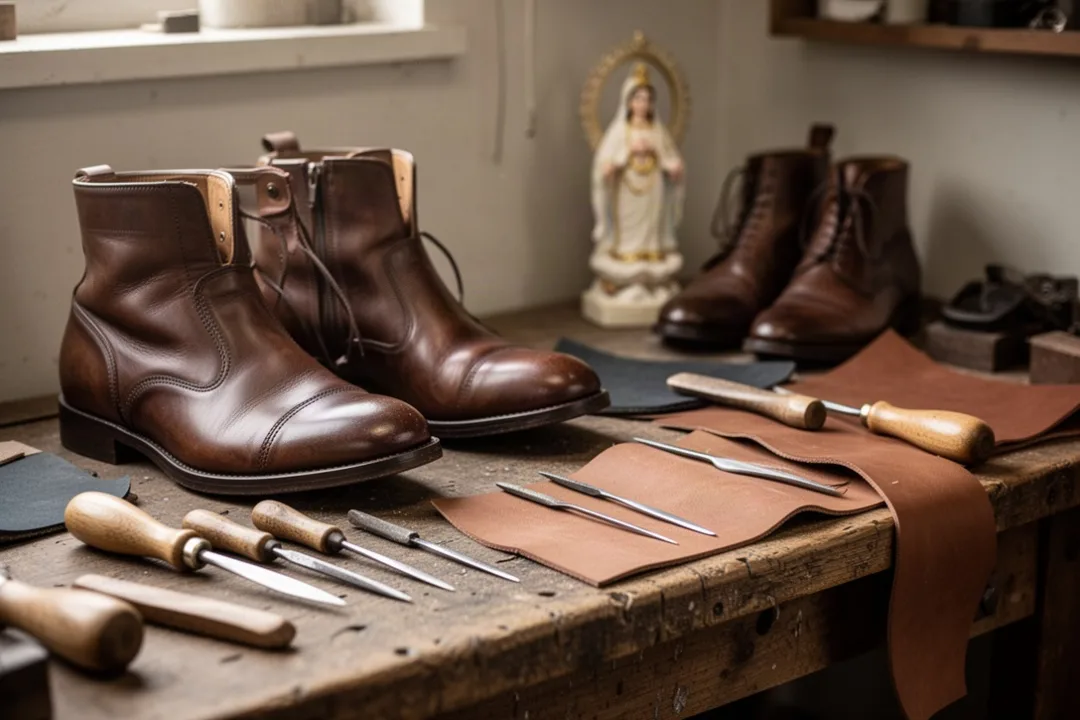
Displaying an image or statue of Saint Crispin with shoemaking tools.
Holding a guild meal, professional gathering, or community celebration.
Remembering the importance of honest work and service to neighbors.
Many people also use the feast day as a time to pray for the continuation of traditional craftsmanship. Modern footwear production is often industrial, but repair shops and independent makers still preserve skills that require years of practice. A feast connected with a working trade can honor both the historical occupation and the people who carry its skills forward today.
October 25 may be particularly meaningful for someone who inherited a family shoemaking business, works in shoe repair, studies leathercraft, or simply feels a personal connection to the brothers’ example. A person does not need to belong to a formal guild to observe the day.
What Saint Crispin represents to shoemakers today
Saint Crispin’s significance extends beyond the historical question of whether every detail in the traditional story can be verified. For many people, he represents the dignity of skilled labor performed with integrity. His story links practical work with a life of faith and service.
One important theme is humility. Crispin is not chiefly remembered as a wealthy patron, military leader, or political figure. He is remembered as someone who worked with his hands. That image can be meaningful in occupations where quality depends on patience, precision, and a willingness to perform tasks that are rarely glamorous.
A second theme is usefulness. Shoes protect people from cold, heat, rough ground, and injury. A shoemaker’s work directly affects a person’s ability to travel, work, and participate in daily life. In the traditional account, the brothers’ craft was not merely a way to earn money; it was also a way to meet real needs.
A third theme is steadfastness. The brothers are honored as martyrs because they remained committed to their faith despite threats. For modern workers, that does not mean seeking hardship. It can instead suggest the value of honesty, reliability, fair dealing, and loyalty to one’s principles when those qualities are difficult or costly.
These ideas can be applied to both traditional and modern footwear work. A person who restores leather boots, designs custom shoes, manages a repair counter, or trains apprentices may see Saint Crispin as a reminder that careful work has social value.
Symbols associated with Saint Crispin
Images of Saint Crispin and Saint Crispinian often show them as brothers, missionaries, or craftsmen. Artistic details vary, but footwear and leatherworking tools may appear because of their traditional occupation.
Common symbols can include shoes, boots, knives, awls, leather, or other tools used in shoemaking. Some images show the brothers in the clothing of missionaries or martyrs rather than in a workshop. The purpose of these symbols is to connect their spiritual identity with the work for which they are remembered.
A shoe or leather tool can therefore serve as more than a trade emblem. It may represent service, protection, craftsmanship, and endurance. In a workshop, a small image of Saint Crispin can function as a reminder to work carefully and treat customers fairly.
Because devotional art differs between regions, there is no single required appearance for Saint Crispin. Some depictions show him alone, while others show both brothers. If you are choosing an image for a shop, guild, or home, a depiction that includes footwear or shoemaking tools will make the patronage immediately clear.
How to honor Saint Crispin in a shoemaking or repair business
A person can honor Saint Crispin through a formal religious observance, a private prayer, or a simple act that reflects the values associated with him. The form matters less than the connection between faith, work, and service.
For a Catholic or another Christian believer, possible practices include attending a service on or near October 25, asking a priest to bless a workshop, or praying for the safety and prosperity of workers. Some people may also ask for guidance when making difficult business decisions or training the next generation of craftspeople.
A business owner might mark the feast day by supporting a local charity that provides shoes to people in need. This practice reflects the practical meaning of the trade: footwear is a basic necessity, and helping someone obtain safe, durable shoes can be a direct expression of compassion.
Other appropriate ways to observe the day include:
Learn the traditional story of Crispin and Crispinian and share it with apprentices or coworkers.
Pray for customers and workers, especially those facing financial hardship or unsafe working conditions.
Donate usable footwear or contribute repair services to a community organization.
Display a small devotional image near, but not in the way of, workshop tools and equipment.
Teach a practical skill to someone who is beginning in shoe repair or leathercraft.
Practice transparent business dealings, including fair pricing and honest explanations of repair options.
Someone who is not religious may still appreciate Saint Crispin as a symbol of the craft tradition behind shoemaking. Observing the day could mean researching local footwear history, preserving hand tools, mentoring a beginner, or recognizing the work of repair professionals.
Practical observance: A fitting way to honor the patron saint of shoemakers is to combine respect for craftsmanship with direct help for someone who needs safe, serviceable footwear.
Prayers and devotional language for Saint Crispin
There is no single universally required prayer to Saint Crispin. Devotional language may ask for his intercession for shoemakers, cobblers, leatherworkers, business owners, apprentices, and their families. It may also focus on patience, honesty, skill, and protection from workplace accidents.
A short personal prayer could ask Saint Crispin to help a worker perform careful work, serve customers fairly, and use the trade to support others. Someone may also pray for a person who is unemployed, struggling to afford shoes, or learning a craft under difficult circumstances.
A prayer for a workshop might include several intentions:
Safety for everyone using knives, machines, adhesives, and other tools.
Wisdom when choosing materials, setting prices, or advising customers.
Patience during complex repairs and demanding projects.
Fairness in dealings with workers, suppliers, and clients.
Generosity toward people who cannot afford necessary footwear.
Continuity for traditional skills and responsible apprenticeships.
People sometimes ask whether Saint Crispin should be prayed to alone or together with Saint Crispinian. Either practice fits the tradition. Because the brothers are commonly remembered as a pair, many prayers name both saints together, especially when referring to their shared trade and missionary work.
It is also reasonable to ask for their intercession on a day other than October 25. Feast days provide a special calendar observance, but devotion to a patron saint is not limited to one date. A worker might pray before opening a shop, beginning a difficult repair, teaching an apprentice, or facing an important business decision.
Saint Crispin in history, literature, and popular memory
The names of Crispin and Crispinian became widely familiar in English-speaking culture through the “Saint Crispin’s Day” speech in William Shakespeare’s play Henry V. The speech imagines soldiers remembering one another on October 25 and treats the feast day as a bond shared by those who stood together in battle.
Shakespeare’s use of the date helped make Saint Crispin’s name famous far beyond shoemaking communities. The literary reference does not change Crispin’s traditional role as patron of shoemakers, but it has given the feast day an additional place in English-language cultural memory.
The historical Crispin and Crispinian should still be distinguished from the literary scene. Shakespeare used the saints’ feast day for a dramatic purpose, while Christian tradition remembers the brothers for their work, preaching, and martyrdom. The two associations developed in different settings.
In professional history, the brothers remain especially important because medieval and early modern craft communities often looked to saints as spiritual patrons and symbols of shared identity. Guilds could combine religious observance with training, mutual assistance, charitable work, and standards for workmanship.
Saint Crispin’s name may therefore appear in churches, guild records, trade organizations, historical accounts of cobblers, and local celebrations. The strength of the tradition differs by country and city, but the underlying connection remains recognizable: Crispin is the traditional saint of shoemakers, and Crispinian is his companion in that devotion.
How Saint Crispin compares with other craft patrons
Several saints are connected with occupations involving leather, tools, or manual labor. Their patronages can overlap, particularly in regions where guild traditions developed locally. Saint Crispin is the clearest answer for shoemakers, but he is not the only saint a footwear worker might encounter.
Saint Crispinian is the closest companion because he is traditionally identified as Crispin’s brother and fellow shoemaker. When a church or organization honors the pair, it may refer to them collectively as the patrons of shoemakers.
Saint Joseph is widely honored as a patron of workers and craftsmen because of his traditional occupation as a carpenter and his role in the life of Jesus. A shoemaker might ask for Saint Joseph’s intercession for work in general while turning to Saint Crispin for the particular trade of footwear.
Saint Homobonus is associated with merchants, businesspeople, and charitable conduct. His example may appeal to a shop owner who wants guidance in combining commercial responsibility with care for people in need. His patronage is broader and should not replace the specific traditional answer of Saint Crispin for shoemakers.
These devotions do not have to compete. A person may honor Saint Crispin for the craft, Saint Joseph for work and family life, and another patron for a particular personal need. The key distinction is that Saint Crispin and Saint Crispinian are the traditional patron saints specifically linked with shoemaking.
Frequently asked questions
Is Saint Crispin the same person as Saint Crispinian?
No. Traditional accounts describe Crispin and Crispinian as two brothers who worked together as missionaries and shoemakers. They are usually commemorated on the same feast day, October 25, which is why their names are often joined. When people say “Saint Crispin,” they may be referring to the pair’s shared tradition, but Crispin and Crispinian are treated as separate saints.
What is Saint Crispin’s feast day?
Saint Crispin and Saint Crispinian are traditionally celebrated on October 25. The date is associated with their martyrdom in the Christian calendar, although the precise historical details of their lives are difficult to verify. Shoemakers and related workers may observe the day with prayer, a church service, a guild gathering, charitable work, or recognition of traditional craftsmanship.
Can Saint Crispin be a patron for a shoe repair business?
Yes. Saint Crispin’s traditional patronage covers shoemakers and is commonly extended to cobblers and people who repair footwear. A repair shop can honor him by displaying an image, observing his feast day, praying for workers and customers, or helping people who need usable shoes. His association is with the trade as a whole, not only with making new footwear.
Why are Saints Crispin and Crispinian connected with leatherwork?
Their traditional biographies say that the brothers earned their living by making shoes while preaching Christianity. That detail links them with leather, footwear, and related manual trades. Since the surviving stories include legendary material and are not fully documented by contemporary records, the connection is best understood as a long-standing religious and occupational tradition rather than a complete modern biography.














Leave a Reply