Who is Saint Nicholas? The bishop behind Santa Claus
Who is Saint Nicholas? The bishop behind Santa Claus
Saint Nicholas was a Christian bishop of Myra, a city in the ancient region of Lycia in what is now southern Turkey. He probably lived during the late third and early fourth centuries and became known for generosity, compassion, and concern for people in need.
His feast day is December 6. Over many centuries, stories about his secret gifts and kindness developed into customs that helped shape Santa Claus, although Saint Nicholas and the modern Christmas figure are not exactly the same person.
Much of what people know about Nicholas comes from later biographies and local traditions rather than records written during his lifetime. Historians generally treat him as a real Christian leader, while recognizing that some popular stories cannot be confirmed in detail.
Name: Nicholas of Myra, also called Saint Nicholas of Bari.
Role: Christian bishop of Myra in Lycia.
Approximate lifetime: The late third century to the mid-fourth century.
Feast day: December 6 in many Christian traditions.
Known for: Generosity, care for the vulnerable, miracles, and intercession.
Modern connection: His gift-giving reputation contributed to traditions surrounding Santa Claus.
The short answer: Saint Nicholas was a bishop remembered for practical charity and faith. The historical person lived in Myra; the familiar Santa Claus figure combines Nicholas traditions with customs from several cultures.
Where Saint Nicholas lived and served
Nicholas is traditionally associated with Patara, a port city in Lycia, and with Myra, a nearby city that became an important Christian center. Both places were in the Roman Empire and are located in present-day Türkiye, along the Mediterranean coast.
Myra was an established city with a significant Christian community. Nicholas served there as bishop, a position that involved teaching, worship, pastoral care, and leadership during a period when Christianity was becoming more established but could still face political pressure.
The exact dates of his life are uncertain. Many traditions place his birth around the third century and his death around the middle of the fourth century. December 6 is generally understood as the date associated with his death, which is why churches commemorate him on that day.
How Saint Nicholas became known for generosity
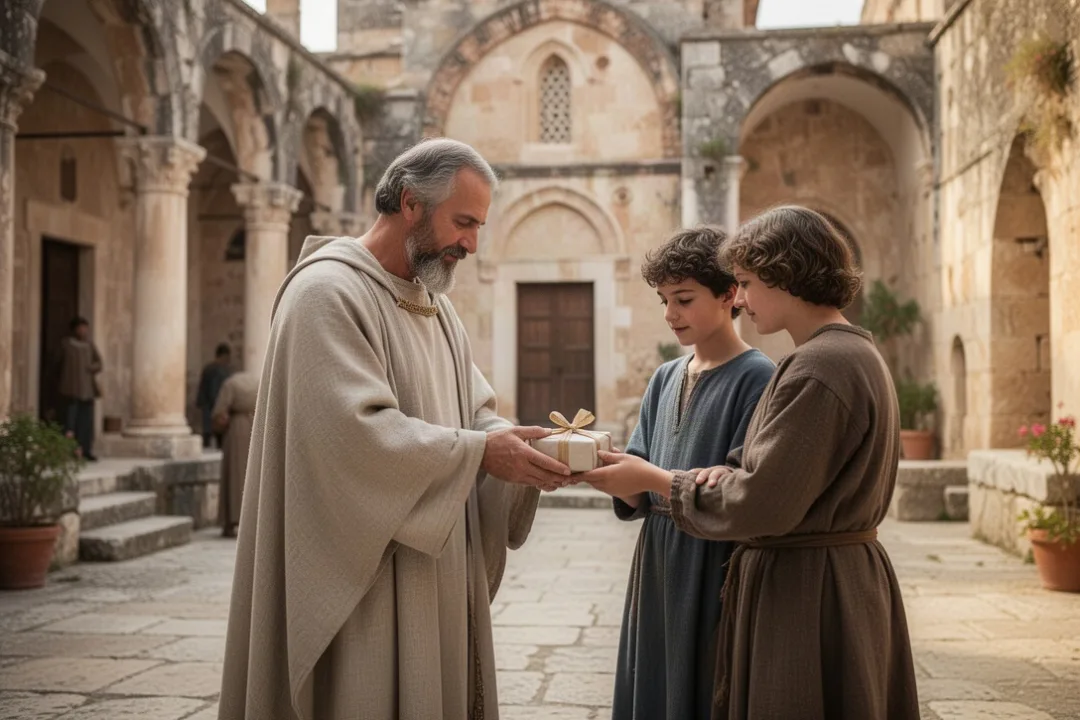
The most famous stories about Nicholas portray him as someone who helped people without seeking recognition. One widely repeated account tells of a poor man who could not provide marriage dowries for his three daughters. Nicholas is said to have secretly supplied money, allowing the family to avoid desperation and preserving the daughters’ future security.
Different versions describe the gifts as bags of gold or other valuable objects placed near the family’s home. Some later retellings say the gifts landed in stockings or shoes left to dry, helping inspire customs involving shoes, socks, and hidden presents.
The historical details of this story cannot be proven. Its enduring significance comes from the moral idea it communicates: generosity protects dignity when assistance is offered quietly rather than used to gain status.
Other traditions describe Nicholas helping sailors, prisoners, children, and people facing unjust treatment. These stories may combine memories of local events, devotional teaching, and the broader Christian belief that holy people intercede for those in danger.
A step-by-step look at how Saint Nicholas became Santa Claus
A bishop gained a reputation for charity. Stories about Nicholas emphasized secret generosity, protection, and concern for ordinary people.
Christians honored him on December 6. Communities marked his feast day with worship, charitable giving, and gifts for children.
European customs added local details. Songs, plays, processions, clothing, and regional characters shaped the way Nicholas was represented.
His name changed across languages. Dutch traditions used forms such as Sinterklaas, which later influenced the English name Santa Claus.
Christmas customs absorbed his gift-giving role. In some places, gifts moved from December 6 to Christmas Eve or Christmas Day.
Modern popular culture reshaped his appearance. Illustrations, poems, advertising, and films helped create the widely recognized red-suited Santa.
This development took place over many centuries. There was no single moment when Saint Nicholas suddenly became Santa Claus. Instead, religious devotion, regional customs, literature, art, and commercial culture gradually combined.
What the historical record tells us
Reliable information about Nicholas is limited. He does not appear in the New Testament, and detailed biographies about him were written later than his lifetime. The earliest surviving accounts often mix biography with miracle stories, making it difficult to separate historical events from devotional tradition.
Still, the lack of detailed records does not prove that Nicholas was fictional. Early Christian communities remembered him as a bishop of Myra, and his veneration spread widely. Historians commonly distinguish between the existence of Nicholas, which is broadly accepted, and individual stories about his life, which vary in reliability.
Some later accounts connect him with persecution under Roman emperors and with the Council of Nicaea. These details are popular in Christian storytelling, but the evidence for particular episodes is not equally strong. A careful explanation can honor the tradition while acknowledging that not every scene has been historically verified.
Historical caution: Saint Nicholas is best understood through two layers: a likely fourth-century bishop remembered by Christian communities and a large body of later legends that express his compassion, courage, and holiness.
Why the stories about Saint Nicholas matter
The stories focus less on power or wealth than on responsible generosity. Nicholas is usually depicted as noticing a person’s need and acting before the situation becomes publicly humiliating. That theme explains why he became associated with children, families, travelers, sailors, merchants, and people with little social protection.
His legends also present charity as personal rather than abstract. Instead of discussing poverty in general terms, they show a bishop responding to a household, a prisoner, a ship’s crew, or a frightened child. The stories encourage listeners to see vulnerable people as neighbors with names, fears, and hopes.
For many Christians, Nicholas is also an example of faith expressed through action. Prayer and worship are important in his traditions, but they are repeatedly connected with practical help: food, money, protection, advocacy, and rescue.
Saint Nicholas as a Christian bishop
As bishop of Myra, Nicholas would have been responsible for guiding a local church and caring for its members. Bishops in the early Christian world often served as teachers, judges within the Christian community, organizers of relief, and representatives of the church in civic life.
That role helps explain why Nicholas is remembered as more than a private benefactor. He is portrayed as someone who used public responsibility for the good of others. His generosity was not merely spontaneous kindness; it was connected with pastoral leadership and moral duty.
Christian art often shows him wearing the clothing of a bishop, including a miter and holding a crozier. These symbols identify his office. Images may also include three gold balls, children, ships, or books, depending on the particular story or local tradition being represented.
Saint Nicholas and the three gold balls
The three gold balls are one of the best-known symbols associated with Nicholas. They refer to the story of the poor family with three daughters and the secret gifts that provided their dowries. In some traditions, the gold appears as three bags; in others, it is shown as three round objects.
This symbol later became associated with pawnbrokers, especially in European visual tradition. The connection reflects the idea of exchanging an object of value for financial assistance. It does not mean that Nicholas himself operated a pawnshop.
When the three gold balls appear in a church, painting, statue, or decorative display, they usually point to his reputation as a discreet helper of people in financial hardship.
Saint Nicholas and children
Saint Nicholas became closely associated with children because his feast-day customs often included gifts, visits, songs, and special celebrations for young people. Stories about his kindness also made him a natural figure for teaching children about generosity and concern for others.
In some countries, children place shoes outside a door or leave them near a fireplace before the feast of Saint Nicholas. They may find fruit, sweets, nuts, small toys, or symbolic gifts the next morning. The details differ by region, and the custom is separate from the larger Christmas gift exchange in many households.
Some traditions also include a bishop-like visitor who asks children to reflect on their behavior and encourages good conduct. Modern families often adapt this practice in gentler ways, focusing on kindness, sharing, and service rather than fear or punishment.
Saint Nicholas traditions vary widely among Christian communities and countries. In parts of Europe, December 5 is associated with the evening before his feast day, while December 6 is the principal day of observance. In other places, his name is familiar but the celebration is modest or has been absorbed into Christmas customs.
Common practices include:
Attending a church service or prayer gathering on or near December 6.
Giving children small presents, fruit, candy, books, or useful items.
Placing gifts in shoes, stockings, bags, or other containers.
Organizing parades, school events, plays, or visits from a person dressed as a bishop.
Collecting food, clothing, or money for families in need.
Sharing stories about Nicholas as a model of quiet and thoughtful charity.
Some communities distinguish Saint Nicholas from Santa Claus by keeping the bishop’s clothing, feast day, and religious meaning. Others use the names more casually or combine the two figures. Neither approach is universal, because customs depend on family, church, and cultural background.
How Saint Nicholas differs from Santa Claus
Saint Nicholas is remembered as a Christian bishop connected with a historical place and church tradition. Santa Claus is a later cultural figure shaped by Saint Nicholas, European folklore, Christmas customs, literature, illustrations, and modern entertainment.
Several differences are especially useful:
Time of celebration: Saint Nicholas is traditionally honored on December 6; Santa Claus is usually associated with Christmas Eve or Christmas Day.
Appearance: Nicholas is commonly shown as a bishop; Santa is generally shown in a red winter suit with a hat and white beard.
Setting: Nicholas belongs to the world of early Christian Myra; Santa belongs to a later northern and global Christmas imagination.
Meaning: Nicholas represents Christian charity and pastoral care; Santa often represents seasonal generosity, wonder, and gift exchange.
Historical status: Nicholas is treated as a saint connected to a real bishop; Santa is a composite cultural character.
These differences do not make Santa unrelated to Nicholas. The connection is genuine, particularly through the theme of secret gift-giving, but Santa Claus is not a simple portrait of the fourth-century bishop.
How the name Santa Claus developed
The English name Santa Claus comes through Dutch traditions surrounding Sinterklaas, a form of Saint Nicholas. Dutch settlers carried the name and related customs to North America, where the pronunciation and spelling gradually changed.
North American writers and artists later contributed new features, including a sleigh, reindeer, a workshop, and a home in the far north. These elements do not come from the life of the bishop of Myra. They belong to the evolving Christmas character that developed around his older gift-giving identity.
The modern image became especially recognizable through nineteenth- and twentieth-century popular culture. No single writer, artist, or company created every feature, and the character continued to change as customs spread internationally.
Where Saint Nicholas is honored today
Saint Nicholas is honored in many Catholic, Eastern Orthodox, Oriental Orthodox, Anglican, and other Christian communities. Churches dedicated to him can be found across Europe, the Middle East, and other regions where Christianity took root.
He is particularly associated with sailors and coastal communities. Myra was connected with Mediterranean travel, and stories of Nicholas protecting ships helped establish him as a patron of seafarers. Churches and chapels dedicated to him often appear near ports or along major travel routes.
He is also recognized as a patron of children, merchants, students, travelers, and people facing hardship. Patronage traditions differ among churches, so lists may not be identical from one country to another.
The connection with Bari and his relics
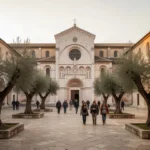
After Nicholas’s death, Myra became an important pilgrimage site associated with his memory. In the medieval period, sailors from Bari, an Italian port city, took relics traditionally identified as belonging to Nicholas from Myra to Bari. A basilica dedicated to him was built there, and Bari became one of the major centers of his devotion.
For that reason, he is sometimes called Saint Nicholas of Bari, even though his episcopal ministry is linked with Myra. Myra, now associated with the archaeological site near Demre, remains important to his history, while Bari remains a major destination for pilgrims.
Relics, pilgrimage, and local devotion helped spread his reputation across Europe. They also encouraged new stories, artwork, prayers, and feast-day customs, strengthening the connection between Nicholas and acts of protection or miraculous help.
What Saint Nicholas can mean in a modern celebration
A family or church does not need to reproduce every traditional custom to honor Saint Nicholas. The central themes can be expressed through a small, deliberate act of service. A child might choose a book for a donation drive, help prepare food for a neighbor, or select a gift without revealing the giver.
Adults can use the feast day to connect seasonal generosity with real needs. Examples include supporting a local food pantry, helping a family with winter clothing, visiting someone who is isolated, or giving financial assistance through a trusted charitable organization.
These practices reflect the strongest thread in the Nicholas tradition: give help that preserves dignity. The value of the act is not measured by its price or visibility, but by whether it responds thoughtfully to another person’s circumstances.
Questions to ask when teaching children about Saint Nicholas
Children often encounter Saint Nicholas through gifts, costumes, or stories. A clear explanation can distinguish the historical saint from the later Santa Claus character without dismissing the wonder of the tradition.
Who was Nicholas before he became part of Christmas customs?
Why did stories emphasize secret or humble gifts?
How can generosity help someone without embarrassing them?
What is the difference between a bishop, a saint, and a fictional holiday character?
How can your family remember people who need practical help?
The answers can be adapted to a child’s age and religious background. The main point is that Saint Nicholas is remembered not because he collected possessions, but because stories portray him as using what he had to protect and serve other people.
Why people still remember Saint Nicholas
Saint Nicholas remains influential because his story links celebration with responsibility. He is associated with presents, but the deeper tradition asks where gifts come from, who is overlooked, and how generosity can be practiced without turning help into a performance.
His historical setting is distant, and many details of his life remain uncertain. Yet the combination of a remembered bishop, a popular feast day, and centuries of storytelling has kept his name familiar. When people ask who Saint Nicholas is, the most accurate answer includes both parts: a likely fourth-century bishop of Myra and the source of a wide family of traditions that eventually helped shape Santa Claus.
Frequently asked questions
Was Saint Nicholas a real person?
Most historians and Christian traditions regard Nicholas as a real bishop who lived in Myra during the fourth century. The surviving evidence is limited, and many detailed episodes come from later accounts. That means his existence and office are more firmly established than every story told about his miracles, persecution, or private acts of generosity.
Is Saint Nicholas the same as Santa Claus?
Saint Nicholas is the historical and religious figure behind many Santa Claus traditions, but the two are not identical. Santa Claus developed from Nicholas customs combined with European folklore, Christmas practices, literature, art, and popular culture. Saint Nicholas is generally associated with December 6 and bishop’s clothing, while Santa is linked with Christmas and a winter gift-giver’s appearance.
Why do children put out shoes for Saint Nicholas?
The custom comes from feast-day traditions in which Nicholas leaves small gifts for children. Shoes provide a simple place for fruit, candy, coins, or toys to be discovered. The practice also connects with stories about Nicholas giving valuable gifts secretly, especially the account involving financial help for a poor family with three daughters.
What is Saint Nicholas the patron saint of?
Saint Nicholas is commonly associated with children, sailors, merchants, travelers, students, and people in difficult circumstances. His patronages differ somewhat between Christian communities and countries. The common thread is his reputation for protection, advocacy, and generosity, especially toward people who were vulnerable, poor, or in danger.











Leave a Reply