St. Lucy feast: traditions, meaning, and ways to celebrate
St. Lucy feast: traditions, meaning, and ways to celebrate
Are you wondering why people wear white robes, carry candles, and serve saffron buns in the middle of December? The St. Lucy feast, also called the Feast of Saint Lucy or Santa Lucia, is celebrated each year on December 13. It honors Lucy of Syracuse, a Christian martyr from Sicily, while also bringing themes of light, courage, generosity, and hope into the darkest part of the year.
The feast has both a religious meaning and a strong cultural life. Catholics may attend Mass, pray for Lucy’s intercession, or learn about her witness. In Sweden and other Scandinavian countries, Lucia processions fill churches, schools, workplaces, and homes with candlelight. In parts of Italy, especially Sicily, families remember Santa Lucia through special foods, processions, and local traditions.
The Feast of Saint Lucy falls on December 13 every year. In the Roman Catholic calendar, it is an optional memorial, meaning churches may observe it liturgically without treating it as one of the highest-ranking feast days. Local communities, religious orders, and parishes may give the day particular importance because Lucy is their patron saint.
December 13 also places the celebration close to the winter solstice, the shortest day of the year in the Northern Hemisphere. Before the Gregorian calendar was adopted, December 13 was closer to the solstice than it is today. That older calendar connection helped strengthen the association between Saint Lucy and light, although the feast began as a commemoration of a martyr rather than as a seasonal festival.
The date is not the same as the start of Advent, Christmas Eve, or Saint Lucy’s Day in every cultural setting. Some communities hold their main procession on the evening before or after December 13 to fit parish, school, or family schedules. The feast itself, however, remains December 13.
Quick answer: The St. Lucy feast is celebrated on December 13. Its central ideas are faithful courage, care for people in need, and light shining during darkness.
Who Saint Lucy was and why Christians remember her
Saint Lucy, or Lucia of Syracuse, is traditionally understood to have lived in Syracuse, Sicily, during the late third and early fourth centuries. She belonged to a Christian family and dedicated herself to God. According to the traditional account, she rejected marriage plans and chose to distribute her wealth to people who were poor.
Lucy lived during a period when Christians in the Roman Empire could face punishment for their faith. She was arrested, tortured, and killed because she refused to renounce Christianity. Historians have more confidence in the broad tradition that she was an early Christian martyr than in every detail of the later stories about her life.
Her name is related to the Latin word lux, meaning light. That linguistic connection, along with her martyrdom and the timing of her feast, shaped the way later Christians spoke about her. Light became a symbol of faith, moral clarity, and God’s presence rather than simply a decoration for a winter celebration.
Saint Lucy is especially associated with the protection of eyesight. Stories about her eyes appear in medieval traditions, and religious art sometimes shows her holding a dish with eyes or carrying a palm branch, a symbol of martyrdom. These images are symbolic and should not be treated as fully established biographical facts.
Her story asks a direct question: what does faith require when it conflicts with social pressure, family expectations, wealth, or personal safety? Lucy is remembered not because her life was easy, but because she used her choices to remain faithful and to help others.
What the St. Lucy feast means in Christian practice
At its heart, the feast is a memorial of Christian witness. A martyr’s feast does not celebrate suffering for its own sake. It remembers a person who remained committed to a religious conviction despite threats and honors the courage required to act according to conscience.
Lucy’s traditional generosity gives the feast a second emphasis: light should lead to service. Lighting a candle without caring for anyone else would miss the point of the symbol. A household might mark the day by donating food, visiting someone who is isolated, supporting a food pantry, or offering practical help to a neighbor.
Many Catholics pray through Saint Lucy’s intercession for people with eye disease, vision loss, or other physical difficulties. A prayer may also ask for clear spiritual vision: wisdom to recognize what is right, courage to respond, and compassion toward people who are struggling.
Churches may use readings, hymns, candles, and a homily focused on light and faithful witness. The exact readings depend on the local lectionary and the day of the week. Passages about light, discipleship, wisdom, or perseverance may fit the theme, but there is no single universal set of readings that every community must use.
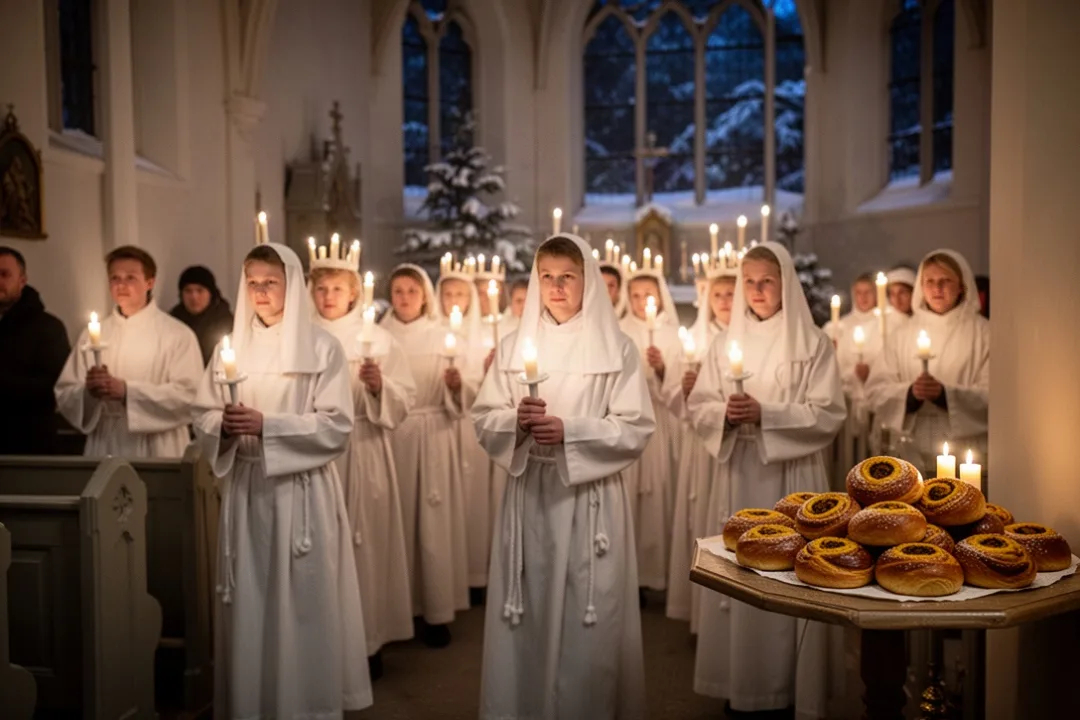
The most recognizable Lucia tradition in the United States comes from Sweden. On December 13, a girl or young woman may be chosen to portray Lucia. She wears a white robe with a red sash and a crown of candles or battery-powered lights. Attendants, often called Lucia’s companions, may wear white robes and carry candles while singing seasonal songs.
Modern Swedish Lucia customs developed over time from several influences. The saint’s feast came through Christian tradition, while older Scandinavian winter customs contributed ideas about light, food, and a special figure appearing during the long night. The white clothing and candle procession are therefore a cultural expression shaped by history, not a direct description of how Lucy dressed in fourth-century Sicily.
Lucia processions are held in churches, schools, town halls, hospitals, workplaces, and nursing homes. Participants often enter in a slow procession while singing. The atmosphere is quiet and communal: candlelight moves through a darkened room, children and adults sing together, and food is served afterward.
Traditional Lucia songs include versions of the Neapolitan song associated with Santa Lucia, as well as Swedish seasonal songs. The words and melodies used at a particular event may reflect local language and practice. Some communities emphasize Christian worship, while others treat Lucia as a cultural winter observance with historical and family significance.
In Sweden, the celebration often begins early in the morning. A family may wake to find one member dressed as Lucia and carrying a tray of coffee and pastries. Schools and workplaces may hold their own processions later in the day. The custom is less about one official ceremony than about bringing warmth and light into shared spaces.
How Italy and Sicily observe Santa Lucia
In Sicily, Saint Lucy has a particularly strong connection to Syracuse, her traditional hometown. Religious celebrations may include Mass, processions, music, and an image or statue of the saint carried through the streets. For local communities, the feast is not merely a Scandinavian candle ceremony; it is a major expression of Sicilian identity and devotion.
Santa Lucia is also honored in other Italian cities and among Italian American families. Customs differ by place. Some families attend church, prepare a traditional dish, set aside a portion of food for someone in need, or tell children the story of the saint. In some communities, Santa Lucia is associated with bringing gifts to children, especially on the night of December 12 or during the day of December 13.
One well-known Sicilian food connected with the feast is cuccìa, a cooked wheat dish that may be sweetened and combined with ricotta, cream, chocolate, or candied fruit. Recipes vary by town and family. The dish is often linked to gratitude for relief from hunger, especially through a traditional story about grain arriving during a famine in Syracuse.
That story should be understood as part of local tradition rather than as a universally verified historical account. Its meaning is still clear: food is received with gratitude and shared as a sign of mercy and communal care.
Some Italian regions also connect Santa Lucia with eye-shaped pastries or images of eyes. These customs reflect her role as a patron of eyesight. Families may adapt the tradition to their own background, using a prayer, a meal, or a small charitable act instead of reproducing a regional recipe exactly.
Why candles and light are central to Lucia traditions
Candles are the visual center of many St. Lucy celebrations. A candle provides actual light, but it also represents hope, faith, truth, and guidance. In December, when evenings arrive early, even a small flame can make a room feel more welcoming and connected.
For Christians, the image of light has deep biblical meaning. The Gospel of John presents Jesus as light, while Matthew describes disciples as a light visible to others. The passages are often read as invitations to live faithfully and to let compassionate actions make belief visible. The feast applies that symbolism to Lucy’s courage and generosity.
The candle crown worn by Lucia in Scandinavian processions is a later cultural symbol, not an item documented in the ancient accounts of Saint Lucy. In modern events, safety has become especially important. Many schools and public groups use battery-powered candles, and even traditional candles should be handled by adults under careful supervision.
A home celebration can use one candle on a table rather than a full procession. You might light it during a prayer, tell the story of Lucy, and then name one way the household will share light with another person. The practice becomes more meaningful when the symbol leads to a specific action.
Food gives the feast a welcoming, family-centered character. In Sweden, the best-known treats are lussekatter, also called saffron buns or Lucia buns. Their yellow color comes from saffron, and their curled shapes are commonly decorated with raisins. They are usually served with coffee, milk, or another warm drink.
Swedish ginger cookies and other Christmas-season pastries may also appear at a Lucia gathering. There is no single required menu. The important features are hospitality, sharing, and the connection between a special food and a remembered tradition.
In Sicily, cuccìa is the food most closely associated with Saint Lucy. It can be prepared in sweet or savory forms, depending on local custom. Wheat, a basic food that represents nourishment, is central to many versions. Families may use a recipe handed down through generations or prepare a simpler adaptation with ingredients available in their area.
Italian American households may combine these traditions with their own regional foods. A family with Sicilian roots might serve cuccìa, while a Scandinavian American community might bake saffron buns. Others may choose soup, bread, cookies, or a shared meal and connect the food to thankfulness and generosity.
If you are serving guests, ask about allergies and dietary needs. Saffron buns may contain dairy, eggs, or wheat, and cuccìa recipes can include dairy, nuts, or chocolate. A thoughtful host can preserve the spirit of the feast by offering a suitable alternative instead of treating one recipe as mandatory.
Practical ways to celebrate the feast at home
You do not need a large procession or a family connection to Sweden or Sicily to observe Saint Lucy’s feast respectfully. A simple plan can combine prayer, learning, light, food, and service. Choose elements that fit your household’s faith tradition and age group.
Learn Lucy’s story. Read a reliable account of her life and explain that some popular details come from later tradition.
Light a candle safely. Use one candle on a stable surface, or choose an electric candle if children or pets are present.
Say a short prayer. Ask for courage, clear judgment, care for people with vision problems, and strength for those facing hardship.
Prepare a traditional food. Bake saffron buns, make cuccìa, or serve a family recipe that expresses hospitality.
Share the light. Donate to a food pantry, support a vision charity, call someone who lives alone, or bring a meal to a neighbor.
End with music or quiet reflection. Sing a Lucia song, listen to sacred music, or sit together in silence for a few minutes.
With children, focus on ideas they can understand: Lucy cared for people who were poor, stayed faithful when others pressured her, and is remembered through light. Avoid presenting every legend as proven history. Children can appreciate a saint’s story while also learning that traditions develop across centuries.
A parish or community group might organize a small procession. Participants can wear white clothing, carry safe lights, sing, and serve a modest breakfast afterward. If the event is explicitly Christian, organizers may include a prayer service or Mass; if it is cultural, they can explain the historical connection without suggesting that all attendees share the same beliefs.
Safety tip: Use battery-operated candles for children’s processions, keep open flames away from loose clothing and decorations, and have an adult supervise every candle activity.
Common mistakes when observing Saint Lucy’s feast
The feast has spread across countries and denominations, so it is easy to blend customs together. That is not necessarily wrong, but explaining the differences helps you honor the traditions rather than creating a misleading version of them.
Calling Lucia a Christmas character: She is a Christian saint and martyr whose feast falls during Advent, not a replacement for Santa Claus or Christmas itself.
Presenting legends as certain facts: Accounts about Lucy’s eyes, her family arrangements, and particular miracles were recorded or developed after her lifetime.
Assuming every Lucia procession is ancient: The Scandinavian procession format is a later cultural development shaped by regional customs.
Ignoring the Sicilian origin: Swedish Lucia celebrations are famous, but Lucy is traditionally from Syracuse, Sicily.
Treating the candle as the whole celebration: Light points toward faith, courage, and service; it is not merely a seasonal decoration.
Using unsafe real candles: A beautiful custom is not worth burns, fires, or panic. Electric lights are a responsible choice.
Insisting on one “authentic” recipe: Foods vary among regions and families, and hospitality matters more than exact ingredients.
Another common misunderstanding is that Saint Lucy’s feast always includes a girl wearing a candle crown. That image is strongly associated with Sweden and Scandinavian communities, but many Catholic parishes observe the day through a liturgy, prayer, or charitable activity without a costumed procession.
How churches and schools can plan a respectful Lucia event
A good event begins by deciding whether its purpose is worship, education, cultural heritage, or community fellowship. The answer will shape the music, prayers, clothing, food, and explanation. A Catholic parish may center the Eucharistic liturgy, while a school may focus on Swedish customs and the history of the saint.
Organizers should explain that the white robe, red sash, crown, and attendants belong to a tradition that developed in Scandinavia. They can then connect those symbols to Lucy’s older story: the robe suggests purity or simplicity, the red sash recalls martyrdom, and the candle crown expresses light in darkness.
A short program might include a welcome, a retelling of Lucy’s life, a candle procession, two or three songs, a prayer or reflection, and a shared meal. Keep the explanation accessible. People unfamiliar with the feast need to understand why the event includes both a fourth-century Sicilian martyr and a Scandinavian winter procession.
Accessibility also deserves attention. Provide seating for people who cannot stand during a procession, printed or spoken descriptions for people with low vision, and non-flame options for participants who cannot safely carry candles. If songs are used, make the words available in a format that allows everyone to participate.
How the feast connects with Advent and the winter season
For many Christians, December 13 falls within Advent, the season of preparation for Christmas. The connection is not that Saint Lucy’s feast is a Christmas holiday. Instead, her witness can support Advent themes of watchfulness, hope, repentance, and readiness to welcome Christ.
Light is particularly meaningful during winter because people experience long nights and limited daylight. The feast acknowledges that darkness is real while refusing to treat it as the final word. A prayer, meal, or procession gives the community a way to practice hope rather than simply talk about it.
The seasonal timing also makes the feast approachable for people who are not familiar with formal saint observances. A candlelit gathering, a warm drink, and a charitable act can create a meaningful community tradition. The event remains strongest when it retains a clear connection to Lucy’s faith and care for others.
Questions to consider during a family celebration
A few thoughtful questions can help a household move beyond costumes and food. Ask what kind of courage Lucy showed, why people connect her with eyesight, and how light can represent a choice to act with compassion. Children might name someone who needs encouragement or choose a small act of kindness.
Adults can also discuss the difference between history and devotional tradition. The broad memory of Lucy as a martyr is ancient, while many vivid details emerged in later accounts. Holding those two ideas together allows families to respect religious tradition without claiming certainty where the historical record is limited.
Finally, ask how the celebration can benefit someone outside the household. A plate of buns is pleasant, but a food donation, a visit, or support for people living with vision loss gives the feast a practical expression. The most faithful response to a story about generosity is generosity itself.
What the St. Lucy feast can mean today
The feast continues because it joins a specific person and place with universal human concerns. Lucy is remembered as a young Christian from Syracuse who chose fidelity and generosity. Her name evokes light, while her feast arrives when many communities are seeking warmth, hope, and connection.
Whether you attend a church service, watch a Swedish procession, cook cuccìa, bake lussekatter, or light one candle at home, the day can be observed with care. Keep the history clear, treat legends thoughtfully, and let the symbols point toward courage, compassion, and shared light.
December 13 offers a simple pattern for celebration: remember a person of faith, welcome others, protect the vulnerable, and turn a symbol into action. That pattern gives the St. Lucy feast meaning across cultures and generations.
Frequently asked questions
Is the St. Lucy feast a Catholic holiday?
It is a Catholic feast day honoring Saint Lucy, but it is also observed culturally by Lutheran, Protestant, secular, and Scandinavian communities. The religious form may include Mass or prayer, while cultural celebrations often feature songs, white robes, candlelight, and traditional foods. The level of religious observance depends on the community and family.
Why does Lucia wear a crown of candles?
The candle crown is mainly part of Scandinavian Lucia tradition, especially in Sweden, rather than a historically documented feature of Saint Lucy’s life. It represents light during winter and is connected with her name, which relates to the Latin word for light. Modern processions often use battery-powered candles for safety.
What food is traditionally eaten on Saint Lucy’s Day?
Swedish celebrations commonly serve lussekatter, or saffron buns, along with coffee and ginger cookies. In Sicily, cuccìa is strongly associated with Santa Lucia and may be made with cooked wheat and sweet ingredients. Recipes vary by region and family, so there is no single required menu for the feast.
Is Saint Lucy the same person as Santa Lucia?
Yes. Saint Lucy, Lucia of Syracuse, and Santa Lucia refer to the same Christian martyr. “Santa Lucia” is the Italian name, while “Saint Lucy” is the common English form. She is traditionally associated with Syracuse in Sicily and is widely honored as a patron of eyesight and the visually impaired.















Leave a Reply