St. Patrick probably died of natural causes, rather than being executed, killed in battle, or murdered. The exact circumstances are unknown because no reliable source describes his final illness or death. Later tradition places his death at Downpatrick in Ireland, usually on March 17, but historians cannot verify every part of that account.
Patrick lived during the fifth century, a period for which written records are scarce. His own writings describe his mission, beliefs, and personal experiences, but they do not explain how or where he died. As a result, the most careful answer is that he likely died peacefully in old age or from illness after years of missionary work, with the details preserved mainly through later tradition.
The historical record does not provide a deathbed account for Patrick. His two surviving writings—the Confessio and the Letter to the soldiers of Coroticus—offer valuable evidence about his life, but neither gives a date, cause, or place of death. They were written during his lifetime and focus on his calling, pastoral work, and criticism of violence against Christian captives.
Patrick also does not describe himself as a martyr. That matters because early Christian saints who died violently were often remembered through detailed stories of imprisonment, torture, execution, or miraculous endurance. No comparable account survives for Patrick. There is no dependable evidence that he was killed for his faith.
The simplest historical explanation is therefore a natural death. He may have died from an illness or the effects of age, as many people did in late antiquity, but even that cannot be stated with certainty. A natural death is a reasonable inference from the silence of the earliest sources, not a documented medical fact.
The careful answer: St. Patrick’s cause of death is unknown. The traditional account says he died at Downpatrick on March 17, while historical evidence supports only the broader conclusion that he probably died peacefully rather than as a martyr.
Why March 17 is associated with St. Patrick
March 17 is observed as St. Patrick’s feast day, and tradition identifies it as the anniversary of his death. The date became closely connected with Patrick through the development of his medieval cult and the growth of churches dedicated to him. It is now celebrated in Ireland and around the world as St. Patrick’s Day.
The date itself does not prove the exact day Patrick died. Medieval communities often assigned or preserved feast days for saints even when detailed historical records were unavailable. A liturgical anniversary could be based on local tradition, a church calendar, or a long-standing association that had become accepted over time.
That distinction does not make March 17 meaningless. It remains an important religious and cultural observance, and it reflects the way generations of Christians remembered Patrick. It simply means that the feast day should not be treated as an independently verified death certificate.
Some modern accounts present March 17 as certain and add dramatic details about Patrick’s final moments. Those details usually come from later biographies, local tradition, or popular retellings rather than from Patrick’s own writings. The more reliable position is to separate the established tradition from what the surviving evidence can prove.
Where did St. Patrick die?
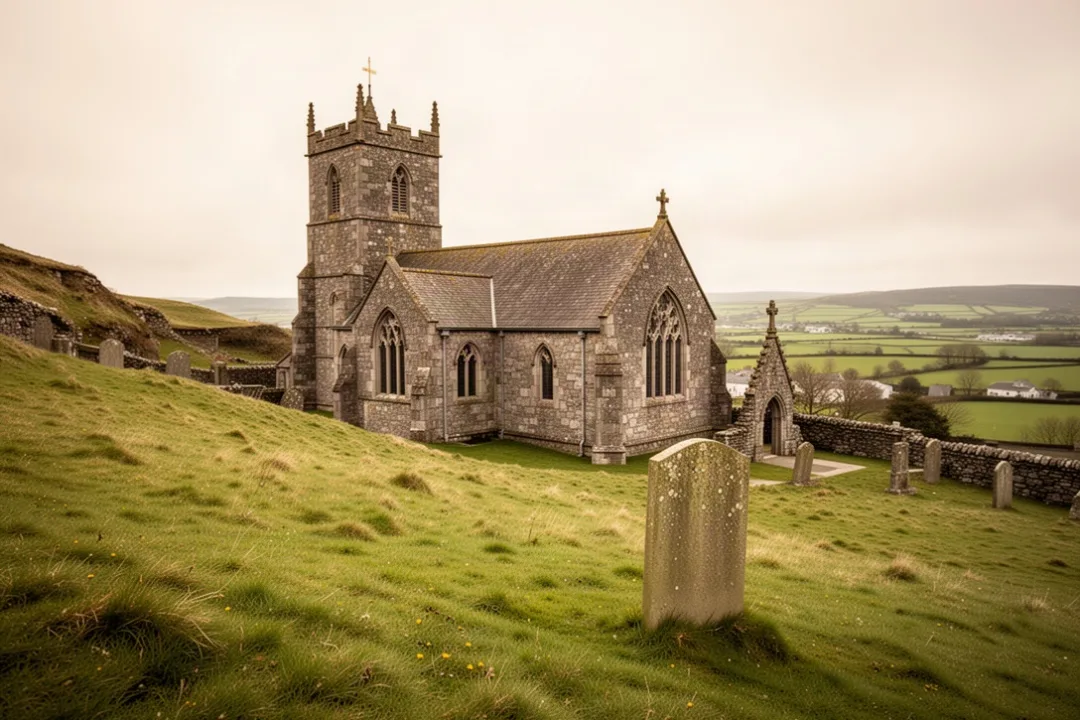
Tradition places Patrick’s death and burial at Downpatrick, a town in present-day County Down, Northern Ireland. The site has long been associated with Patrick, and Down Cathedral stands near a traditional grave marked by a large stone. The area also contains historic associations with other early Irish saints, including Brigid and Columba.
Downpatrick’s claim developed over many centuries, not from a surviving fifth-century record that clearly reports Patrick’s final day. Medieval church communities had strong reasons to preserve and promote connections with important saints. A claimed burial place could support pilgrimage, local identity, and the status of a religious institution.
That does not mean the tradition was invented recently or has no historical value. A long-standing local memory may preserve a genuine connection, but it can also combine older facts with later interpretation. Historians therefore describe Downpatrick as the traditional burial place, rather than an absolutely proven location.
Other places in Ireland are connected with Patrick’s ministry, including Armagh, Saul, and Croagh Patrick. His association with several regions can make it difficult to identify one definitive final location. Patrick traveled extensively, and later communities naturally emphasized the parts of his story most important to their own religious history.
What the earliest sources say—and do not say
Patrick’s Confessio is the most important surviving source written by Patrick himself. In it, he presents a spiritual account of his life, including his early captivity in Ireland, his Christian calling, and his work among the Irish. He writes with humility and repeatedly frames his mission as something made possible by God.
The Confessio is not a conventional biography. Patrick was not trying to record every event in chronological order, and he was not writing a medical or historical report about his final years. The work gives glimpses of his fears, opposition, and responsibilities, but it ends without describing his death.
His letter concerning Coroticus condemns the seizure and killing of newly baptized Christians. It reveals Patrick’s concern for converts and his willingness to confront powerful leaders, but it also contains no information about his eventual death. The letter is useful for understanding Patrick’s world, not for identifying the cause of his death.
Later biographies provide much more narrative material, including miracles, journeys, contests with pagan figures, and encounters with rulers. These texts are significant for understanding how Patrick’s reputation developed, but they were written long after his lifetime. Their purpose was often devotional rather than strictly documentary.
When historians assess Patrick’s death, they give the greatest weight to the earliest evidence. That evidence is limited but meaningful: Patrick was a missionary bishop who left no account of a violent death. The later stories can illuminate tradition, but they cannot automatically fill gaps in the historical record.
Did St. Patrick die as a martyr?
There is no strong evidence that Patrick was executed or otherwise killed because of his Christianity. He certainly faced danger. His writings refer to threats, hostility, criticism, and the hazards of traveling and working in a society with competing religious and political loyalties. Those dangers, however, are not the same as proof of martyrdom.
Patrick’s own description of his ministry includes serious opposition, but he does not describe a final arrest or execution. If he had died in a famous act of martyrdom, later Christian writers might have been expected to preserve a detailed account. Instead, the tradition surrounding his death emphasizes his burial and feast day more than a specific killing.
Some confusion arises because Patrick is celebrated as a major Christian saint, and many early saints were martyrs. Sainthood does not itself imply violent death. Christian traditions also honor missionaries, teachers, bishops, monastics, and people remembered for holiness who died from illness or old age.
The most defensible answer is therefore no: Patrick is not known to have died as a martyr. He may have experienced violence or faced the possibility of it during his life, but the available evidence does not establish that someone killed him.
Why historians disagree about the year Patrick died
Even the year of Patrick’s death is debated. A traditional date is March 17, 461, but some chronological interpretations place his death later, around 493. The disagreement comes from the difficulty of aligning Patrick’s writings, later records, and the succession of other early Irish church leaders.
The number 461 is often associated with a traditional chronology that places Patrick’s death relatively early in the fifth century. The later date of 493 is connected with interpretations that give Patrick a longer active career and place other important figures in a different sequence. Neither date can be confirmed by a surviving contemporary document.
Dating problems are common for people who lived in fifth-century Ireland. Written records were limited, calendars could be interpreted differently, and later authors sometimes organized events according to local traditions. A date repeated in many sources can become authoritative without being independently verified.
For that reason, responsible accounts may say that Patrick died in the late fifth century, or they may mention the traditional dates while explaining the uncertainty. The disagreement does not undermine the basic historical picture of Patrick. It shows how difficult it is to reconstruct the life of a figure from a period with few surviving records.
How Patrick’s life may have ended
Patrick appears to have spent much of his adult life serving Christian communities in Ireland. His work involved preaching, baptizing, teaching, organizing churches, communicating with other Christian leaders, and defending his mission. These activities would have required travel, correspondence, and sustained physical effort.
He also lived in a world where disease, injury, poor nutrition, and limited medical treatment could shorten a person’s life. If Patrick died from illness, the specific condition would almost certainly be impossible to identify now. No physical examination, medical record, or contemporary report survives.
It is possible that Patrick died after completing the main part of his ministry and withdrawing from public work. It is also possible that he continued working until shortly before his death. The sources do not give enough information to reconstruct his final months. Any detailed description of a final sermon, a last journey, or a particular illness should be recognized as tradition or speculation.
A cautious reconstruction would look like this:
Patrick continued his Christian mission in Ireland for many years.
He faced opposition and danger but is not known to have been executed.
He eventually died from an unknown cause, probably naturally.
Later Christians associated his death with March 17 and with Downpatrick.
This reconstruction answers the question without claiming more than the evidence permits. It also explains why accounts of Patrick’s death often sound less dramatic than stories about other saints: the surviving historical material simply does not preserve a dramatic final episode.
How later legends shaped the story of Patrick’s death
Patrick became one of Ireland’s most important saints, and his story grew as churches, writers, and communities remembered him. Medieval biographies presented him as a powerful missionary who confronted paganism, challenged rulers, and performed miracles. These accounts helped communicate religious ideals to audiences who valued sacred biography.
Legends often preserve the meaning a community attached to a person, even when they do not provide a literal record of events. Stories about Patrick’s courage and spiritual authority helped establish his role as a patron of Ireland. They also connected local landscapes, wells, churches, and hills with his ministry.
The growth of his legend does not mean every detail is false. Some traditions may preserve older memories, place names, or genuine links to Patrick. But the farther a source is removed from the events, the more carefully it must be assessed. A later story can show what people believed about Patrick without proving exactly what happened to him.
Stories about Patrick’s final days should therefore be read on two levels. They may be meaningful expressions of faith and local identity, while still being uncertain as historical evidence. Tradition explains why people remember Patrick in a certain way; early sources determine what historians can confidently claim.
Common mistakes when explaining St. Patrick’s death
Short answers about Patrick often repeat details that sound certain but are not supported by strong evidence. If you are writing, teaching, or discussing the subject, keep the historical and traditional parts clearly separated.
Do not say Patrick was murdered. No reliable source establishes assassination, execution, or a fatal attack.
Do not call him a martyr without qualification. He is a saint, but the evidence does not show that he died for the faith through execution.
Do not treat March 17 as completely proven. It is his traditional feast day and is widely associated with his death, but the exact date remains uncertain.
Do not present Downpatrick as certain beyond dispute. It is the traditional burial place, not a location confirmed by a contemporary death record.
Do not use later legends as eyewitness testimony. Medieval biographies are valuable sources for Patrick’s cult and reputation, but they were written long after his lifetime.
Do not invent a medical diagnosis. The cause of death is unknown, and the evidence does not identify a disease.
A precise sentence can preserve both history and tradition: “St. Patrick is traditionally said to have died at Downpatrick on March 17, probably from natural causes, but the earliest sources do not record his cause or exact date of death.” That wording gives readers the answer they need while showing where uncertainty remains.
What Patrick’s own writings reveal about his final years
Although Patrick’s writings do not describe his death, they reveal how he understood his work. He saw himself as someone called to serve people in Ireland despite his own doubts and limitations. His writing also indicates that he cared deeply about the treatment of converts and about the moral responsibilities of Christian leaders.
Patrick’s tone is sometimes defensive because he faced criticism from other Christians. He explains his background and motives, apparently to show that his mission was not driven by wealth or personal status. These concerns suggest that the final period of his life may have involved continuing disputes as well as pastoral responsibilities.
He also describes himself as a person dependent on divine help. That perspective shaped how later Christians remembered him. The emphasis was not only on the physical circumstances of his death, but on a life spent serving others and establishing Christian communities.
Because the writings end without a final farewell, readers should resist treating the last sentence of the Confessio as a deathbed statement. It is a theological and personal work, not a completed biography. The missing ending is one reason the exact circumstances of Patrick’s death remain open.
Why the uncertainty does not lessen Patrick’s historical importance
Many details about Patrick remain uncertain, but his historical importance does not depend on knowing the cause of his death. His writings are rare firsthand evidence from early Christian Ireland, and they provide a direct view of a missionary bishop’s concerns during a formative period.
Patrick’s account of being taken captive as a young man, working as a slave, escaping, and later returning to Ireland is central to his identity. His letters also show how Christian communities, political power, slavery, and violence overlapped in the fifth century. These details are more securely grounded than many of the later stories about his miracles.
His death became a focus of devotion because communities wanted to honor the person who had become associated with the spread of Christianity in Ireland. Yet the legacy of a historical figure can be substantial even when the final event is poorly documented. Patrick’s surviving voice matters more than a dramatic story about how he died.
The best answer remains modest but clear: Patrick probably died naturally, likely late in the fifth century, and tradition places his death at Downpatrick on March 17. The historical record does not identify a disease, a final scene, or a violent cause of death.
How to distinguish historical fact from tradition
When you encounter a claim about Patrick’s death, ask what kind of source supports it. A statement drawn from Patrick’s own writings carries a different weight from one found in a much later saint’s life. A local tradition may be culturally important without providing the same level of historical certainty.
These questions can help you assess a claim:
How close is the source to Patrick’s lifetime? Earlier sources generally offer stronger evidence, although they can still be incomplete.
Does the source claim to record history or teach a religious lesson? A devotional story may use symbolic details rather than document events.
Do independent sources agree? A detail repeated across separate early records is more persuasive than a claim found only in one late text.
Is the statement stronger than the evidence? “Tradition places his burial at Downpatrick” is more accurate than “Patrick definitely died there.”
This approach is useful beyond Patrick’s story. Historical knowledge often includes both well-supported facts and long-standing traditions. Clear language allows you to respect religious memory while avoiding claims that the evidence cannot support.
Best one-sentence answer: St. Patrick most likely died of natural causes in fifth-century Ireland; tradition says he died at Downpatrick on March 17, but neither the exact cause nor the date is historically certain.
What remains unknown about St. Patrick’s final day
No surviving source tells us who was with Patrick, what he said, whether he was ill for a long time, or how his community responded immediately after his death. We also cannot establish with certainty where his body was first buried or how later claims about his grave developed.
Those gaps are not unusual for a person who lived more than fifteen centuries ago. The written record from early medieval Ireland is limited, and later generations preserved Patrick’s memory through worship, storytelling, place names, and church traditions. The lack of a detailed death account is therefore a limitation of the evidence, not proof that his death was mysterious or violent.
What can be said with confidence is narrower and more useful. Patrick was a fifth-century Christian missionary and bishop whose own writings survive. He became one of Ireland’s most influential saints. He is traditionally associated with a March 17 feast and with Downpatrick. The circumstances of his death, however, remain unknown, and natural causes are the most reasonable historical assumption.
Frequently asked questions
Was St. Patrick killed by the Irish?
No reliable historical source says that St. Patrick was killed by the Irish or by any particular person. His writings mention danger and opposition, but they do not describe an assassination or execution. Most historians therefore think he probably died from natural causes, although the exact illness or final circumstances cannot be identified.
Did St. Patrick die on March 17?
March 17 is traditionally observed as St. Patrick’s feast day and is commonly described as the anniversary of his death. However, the date is not confirmed by a surviving contemporary record. It is safest to call March 17 the traditional date rather than a fact established beyond doubt.
Is St. Patrick buried in Downpatrick?
Downpatrick is widely regarded as St. Patrick’s traditional burial place, and the site has been associated with him for centuries. The tradition is historically significant, but no contemporary burial record proves the location with absolute certainty. Claims about his grave should therefore be described as traditional rather than definitively documented.
What year did St. Patrick die?
The year is disputed. Many traditional accounts use 461, while some historical chronologies place his death around 493. The disagreement results from limited fifth-century records and different interpretations of Patrick’s timeline. A general reference to the late fifth century avoids presenting a debated date as certain.












Leave a Reply