Gertrude of Nivelles: Life, feast day, and patronage
Gertrude of Nivelles: Life, feast day, and patronage
If you have seen Gertrude of Nivelles associated with cats, mice, travelers, or the date March 17, you may wonder how these connections began. Gertrude was a seventh-century Frankish abbess who helped establish the monastery at Nivelles, in present-day Belgium, and became known for her disciplined religious life, care for the poor, hospitality, and support of learning.
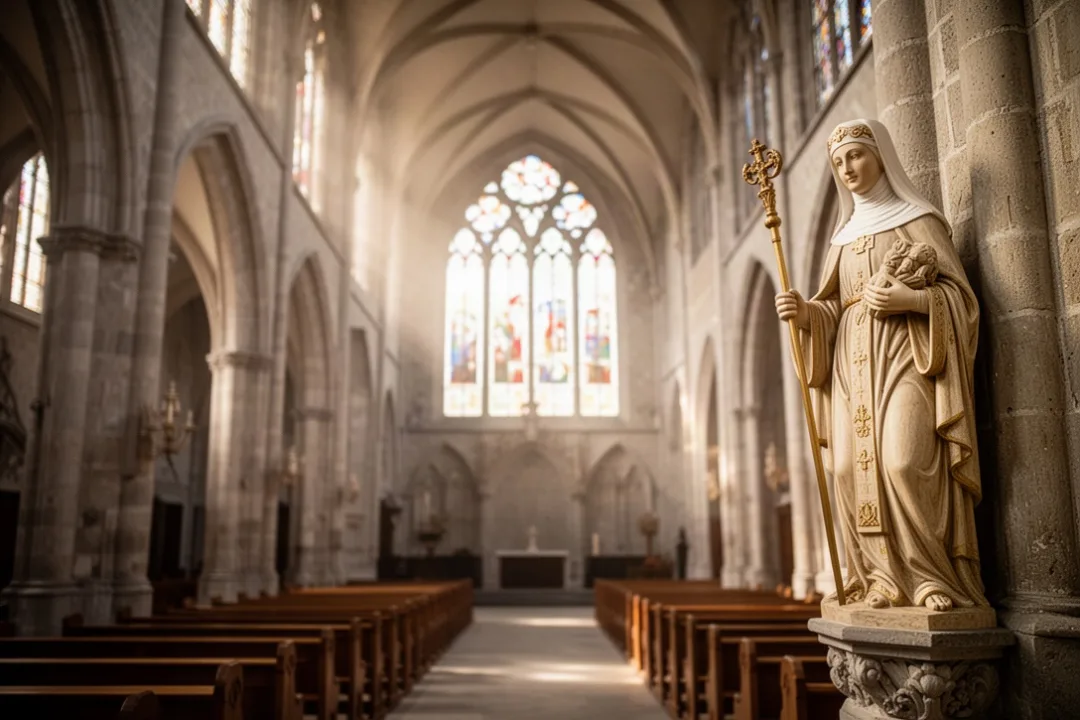
She is honored as a saint in the Catholic Church, and her traditional feast day is March 17. Medieval images often show her with a pastoral staff, a book, or mice climbing her robes. Those symbols reflect different parts of her story: her leadership as an abbess, her connection with prayer and study, and later traditions about protection from vermin and travel-related dangers.
Gertrude was born around 626 into a prominent aristocratic family in the region of Austrasia, a Frankish kingdom that included parts of modern Belgium, France, Luxembourg, and Germany. Her father was Pepin of Landen, a powerful official, and her mother was Itta, also called Ida in some sources.
Her family was connected to the political and religious life of the Frankish world. Gertrude’s sister Begga later became a saint, and several members of the family played important roles in the growth of Christian institutions in the region. Gertrude’s early surroundings therefore gave her access to influence, but the surviving accounts present her as choosing a religious vocation rather than a conventional aristocratic marriage.
After Pepin’s death, Itta founded a monastery at Nivelles with the help and encouragement of the missionary bishop Amandus. Itta is traditionally said to have cut her daughter’s hair in a religious ceremony, marking Gertrude’s decision to enter consecrated life. Gertrude then became the community’s first abbess.
Historical perspective: Much of what is known about Gertrude comes from medieval religious biographies written after her death. They preserve the memory of her character and influence, but some miraculous episodes belong to devotional tradition rather than independently documented history.
How Gertrude’s life unfolded
The main events of her life can be understood in a straightforward sequence:
She was born into a leading Frankish family around the early seventh century.
She rejected a proposed marriage, according to her traditional biography, and chose religious consecration.
Her mother Itta founded the monastery at Nivelles after the death of Pepin of Landen.
Gertrude became the first abbess and guided a mixed religious community that included women and, in its early development, men serving the monastery.
She supported missionary activity and education, including relationships with Irish monks and other church leaders.
She resigned from administrative duties near the end of her life, according to tradition, and devoted more time to prayer.
She died on March 17, 659, and was buried at Nivelles.
This sequence matters because Gertrude’s significance was not based only on private devotion. She was also an organizer, a religious superior, a patron of missionary work, and a public figure within the Merovingian church.
Why Gertrude refused marriage and entered religious life
Medieval accounts say that Gertrude was presented with a marriage proposal while she was still young. Rather than accept the match, she reportedly declared that she wanted Christ as her bridegroom. The story expresses a central ideal of early medieval Christian spirituality: a consecrated woman could dedicate her life entirely to prayer, service, and the religious community.
The episode should also be read in its social setting. Aristocratic marriages often served family alliances and political interests. Gertrude’s choice represented a significant alternative to those expectations. By entering a monastery, she did not disappear from public life; as an abbess from a powerful family, she gained responsibility for property, people, hospitality, and religious affairs.
Her vocation therefore combined personal commitment with institutional leadership. The tradition emphasizes her courage and determination, while the monastery’s later history shows that her decision helped create a lasting center of worship and community life.
What Gertrude did as abbess of Nivelles
As abbess, Gertrude was responsible for far more than leading daily prayers. A monastery required food, land management, buildings, supplies, legal protection, and a system for welcoming visitors. It also needed people able to copy books, teach, care for the sick, and maintain the liturgical life of the community.
Traditional accounts describe Gertrude as generous to the poor and attentive to travelers. Nivelles stood in a region where roads connected settlements and religious centers, so hospitality had both a spiritual and practical value. Monasteries frequently served as places where pilgrims, clergy, messengers, and people in need could receive shelter or assistance.
Gertrude is also associated with the education of religious women. A monastery could preserve texts and provide instruction in prayer, Scripture, chant, and the skills needed to administer a community. The evidence does not support imagining a modern school system, but Nivelles was clearly remembered as a place connected with learning and religious culture.
Her leadership was supported by her mother, Itta, and by religious advisers and missionaries connected with the monastery. This collaboration reflects how early medieval monasteries often developed: wealthy families supplied land and protection, abbesses organized the community, and clergy or monks provided pastoral and scholarly support.
Gertrude’s connection with Irish monks and missionary work
Gertrude’s story is connected with Irish missionaries, particularly Foillan, who is traditionally identified as the brother of the missionary saint Fursa. These monks were active in the Christianization and religious development of parts of the Frankish territories. Their presence helped link Nivelles with broader networks of prayer, travel, preaching, and learning.
According to the traditional account, Gertrude and the community at Nivelles offered support to Foillan and other religious travelers. After Foillan’s death, his relics were brought to the area and connected with the monastery at Fosses-la-Ville, where he was venerated. The details belong partly to medieval tradition, but they illustrate the role Nivelles played in regional Christian networks.
Gertrude’s support for missionaries did not necessarily mean that she traveled widely herself. Her contribution was often logistical and institutional: offering hospitality, arranging resources, preserving relationships, and sustaining a place where religious work could continue. That form of leadership was essential to the survival of missions and monasteries.
A useful distinction: Gertrude is sometimes described simply as a contemplative nun, but her historical importance also comes from administration, hospitality, education, and patronage. Her religious life involved practical responsibility as well as prayer.
What happened during Gertrude’s final years
Gertrude died relatively young, traditionally at the age of about thirty-three. Medieval sources say that the demands of leadership affected her health, and that she entrusted more of the monastery’s administration to others before her death. Whether every detail can be confirmed, the tradition presents her final period as one of intensified prayer and preparation.
Her death on March 17, 659, gave the community a permanent annual day of remembrance. The monastery at Nivelles continued to develop, and Gertrude’s reputation spread beyond the original community. The place became an important pilgrimage center, and her relics were honored there for centuries.
The surviving church at Nivelles, the Collegiate Church of Saint Gertrude, is associated with her memory. The building has undergone changes and restoration over time, as has much medieval architecture, but the site remains one of the clearest places to encounter her historical and devotional legacy.
Why March 17 is Gertrude’s feast day
Gertrude’s traditional feast day is March 17, the anniversary of her death. In Christian liturgical calendars, a saint’s feast commonly falls on the day the person died, understood as the saint’s entrance into eternal life. This date also places her feast close to the beginning of spring in the Northern Hemisphere, which helped connect her with seasonal customs in parts of Europe.
March 17 is also associated with Saint Patrick, whose feast is more widely recognized in the United States. Gertrude’s feast can therefore receive less attention in general culture, even though it remains significant in Catholic communities and in regions where she has a strong local cult.
Some calendars may use different levels of observance or different local dates, depending on the church, diocese, religious order, or country. If you are looking for a service, procession, or parish celebration, check the calendar of the specific community rather than assuming that every church observes her feast in the same way.
Artists use a small group of recurring symbols to identify Gertrude. These images developed over centuries, so their meaning may vary from one work to another.
Pastoral staff: This represents her role as abbess and spiritual leader of the monastery.
Book: The book may signify prayer, learning, Scripture, or the written traditions of the religious community.
Church or monastery: A building points to her foundation and leadership at Nivelles.
Mice or rats: These reflect later traditions that connected her with protection from rodents and other household or agricultural pests.
Travelers or pilgrims: These refer to hospitality, roads, and her association with people journeying for religious or practical reasons.
Staff with mice: In some images, the animals climb the pastoral staff or her robes, combining her abbess symbol with her unusual patronage.
The mouse symbolism can seem surprising because it is not the central feature of the earliest accounts of her life. It developed as her cult expanded and as local communities connected her name with protection from vermin, illness, or dangers associated with travel. Religious art often preserves these later associations even when they are not part of the saint’s original biography.
Why Gertrude is associated with cats and mice
Gertrude is more traditionally linked with mice and rats than with cats. In some modern references, people mention cats because cats are natural protectors against rodents, but the historical devotional symbol is usually the mouse or rat itself. Medieval and early modern communities invoked Gertrude against infestations that could threaten stored grain, food supplies, and household life.
One explanation connects the rodents with a vision or symbolic image in which mice climbed over Gertrude’s staff or clothing. Another tradition links her with protection from plagues or pests. These stories should not be treated as a single, fully documented historical event. They are examples of how local devotion adapts a saint’s reputation to everyday concerns.
For farmers and householders, vermin were not a minor inconvenience. Rodents could damage crops, consume food, and spread fear during periods when communities had limited ways to control infestations. Invoking Gertrude gave a religious form to an urgent practical concern.
Some people today ask whether Gertrude is the patron saint of cats. That description is understandable but imprecise. She may be represented with cats in some modern settings, yet her more established animal association is with mice and rats.
What Gertrude is the patron saint of
Patronage developed gradually through prayer, local custom, stories, and the needs of communities. Gertrude is commonly invoked by people connected with several areas:
Travelers and pilgrims: Her monastery welcomed people on the road, and later traditions associated her with safe travel.
Gardeners and farmers: Her connection with rodents made her relevant to those protecting crops and stored food.
People seeking protection from mice and rats: This is one of her best-known popular associations.
Widows: Her name may appear among patrons connected with women facing major changes in family or social circumstances.
Mental and emotional distress: Some devotional traditions invoke her in connection with illness or suffering of the mind, although the historical basis for this patronage is less direct than her connection with Nivelles and rodents.
Hospitality and charitable care: Her reputation for assisting the poor and travelers supports this broader devotional connection.
Patron saint lists are not always identical. A local church may emphasize one aspect of Gertrude’s story while another community focuses on a different one. Her most secure historical associations are her role as abbess of Nivelles, her support for religious communities, and her reputation for prayer, service, and hospitality.
How to observe Gertrude’s feast day
Someone who wants to honor Gertrude does not need a complicated ceremony. The most fitting observance reflects the parts of her life that communities remembered: prayer, care for vulnerable people, hospitality, learning, and protection of the home.
Attend Mass or another prayer service on or near March 17, if one is available in your parish.
Read about Nivelles and early medieval monastic life to place her story in its historical setting.
Pray for travelers, pilgrims, farmers, gardeners, or people facing housing and food insecurity.
Offer practical help to someone in need, such as donating food or supporting a shelter.
Care for your home and garden responsibly rather than relying on superstition, especially when dealing with pests.
Use religious art thoughtfully, recognizing that mice, books, and staffs represent different layers of her tradition.
A parish or religious community may mark the day with a procession, a blessing, a reading about Gertrude, or a special prayer. Customs differ by place. In Nivelles, her feast has a particularly strong local identity because the city’s church, history, and public traditions remain closely tied to her memory.
Gertrude’s significance for women’s religious history
Gertrude’s life offers a valuable example of how women exercised authority in the early medieval church. As abbess, she held responsibility over a substantial religious institution and acted within networks that included aristocratic families, bishops, missionaries, landowners, and pilgrims.
Her position was not identical to that of a modern organizational leader. The monastery operated within a world shaped by family property, royal politics, ecclesiastical authority, and local customs. Even so, an abbess could make decisions about resources, community discipline, hospitality, construction, education, and relationships with outside religious figures.
Gertrude also belongs to a wider group of early medieval women whose religious foundations helped shape European towns. Nivelles was not merely a private retreat. It became a center around which worship, settlement, pilgrimage, and local identity developed. Her story shows how religious women could influence public life through institutions that lasted long after their founders died.
Reading Gertrude’s life carefully means allowing both history and devotion to remain visible. The broad outline is widely accepted: she came from the family of Pepin and Itta, entered religious life, led the monastery at Nivelles, supported religious activity, and died in 659. Specific miracles, visions, and explanations for her patronage require more caution.
Medieval saints’ lives were not biographies in the modern sense. Their authors often aimed to show holiness through biblical patterns, miracles, heroic virtue, and signs after death. That does not make the texts useless. They reveal what communities admired in Gertrude and how her reputation developed, even when they cannot verify every episode as ordinary historical reporting.
When evaluating a claim about her, ask three questions:
Does the claim come from an early source or a much later tradition?
Is it repeated across several independent accounts, or does it appear only in one legend?
Does it describe Gertrude’s documented role, or a symbolic patronage that developed afterward?
This approach helps explain why Gertrude can be both a historically significant abbess and a saint surrounded by imaginative stories about mice, visions, and protection. The two layers are related, but they are not the same kind of evidence.
Where Gertrude of Nivelles is remembered today
Gertrude’s strongest historical center remains Nivelles, Belgium. The Collegiate Church of Saint Gertrude preserves the memory of the monastery and the saint associated with its foundation. Religious art, relics, architectural remains, and local celebrations connect the modern city with its early medieval past.
Her name also appears in churches, chapels, artworks, devotional books, and local customs in parts of Belgium, France, Germany, and other areas shaped by medieval Catholic practice. The exact form of devotion differs widely. In one place she may be remembered mainly as an abbess; in another, as a protector of travelers or crops.
For a reader encountering her name for the first time, the clearest description is this: Gertrude of Nivelles was a seventh-century abbess and founder whose religious leadership shaped one of the major early Christian communities in the Low Countries. Her later symbols add layers to that memory, but they do not replace the central story of her vocation, service, and institutional influence.
Frequently asked questions
Was Gertrude of Nivelles related to Saint Begga?
Yes. Gertrude and Begga are traditionally identified as sisters, daughters of Pepin of Landen and Itta. Begga later founded the monastery at Andenne and is also honored as a saint. Their family connections help explain why several early medieval religious communities in the region were linked to the same aristocratic network.
Is Gertrude of Nivelles the same person as Saint Gertrude the Great?
No. Gertrude of Nivelles lived in the seventh century and was an abbess in what is now Belgium. Gertrude the Great was a thirteenth-century German Benedictine nun and mystic associated with Helfta. Their names and sainthood sometimes cause confusion, but they are different historical figures with different feast traditions.
What prayer can someone say to Gertrude of Nivelles?
A person may use a traditional prayer from a prayer book or speak in their own words. Common intentions include safe travel, protection for crops and homes, help for the poor, and strength for people experiencing illness or hardship. A simple prayer can ask Gertrude to intercede for those needs and encourage practical acts of care.
Where can visitors learn more about Gertrude in person?
Nivelles, Belgium, is the most important place to visit because the Collegiate Church of Saint Gertrude preserves the city’s connection with her monastery and cult. Local museums, parish resources, and heritage organizations can provide current information about access, relics, architecture, and feast-day events before you travel.












Leave a Reply