St Adela most commonly refers to Adela of Pfalzel, a seventh- and eighth-century Frankish noblewoman who became an abbess and founded a women’s monastery at Pfalzel, near Trier in present-day Germany. Her feast day is generally observed on December 24.
Adela is remembered for using her position and resources to support Christian community life, prayer, education, and care for others. Her story also comes with some uncertainty: medieval accounts preserve valuable traditions about her, but later genealogical claims are not equally reliable.
St Adela lived during the transition from the seventh to the eighth century, a period when Christianity was becoming more firmly organized across parts of the Frankish kingdoms. The political landscape was changing, and monasteries served not only as places of worship but also as centers of learning, hospitality, administration, and social care.
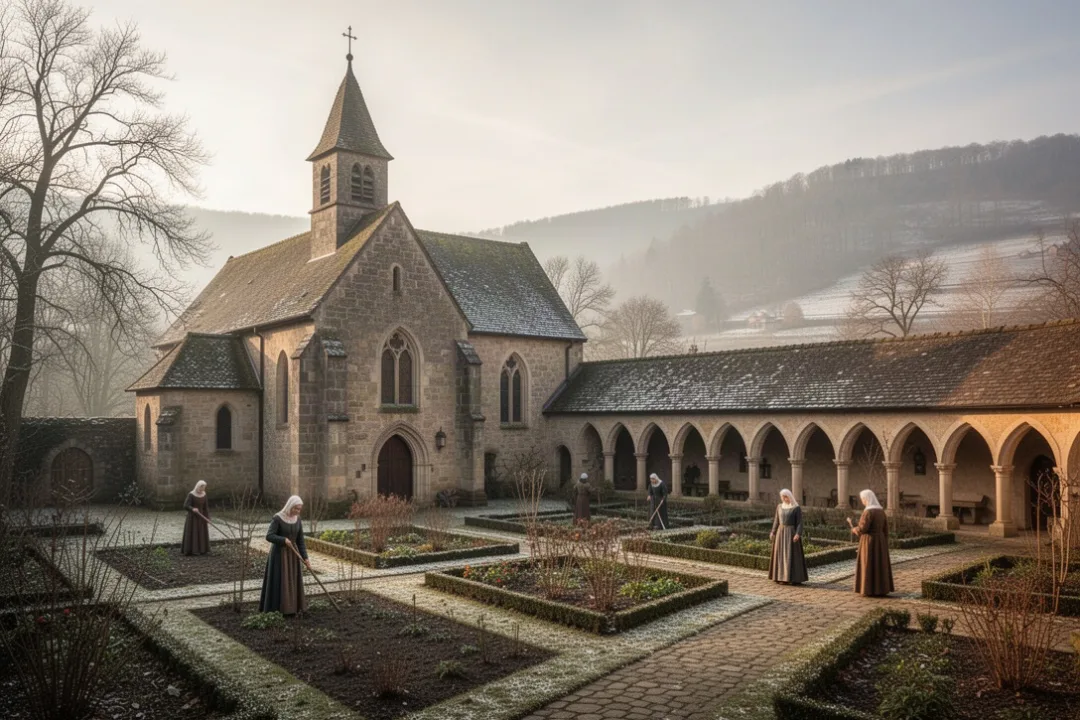
Adela is associated with Pfalzel, a settlement near Trier on the Moselle River. The place had Roman roots and was known in older sources by names related to Palatiolum. Adela established a religious community there for women, becoming its abbess and helping shape its spiritual and practical life.
Her identity is sometimes confused with other women named Adela or Adelaide. The name was used widely in medieval Europe, and records from the period are often brief. When a church calendar or devotional source simply says “St Adela,” it usually means Adela of Pfalzel, but the surrounding context can matter.
Quick identification: The saint most often meant by “St Adela” is the abbess connected with Pfalzel near Trier. She is distinct from later noblewomen named Adelaide and from historical figures who were never formally canonized.
Adela’s family background and the limits of the evidence
Medieval tradition places Adela within the Christian nobility of the Frankish world. She is frequently described as the daughter of Irmina of Oeren, another important religious woman associated with the Trier region. Some traditions also connect Adela with noble families involved in the growth of monasteries across Austrasia, the eastern part of the Frankish realm.
Her family relationships are not completely settled. Older devotional accounts and later genealogies sometimes identify her as a daughter of King Dagobert II, but historians treat that claim cautiously because the supporting evidence is limited and the tradition developed long after the period in which she lived.
That uncertainty does not erase Adela’s historical importance. It simply means that her documented religious work deserves more confidence than every detail of her ancestry. Her connection with Pfalzel and her role as an abbess are central to the tradition surrounding her.
Adela is also connected in some accounts with Alberic, a churchman associated with Utrecht. The exact family relationships in this period can be difficult to reconstruct, and different sources present them differently. A responsible account should distinguish between early evidence, later biography, and pious tradition.
Why Adela founded a monastery at Pfalzel
Women’s monasteries in the early medieval period could be influential institutions. They gave women a structured setting for prayer and religious discipline, while also offering opportunities for leadership, education, manuscript work, hospitality, and service. An abbess often managed land, buildings, workers, supplies, and relationships with local rulers or bishops.
Adela’s foundation at Pfalzel was therefore more than a private retreat. It created a stable Christian community in a region with a long history of settlement and religious activity. The monastery could support the worship of God while also contributing to the development of the surrounding area.
Her example shows how religious leadership and practical administration could work together. A community needed rules and prayer, but it also needed food, shelter, trained members, careful stewardship, and relationships with neighbors. The abbess carried responsibility for both spiritual direction and daily order.
Although the surviving record does not provide a complete picture of the monastery’s earliest years, Adela’s name remained linked with Pfalzel. That continuing association is one reason she is honored as a founder and not merely as a private holy woman.
What St Adela is known for
St Adela is chiefly remembered for four connected qualities: founding a monastery, exercising wise leadership, maintaining a life of prayer, and supporting the Christian community around her. These themes appear more consistently than dramatic stories of miracles or martyrdom.
Foundation: She is associated with establishing the women’s religious community at Pfalzel.
Leadership: She served as an abbess, guiding the community and managing its responsibilities.
Steadfast faith: Her memory emphasizes a disciplined Christian life rather than a single spectacular event.
Service: Her work reflects the broader role monasteries played in education, hospitality, worship, and care.
Adela was not a martyr in the usual sense. She is honored as a woman who pursued holiness through consecrated community life and responsible leadership. Her example can be especially meaningful to people who understand service as patient, organized, and faithful work carried out over many years.
There is no universally recognized patronage associated with St Adela in the way that some saints are patrons of a particular profession, illness, or place. She may still be chosen as a personal patron by women religious, abbesses, community leaders, or anyone seeking guidance in serving others with sound judgment.
St Adela’s feast day and church calendar
The traditional feast day of St Adela of Pfalzel is December 24, Christmas Eve. The date places her commemoration immediately before the celebration of Christ’s birth, a season that highlights faithfulness, expectation, humility, and the faithful care of a community.
Local calendars can differ. A parish, religious order, diocese, or traditional calendar may use a different date or may not include Adela in its public calendar. The most reliable way to confirm a local observance is to check the calendar of the church or community where you worship.
December 24 can make her feast easy to overlook because Christmas preparations dominate the day. A brief commemoration can still be appropriate: lighting a candle, reading about her foundation at Pfalzel, praying for religious communities, or remembering people whose quiet work supports a church or neighborhood.
The placement of her feast should not be treated as proof that every detail of her biography is certain. Feast days preserve the Church’s devotional memory, while historical research continues to examine dates, family connections, and the development of written accounts.
How St Adela is represented in art and devotion
There is no single universal artistic image of St Adela. Because she is honored as an abbess and founder, she may be shown in a religious habit or with a veil, sometimes holding a pastoral staff that signifies her authority as an abbess. Images may also include a church, monastery, or model of a religious house.
These symbols communicate her role rather than document exactly what she wore. Early medieval clothing varied by community and social position, and later artists often portrayed saints according to the artistic conventions of their own period.
A building in her hand can represent the monastery at Pfalzel or the work of founding and protecting a religious community. A book may suggest prayer, Scripture, learning, or the governance of a community according to a rule. A staff may symbolize pastoral responsibility rather than rank or worldly power.
When looking at an image of St Adela, ask what the symbols teach about her vocation. The emphasis is usually on faithful stewardship: creating a place where worship, learning, discipline, and care for others could continue.
Adela’s story presents holiness as more than private religious feeling. Founding and guiding a monastery required decisions about people, property, routines, and long-term stability. Her example connects prayer with the responsibilities that make a community possible.
One lesson is the value of building institutions that outlast one person. A founder may begin a work, but a community survives only when its members are formed, supported, and given clear responsibilities. Adela’s memory points toward patient preparation rather than quick recognition.
A second lesson is the dignity of practical service. Meals must be organized, visitors welcomed, buildings maintained, and vulnerable people treated with care. These tasks may receive little public attention, yet they allow a religious community to fulfill its purpose.
A third lesson concerns responsible use of influence. Adela’s noble background likely gave her access to resources and connections that many people did not have. Her example invites you to consider how time, authority, education, money, and relationships can be used for the good of others.
Her story also encourages intellectual honesty. Admiring a saint does not require repeating every later legend as established fact. Faithful devotion and careful historical judgment can coexist, especially when the surviving evidence is incomplete.
Practical ways to honor St Adela
You do not need to live in Germany or belong to a monastery to mark St Adela’s feast. A meaningful observance can connect her historical setting with a concrete act of prayer or service.
Pray for religious communities. Remember women and men who serve through prayer, education, hospitality, healthcare, parish ministry, or care for the vulnerable.
Learn about Pfalzel. Read about the settlement near Trier and the history of its religious foundation to place Adela’s life in its geographic setting.
Support quiet service. Donate supplies, time, or practical help to a church, shelter, school, monastery, or community organization.
Pray for wise leadership. Ask for the patience to make decisions that benefit a whole community rather than only yourself.
Share her story accurately. When speaking about her family or dates, distinguish established tradition from details that remain uncertain.
Families can mark the feast with a short prayer for people who care for others behind the scenes. A parish might mention Adela during prayers for religious vocations or community leaders. A school or study group could discuss how monasteries preserved learning and provided social support in the early Middle Ages.
Common mistakes when researching St Adela
The short search phrase “St Adela” can lead to mixed results. Some pages combine several women with similar names, while others present medieval traditions as though every detail were documented. A careful reader can avoid confusion by checking the saint’s location, role, and feast day together.
Do not assume every Adela is the same person. Compare the place, century, religious role, and feast date.
Do not treat the royal ancestry as certain. The claim that Adela was a daughter of Dagobert II belongs to a tradition that historians question.
Do not confuse an abbess with a martyr. Adela is primarily remembered for religious leadership and foundation work.
Do not assume December 24 is universal. Local and denominational calendars may vary.
Do not assign an unverified patronage. Her recognized identity is linked to Pfalzel and monastic leadership, not a universally agreed special cause.
Do not overlook the place. Pfalzel is central to identifying this particular St Adela.
Research tip: When a biography gives a precise family tree or dramatic event, check whether it comes from an early record, a medieval life, or a much later genealogy. The source’s age and purpose affect how confidently the detail should be presented.
Adela’s relationship to other saints named Adelaide
Adela is related linguistically to names such as Adelaide and Adelheid, which come from Germanic elements associated with nobility and kind or graceful character. Similar names can create confusion in calendars, family histories, and online searches.
One well-known later figure is St Adelaide of Italy, a tenth-century empress whose life and feast day are different from those of Adela of Pfalzel. She was a major political and religious figure of the Holy Roman Empire, but she should not be identified with the earlier abbess of Pfalzel.
Other women named Adela or Adelaide appear in medieval history as queens, countesses, benefactors, abbesses, or blessed figures. Some have local cults, and some are remembered in regional traditions without a universal calendar entry. The name alone cannot establish identity.
For a reliable identification, look for the combination of Pfalzel, abbess, Trier, and December 24. Those details point to the saint most commonly intended by the phrase “St Adela.”
Where St Adela’s story matters today
Adela’s historical setting is distant, but the questions raised by her life remain familiar. How should a person use inherited advantages? What makes a community stable? How can spiritual ideals shape ordinary responsibilities? Her memory offers an answer centered on faithful service with lasting purpose.
Her story is particularly relevant to people who lead schools, parishes, charitable organizations, religious houses, or families. Leadership is not only public decision-making; it also includes forming others, preserving a mission, and creating conditions in which people can flourish.
Adela can also speak to anyone whose contribution is largely unseen. The work of organizing, maintaining, teaching, welcoming, and caring may not produce dramatic stories, but it can sustain an entire community. Her example gives religious meaning to that kind of patient responsibility.
Remembering St Adela does not require exaggerating her biography. It is enough to recognize a woman associated with Pfalzel’s early religious foundation, honor the tradition that preserved her name, and imitate the virtues most closely connected with her: prayer, wise stewardship, courage, and service.
A short prayer inspired by St Adela
God of wisdom and faithful service, guide those who lead communities, care for the vulnerable, and preserve places of prayer. Through the example associated with St Adela of Pfalzel, teach us to use our gifts responsibly, serve with patience, and build what will help others seek truth and peace. Amen.
You can adapt this prayer for a parish, school, family, or religious community. On December 24, it may be paired with a prayer for those preparing for Christmas and for all who spend the season serving others rather than receiving public recognition.
Frequently asked questions
Is St Adela the same person as St Adelaide?
Not usually. St Adela of Pfalzel was an early medieval abbess associated with a monastery near Trier, while St Adelaide of Italy was a later empress and religious patron. Their names are related, but their lives, dates, places, and historical roles are different. Check the location and feast day before treating a reference to “Adela” or “Adelaide” as a specific saint.
Was St Adela a daughter of King Dagobert II?
Some medieval traditions describe Adela as a daughter of Dagobert II, but historians do not regard that relationship as firmly established. Her association with Pfalzel and her role as an abbess are more secure parts of her traditional biography. Genealogical claims about early medieval nobles should be presented with care because later sources sometimes expanded or reshaped family connections.
What is St Adela the patron saint of?
St Adela does not have a universally recognized patronage comparable to saints associated with a particular illness, trade, or country. Because she is remembered as an abbess and founder, individuals may reasonably ask for her intercession for religious communities, responsible leadership, spiritual formation, and work that supports others. Those uses are devotional applications rather than universally established official patronages.
How can I celebrate St Adela’s feast day?
Her traditional feast day is December 24. You could attend worship, pray for monasteries and religious vocations, learn about Pfalzel, or perform a practical act of service. Supporting a food pantry, helping a church prepare for Christmas, or thanking someone whose quiet work sustains a community reflects the leadership and stewardship associated with Adela.














Leave a Reply