St. Patrick’s Breastplate: meaning and prayer guide
St. Patrick’s Breastplate: meaning and prayer guide
You may have heard someone mention St. Patrick’s Breastplate as a prayer for protection and wondered whether it is a literal piece of armor, a poem, or a Christian devotion. It is a traditional prayer, also called the Lorica of St. Patrick, that asks Christ to surround the believer’s whole life: body, mind, faith, relationships, and daily work.
The word lorica originally referred to a protective breastplate or cuirass. In Christian prayer, the image became a way of asking God to guard a person spiritually. St. Patrick’s Breastplate is especially known for its repeated focus on Christ’s presence: Christ before the believer, behind, above, below, within, and around them.
The short answer: St. Patrick’s Breastplate is not a spell or a guarantee against harm. It is a prayer of dedication, trust, and spiritual protection centered on Christ.
What St. Patrick’s Breastplate is and what it is not
St. Patrick’s Breastplate is a long Christian prayer traditionally associated with Patrick, the fifth-century missionary and bishop connected with Ireland. It is also known by the Irish title Faed Fíada, often translated as “the deer’s cry” or “the deer’s prayer.” The exact meaning and history of that title are debated, and English translations vary.
The prayer asks for Christ’s protection through a series of affirmations. It draws attention to the Christian faith, the Trinity, creation, angels, saints, the work of the sun and moon, and the believer’s ordinary surroundings. Its best-known section names Christ as present in every direction and circumstance.
Despite the popular name, there is no reliable evidence that Patrick wrote down the prayer in the form commonly printed today. The traditional association gives the prayer its identity, but its authorship and date are not certain. The earliest surviving manuscript witness is generally connected with the Book of Armagh, a medieval manuscript from the early eleventh century. Scholars often place the composition of the prayer earlier than that manuscript, but the exact date remains uncertain.
This distinction matters because it allows you to appreciate the prayer without treating uncertain traditions as established facts. It is ancient in character and deeply rooted in Irish Christian spirituality, even though the familiar claim that Patrick personally composed every line cannot be proven.
How the prayer is organized
The full prayer is much longer than the familiar closing lines. Its structure moves from faith and divine power toward a personal request for protection. Different prayer books divide it into slightly different sections, but the main progression is easy to recognize.
Faith in the Trinity: The prayer begins by affirming belief in the Father, Son, and Holy Spirit.
Christ’s saving work: It recalls Christ’s incarnation, baptism, death, resurrection, ascension, and future judgment.
God’s created order: The sun, fire, lightning, wind, sea, earth, and rocks become reminders of divine strength.
Heavenly and human witnesses: Angels, saints, patriarchs, prophets, apostles, and other faithful people are named as part of the spiritual community.
Personal protection: The person praying asks to be guarded from destructive forces, falsehood, traps, and hostile influences.
Christ’s presence: The prayer ends with a powerful list of places and relationships in which Christ is present and active.
This movement gives the prayer a deliberate rhythm. It does not begin with fear and stay there. Instead, it starts with what the believer trusts, then places personal concerns within that larger confession of faith.
How to pray St. Patrick’s Breastplate step by step
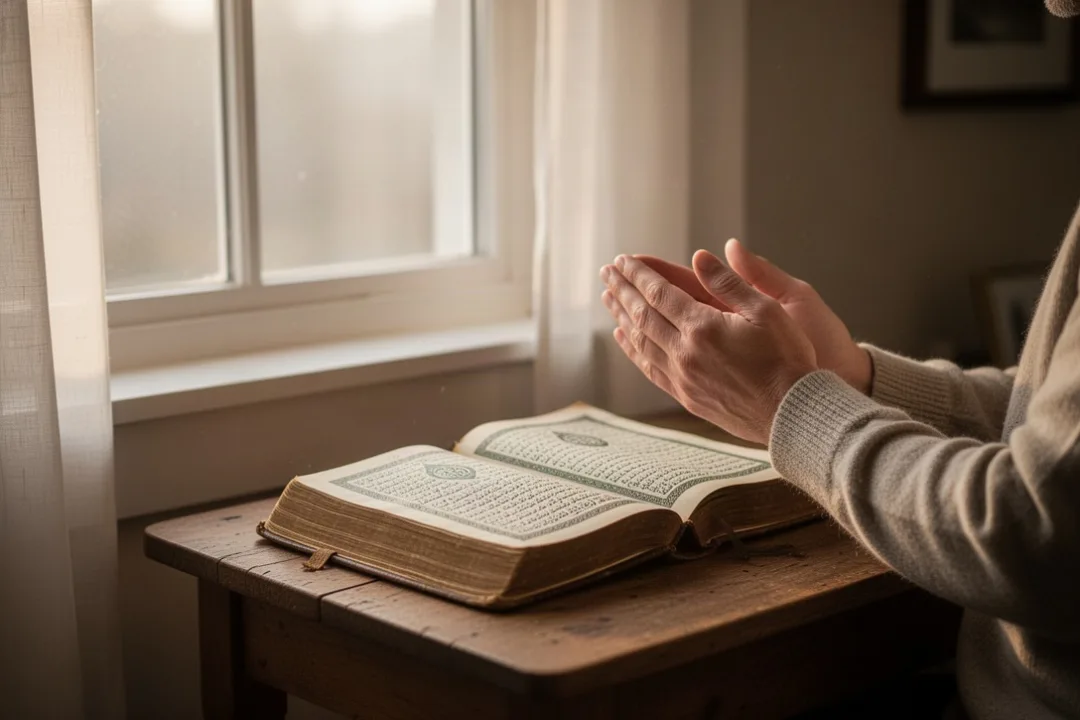
You do not need a special object, location, or physical posture to pray it. Some people pray the entire text slowly; others use a shorter section each morning. The prayer can take several minutes, especially when you pause over each image.
Choose a quiet moment. Morning, bedtime, or the beginning of a difficult day can work well. You can also pray it while walking or traveling.
Begin with the central purpose. Ask God to help you trust Christ rather than treating the prayer as a protective formula.
Read the prayer slowly. The full version contains many images and names. Let each section bring a different aspect of faith to mind.
Personalize the request. Mention a particular fear, decision, relationship, temptation, or responsibility that you are carrying.
Pause at the Christ-centered lines. Consider what it means for Christ to be with you in front, behind, above, below, within, and around you.
End with practical faithfulness. Ask for wisdom to make good choices, courage to seek help, and compassion toward the people around you.
If the complete prayer feels too long, use a short daily pattern. You might read the opening confession on one day, the protection section on another, and the final Christ-with-me section throughout the week. The point is not speed or perfect memorization; it is attentive prayer.
What the main images in St. Patrick’s Breastplate mean
The breastplate represents spiritual commitment
A breastplate protects the chest, but the prayer uses that image symbolically. In ancient Christian language, putting on a spiritual defense could mean choosing truth, faith, righteousness, and steadfastness. The breastplate is therefore less like an invisible shield that prevents every bad event and more like a declaration of where your security rests.
Praying the lorica can remind you to guard your inner life from panic, bitterness, dishonesty, and despair. It also points beyond self-reliance. The believer is not claiming personal control over every danger; the believer is asking to remain faithful and attentive in the middle of danger.
The opening references to the Father, Son, and Holy Spirit place the prayer within traditional Christian belief. The protection being requested is not presented as an impersonal energy. It is sought from the living God, known through creation, Christ’s saving work, and the presence of the Holy Spirit.
For many Christians, this makes the prayer an act of creedal faith as well as personal devotion. It says, in effect, that protection begins with remembering who God is before asking what God will do.
Creation shows that God is not limited to one place
The prayer names natural forces such as sunlight, fire, lightning, wind, deep water, earth, and solid ground. These images can sound unfamiliar to modern readers, but they communicate something straightforward: the God who sustains creation is not confined to a church building or a private devotional moment.
These references can also change the way you pray. Instead of viewing the world only as a source of threats, you can see ordinary elements as reminders of order, strength, dependence, and wonder. The prayer’s natural imagery is not meant to make the sun or sea divine. It directs attention from creation to its Creator.
The saints represent a community of faith
St. Patrick’s Breastplate refers to figures from Christian history and Scripture, including apostles, prophets, patriarchs, and other faithful witnesses. Their presence reinforces the idea that no Christian prays in total isolation. Faith has been handed down through generations, often by people who endured danger, uncertainty, and opposition.
Different Christian traditions understand the role of saints differently. Some ask saints to pray for them, while others use the names primarily as examples of faithful discipleship. Either way, the prayer connects personal devotion with a much larger history.
The repeated “Christ with me” lines express constant presence
The final section is the part most people recognize. It describes Christ with the person praying in multiple directions and relationships: before and behind, above and below, on the right and left, in the heart of everyone who thinks of the believer, in the mouth of those who speak, and in the eyes and ears of those who encounter them.
Christ with me, Christ before me, Christ behind me, Christ in me, Christ beneath me, Christ above me.
These lines are not a claim that every thought or statement made by another person automatically comes from Christ. They are a prayer that Christ’s presence will shape the believer’s relationships, speech, perception, and response to the world.
What “protection” means in this Christian prayer
People often turn to St. Patrick’s Breastplate before travel, during illness, when facing conflict, or while feeling spiritually vulnerable. The prayer can provide a strong framework for asking for protection, but its meaning should be kept grounded. It does not promise that accidents, loss, illness, or injustice will never occur.
Instead, protection may include strength to endure, discernment to avoid harmful choices, courage to tell the truth, and help from other people. It can also mean protection from becoming consumed by fear or responding to hostility with cruelty.
That understanding fits the prayer’s language. The text asks for help against snares, false accusations, harmful influences, and spiritual enemies, but it also centers the character and presence of Christ. The goal is not simply to escape every difficulty. It is to remain aligned with God while facing real life.
Use the prayer with wisdom: If you are dealing with abuse, a medical emergency, threats, or severe mental distress, prayer can accompany practical help but should not replace emergency services, medical care, counseling, or a trusted support network.
How the prayer differs from a magical protection formula
A magical formula is usually treated as a set of words that produces a desired result when spoken correctly. St. Patrick’s Breastplate belongs to a different category. It is a Christian prayer that expresses dependence on God, and its words do not function as a charm that gives the speaker control over events.
The distinction is especially useful if you are new to traditional prayers. You do not need to pronounce every phrase perfectly, repeat it a fixed number of times, or carry a printed copy as a talisman. You can pray it sincerely in your own language and adapt the wording to your circumstances while preserving its central meaning.
That does not make the prayer weak or merely symbolic. Prayer can shape attention, calm a frightened mind, strengthen moral resolve, and help someone recognize the need for community and action. Its power is understood through relationship with God, not through secret properties in the wording.
Ways to use St. Patrick’s Breastplate in daily life
The prayer works best when connected to a specific rhythm rather than treated as something you read only when frightened. A regular practice can help you remember its meaning when pressure makes clear thinking difficult.
Morning dedication: Pray the Christ-with-me lines before work, school, caregiving, or travel.
Before a difficult conversation: Ask for truthful speech, patient listening, and freedom from the desire to win at any cost.
During a transition: Use the prayer when starting a new job, moving, entering treatment, or taking on a major responsibility.
At bedtime: Place the day’s failures and worries before God rather than rehearsing them through the night.
With children or a group: Select a few accessible lines and explain the images instead of expecting everyone to understand the full text immediately.
During outdoor prayer: Let references to light, wind, water, and earth prompt gratitude for creation.
You can also write a personal response after praying. Ask yourself: What am I afraid of? What truth do I need to remember? What responsible action is available to me today? This keeps the devotion connected to real decisions rather than leaving it as a purely abstract exercise.
Why the historical uncertainty does not erase the prayer’s value
Some readers feel disappointed when they learn that the prayer may not be directly traceable to Patrick. Historical caution does not require dismissing the devotion. Many prayers have complex transmission histories, changing translations, and traditional names that express how communities received them rather than proving a single author.
The important questions are also theological and practical: What does the prayer say? Does it direct attention toward Christ? Does it encourage truth, courage, humility, and love? Can it help you pray honestly without encouraging superstition or passivity?
St. Patrick’s Breastplate has endured because its images are memorable and comprehensive. It brings together doctrine, nature, community, danger, and personal trust. Even when read as a medieval prayer associated with Patrick rather than a document certainly written by him, it remains a significant part of Christian devotional history.
A simple short form for busy days
When you cannot pray the complete lorica, a brief form can preserve its central movement. Begin by naming your trust in the Father, Son, and Holy Spirit. Then ask Christ to be with you in your thoughts, words, choices, work, relationships, and surroundings.
You might pray in your own words:
Christ with me in this day; Christ before me in each decision; Christ behind me in what I leave; Christ within me in my thoughts; Christ around me in every encounter.
Follow that prayer with one concrete request. For example, ask for patience during a conflict, wisdom about a medical decision, courage to set a boundary, or compassion for someone who is difficult to understand. A specific request helps turn a broad prayer of protection into attentive discipleship.
There is no single universally used English translation. Some versions are poetic and formal, while others use contemporary language. A good version should preserve the prayer’s Christian focus and make its meaning understandable to you.
Does the wording clearly center on Christ and the Trinity?
Does the translation explain unfamiliar references in notes or surrounding material?
Can you understand the request for protection without treating it as a guarantee?
Does the length fit the way you actually pray?
Does the version identify itself as a translation or adaptation when appropriate?
If a phrase seems confusing, look at another translation rather than assuming the confusion is spiritually significant. Older English can sound solemn, but archaic wording is not required for sincere prayer. Understanding and attention matter more than a particular style.
St. Patrick’s Breastplate and the armor of God
Readers sometimes connect this prayer with the “armor of God” passage in Ephesians 6. That connection is understandable because both use defensive clothing as an image for faithful living. The two texts are not the same, however, and St. Patrick’s Breastplate is not simply another version of the Ephesians passage.
The Ephesians imagery emphasizes truth, righteousness, faith, salvation, the gospel of peace, and the word of God. The lorica emphasizes Christ’s presence, the Trinity, creation, the saints, and a broad request for protection. Reading them together can be meaningful, as long as you recognize the distinct voice and history of each prayer.
Both point toward a similar practical reality: Christian protection includes the formation of character. A person who prays for protection is also being invited to practice honesty, mercy, courage, self-control, and love. The prayer does not remove the need to live those virtues.
When St. Patrick’s Breastplate may be especially meaningful
The prayer can speak powerfully during moments when your life feels divided or exposed. Its repeated “Christ with me” pattern gathers scattered attention and places each area of life under one central relationship.
It may be particularly helpful when you are:
Starting or ending a demanding season of work or study
Traveling away from home or caring for someone at a distance
Facing grief, uncertainty, illness, or a major change
Trying to respond wisely to hostility or pressure
Seeking a daily prayer that combines doctrine with personal devotion
Looking for a traditional Christian text to pray with a family or congregation
Approach it as a practice of remembrance. You are reminding yourself that faith is not confined to one part of the day, one location, or one emotional state. The prayer asks you to recognize Christ in your responsibilities, relationships, fears, and hopes—and to respond to those realities with trust and wise action.
Frequently asked questions
Is St. Patrick’s Breastplate really written by St. Patrick?
The prayer is traditionally associated with St. Patrick, but direct authorship has not been established. Its earliest surviving manuscript witness is medieval, and scholars debate when its underlying composition took shape. It is more accurate to call it an ancient Christian prayer linked by tradition to Patrick than to present every line as certainly written by him.
What does “lorica” mean in St. Patrick’s Breastplate?
“Lorica” is a Latin word associated with protective body armor, especially a breastplate. In Christian devotional language, it became a metaphor for prayerful spiritual protection. The term does not mean that the prayer is a physical shield or charm. It expresses a request to remain guarded in faith, character, judgment, and relationship with Christ.
Can I pray St. Patrick’s Breastplate every day?
Yes. Many people use it in the morning, before travel, during stressful periods, or at bedtime. You can pray the complete version or select a shorter passage, particularly the lines about Christ’s presence. Read it attentively and connect it with a specific need, while remembering that prayer complements—not replaces—practical safety measures and help from qualified professionals.
Is St. Patrick’s Breastplate only for Catholics?
No. The prayer comes from the broader history of Irish Christianity and is used by Christians from several traditions. Some communities have particular practices concerning saints, while others focus on the prayer’s direct confession of faith in God and Christ’s presence. You can use a translation that fits your tradition and understanding without needing a particular denominational identity.















Leave a Reply