Saint Cuthbert: life, miracles, relics, and legacy
Saint Cuthbert: life, miracles, relics, and legacy
Who was Saint Cuthbert, and why does his name still appear on churches, trails, crosses, and historic sites across northern England? The short answer is that Cuthbert was a seventh-century monk, hermit, bishop, and spiritual leader whose reputation grew far beyond the communities he served. His life connected disciplined prayer with practical pastoral care, and stories about his compassion, miracles, and closeness to the natural world made him one of the most influential saints of Anglo-Saxon England.
Cuthbert lived in Northumbria, a kingdom covering much of northern England and parts of southeastern Scotland. He entered monastic life during a period when Christianity was becoming firmly established but was still shaped by regional customs, political tensions, and debates about church practice. His career included service at Melrose, leadership at Lindisfarne, a period of solitude on the Farne Islands, and a brief term as bishop before his death in 687.
His story is known through medieval accounts, especially the writings of Bede, whose prose helped preserve Cuthbert’s memory for later generations. Some episodes are historical reports, while others belong to the devotional tradition surrounding a holy person. Reading the stories in that way allows you to appreciate both the documented figure and the enduring religious imagination that developed around him.
Saint Cuthbert was probably born around 634, although the exact place and date are uncertain. He grew up in the northern borderlands of Anglo-Saxon Northumbria, a region where Christian communities stood alongside older traditions and where monastic houses served as centers of worship, education, farming, and political influence.
According to the traditional account, Cuthbert experienced a powerful religious vision while tending sheep. He saw what he understood as an angel carrying the soul of a holy man to heaven and later learned that the event coincided with the death of Saint Aidan, the founding bishop of Lindisfarne. The story is usually presented as the moment that encouraged Cuthbert to enter religious life, though its details come from later written tradition rather than a modern biography.
Cuthbert joined the monastery at Melrose, then an important religious community near the River Tweed. There he came under the influence of Saint Boisil, the monastery’s prior, and developed a reputation for prayer, fasting, humility, and energetic service. His early monastic life was not limited to private devotion: monks traveled through local settlements, taught Christian practice, cared for the poor, and offered pastoral guidance.
Melrose was associated with the form of Christianity brought to Northumbria from the Irish monastic tradition. During Cuthbert’s lifetime, Northumbrian church leaders also faced the Synod of Whitby in 664, where questions about the dating of Easter and other customs were debated. The decision favored practices associated with the Roman church, and Cuthbert adapted to the changing ecclesiastical settlement rather than becoming known primarily as a partisan of the dispute.
His life can be understood through several connected roles:
Monk: He embraced prayer, fasting, communal discipline, and service.
Missionary pastor: He traveled to scattered communities to preach and minister.
Monastic leader: He served as prior at Melrose and later at Lindisfarne.
Hermit: He sought solitude on the Farne Islands for extended periods.
Bishop: He became bishop of Lindisfarne and possibly also held the title associated with Hexham.
These roles explain why Cuthbert became so important to different audiences. Monks remembered his discipline, rural Christians remembered his visits, bishops remembered his leadership, and later pilgrims remembered the holiness associated with his body and shrine. He was not portrayed as distant from ordinary people, even when he chose a life of extreme solitude.
A useful distinction: Cuthbert belonged to the Christian world of seventh-century Northumbria, long before the later medieval idea of a saint developed its full institutional form. His reputation grew through local memory, monastic writing, reported miracles, and devotion at his burial places.
How Cuthbert served as a monk, prior, and bishop
Cuthbert’s religious career moved between community leadership and solitude. At Melrose, he was valued for his strict personal practice and his ability to encourage others. Medieval accounts describe him visiting villages and remote households, sometimes walking long distances in difficult weather to reach people who had little access to formal religious instruction.
His pastoral work helped create the image of a saint who knew the landscape and its people. He was associated with the exposed hills, marshes, coasts, and islands of the north, not just with a single monastery. Traveling on foot also carried spiritual meaning: it suggested humility, endurance, and willingness to meet people where they lived.
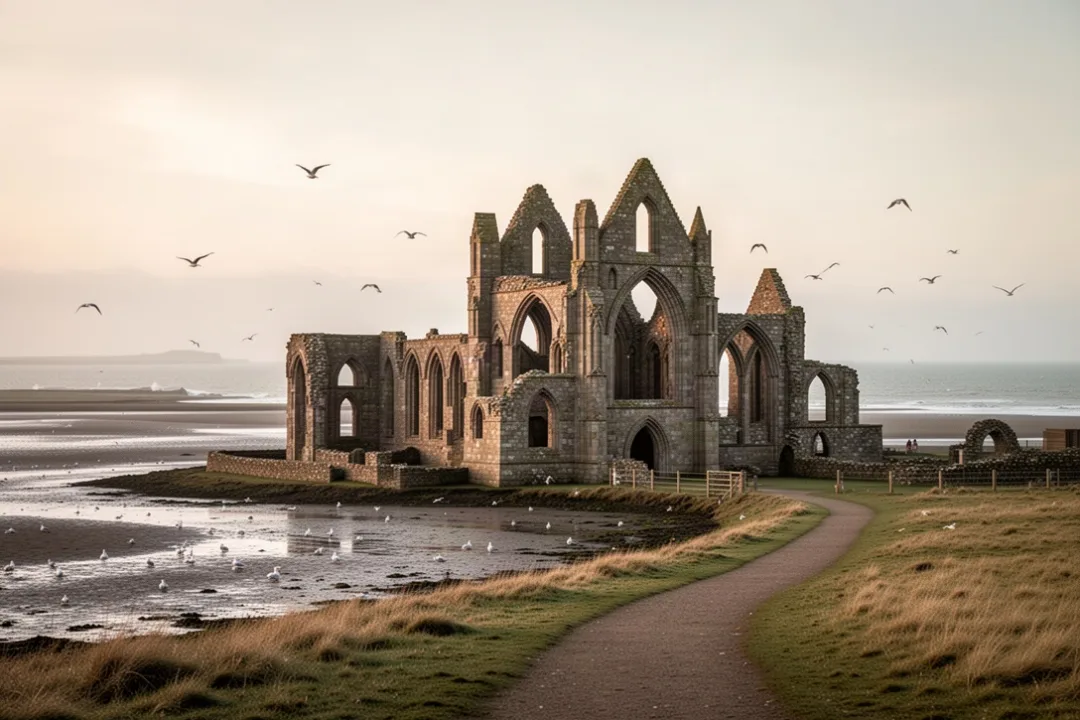
After serving at Melrose, Cuthbert became connected with Lindisfarne, the island monastery founded by Aidan in 635. Lindisfarne, also called Holy Island, was a major Christian center in Northumbria. Its location made it both a place of retreat and a symbol of the island-based monastic culture that shaped the region’s religious identity.
Cuthbert eventually served as prior there. The role required more than personal holiness. A prior organized the community’s religious life, managed relationships with visitors and patrons, oversaw practical work, and helped maintain discipline. Accounts of Cuthbert emphasize his ability to combine firmness with kindness, a quality that became central to his reputation as a spiritual guide.
Later, Cuthbert withdrew to the Inner Farne, one of the islands off the Northumbrian coast. Hermits chose such places to reduce distractions and devote themselves to prayer, but isolation did not mean complete separation from society. Visitors still came for advice, confession, blessing, and healing, and a hermit’s reputation could attract more people than he expected.
The Farne Islands also became central to stories about Cuthbert’s relationship with animals. A famous account says that birds took food from him or were disciplined when they stole from his stores. Another story describes two horses or animals helping with his work. These narratives should not be treated as wildlife reports in the modern sense; they express a medieval understanding of holiness in which creation responds peacefully to a person restored to proper spiritual order.
In 685, Cuthbert was chosen as bishop of Lindisfarne. He may also have held the bishopric of Hexham before moving fully into the Lindisfarne role. Episcopal office brought public responsibilities that contrasted sharply with his preference for retreat, but he accepted the appointment and continued to serve through preaching, pastoral care, and guidance of the church.
His time as bishop was short. Cuthbert returned to the Inner Farne and died there on March 20, 687. He was buried at Lindisfarne, where his burial site soon became a place of prayer and pilgrimage. March 20 remains his principal feast day in many calendars, while September 4 is associated with the translation of his relics.
What the stories about Cuthbert’s miracles mean
Medieval accounts of Cuthbert include healings, visions, protection from danger, answered prayers, and signs involving animals or the natural world. These stories were recorded to show his spiritual authority, not simply to satisfy curiosity. They present holiness as something visible through compassion, discernment, self-control, and trust in God.
One recurring theme is Cuthbert’s concern for people who were physically or spiritually vulnerable. He is described as visiting the sick, comforting the grieving, and offering guidance to those facing fear or uncertainty. The stories give special attention to people living outside major settlements, reflecting the missionary work required in a sparsely populated medieval landscape.
Another theme is prophetic insight. Cuthbert sometimes appears in the accounts as someone who understands hidden dangers or recognizes the significance of events before others do. Such stories supported the belief that a holy person could see beyond ordinary appearances, while also presenting Cuthbert as cautious rather than eager for power.
The natural world is especially prominent in his legends. Cuthbert is linked with seabirds, horses, seals, and other creatures associated with the coast and islands. These details helped make his story memorable, but they also carried theological meaning: the saint’s disciplined life was portrayed as bringing him into harmony with creation.
Several lessons commonly emerge from the miracle traditions:
Compassion matters: Cuthbert’s holiness is repeatedly connected with attention to suffering people.
Solitude is purposeful: His retreats are shown as preparation for service, not escape from every responsibility.
Leadership requires humility: He accepts authority while continuing to value simplicity and prayer.
Creation has spiritual meaning: Animal stories symbolize peace, care, and the proper use of the natural world.
Local places shape memory: Islands, shorelines, monasteries, and roads become part of the saint’s story.
It is also useful to separate historical evidence from devotional interpretation. The broad outline of Cuthbert’s life is supported by early written sources and the records of Northumbrian monasteries. Individual miracles cannot be verified in the same way as dates or offices, but they reveal what his communities admired and wanted future generations to remember.
“He was gentle to those who sought him, yet severe with himself.”
This line paraphrases a common pattern in accounts of Cuthbert: mercy toward other people paired with demanding personal discipline. Medieval writers often used this contrast to define a holy leader. The saint did not prove his virtue by making life harder for everyone around him; he was expected to carry the strictest burden himself.
Why Lindisfarne and Durham became linked to Cuthbert
Cuthbert was buried at Lindisfarne, and the monastery became the first major center of his cult. His shrine attracted visitors and helped strengthen the island’s religious importance. The community also preserved texts about his life, ensuring that his reputation could travel well beyond Northumbria.
The Viking raid on Lindisfarne in 793 made the monastery famous across Europe, but it did not immediately end the community’s existence. Over time, repeated danger and political instability encouraged the monks to move with Cuthbert’s relics. Their long journey connected several northern settlements with the saint’s memory.
The community eventually settled at Durham in the late tenth century. Tradition dates the arrival of Cuthbert’s relics at Durham to 995, when the monks found a defensible site in a bend of the River Wear. The cathedral that later rose there became one of the great monuments of medieval England, and Cuthbert’s shrine stood at the heart of its religious identity.
Durham’s location offered practical protection as well as symbolic power. A river bend, steep banks, and elevated ground made the site easier to defend. The community’s decision to build around Cuthbert’s shrine also made the saint central to Durham’s political and ecclesiastical status.
In 1104, Cuthbert’s shrine was opened during work connected with the construction of the Norman cathedral. Medieval witnesses reported that his body was found in an exceptionally preserved condition. That report strengthened his reputation, although modern readers should understand it as part of the medieval record and devotional tradition rather than as a simple scientific claim.
Objects associated with the opening and later examination of the tomb became important relics. Among them was the St Cuthbert Gospel, a small manuscript of the Gospel of John placed in his coffin. Its preservation makes it one of the earliest surviving Western European books in its original binding, and it is now held by the British Library.
Other objects associated with Cuthbert include a small pectoral cross, a comb, and items of clothing or liturgical equipment. These relics offer evidence about how his body and memory were treated by later communities. They also show that medieval devotion was physical: pilgrims prayed near shrines, touched reliquaries, and regarded objects connected with a saint as meaningful links to the holy person.
Visit in context: Lindisfarne tells the story of Cuthbert’s monastic community and coastal spirituality, while Durham shows how his shrine shaped a major cathedral city. The two places are connected, but they present different stages of his legacy.
What Saint Cuthbert’s symbols and places represent
Art and local tradition often identify Cuthbert through symbols that reflect his life. He may appear as a bishop holding a crozier, as a monk in a simple habit, or as a hermit associated with the sea and islands. His most distinctive images often include birds or other animals, recalling the Farne Island stories.
The cross found with his remains is another important symbol. A small cross can represent personal prayer, episcopal identity, and the continuity between Cuthbert’s private devotion and public office. The St Cuthbert Gospel adds a different dimension: it connects the saint’s burial with the preservation of a precious book and the intellectual work of early Christian communities.
Churches dedicated to Cuthbert are especially common in northern England and the Scottish border region. Their distribution reflects the geography of his ministry and the routes taken by his community. A dedication does not necessarily mean that Cuthbert visited the exact site; it may reflect later devotion, a landowner’s choice, or the influence of Durham and Lindisfarne.
His name also appears in natural and cultural landmarks. The St Cuthbert’s Way walking route links Melrose with Lindisfarne and follows a landscape associated with his life and the movement of his relics. Walking part of the route can provide a useful sense of distance, weather, terrain, and isolation—conditions that shaped medieval religious practice.
Visitors interested in Cuthbert’s history may want to focus on:
Lindisfarne Priory: the island community most closely associated with his ministry and shrine.
The Farne Islands: the landscape of his hermitage and animal traditions.
Durham Cathedral: the major medieval home of his relics and shrine.
Melrose: the monastery where his religious career began.
The British Library’s St Cuthbert Gospel: an exceptionally important surviving book linked to his burial.
Practical planning matters at Lindisfarne because the island is reached across a tidal causeway. Travelers need to check official crossing times and allow room for delays; the road is not safely passable at every hour. The Farne Islands are also reached by boat, and access can vary with weather, wildlife protection measures, and seasonal conditions.
How Saint Cuthbert is remembered today
Cuthbert remains significant for several different reasons. For Christians, he is a model of prayer joined to service: he sought solitude but returned to communities, accepted leadership but valued simplicity, and treated pastoral care as a central part of religious life.
For historians, his life offers a window into seventh-century Northumbria. His story touches on monastic organization, missionary activity, royal and ecclesiastical power, burial customs, manuscript culture, and the movement of communities during periods of invasion and political change.
For travelers and local communities, Cuthbert provides a way to understand the northern landscape. Lindisfarne, the Farne Islands, Melrose, Durham, and the surrounding routes are not interchangeable sites. Each preserves a different layer of memory, from the first monastic foundations to the later cathedral cult centered on his relics.
His legacy also encourages careful thinking about historical sources. The earliest accounts were written to inspire faith and admiration, so they are not modern biographies. They still preserve valuable information, but they should be read alongside archaeology, manuscript evidence, church history, and knowledge of medieval literary conventions.
The most lasting image of Cuthbert is therefore not limited to a single miracle or relic. It is the image of a northern Christian leader who moved between wilderness and community, prayer and administration, local ministry and international fame. His shrine survived the movement of a monastic people, and his name remains attached to the places where that story unfolded.
Frequently asked questions
When is Saint Cuthbert’s feast day?
Saint Cuthbert’s principal feast day is March 20, the date traditionally associated with his death in 687. September 4 is also important because it commemorates the translation of his relics. Calendars can differ by Christian denomination or local church tradition, so a particular parish may observe one date more prominently than the other.
Was Saint Cuthbert buried at Lindisfarne or Durham?
Cuthbert was first buried at Lindisfarne after his death. His monastic community later moved with his relics because of political instability and Viking attacks, eventually settling at Durham in the late tenth century. Durham Cathedral became the principal medieval shrine associated with his remains.
What animals are associated with Saint Cuthbert?
Stories about Cuthbert commonly mention seabirds and other animals connected with his hermitage on the Farne Islands. The birds are especially famous because medieval accounts describe them interacting peacefully with the saint. These traditions symbolize his care for creation and the harmony associated with a holy life.
Where can you see objects connected with Saint Cuthbert?
Durham Cathedral preserves the historic setting of his shrine and relics, while the British Library holds the St Cuthbert Gospel, a small Gospel of John found in his coffin. Lindisfarne and Melrose are also important places for understanding his life, even when original objects are no longer present there.














Leave a Reply