If you are looking for St. William of York because his name appears on a church calendar, parish, or prayer card, the short answer is this: he was a medieval archbishop of York whose appointment became caught in a serious church and political dispute. After losing his office, he spent years away from York, was restored shortly before his death, and was later honored as a saint.
William is also known as William FitzHerbert, a name that reflects his family background rather than a separate identity. His feast day is generally observed on June 8. His story brings together questions about church authority, public accusations, perseverance, and the way medieval Christians understood holiness.
Who St. William of York was and why his name matters
William lived in the 12th century, a period when England was divided by political conflict and the church was strengthening its rules about leadership, elections, and clerical conduct. He came from an influential family connected with the church and royal government in York. His father, Herbert, served as treasurer of York, so William grew up close to the cathedral, its administration, and the powerful people who shaped public life.
That background gave him education, connections, and a plausible path toward high office. It also created suspicion. When William was chosen to become archbishop of York, some churchmen questioned whether his election had been influenced by wealth, family pressure, or royal politics. His supporters regarded him as a suitable candidate; his opponents believed the process had been compromised.
The dispute cannot be separated from the civil war known as the Anarchy, fought during the reign of King Stephen. Royal factions competed for power, and bishops were often connected to those factions. York was not simply selecting a spiritual administrator. The archbishop held major influence, controlled substantial resources, and occupied a position with political consequences across northern England.
William’s story therefore does not fit a simple pattern of an innocent man facing obvious villains. The surviving accounts were written in a period of controversy, and they reflect the interests of different parties. Some charges against him were serious, including accusations of simony—the improper buying or selling of church office—and accusations concerning his personal conduct. Modern readers should treat those claims carefully rather than repeating them as proven facts.
A useful distinction: St. William’s canonization does not mean every detail of the medieval dispute is known with certainty. It means the church came to honor his life, his restoration to office, and the devotion that grew around him after his death.
For many people, William’s importance lies in the way his life combines public controversy with a lasting reputation for pastoral concern. Medieval tradition remembered him as a gentle and charitable bishop, while his opponents’ allegations formed part of the long debate over his legitimacy. Both the conflict and the later devotion are necessary to understand why he became an important saint of York.
How William became archbishop of York
William was elected to the see of York in the early 1140s. The exact circumstances were contested from the beginning, especially because the cathedral chapter was divided and the appointment had support from influential political figures. He was consecrated as archbishop in 1143 by Henry of Blois, bishop of Winchester and a powerful churchman who was also closely involved in the politics of King Stephen’s reign.
For William, consecration appeared to settle the matter, but his opponents continued to challenge the election. They argued that the process had been irregular and that William was unfit for the office. Supporters pointed to his education, family standing, and ability to lead one of England’s most important dioceses. The arguments were both spiritual and institutional: who had the authority to elect an archbishop, and what standards should govern that election?
The papacy eventually became involved. Pope Innocent II did not accept the situation as settled, and William’s claim to York was placed under scrutiny. The accusations connected with his election were taken seriously in an age when the church was trying to limit corruption and secure a more disciplined clergy. Even so, the proceedings unfolded amid wider political tensions, which made it difficult to separate religious judgment from factional rivalry.
William had supporters within York and among influential nobles, but he also faced determined opposition from churchmen who wanted another candidate. Bernard of Clairvaux, one of the most respected religious figures of the period, supported Henry Murdac, a Cistercian abbot who became William’s principal rival for the archbishopric. Bernard’s involvement gave the opposition considerable moral and political weight.
William’s first period as archbishop was relatively brief. He worked to exercise authority in York, but questions about his election continued to weaken his position. The conflict was not merely a disagreement over personality. It raised broader concerns about whether a bishop could take office when his election was challenged and whether a secular ruler or politically connected churchman had influenced the process.
The accusations surrounding his election
The charge of simony was particularly damaging because church reformers considered the purchase of ecclesiastical office a grave abuse. Other accusations concerned William’s sexual morality and personal behavior. The historical record does not allow a modern reader to verify every allegation, and accounts were shaped by the conflict between William’s supporters and opponents.
That uncertainty matters. A responsible account should neither dismiss the controversy as meaningless nor present every hostile claim as established fact. What can be said with confidence is that his election was disputed, papal authorities refused to let the matter rest, and William eventually lost the office he believed he had rightly received.
Why St. William lost York and spent years away
In 1147, William was suspended and removed from the archbishopric. Henry Murdac was installed as his replacement, and William entered a period of exile from York. This was a profound reversal. He had held one of the highest church offices in England, yet he was now separated from his cathedral, his supporters, and the community he believed he was called to serve.
William’s years away from York are central to the later understanding of his character. He did not simply disappear from church life. He remained connected with religious communities and continued to seek recognition of his claim. During this period, he had to endure uncertainty, public suspicion, and the loss of status. His story became one of patience under pressure rather than uninterrupted success.
The dispute was affected by changes in church leadership. Pope Eugenius III supported the decision against William, while Bernard of Clairvaux remained an important influence among those who opposed him. Church councils and papal decisions upheld the challenge to his position. William’s case could not be resolved only in York because it involved the authority of the pope, the rights of a cathedral chapter, and the role of secular power.
York itself also experienced the consequences. A disputed archbishop could divide clergy and laity, disrupt administration, and weaken confidence in church leadership. Rival claims made it harder for the diocese to present a united public voice. In this setting, William’s personal reputation and the institutional needs of York became closely linked.
It would be easy to describe his exile only as punishment, but medieval religious life often interpreted forced absence through the language of trial and purification. That interpretation did not erase the practical hardships. William still faced the loss of income, authority, and ordinary access to his people. Yet later devotion emphasized his endurance, prayer, and refusal to abandon his vocation.
He lost office even though he continued to claim that his election was legitimate.
He lived away from York while church and political authorities reconsidered his case.
He waited through a change in papal leadership before the path to restoration opened.
He returned to a community marked by division rather than to an uncomplicated victory.
The change came after Eugenius III died and the papacy passed to Anastasius IV. William’s case was reconsidered, and the new pope recognized his claim. William was consecrated again in 1153, restoring him to the archbishopric that he had lost several years earlier.
Historical perspective: William’s restoration was not a sudden proof that every earlier accusation had been fabricated. It reflected a new papal decision, changed circumstances, and a fresh assessment of his claim to York.
What happened after William returned to York
William returned to York late in life and had little time to exercise his office. His restoration was still a significant event because it allowed him to serve publicly in the place from which he had been excluded. Accounts of this period present him as welcoming, compassionate, and attentive to the poor, qualities that became especially important in the growth of his reputation for holiness.
Medieval biographies often portray saints in idealized language, so individual descriptions should be read with care. Still, the consistent picture of William after his return is not that of a triumphant political operator. He was remembered as a bishop who approached his restored ministry with humility and concern for ordinary people.
His return also offered a form of reconciliation for York. The city had endured years of uncertainty over its archbishop, and William’s presence could help heal the division surrounding the office. Even if the underlying conflict could not be erased, the restored archbishop represented continuity and the possibility that ecclesiastical disputes might eventually give way to service.
William died on June 8, 1154, only a short time after returning to York. The brevity of his second tenure has shaped the way he is remembered. He did not have decades to build institutions or carry out a long program of reform. Instead, his life became associated with fidelity through opposition, restoration after rejection, and a ministry continued despite limited time.
Some later stories connected his death with poisoning, but that claim is not established with enough certainty to present as fact. The essential historical point is that he died soon after his return, and devotion to him grew rapidly among people who believed they had witnessed the vindication of a wronged archbishop.
Why his short second tenure became meaningful
William’s return mattered symbolically as much as administratively. He had been publicly challenged, removed, and kept away from the city. Returning to York allowed him to die as its recognized archbishop rather than as a permanently defeated claimant.
For Christians facing their own difficult circumstances, his life has often suggested that faithfulness is not measured only by visible success. A person may lose a position, endure misunderstanding, or wait years for a situation to be corrected. William’s example is not a promise that every dispute will end favorably. It is a reminder that a vocation can be lived with integrity even when recognition is delayed.
How the church honored St. William of York
Devotion to William developed after his death, particularly in and around York. Reports of miracles and the veneration of his memory supported the movement to recognize him formally as a saint. He was canonized in 1227 by Pope Honorius III, more than seven decades after his death.
Canonization gave official recognition to a devotion that had already taken root. It also settled the public memory of William in a particular way. The church did not remember him primarily for the political controversy surrounding his election. Instead, it emphasized his pastoral qualities, his endurance during exile, his return to ministry, and the holiness associated with his life and death.
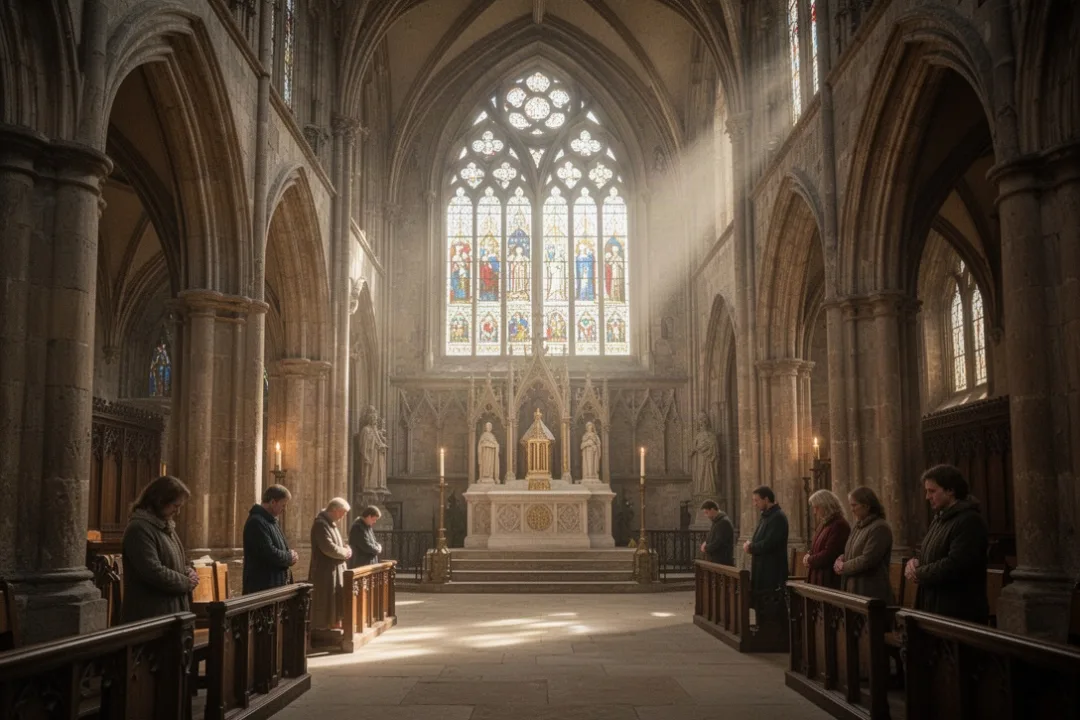
A shrine dedicated to him was established at York Minster during the medieval period. Pilgrims came to honor his relics and seek his intercession. As with many English shrines, the site was later damaged or dismantled during the religious upheavals of the Reformation, so the medieval setting is not preserved in its original form.
His feast day, June 8, keeps his memory connected with the date of his death. In the tradition of the church, a saint’s death is often treated as a birth into eternal life, which is why feast days commonly fall on the day a saint died rather than the day he was born. Local calendars and communities may observe the day in different ways.
Attend a parish Mass or prayer service on or near June 8.
Read about York’s medieval cathedral and the role of an archbishop in the 12th century.
Pray for people experiencing false accusations, public conflict, or long delays in justice.
Ask for St. William’s intercession when you need patience without abandoning responsibility.
Reflect on how restored relationships require both truth and a willingness to serve.
St. William is especially meaningful for people who serve in public or institutional roles. His life shows how easily a religious office can become entangled with status, family influence, and political expectations. It also points toward a different standard: leadership should be directed toward the care of people, not merely the protection of position.
His story can also help readers approach historical saints with greater honesty. Saints were real people who lived amid imperfect institutions and incomplete information. Recognizing the complexity of William’s case does not weaken devotion; it makes that devotion more responsible and more grounded in what can actually be known.
What St. William of York can mean for prayer and daily life
People often turn to St. William when they are dealing with misunderstanding, delayed justice, or difficult leadership. His life does not offer a quick formula for resolving conflict. It offers a model of remaining committed to truth and service while accepting that recognition may take time.
A prayer inspired by William might ask for fairness without bitterness, courage without aggression, and humility when responsibility returns. You might also pray for church leaders, public officials, or family members whose decisions affect others. His example is particularly relevant when a dispute has made it tempting to treat every opponent as entirely corrupt or every supporter as entirely right.
His intercession can be approached in a simple way. Begin by naming the conflict honestly. Ask for wisdom to distinguish accusation from fact, strength to act responsibly, and patience to endure what cannot immediately be changed. Then consider one practical step toward truth, repair, or faithful service.
St. William’s legacy also challenges the desire for instant vindication. He did not return to York with a long period of public triumph. He came back near the end of his life and served for only a short time. Yet that limited opportunity was enough for later generations to associate him with perseverance, pastoral care, and reconciliation.
Remembering him does not require ignoring the uncomfortable parts of his history. His disputed election, exile, opponents, and uncertain accusations all belong to the record. They make his story useful because they show holiness being recognized within a genuinely complicated human situation, not in a life untouched by institutional conflict.
For Catholics and others interested in the saints of England, St. William of York remains closely tied to the identity of York and its cathedral tradition. His feast day invites prayer for those who lead, those who are judged unfairly, and those waiting for a chance to serve again. His life asks a practical question: when your position is questioned, can you pursue truth while continuing to care for the people entrusted to you?
Frequently asked questions
Was St. William of York the same person as William FitzHerbert?
Yes. William FitzHerbert is the name commonly used for the man known as St. William of York. FitzHerbert identifies his family lineage, while “of York” highlights his office and association with the archdiocese. Medieval sources and modern references may use either form, so seeing both names does not indicate two different saints.
Why was St. William of York removed from office?
His election as archbishop was challenged by opponents who questioned the process and raised accusations about simony and personal conduct. The dispute unfolded during political instability in England and involved papal authorities, rival churchmen, and competing claims to York. He was removed in 1147, then restored after his case was reconsidered under Pope Anastasius IV.
What is St. William of York the patron saint of?
He does not have one universally recognized patronage comparable to saints associated with a particular illness, occupation, or country. People may nevertheless seek his intercession for church leaders, difficult public disputes, delayed justice, reconciliation, and perseverance during periods of rejection. His strongest association remains York, where his ministry and medieval shrine shaped his lasting reputation.
How can I celebrate St. William of York’s feast day?
His feast is observed on June 8. You could attend Mass, read about York’s medieval church history, pray for leaders facing controversy, or ask for help in responding to conflict with patience and honesty. A charitable act for people experiencing poverty or exclusion also reflects the pastoral qualities traditionally associated with his memory.













Leave a Reply