Saint Eugene is not one single universally identified saint; the name refers to several Christian figures, with Pope Saint Eugene I usually the best-known Catholic answer.
Why the name Saint Eugene can refer to different people
Eugene comes from the Greek name Eugenios, commonly understood to mean “well-born” or “of noble origin.” Several bishops, monks, missionaries, and martyrs carried the name, and at least two popes named Eugene are honored as saints or blessed in different Christian traditions.
When someone asks about “Saint Eugene,” they may mean Pope Eugene I, whose Catholic memorial is celebrated on June 2. They may instead be asking about Pope Eugene III, a twelfth-century pope associated with the Cistercian order, or a local saint known by the same name.
The surrounding details usually identify the right person. A question about church leadership and the Monothelite controversy points to Eugene I. A question about Bernard of Clairvaux, the Cistercians, or the Second Crusade points to Eugene III. A parish, school, or town named Saint Eugene may honor a different figure altogether.
Start with the name and feast day. If the reference is to June 2, it most likely concerns Pope Saint Eugene I. If the reference is to July 8, it may concern Pope Saint Eugene III.
How to identify which Saint Eugene you are researching
Use the following clues before relying on a picture, prayer card, or church name. The same name can appear with different symbols, dates, and historical settings.
Check the feast day. June 2 is associated with Eugene I in the Roman Catholic calendar, while July 8 is associated with Eugene III.
Look for the title. “Pope,” “abbot,” “bishop,” and “martyr” identify different people even when the first name is identical.
Notice the symbols. A papal tiara, pallium, or cross may suggest a pope; a monk’s habit may point to Eugene III or another monastic figure.
Read the location. Roman references often concern Eugene I, while Cistercian communities may be referring to Eugene III.
Check the church’s dedication. A parish called Saint Eugene may identify its patron in its official history, feast-day schedule, or sanctuary artwork.
This method matters because devotional traditions are often local. A community may celebrate a saint under a shortened name, use a regional spelling, or preserve a story that is not associated with the better-known pope.
Pope Saint Eugene I and his place in church history
Pope Eugene I served as bishop of Rome during a difficult period in the seventh century. He became pope in 654 and died in 657, during a dispute over how to describe the relationship between Christ’s divine and human wills.
The controversy is usually called Monothelitism. Supporters of that position taught that Christ had one will, while Catholic teaching came to affirm that Christ possesses both a divine will and a human will, united in one person without confusion or division.
Eugene I did not create the controversy, which had already troubled the eastern and western churches for years. His importance comes from his refusal to accept a theological formula that he and other church leaders believed weakened the full reality of Christ’s humanity.
His papacy unfolded under strong imperial pressure. The Byzantine emperor and officials connected with Constantinople sought religious unity, partly because theological conflict threatened political stability. The pope, however, could not simply treat a disputed formula as settled if he believed it contradicted the church’s understanding of Jesus Christ.
Accounts of Eugene’s pontificate describe tension between Rome and imperial representatives. He was reportedly treated harshly toward the end of his life, although details vary in historical sources. His memory became connected with steadfastness under pressure and fidelity to Christian teaching.
What Eugene I defended about Jesus Christ
The dispute can sound technical, but its religious meaning is direct. Christians confess Jesus as truly divine and truly human. If Christ lacked a genuine human will, his human life, obedience, suffering, and relationship with the Father could be misunderstood as incomplete or merely apparent.
In Catholic theology, Christ’s human will is not rebellious against his divine will. Instead, his human will freely follows the divine will. The issue therefore concerns more than terminology: it concerns the fullness of Christ’s humanity and the meaning of salvation.
The later Third Council of Constantinople, held in the seventh century after Eugene’s death, rejected Monothelitism and affirmed that Christ has two wills corresponding to his two natures. That council’s decision provides the wider theological setting for Eugene I’s stand, although he did not live to see it.
Christian teaching presents Christ as fully divine and fully human, rather than divine only in appearance.
Saints are not honored only because they held important offices. Eugene I is remembered because his office required him to make a difficult public witness during a period of conflict, pressure, and limited political freedom.
Three qualities stand out in his traditional memory:
Doctrinal fidelity: he resisted a compromise that he believed distorted Christian teaching about Christ.
Pastoral responsibility: he acted as a bishop responsible for preserving the faith entrusted to the church.
Endurance: he continued his service despite conflict with imperial authority and the danger surrounding his position.
His story does not suggest that every disagreement should become a confrontation. It shows instead that a church leader may need to distinguish between a harmless difference in wording and a claim that changes the substance of the faith.
For people who pray with the saints, Eugene I can represent courage joined to careful conviction. He is not primarily remembered for dramatic miracles or a long series of writings. His witness rests on the way he remained faithful during a dispute that tested the church’s unity.
Pope Saint Eugene III and the Cistercian connection
Pope Eugene III was a different person who lived nearly five centuries after Eugene I. He was born in the late twelfth century, became a Cistercian monk, and was associated with Bernard of Clairvaux, one of the most influential spiritual leaders of his era.
Before becoming pope, Eugene III belonged to a reform-minded monastic environment. The Cistercians emphasized a disciplined communal life, prayer, work, simplicity, and a return to the foundational ideals of monastic observance. His election as pope placed a man formed by that world at the center of European church affairs.
Eugene III was elected pope in 1145. Rome was politically unstable, and the pope spent significant periods outside the city. His pontificate also coincided with the preparation and preaching of the Second Crusade, a campaign that developed after the fall of the Christian stronghold of Edessa.
Bernard of Clairvaux supported the crusade and preached in its favor, while Eugene III authorized it. The campaign ended unsuccessfully, and that failure forms part of the difficult historical context of Eugene III’s papacy. It would be misleading to reduce his entire legacy to the crusade, but it would also be inaccurate to discuss his pontificate without acknowledging it.
How Eugene III’s life differed from Eugene I’s
Eugene I is mainly remembered in connection with Christological teaching and resistance to imperial pressure. Eugene III is more closely connected with monastic reform, papal government, Bernard of Clairvaux, and the political and military conflicts of the twelfth century.
The two men therefore offer different models of Christian witness. Eugene I represents persistence in a doctrinal dispute during the Byzantine era. Eugene III represents the challenge of exercising church leadership while carrying a monastic ideal into a turbulent political setting.
When a person asks for the “meaning” of Saint Eugene, the answer should reflect which figure is intended. A reflection based on Eugene III might focus on humility, reform, prayer, and responsibility, while a reflection on Eugene I would focus more strongly on theological fidelity and courage under pressure.
Feast days and how Catholics observe them
A saint’s feast day is not normally a birthday. It usually commemorates the person’s death, understood as the completion of earthly life and entry into eternal life. The day may also reflect the date assigned by a liturgical calendar rather than the exact date of death.
For Pope Saint Eugene I, the commonly observed Catholic memorial is June 2. Pope Saint Eugene III is commonly commemorated on July 8. Calendars can differ by denomination, country, diocese, religious order, or local tradition, so a parish calendar is the best guide for a specific celebration.
A parish or family observing Saint Eugene’s feast day might:
Attend Mass or another Christian service.
Read a reliable account of the saint’s life.
Pray for church leaders, teachers, or people facing religious pressure.
Ask for the saint’s intercession in keeping with the customs of the community.
Support a work of mercy, education, hospitality, or care for the vulnerable.
The point is not to recreate the saint’s historical circumstances. It is to let the saint’s example shape present conduct. Eugene I’s witness may prompt a person to examine whether convictions are based on truth rather than pride, while Eugene III’s story may raise questions about how prayer and service should guide leadership.
What Saint Eugene’s name means in Christian devotion
The meaning of Eugene’s name can be a useful starting point, but a saint’s importance does not come from the dictionary definition alone. The name’s association with noble birth can be read spiritually as a reminder that Christian dignity comes from belonging to God, not from social rank or public success.
That interpretation should not be confused with a claim that Eugene I or Eugene III promoted status or privilege. Their lives, particularly their ecclesial and monastic commitments, point toward responsibility rather than entitlement.
For a believer, the name Saint Eugene can bring several themes together:
Truth: faith should not be reshaped merely to avoid conflict.
Humility: leadership requires service, listening, and accountability.
Discernment: difficult disputes need careful study rather than quick reactions.
Perseverance: a faithful life may involve uncertainty, opposition, or disappointment.
Hope: the church’s memory preserves witness across generations.
These themes apply beyond formal theology. They can guide a parent teaching a child, a pastor resolving a disagreement, a student facing pressure, or anyone trying to act with integrity when approval is not guaranteed.
Praying with Saint Eugene without inventing a historical prayer
No single universally required prayer belongs to Saint Eugene I or Saint Eugene III. Many Catholic communities use a short request for intercession, while others pray a novena or a parish-approved prayer. The wording may vary considerably.
You can pray simply and honestly. Begin by naming the saint you mean, ask for help in a particular need, and place that request within Christian prayer rather than treating the saint as a source of power independent of God.
For example, you might pray in your own words for:
Faithfulness when a cherished belief is challenged.
Wisdom for bishops, pastors, teachers, and public leaders.
Peace within a divided church, family, or community.
Strength for people facing unjust pressure or intimidation.
Humility when responsibility and authority come together.
Scripture can accompany this devotion. Passages such as John 1:14, which Christians read as affirming the Word becoming human, may help explain why the Christological dispute mattered. Philippians 2:5-11 can support prayerful reflection on Christ’s humility, while 1 Peter 5:1-4 speaks to the character expected of Christian leaders.
These references should be read in a Bible translation approved or trusted by your church. The purpose is not to force a passage into a biography, but to place the saint’s witness within the broader Christian story.
A practical prayer pattern: identify the saint, name the need, ask for intercession, and finish by entrusting the outcome to God. This keeps devotion focused on faith and charity rather than superstition.
Saint Eugene in church names, art, and local traditions
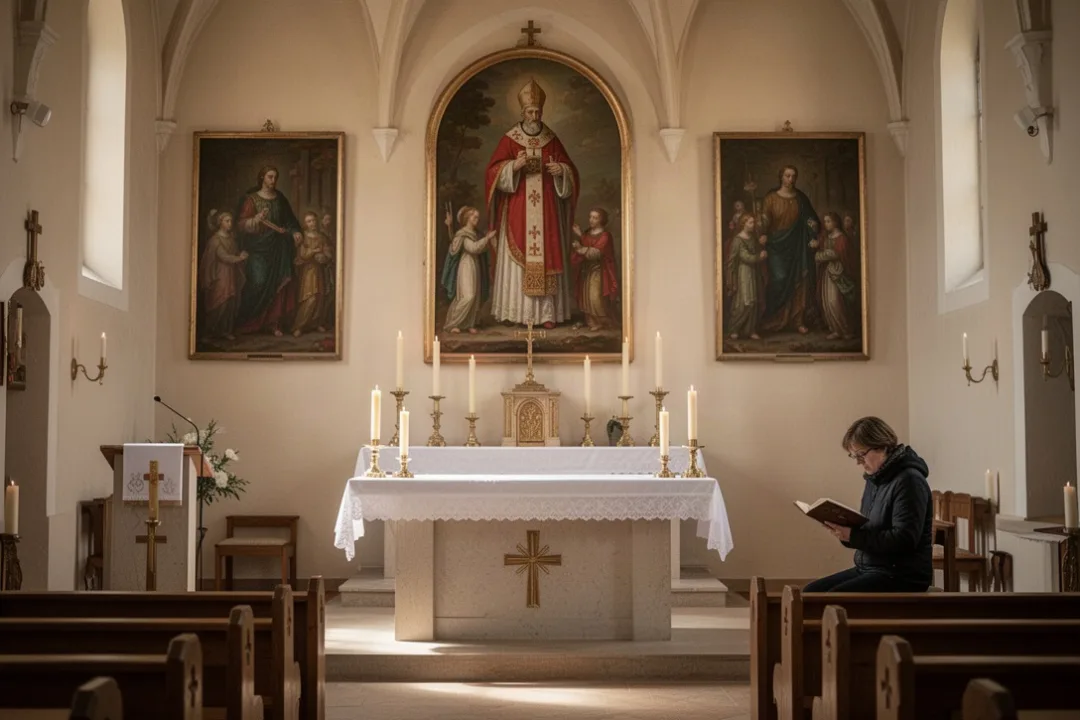
Churches dedicated to Saint Eugene may preserve clues about which figure they honor. A statue wearing papal vestments may refer to one of the popes, while an image in a monk’s habit may suggest Eugene III. Symbols are helpful, but they are not always definitive because artists and local traditions use different conventions.
Look for a parish biography, dedication statement, feast-day announcement, or inscription near an image. The church’s official website or diocesan directory may also identify the saint. If a parish uses only “Saint Eugene” without a numeral, its community history is more reliable than a general search result.
Some places also use forms of the name such as St. Eugenia, Ouen, or another regional adaptation. Similar names do not automatically indicate the same person. Check the original language and the saint’s dates before assuming that two dedications are connected.
Artistic traditions can also reflect a saint’s role rather than a precise historical portrait. A book may indicate teaching, a crozier may indicate an abbot or bishop, and papal clothing may indicate a pope. Such images help with devotion, but they should not be treated as photographic evidence.
Common mistakes when researching Saint Eugene
The most common mistake is combining details from different people. A biography may begin with Eugene I’s seventh-century controversy and then shift to Eugene III’s Cistercian life without signaling the change.
Other errors arise when a source presents a local tradition as universal. Feast days, patronage claims, prayers, and legends may be accepted in one community but not appear in the official calendar of another.
Separate the centuries. Eugene I lived in the seventh century; Eugene III lived in the twelfth.
Separate the controversies. Eugene I is connected with Monothelitism; Eugene III is connected with monastic reform and the Second Crusade.
Distinguish canonization language. “Saint,” “blessed,” “venerable,” and “servant of God” do not mean the same thing.
Verify patronage claims. A local church may honor a saint without that saint having a widely recognized universal patronage.
Use a calendar for the date. Online lists may confuse local observances with the general calendar.
These distinctions are especially useful for school projects, parish materials, baptismal names, and family histories. Clear identification prevents a respectful devotion from being built on mixed or inaccurate information.
Choosing which Saint Eugene to honor
If you or someone in your family is named Eugene, you do not have to choose solely on the basis of the name. Consider the saint’s life, the feast day used by your parish, and the qualities that speak to your circumstances.
Pope Eugene I may be a meaningful patron for someone concerned with truth, theological study, moral courage, or perseverance under pressure. Pope Eugene III may speak more directly to someone drawn to monastic spirituality, church reform, disciplined prayer, or the burdens of leadership.
You can also honor a local Saint Eugene whose story has shaped your parish or community. Local memory has value, especially when it leads to service, prayer, and a deeper understanding of Christian responsibility.
The most faithful observance is not simply wearing a medal or repeating a name. It is allowing the saint’s example to encourage concrete action: study carefully, speak truthfully, serve humbly, and remain attentive to people who carry heavy responsibilities.
What Saint Eugene can teach modern readers
The historical circumstances of the Eugens are distant from ordinary life, yet their central questions remain familiar. How should you respond when an important belief is challenged? How can a leader remain humble? What should happen when institutions, politics, and conscience pull in different directions?
Eugene I’s story urges seriousness about the content of faith. Conviction should be informed, patient, and willing to explain itself. Eugene III’s story shows that spiritual formation does not remove political or administrative difficulty; it gives a person a framework for facing those difficulties responsibly.
Neither life should be reduced to a simple slogan. Eugene I’s resistance took place within a complicated imperial world, and Eugene III’s leadership included decisions that remain historically contested. Reading the saints honestly means honoring their witness while recognizing the limits and complexity of their time.
For that reason, Saint Eugene can be approached through both devotion and historical study. Prayer asks for help; history asks careful questions. Together, they offer a fuller picture of why a person’s name continues to be remembered in worship, art, community life, and Christian teaching.
Frequently asked questions
Is Saint Eugene the same person as Pope Eugene I?
Not necessarily. Pope Eugene I is one important saint known by the name, but Pope Eugene III is another distinct figure, and local traditions may honor additional Eugens. The feast day, historical period, title, and church dedication usually reveal which person is intended.
When is Saint Eugene’s feast day?
Pope Saint Eugene I is commonly commemorated on June 2 in the Roman Catholic calendar. Pope Saint Eugene III is commonly associated with July 8. Local calendars and other Christian traditions may use different dates, so check the calendar of the parish or denomination involved.
What is Saint Eugene the patron saint of?
There is no single universally recognized patronage that applies to every Saint Eugene. Devotional associations vary by person and locality. Eugene I is often remembered for doctrinal courage and perseverance, while Eugene III may be connected devotionally with monastic life, reform, and the responsibilities of church leadership.
How can I pray to Saint Eugene?
Begin by identifying which Saint Eugene you mean, then ask for his intercession in a specific need. You might pray for wisdom, courage, faithful leadership, or peace during conflict. Use a parish prayer if one exists, or speak in your own words while directing worship and trust to God.











Leave a Reply