Thomas a Becket was the archbishop of Canterbury who became a martyr after opposing King Henry II over the rights of the English Church. Four knights killed him inside Canterbury Cathedral on December 29, 1170, and the Catholic Church canonized him in 1173.
His story is not simply a clash between a cruel king and a heroic churchman. Becket and Henry had once been close allies, and both men helped shape a struggle over royal authority, church jurisdiction, and the limits of political obedience in 12th-century England.
Thomas Becket was born in London in the 1120s to a family of modest means. His parents were associated with the prosperous merchant community, and Thomas received an education that prepared him for administrative and legal work. He studied in England and later spent time in Paris, although the details of his early education are not fully certain.
His career advanced when he entered the household of Archbishop Theobald of Canterbury. Becket worked as a clerk and administrator, handled legal matters, and represented the archbishop in important dealings. This experience gave him a practical understanding of church law and royal government.
In 1154, Theobald ordained Becket as a deacon and appointed him archdeacon of Canterbury. The position brought substantial responsibility and income, but Becket was not yet a priest. His reputation for intelligence, diplomacy, and efficient administration soon attracted the attention of the new king, Henry II.
How Henry II and Thomas Becket became political allies
Henry II became king of England in 1154 and set out to restore royal control after years of civil conflict. He needed a trusted official who could manage correspondence, finances, and negotiations. In 1155, he made Becket chancellor of England.
As chancellor, Becket served as the king’s senior administrator. He helped enforce royal policy, supported the expansion of royal courts, and represented Henry in diplomatic missions. The two men also shared a demanding public lifestyle, traveling frequently and maintaining a court that displayed the strength of the monarchy.
Contemporary accounts describe Becket as an impressive and sometimes lavish figure during this period. He could act as a diplomat, administrator, and political operator. Henry valued him partly because Becket was not an English nobleman with an independent territorial power base. He appeared to be a loyal servant whose advancement depended on the king.
The central change in Becket’s life: Henry expected the future archbishop to remain his political ally, but Becket came to understand his new office as requiring him to defend the Church even when that meant resisting the king.
Why Henry II appointed Becket archbishop of Canterbury
Archbishop Theobald died in 1161, leaving the most important church office in England vacant. Henry supported Becket’s appointment, and Becket was elected archbishop in 1162. He was ordained a priest on June 2 and consecrated archbishop the next day.
The appointment was politically convenient for Henry. He hoped Becket would help him bring the English Church more firmly under royal authority. The king also wanted to reduce conflicts between church courts and royal courts, particularly in cases involving clerics accused of serious crimes.
Becket’s conduct changed after his consecration. He resigned as chancellor, adopted a more austere religious life, and began to defend the independence of Canterbury. The shift surprised Henry, who believed their longstanding friendship and shared political work would continue.
Becket did not necessarily reject all royal authority. The dispute concerned the boundaries of that authority. He accepted that a king had important responsibilities in maintaining peace and justice, but he resisted policies that he believed allowed the Crown to control church offices or punish clergy outside proper ecclesiastical procedures.
How the conflict between Becket and Henry II developed
The dispute became public through a series of arguments about customary rights and legal jurisdiction. Henry wanted to establish clearer rules that would strengthen royal courts and limit the practical independence of church officials. Becket feared that vague claims about “ancient custom” could be used to weaken the Church’s legal privileges.
One major issue involved criminous clerks, meaning members of the clergy accused of crimes. Church courts could impose spiritual penalties and other punishments, while royal officials argued that serious offenses required stronger secular penalties. Henry objected that a cleric convicted in a church court could avoid the king’s harsher justice.
In 1164, Henry presented the Constitutions of Clarendon, a set of clauses intended to define the relationship between the Crown and the Church. Becket initially accepted parts of the agreement, but he later withdrew his support. Historians continue to debate the precise nature of his promises and the extent of his change of position.
The conflict then moved from policy to personal retaliation. Henry’s officials accused Becket of financial misconduct connected with his time as chancellor. Becket appeared before royal judges but objected to the proceedings and refused to accept the judgment against him. He eventually left England and sought protection in France.
The dispute in five stages
Alliance: Henry II appointed Becket chancellor, and the two worked closely to strengthen royal administration.
Promotion: Henry supported Becket’s election as archbishop of Canterbury, expecting a dependable ally in church affairs.
Reversal: Becket resigned as chancellor and adopted a more forceful defense of ecclesiastical independence.
Exile: The king’s accusations and political pressure drove Becket to France, where he appealed to Pope Alexander III.
Return and murder: A temporary reconciliation allowed Becket to return to England, but renewed hostility preceded his killing at Canterbury Cathedral.
This sequence matters because Becket’s martyrdom was the result of a long institutional conflict, not a sudden disagreement. Personal resentment made the dispute more dangerous, but the underlying questions concerned who could judge whom and how far a medieval king could direct the Church.
Why Thomas Becket went into exile
Becket left England in 1164 after the proceedings against him became politically and legally unsafe. He traveled to France and appealed to Pope Alexander III, who was himself involved in a wider struggle with the Holy Roman Emperor and could not afford to alienate either the English king or the archbishop completely.
Henry pressured religious communities and Becket’s supporters, while Becket used letters and papal appeals to defend his position. His exile lasted several years. During this time, both sides negotiated through intermediaries, but neither was willing to surrender the principles it considered essential.
Becket’s position in exile also changed his public image. He was no longer mainly the king’s administrator. He became a prominent defender of church liberty, although his actions could be severe. He supported ecclesiastical penalties against opponents and used the tools of medieval religious authority against those who challenged him.
The pope eventually helped create conditions for Becket’s return. Henry made concessions, but the agreements were not precise enough to remove all resentment. Becket returned to England in December 1170, expecting to resume his office, while some of the king’s supporters viewed him as a continuing threat.
What happened when Becket returned to Canterbury
Becket returned to Canterbury on December 1, 1170. He soon suspended or excommunicated several bishops who had supported royal policies during his absence. These actions reignited the conflict and prompted complaints to Henry, who was then in Normandy.
Medieval sources report that Henry made an angry statement expressing a wish that someone would rid him of the troublesome archbishop. The exact wording is uncertain because the surviving accounts were written by people with different perspectives. Four knights—Reginald FitzUrse, Hugh de Morville, William de Tracy, and Richard le Breton—traveled to Canterbury after hearing the king’s words.
On December 29, the knights confronted Becket in the cathedral. After a tense exchange, they struck and killed him near the area of the transept. The murder shocked Christian Europe because it took place in a sacred building and involved an archbishop who had been serving in one of the Church’s most important offices.
Accounts of the killing differ in detail, especially concerning the sequence of blows and Becket’s exact words. The broad facts are clear: Becket was killed at Canterbury Cathedral by knights connected with the king’s faction, and Henry was widely blamed for creating the atmosphere that made the attack possible.
Why Becket’s murder became a major religious event
News of Becket’s death spread rapidly. Pilgrims began visiting his tomb, and reports of miracles helped establish his reputation as a martyr. The Church canonized him in 1173, less than three years after his death, an unusually rapid recognition that reflected both devotion to Becket and the political importance of the controversy.
Henry II performed public penance at Canterbury in 1174. Accounts describe him allowing himself to be whipped by clergy while praying at Becket’s shrine. The act did not erase the king’s authority, but it showed that the murder had damaged his standing and that he needed to acknowledge responsibility before the Church and the public.
Becket’s shrine became one of the most famous pilgrimage destinations in medieval Europe. Visitors came to ask for healing, fulfill religious vows, or honor a saint whose death represented resistance to unjust power. Geoffrey Chaucer later used the pilgrimage to Canterbury as the setting for The Canterbury Tales, although the poems are literary works rather than straightforward historical records.
Historical caution: Becket’s reputation comes mainly from accounts written by supporters, clerics, and admirers. These sources are valuable but not neutral, so details of his personality, speeches, and final moments should be treated with care.
What Thomas Becket’s conflict reveals about medieval government
Becket and Henry were arguing in a world where modern ideas of church-state separation did not exist. Religious and political institutions overlapped at every level. Bishops could act as royal officials, church courts could decide matters with practical consequences, and kings were expected to protect the Church while also governing it in significant ways.
The controversy exposed a tension between two models of authority. Henry emphasized the king’s duty to preserve public order through a unified legal system. Becket emphasized the Church’s right to govern its clergy and to resist royal interference in spiritual and ecclesiastical matters.
The outcome did not produce a complete victory for either side. Henry retained extensive power, and the English monarchy continued to influence church appointments and policy. At the same time, Becket’s death made it difficult for rulers to treat church jurisdiction as merely another department of royal administration.
The dispute also shows why medieval “custom” was politically powerful. Both sides claimed to defend established practice, but the evidence for earlier customs was often incomplete or contested. Appeals to tradition could therefore serve as arguments for change as much as arguments for preservation.
How historians assess Thomas Becket’s character
Becket can appear very different depending on the source. Some accounts present him as a courageous shepherd who accepted suffering rather than betray the Church. Others highlight his pride, stubbornness, political ambition, and willingness to use harsh penalties against his opponents.
Both images contain part of the historical record. Before becoming archbishop, Becket was a capable royal administrator who benefited from Henry’s patronage. After becoming archbishop, he adopted a demanding view of his office and defended it with remarkable determination. His strength of purpose could look like integrity to supporters and arrogance to enemies.
He was also a product of his time. His belief in ecclesiastical privilege, excommunication, public penance, and sacred kingship belonged to the institutions of medieval Europe. Judging him only by modern political categories can hide the religious assumptions that made the conflict meaningful to his contemporaries.
What happened to the knights who killed Becket
The four knights who killed Becket did not receive the punishment that modern readers might expect. They appear to have believed they were acting in defense of the king, although historians debate whether Henry explicitly ordered the murder. The knights later went to Rome and sought forgiveness.
They were not formally tried and executed by the Crown. Instead, they undertook penance and were sent to the Holy Land, where they lived under religious obligations. Their later lives are less clearly documented than the dramatic events at Canterbury.
Their lack of a conventional criminal trial reflects the political and religious setting of the killing. The issue was treated not only as homicide but also as an offense against a consecrated archbishop and the Church. The spiritual consequences of the act therefore mattered alongside royal justice.
How Canterbury remembered Becket
Becket’s body was first buried in the cathedral crypt. As devotion increased, his remains were moved to a more prominent shrine in 1220. The shrine became the center of Canterbury’s pilgrimage culture and helped the city gain lasting religious and economic importance.
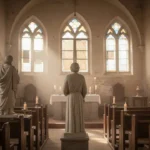
The shrine was destroyed during the English Reformation under Henry VIII in the 16th century. The surviving cathedral still contains places associated with Becket’s death, including the area known as the Martyrdom. These locations help visitors connect the building’s architecture with the events that made it famous.
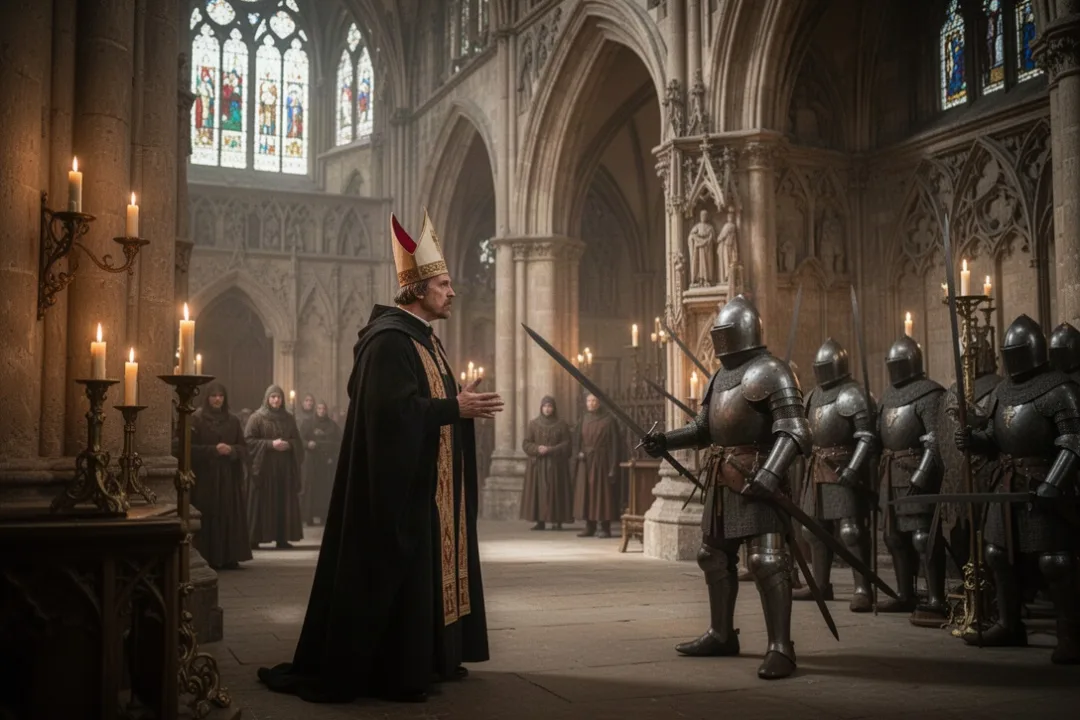
Becket’s story also survives through medieval manuscripts, church art, sermons, plays, and later historical writing. Images often show him wearing the vestments of an archbishop or suffering martyrdom. Such representations reveal how later generations interpreted him, even when they cannot establish every detail of what happened in 1170.
How to understand Thomas Becket’s lasting significance
He represents a conflict over jurisdiction: the dispute asked whether clergy accused of crimes should answer only to church courts or also to royal justice.
He illustrates the risks of royal patronage: a trusted official could become a powerful opponent when a change of office created different obligations.
He became a political martyr: devotion to Becket expressed both religious belief and concern about unchecked authority.
He shaped Canterbury’s identity: his shrine helped make the cathedral one of medieval Europe’s best-known pilgrimage sites.
He remains difficult to classify: he was at once an administrator, archbishop, political combatant, ascetic, and saint.
Thomas a Becket is best understood through the relationship between these roles. The efficient chancellor and the uncompromising archbishop were the same person, but each office demanded a different kind of loyalty. His tragedy emerged when service to the king and service to the Church could no longer be reconciled.
The enduring question is not simply whether Becket was right or Henry was wrong. It is how institutions respond when two forms of legitimate authority claim the same space. Becket’s death gave that question a human cost, and the memory of his martyrdom ensured that the argument continued long after the political dispute itself had changed.
Key dates in Thomas Becket’s life
1120s: Becket is born in London.
1154: He becomes archdeacon of Canterbury after entering Archbishop Theobald’s service.
1155: Henry II appoints him chancellor of England.
1162: Becket becomes archbishop of Canterbury.
1164: The Constitutions of Clarendon intensify the dispute between Becket and Henry.
1164–1170: Becket lives largely in exile in France.
December 1170: He returns to England and is killed at Canterbury Cathedral on December 29.
1173: Pope Alexander III canonizes Becket.
1174: Henry II performs penance at Becket’s tomb in Canterbury.
Frequently asked questions
Was Thomas Becket a Catholic saint?
Yes. Thomas Becket was canonized by Pope Alexander III in 1173, less than three years after his death. He is recognized as a martyr and is commemorated in the Catholic Church on December 29, the anniversary of his murder. The Church of England also remembers him, although interpretations of his authority and legacy differ across Christian traditions.
Did Henry II directly order Thomas Becket’s murder?
No surviving evidence proves that Henry II gave a direct command to kill Becket. Henry’s angry words encouraged action by four knights, and contemporaries held him morally responsible for creating the circumstances of the murder. The knights appear to have believed they were defending the king, but the exact connection between Henry’s statement and their decision remains debated.
What were the Constitutions of Clarendon?
The Constitutions of Clarendon were clauses issued in 1164 that sought to define royal control over church affairs in England. They addressed matters such as the trial of clerics, appeals to Rome, and the authority of royal courts. Becket’s initial response and later rejection of the provisions became a major part of his conflict with Henry II.
Can you visit places connected with Thomas Becket today?
Yes. Canterbury Cathedral in England preserves locations associated with Becket, including the site of his murder known as the Martyrdom. His original shrine was destroyed during the Reformation, but the cathedral continues to present his history through architecture, memorials, and interpretation. Other churches and museums also preserve objects linked to his cult and medieval pilgrimage.












Leave a Reply