Anglicanism: beliefs, history, worship, and traditions
Anglicanism: beliefs, history, worship, and traditions
Anglicanism is a worldwide Christian tradition rooted in the English Reformation and shaped by shared worship, bishops, and common prayer.
It is often described as a middle way between Roman Catholicism and Protestantism, although that phrase only tells part of the story. Anglican churches retain features associated with historic Catholic Christianity, including bishops, ordained ministry, sacraments, and a structured liturgy. They also affirm central Protestant principles, such as the authority of Scripture and salvation through God’s grace received by faith.
Anglicanism is not a single church governed by one worldwide leader. Instead, it is a family of self-governing churches connected through the Anglican Communion. These churches share historical roots, worship resources, relationships, and formal gatherings while making many of their own decisions.
The roots of Anglicanism reach back to the medieval Christian church in England, but the tradition took its distinctive shape during the English Reformation in the 16th century. Political disputes, royal authority, theological reform, and existing criticism of church practices all contributed to the separation of the English church from papal jurisdiction.
King Henry VIII’s conflict with the papacy was a major turning point. The English church became institutionally independent from Rome, but the early changes did not immediately create a clearly Protestant church. Under Henry VIII, many traditional teachings and forms of worship remained in place even as the relationship with the pope changed.
More extensive reforms followed during the reign of Edward VI. English worship was increasingly conducted in the vernacular, and reformers revised church services, teaching, and the administration of the sacraments. The first editions of the Book of Common Prayer, associated especially with Thomas Cranmer, gave the emerging tradition a common language for worship.
Under Mary I, England was briefly reunited with Roman Catholicism, and Protestant reforms were reversed. After Elizabeth I came to the throne, the church settlement moved toward a durable form of Anglican identity. It combined reformed teaching with bishops, traditional patterns of public worship, and a national church structure.
Essential distinction: Anglicanism did not arise from one isolated disagreement. Its development involved a long interaction among political authority, biblical reform, English religious customs, and debates over the church’s connection to Rome.
The Elizabethan Settlement helped establish a broad church that could include different convictions about worship and doctrine. Some Anglicans favored more visibly Protestant churches and services, while others preserved a stronger sense of continuity with Catholic tradition. These tensions have continued in changing forms throughout Anglican history.
The 17th-century Anglican divines played an important role in defining the tradition’s intellectual and spiritual character. Writers such as Richard Hooker emphasized the importance of Scripture, tradition, and reason in the life of the church. Anglican theology did not treat these sources as identical, but it often resisted reducing Christian authority to only one of them.
The Church of England became closely connected with English public life, but Anglican Christianity also spread beyond England through migration, trade, colonial expansion, missionary work, and the development of local Christian communities. Over time, churches outside England gained greater independence and developed forms of Anglican practice shaped by their own cultures.
What Anglicans believe about Christian faith
Anglican beliefs are grounded in the Holy Scriptures, the historic creeds of Christianity, and the church’s inherited teaching. The Apostles’ Creed, Nicene Creed, and Athanasian Creed are important statements of the faith, though the Athanasian Creed is used less frequently in many congregations.
Anglicans affirm the central Christian teachings about the Trinity, the incarnation of Jesus Christ, his death and resurrection, the work of the Holy Spirit, the church, forgiveness of sins, and the hope of resurrection and eternal life. These beliefs place Anglicanism within the broad historic Christian tradition shared by many churches.
The Book of Common Prayer is influential because it combines doctrine, prayer, Scripture, and pastoral practice. Its catechism explains basic Christian beliefs and duties, while its services give congregations a common pattern for baptism, Holy Communion, marriage, burial, daily prayer, and other occasions.
Anglicans generally see the Bible as the primary written authority for Christian teaching. At the same time, Anglican interpretation often considers how Scripture has been read within the historic church and how Christian reasoning applies biblical principles to new situations.
This approach is sometimes described through the phrase Scripture, tradition, and reason. The phrase is used in different ways, and not every Anglican explains the relationship among these sources identically. In general, it points to a method that values biblical revelation, the church’s accumulated wisdom, and careful theological judgment.
Anglicanism teaches that people are reconciled to God through God’s grace in Jesus Christ, not by earning salvation through good deeds. At the same time, Christian faith is expected to produce a life of love, repentance, justice, service, and holiness. Worship and ethical action belong together rather than representing separate kinds of Christianity.
Most Anglican churches recognize two principal sacraments: baptism and the Eucharist, also called Holy Communion or the Lord’s Supper. These are understood to have been instituted by Christ and to be central to the church’s life.
Baptism marks entry into the Christian community and is commonly administered to infants as well as adult converts.
The Eucharist remembers and proclaims Christ’s saving work while giving worshipers communion with him and with one another.
Confirmation provides a public affirmation of baptismal faith and is often connected with prayer for the strengthening of the Holy Spirit.
Marriage, reconciliation, ordination, and anointing may also be called sacramental rites, though their classification and practice can differ among Anglican churches.
Anglicans hold a range of views about how Christ is present in Holy Communion. Most treat the Eucharist as more than a symbolic reminder, but they may not define the mystery in precisely the same way as Roman Catholic or Eastern Orthodox theology. The shared act of worship is usually more important than agreement on one philosophical explanation.
Anglican churches also vary in their teaching on human sexuality, gender, marriage, biblical interpretation, and the ordination of women. Some provinces and congregations hold socially conservative positions, while others support broader inclusion and progressive revisions of church policy. These differences can create serious disagreement within the wider communion.
How Anglican worship is organized and practiced
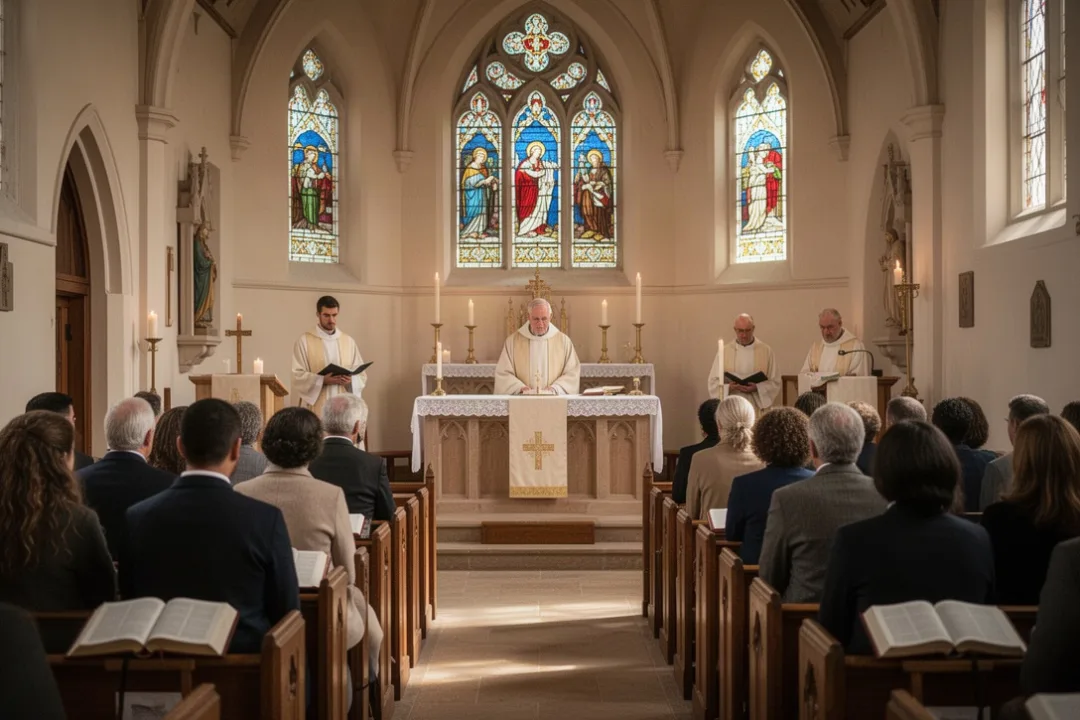
Anglican worship is usually liturgical, meaning that it follows an established order rather than being improvised from week to week. A service commonly includes Scripture readings, a sermon, prayers, a confession of sin, the peace, the Eucharist, and a blessing. Exact patterns vary by province, parish, season, and worship tradition.
The liturgical year gives worship a repeated rhythm. Advent prepares for Christmas, Christmas celebrates Christ’s birth, and Epiphany focuses on his manifestation to the nations. Lent leads toward Holy Week and Easter, while Pentecost and the long season after Pentecost emphasize the Spirit’s work and Christian growth.
Many Anglican churches use robes, candles, vestments, processions, incense, music, and carefully arranged gestures. These features are more prominent in some congregations than others. An Anglican service can range from a simple spoken gathering in a small parish to a highly ceremonial celebration with a choir and organ.
The Book of Common Prayer remains especially important in Anglican history and spirituality, but it is not the only resource used today. Many provinces authorize newer prayer books or worship books, and some congregations use modern language while others retain traditional forms.
Anglican prayer has a strong communal character. The congregation usually prays words spoken together, listens to Scripture, responds through repeated phrases, and participates in a shared pattern of praise and confession. This practice helps connect worshipers across generations and across different parts of the Anglican Communion.
Daily prayer is also significant. Morning Prayer and Evening Prayer, historically known as the Daily Office, organize Scripture readings, psalms, prayers, and responses around the day. Some people pray these services privately, while others attend them in a church or participate through an online or printed format.
What happens in a typical Anglican Eucharist
A Sunday Eucharist usually begins with a gathering and opening prayers. The service then moves through readings from the Bible, a sermon or homily, the creed, prayers for the church and the world, confession, and a sign of peace before reaching the Eucharistic prayer.
The Eucharistic prayer gives thanks to God, recalls the story of salvation, and remembers Jesus’ Last Supper. The congregation receives consecrated bread and wine, or in some circumstances receives only bread. The service concludes with thanksgiving, a blessing, and a sending into the world.
Visitors are generally welcome to attend Anglican worship. Communion practices differ, so a visitor who has questions can ask a priest or an usher before the service. Some churches invite all baptized Christians to receive, while others have more specific local guidelines.
“The church is not a community of perfect people, but a community being made holy by grace.”
This paraphrases a recurring Anglican emphasis: Christian worship is both an offering of praise and a place where people receive forgiveness, instruction, nourishment, and encouragement. The liturgy does not assume that worshipers have already achieved spiritual maturity.
How Anglican churches are governed worldwide
Anglican churches are organized through a system of bishops, dioceses, parishes, and provinces. A bishop normally oversees a diocese, which contains multiple congregations. A priest or rector generally leads a local parish, often with assistance from deacons, other clergy, and lay ministers.
Anglican governance is episcopal, but it is not simply a chain of command. Dioceses and provinces commonly make decisions through assemblies that include bishops, clergy, and lay representatives. This gives lay members a formal role in legislation, budgets, ministry planning, and the election or selection of church leaders.
The Archbishop of Canterbury is a senior symbolic and spiritual figure within the Anglican Communion, but does not function as a pope for all Anglicans. The archbishop leads the Church of England’s Province of Canterbury and serves as a focus of unity for the wider communion without directly governing every Anglican province.
The Anglican Communion consists of autonomous churches, often called provinces or member churches. Examples include the Church of England, the Episcopal Church in the United States, the Anglican Church of Canada, the Anglican Church of Australia, and churches in many African, Asian, Latin American, Caribbean, and Pacific nations.
These churches cooperate through several international instruments:
The Lambeth Conference brings bishops together for consultation, prayer, study, and discussion.
The Anglican Consultative Council includes bishops, clergy, and lay members and supports cooperation across the communion.
The Primates’ Meeting gathers the senior bishops or archbishops of the member churches.
The Archbishop of Canterbury serves as a central point of relationship and public representation.
None of these arrangements turns the communion into one centralized institution. A province may authorize a worship book, ordain women, recognize a marriage, or adopt a social policy without every other province making the same decision. That autonomy allows local adaptation, but it also makes disputes across national boundaries difficult to resolve.
For American readers: the Episcopal Church is the Anglican member church in the United States. “Anglican” can also refer more broadly to other churches in the United States that identify with Anglican tradition but are not part of the Episcopal Church.
The phrase Anglican realignment refers to movements and reorganizations connected with disagreements over theology, sexuality, biblical authority, and church governance. Some congregations and clergy have changed affiliations, and new Anglican bodies have formed. The result is a more complicated Anglican landscape than a single national denomination.
How Anglicanism differs from other Christian traditions
Anglicanism shares much with Roman Catholicism, Eastern Orthodoxy, Lutheranism, Presbyterianism, Methodism, and other Christian traditions. It is distinguished less by one completely unique doctrine than by a particular combination of historic episcopal order, reformed theology, common prayer, and national or provincial independence.
Compared with Roman Catholicism, Anglicanism does not recognize the pope as its universal head. Anglican churches generally do not accept all Roman Catholic definitions of authority and doctrine, including those concerning papal jurisdiction. Nevertheless, many Anglicans value continuity with the early church and retain forms of worship that look familiar to Catholic observers.
Compared with many evangelical Protestant churches, Anglicanism usually places greater emphasis on formal liturgy, the church calendar, bishops, sacraments, and the visible continuity of ordained ministry. An evangelical Anglican congregation may have contemporary music and informal preaching while still retaining Anglican structures and forms of prayer.
Compared with Eastern Orthodoxy, Anglicanism shares an interest in historic Christianity, bishops, sacraments, and liturgical worship but developed in a different historical setting. It is also more closely connected to the English Reformation and generally has different approaches to church authority, doctrinal development, and relations among autonomous churches.
Anglican identity is often broad enough to include several spiritual styles:
Anglo-Catholic parishes emphasize sacramental worship, traditional vestments, saints’ days, and continuity with Catholic practice.
Evangelical Anglican churches emphasize biblical preaching, personal conversion, mission, and active discipleship.
Broad-church or liberal congregations may focus on thoughtful interpretation, social responsibility, inclusion, and engagement with modern culture.
Charismatic Anglican communities highlight prayer for healing, spiritual gifts, lively praise, and the active work of the Holy Spirit.
These labels are useful but imperfect. A parish may combine evangelical preaching with traditional worship, or Anglo-Catholic liturgy with strong social activism. Local history, national culture, clergy leadership, and the congregation’s neighborhood all influence how Anglicanism is lived.
What Anglicanism means for people who attend or join
Someone exploring Anglicanism may encounter a church that feels both familiar and unfamiliar. The service may contain biblical readings and a sermon recognizable from many Protestant churches, yet it may also include kneeling, written prayers, vestments, a formal creed, and Communion at the center of the gathering.
You do not need to understand every movement of the service before attending. Printed orders, service booklets, projection screens, or prayer books usually provide guidance. Watching the congregation for cues is fine, and you can speak with a priest afterward if you want to understand the meaning of a particular practice.
People are drawn to Anglican churches for different reasons. Some value historic continuity and a stable pattern of worship. Others appreciate the connection between faith and public service, the intellectual breadth of Anglican theology, or the opportunity to encounter Scripture through a regular lectionary.
Many Anglican parishes place strong emphasis on community service. Ministries may include food distribution, refugee support, prison ministry, disaster response, pastoral visiting, housing advocacy, and partnerships with local organizations. The exact priorities depend on the congregation and its surrounding community.
Joining an Anglican church normally involves attending worship, meeting members, learning about the parish, and speaking with a priest. A person already baptized in the name of the Trinity may be received or confirmed according to the practice of the relevant church. Someone who has not been baptized would usually begin preparation for baptism.
Church membership and Communion are related but not identical questions. A congregation may welcome visitors to worship while reserving Communion for baptized Christians or for people who meet its particular guidelines. Asking respectfully before receiving is the clearest way to understand a parish’s practice.
Anglicanism can offer a durable framework for faith without requiring every congregation to look the same. Its common prayer connects people across time and geography, while its provincial structure leaves room for local language, music, customs, and pastoral decisions.
Its internal diversity also demands patience. Anglicans may disagree about doctrine, ethics, worship style, or church policy while still recognizing a common inheritance. For many believers, that combination of shared prayer and continuing theological conversation is one of the tradition’s defining characteristics.
Frequently asked questions
Is Anglicanism Protestant or Catholic?
Anglicanism has both Protestant and Catholic features. It emerged from the English Reformation and generally affirms reformed teachings about Scripture and grace, but it retains bishops, sacraments, historic creeds, and structured liturgy. “Catholic” here often means connected to the universal and historic church, not necessarily subject to the pope. Individual Anglican communities may lean more Protestant or more Catholic in worship and theology.
What is the difference between Anglicanism and the Episcopal Church?
Anglicanism is the wider Christian tradition and international family of churches. The Episcopal Church is the Anglican province in the United States. Other Anglican provinces serve Christians in different countries, and additional U.S. churches use Anglican identity outside the Episcopal Church. Their relationships, structures, and positions on contested issues may differ, so the name alone does not identify one uniform organization.
Do Anglicans believe in the real presence of Christ in Communion?
Anglican churches commonly treat Communion as a genuine means of grace and more than a simple mental reminder. They differ, however, in how they explain Christ’s presence in the bread and wine. Some use language close to Catholic sacramental theology, while others emphasize mystery or spiritual participation. There is no single explanation required across every Anglican province.
Can a person attend an Anglican church without being Anglican?
Yes. Anglican worship is generally open to visitors, and you may attend without making a membership commitment. You can participate in prayers and hymns as comfortable, while Communion policies vary by congregation. If you are unsure about receiving, speak with a priest or consult the service information. Visiting several parishes can help you find a worship style and community that fit your needs.












Leave a Reply