Priesthood: meaning, roles, and Christian traditions
Priesthood: meaning, roles, and Christian traditions
Priesthood is service before it is status: it describes a person’s or community’s calling to worship God, serve others, and represent sacred responsibilities faithfully.
The word can refer to several related ideas. In some churches, priesthood means ordained ministry, entrusted with worship, teaching, pastoral care, and sacraments. In other Christian traditions, the emphasis falls on the priesthood of all believers, meaning that every Christian has direct access to God and a responsibility to serve. Some churches also use priesthood for a formal office with distinctive authority and ordinances.
Because the term carries different meanings, a useful explanation must distinguish biblical language from later church practice. It must also separate the work of clergy from the broader spiritual calling shared by the faithful.
A priest is generally understood as someone who performs sacred service on behalf of a religious community. In the ancient world, that service often included offering sacrifices, leading rituals, maintaining holy places, and teaching religious obligations.
Christian use of the word draws heavily on the Bible but does not treat every reference to priests in exactly the same way. The priesthood of ancient Israel belonged to the worship system established through Moses, while the New Testament presents Jesus as the unique and definitive high priest in Christian theology. Churches then developed different understandings of how ministry relates to Christ’s priesthood.
Priesthood therefore has both a vertical dimension and a horizontal dimension. The vertical dimension concerns worship, prayer, holiness, and relationship with God. The horizontal dimension concerns teaching, reconciliation, compassion, leadership, and practical care for people.
Core idea: Christian priesthood is not mainly about privilege or social rank. It is about being entrusted with worship, spiritual care, teaching, and service for the good of others.
How priesthood appears in the Hebrew Bible
In the Hebrew Bible, priests served within the covenant life of Israel. Their responsibilities included caring for the tabernacle and later the temple, presenting offerings, blessing the people, and helping preserve the holiness of communal worship.
Aaron and his descendants held the central priestly office in the biblical account. The Levites assisted with duties connected to worship, although not every Levite was a priest. The high priest held a distinct role within the sanctuary’s sacrificial system and represented the people in particularly solemn rituals.
Priests were not simply religious officials who performed ceremonies. They were expected to follow detailed standards of conduct and ritual purity, teach the law, and distinguish what was holy from what was ordinary. Their actions affected the entire community, so the office carried serious moral and spiritual obligations.
The prophets also challenged priests and other leaders when worship became separated from justice. Biblical criticism of empty ritual shows that correct ceremony was not enough. Faithfulness required care for the vulnerable, honesty, repentance, and obedience to God.
Another important biblical theme is that Israel as a whole was called to be a holy people with a distinctive purpose among the nations. This communal calling helps explain why Christians later spoke about a broader priesthood shared by all believers, even though the ancient priestly office itself had specific family and temple requirements.
How the New Testament changes Christian understandings of priesthood
The New Testament centers Christian priesthood on Jesus. The Letter to the Hebrews describes him as the high priest who brings humanity into reconciliation with God. Christian traditions understand this in different ways, but they generally agree that Jesus occupies a unique place that no ordinary minister replaces.
Christian teaching also connects priesthood with Jesus’ self-giving life, death, and resurrection. Instead of treating priesthood only as a function performed in a temple, the New Testament emphasizes faithful obedience, prayer, service, and offering one’s life to God.
Several New Testament passages describe Christians as a holy or royal priesthood. These passages are commonly understood to mean that believers are called to worship, proclaim God’s work, offer spiritual sacrifices such as praise and mercy, and live as a visible witness to their faith.
That language does not erase every distinction between ordained ministers and other Christians. Rather, it creates a theological foundation for the idea that all believers share responsibility for the life and mission of the church. Different communities then interpret that shared responsibility alongside their own structure of ordained leadership.
The New Testament also describes leaders such as elders, overseers, pastors, teachers, and deacons. The names and functions overlap in some passages and traditions, but the general pattern is clear: Christian communities need people who teach, guide, protect, and serve, while the whole congregation participates in worship and ministry.
What ordained priesthood means in Catholic and Orthodox churches
In Roman Catholic, Eastern Orthodox, and Oriental Orthodox churches, priesthood is ordinarily understood as a sacramental ministry. A man is ordained by a bishop through a rite that the church believes gives him a lasting ministerial identity and authority to serve the church.
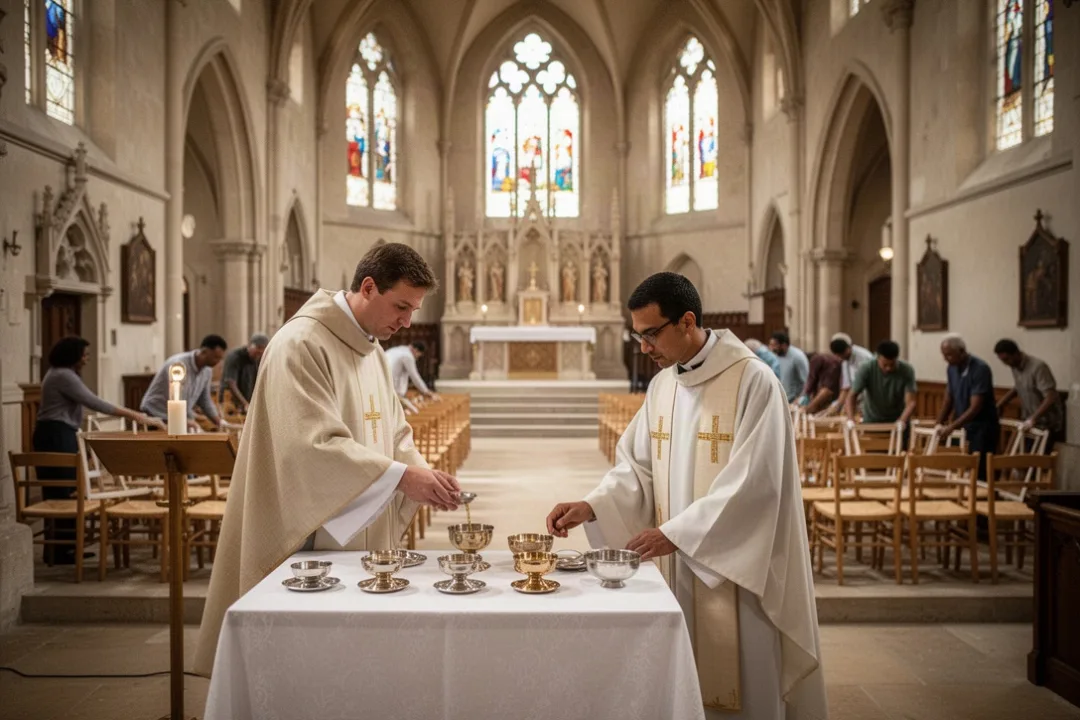
In these traditions, priests normally celebrate the Eucharist or Divine Liturgy, hear confessions, baptize in appropriate circumstances, bless people and objects, preach, visit the sick, and guide parish life. The exact responsibilities vary by church, but the priest’s work is centered on worship and pastoral care.
The bishop is the chief pastor of a local church or diocese, while priests generally serve communities under the bishop’s authority. Deacons assist in worship and service but do not normally preside over the Eucharist. These three levels—bishop, priest, and deacon—are commonly called the threefold order of ministry.
Catholic and Orthodox theology does not usually describe a priest as an independent religious entrepreneur. The priest serves in communion with the bishop and the wider church. Ordination is therefore connected to doctrine, discipline, apostolic continuity, and a public commitment to the community.
There are differences between Catholic and Orthodox practice. For example, both churches honor celibate clergy, but their rules concerning married men ordained to the priesthood are not identical. In both traditions, bishops are normally chosen from clergy who are celibate or monastic, though the details are governed by each church’s discipline.
Women’s ordination also differs sharply among Christian denominations. Catholic, Eastern Orthodox, and Oriental Orthodox churches do not ordain women as priests, while several Anglican, Lutheran, Methodist, Episcopal, and other Protestant bodies do ordain women to forms of pastoral ministry. A church’s position reflects its theology, history, and interpretation of scripture and tradition.
What the priesthood of all believers means
The priesthood of all believers means that every Christian can approach God through faith in Christ and is called to offer worship and service. It rejects the idea that only ordained clergy can pray, understand scripture, witness to the faith, or serve as a channel of God’s care.
This teaching became especially prominent during the Protestant Reformation, although its roots are found in the New Testament. Martin Luther used it to challenge the idea that ordained clergy possessed a higher spiritual status simply by virtue of their office. The concept supported wider access to scripture, congregational participation, and the dignity of ordinary Christian work.
The phrase does not necessarily mean that every Christian performs every church function. Many Protestant churches still recognize pastors, elders, ministers, or other leaders with specific responsibilities. Instead, it means that ordination does not create a separate class of Christians who alone belong to God.
A congregation’s members may exercise this shared calling in many ways:
Praying for family members, neighbors, leaders, and people in crisis.
Teaching children or leading Bible studies within the church’s guidelines.
Offering hospitality, practical help, counseling referrals, or financial support.
Speaking about faith with humility and respecting another person’s freedom.
Working for justice, reconciliation, honesty, and care for vulnerable people.
Using professional skills to strengthen the church and serve the wider community.
This broader priesthood should not be confused with informal authority. A person may have a genuine spiritual calling without being authorized to preach publicly, administer sacraments, provide clinical counseling, or make decisions for a congregation. Calling and accountability belong together.
How priesthood differs across Christian traditions
The word priesthood does not carry the same weight in every church. Some communities use “priest” as their normal title for ordained ministers, while others avoid the term because they believe the New Testament presents Christ as the only priest in the fullest sense.
Here are several broad patterns:
Catholic churches: Priests are ordained ministers who serve under bishops and preside at the Eucharist, offer pastoral care, preach, and administer sacraments according to church law.
Eastern and Oriental Orthodox churches: Priests serve the liturgical and sacramental life of local churches under bishops, with strong emphasis on continuity with the ancient church.
Anglican and Episcopal churches: Priests typically lead congregational worship, preach, administer sacraments, and provide pastoral oversight within an episcopal structure.
Lutheran, Methodist, Presbyterian, and other Protestant churches: Ministers may be called pastors, priests, elders, or presbyters depending on the denomination and its historical vocabulary.
Baptist and many evangelical churches: Leaders are usually called pastors or ministers, with emphasis on the priesthood of all believers and the authority of scripture.
Latter-day Saint tradition: Priesthood refers to God’s authority conferred through ordination, with distinct offices and responsibilities in church governance, teaching, ordinances, and service.
These descriptions are broad and cannot capture every denomination. Even churches that share a label may differ in ordination requirements, authority, sacramental theology, gender policies, training, and expectations for clergy.
When someone asks what “the priesthood” means, the best response may depend on the setting. A Catholic parish, an Orthodox monastery, a Protestant seminary, and a Latter-day Saint congregation may use the word with different assumptions.
What priests typically do in a local church
A priest’s visible role often involves worship, but parish ministry extends far beyond the service itself. Priests may spend much of their week preparing sermons, visiting hospitals, meeting with families, planning funerals, coordinating volunteers, studying theology, and responding to pastoral emergencies.
Common responsibilities include:
Leading worship: Preparing and conducting services, prayers, readings, sermons, and sacraments according to the church’s tradition.
Teaching: Explaining scripture, doctrine, ethics, and spiritual practice in sermons, classes, and personal conversations.
Providing pastoral care: Listening to grief, illness, family conflict, doubt, and other personal concerns without treating ministry as a substitute for professional care.
Marking important life events: Supporting people at baptisms, weddings, funerals, confirmations, and other significant moments.
Building community: Helping people worship together, resolve conflicts, welcome newcomers, and care for neighbors.
Maintaining accountability: Following church law, safeguarding policies, confidentiality rules, and supervision requirements.
Priests do not always work alone. Effective ministry normally involves deacons, musicians, teachers, administrators, pastoral associates, lay leaders, and volunteers. Sharing responsibility protects both the minister and the congregation from an unhealthy dependence on one individual.
Healthy boundary: A priest can offer spiritual support, but serious mental-health concerns, abuse allegations, medical needs, and legal matters may require qualified professionals or public authorities as well.
How people discern a call to priesthood
A call to priesthood is usually tested over time rather than established by a single emotional experience. A person may feel drawn to prayer, worship, teaching, service, or pastoral care, but personal desire alone does not prove suitability for ordained ministry.
Discernment normally includes prayer, honest self-examination, conversations with experienced clergy, participation in church life, and assessment by the relevant denomination. Many traditions also require formal education, background checks, psychological evaluation, supervised ministry, and approval by a bishop, congregation, presbytery, or other governing body.
Do people consistently experience you as trustworthy, patient, teachable, and compassionate?
Can you accept correction and remain responsible when ministry becomes difficult?
Are you willing to serve people who cannot repay you or share your opinions?
Can you communicate Christian teaching accurately without using authority to control others?
Are your family, work, health, finances, and relationships stable enough for sustained ministry?
Does your church community recognize gifts for leadership, worship, teaching, or pastoral care?
A genuine call may include joy, but it also includes discipline, sacrifice, and accountability. Priests encounter conflict, grief, criticism, administrative burdens, and the limits of what one person can repair. Healthy discernment takes those realities seriously.
Common mistakes people make when thinking about priesthood
Many misunderstandings come from treating one tradition’s definition as universal. The following distinctions can help:
Equating priesthood with personal holiness: Ordination does not make someone incapable of sin, error, or misconduct. Ministers remain morally accountable.
Assuming priests have unlimited authority: A priest’s authority is limited by scripture, church rules, professional standards, civil law, and the rights of other people.
Reducing priesthood to public ritual: Worship matters, but listening, teaching, visiting, administration, protection, and service are also central to ministry.
Confusing the priesthood of believers with the absence of leadership: Shared spiritual dignity does not eliminate the need for trained and accountable leaders.
Assuming all priests must be celibate: Celibacy is required in some traditions or contexts, but married clergy are accepted in others.
Using “priest” and “pastor” as exact synonyms: The terms overlap in some churches and differ in others. A denomination’s own definitions should guide usage.
Expecting one priest to solve every personal problem: Spiritual care works best alongside medical, psychological, financial, and legal assistance when those forms of help are needed.
Ignoring safeguarding: Respect for clergy does not remove the need for boundaries, reporting procedures, supervision, and protection from abuse.
These distinctions are especially useful when comparing churches. Ask what a tradition believes ordination does, who may receive it, what authority it grants, how ministers are supervised, and how the congregation shares responsibility.
What priesthood asks of a Christian community
Priesthood is not only a question for people considering ordained ministry. It also asks congregations how they receive leadership and exercise their own responsibilities. A church can support its priest by praying, participating, giving honest feedback, respecting appropriate boundaries, and serving rather than treating the minister as a hired spiritual service provider.
Communities should also expect ethical leadership. That includes transparent finances, responsible handling of confidential information, clear safeguarding procedures, fair treatment of staff, and appropriate responses to complaints. Reverence for a sacred office should never be used to silence people who report harm.
Members who are not ordained still have meaningful work to do. They can welcome strangers, visit the lonely, teach, organize relief, mentor younger people, repair relationships, and bring Christian principles into workplaces and neighborhoods. The health of a church depends on this shared ministry.
At its best, priesthood points beyond the individual who holds the office. A priest’s purpose is not to make people permanently dependent on the priest, but to help them grow in faith, wisdom, service, and love. The office is strongest when it equips a community to worship God and care for one another with maturity.
Frequently asked questions
Is priesthood only for ordained clergy?
No. In many Christian traditions, priesthood refers both to ordained ministry and to the spiritual calling shared by all believers. Ordained clergy have defined responsibilities and authority, while all Christians are called to worship, serve, pray, witness, and care for others. The balance between these two meanings differs among denominations.
What is the difference between a priest and a pastor?
The distinction depends on the church. “Priest” often emphasizes sacramental ministry and continuity with historic priesthood, while “pastor” emphasizes shepherding and pastoral care. Some churches use both titles for the same minister; others use only one. A denomination’s theology and rules determine the practical difference.
Do priests have to be celibate?
Not universally. Roman Catholic discipline generally requires celibacy for priests in the Latin Church, with specific exceptions. Eastern Catholic and Orthodox churches commonly ordain married men, although bishops are normally celibate. Many Anglican and Protestant traditions also permit married clergy. Requirements vary by church and jurisdiction.
Can a woman become a priest?
The answer varies by denomination. Roman Catholic, Eastern Orthodox, and Oriental Orthodox churches do not ordain women as priests. Several Anglican, Episcopal, Lutheran, Methodist, and other Protestant bodies do ordain women to pastoral or priestly ministry. Each tradition bases its practice on its interpretation of scripture, tradition, and church authority.












Leave a Reply