When you see a man assisting the priest at Mass, proclaiming the Gospel, or leading a funeral service, you may wonder, “Is he a priest?” A Catholic deacon is an ordained minister who serves the Church through the ministry of the Word, liturgy, and charity. He is not a priest, but he has received the first degree of the sacrament of Holy Orders.
Deacons serve in parishes, hospitals, prisons, schools, diocesan offices, and local communities. Their work combines public worship with practical care for people who are grieving, poor, sick, isolated, or searching for faith. Some deacons serve as a permanent vocation, while others are ordained as deacons for a period before becoming priests.
The word deacon comes from a Greek term associated with service or ministry. In Catholic teaching, a deacon is not simply a volunteer who helps during worship. Through ordination, he receives a specific office of service and becomes part of the clergy, alongside bishops and priests.
The three degrees of Holy Orders are bishop, priest, and deacon. A bishop possesses the fullness of Holy Orders, while priests share in the bishop’s ministry in a particular way. Deacons are ordained to assist bishops and priests and to serve the people of God, especially by bringing the Church’s care to those on the margins.
The New Testament describes the early Church choosing men for a ministry concerned with service to the community. Acts 6:1-6 is traditionally connected with the development of the diaconate, although the passage does not use every later Catholic distinction about the office. The New Testament also refers to deacons in Philippians 1:1 and 1 Timothy 3, where character and household responsibilities receive particular attention.
Essential distinction: A deacon is ordained clergy, but he cannot celebrate Mass, hear sacramental confessions, or anoint the sick as a priest does. His ministry is real and sacramental, but it is not the priesthood.
What a Catholic deacon does at Mass
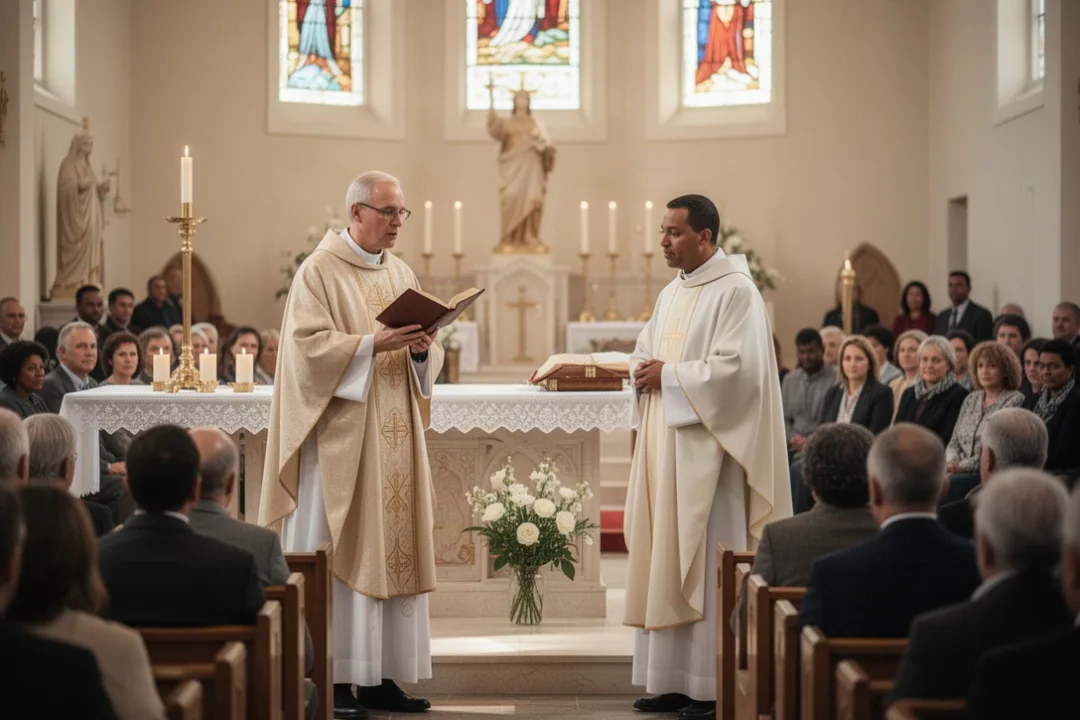
A deacon’s role at Mass is both liturgical and symbolic. He serves at the altar, assists the priest and bishop, and helps the congregation hear and respond to the Gospel. The exact duties can vary according to the form of the liturgy and the instructions of the bishop or pastor.
Proclaiming the Gospel: The deacon normally carries the Gospel book in the procession and proclaims the Gospel reading.
Preaching: He may give the homily when permitted by the Church’s liturgical norms and assigned by the celebrant.
Preparing the altar: He assists with the preparation of the gifts and the altar during the Eucharistic celebration.
Serving the chalice: He may assist with the distribution of Communion, including the Precious Blood when it is offered.
Giving instructions: He may invite the congregation to exchange peace, kneel, stand, or go forth in peace, depending on the liturgy.
Dismissal: He sends the people out at the end of Mass, connecting worship with Christian service beyond the church building.
His place at the altar should not be mistaken for a lesser version of the priest’s role. The deacon’s liturgical service points to his broader vocation: hearing the Word, living the Word, and helping others live it. His dismissal at the end of Mass has a practical meaning because Christians are sent into daily life to serve neighbors and the wider community.
What a Catholic deacon can do outside Mass
Much of a deacon’s ministry happens away from the sanctuary. He may visit patients in a hospital, accompany a family after a death, teach adults preparing for baptism, or help connect parishioners with food, housing, counseling, or other assistance. The work depends on the needs of the parish and the assignment given by the bishop or pastor.
A deacon can ordinarily baptize and can assist at weddings in the Catholic Church when he has the necessary delegation. He may preside at certain funeral rites, prayer services, Communion services, Benediction, and other celebrations that do not require a priest. He can also lead the Liturgy of the Hours and offer blessings when the Church’s law and liturgical books permit.
Deacons often preach in settings beyond Sunday Mass. Their preaching may take place at a baptism, wedding, funeral, prayer service, retreat, or parish formation event. A deacon’s professional background can also shape his service. Someone with experience in social work, health care, education, law, business, or public safety may bring valuable skills to ministry, although ordination is not granted merely because a candidate has useful professional abilities.
Sacraments and rites a deacon may perform
The most useful way to understand a deacon’s authority is to distinguish what he can do from what requires a priest or bishop. A deacon’s ministry includes important sacramental responsibilities, but the Eucharist and reconciliation remain outside his sacramental power.
Baptism: A deacon can administer baptism, normally in accordance with the parish’s preparation and scheduling.
Marriage: He may assist at a Catholic marriage when properly delegated and when the required conditions are met.
Funerals: He may lead funeral rites that do not include the celebration of Mass and can accompany families through mourning.
Preaching: He may preach in settings authorized by the Church and his assignment.
Eucharist: He cannot consecrate the bread and wine or celebrate Mass.
Confession: He cannot hear sacramental confessions or grant absolution.
Anointing of the sick: He cannot administer the sacrament of Anointing of the Sick.
Ordination: He cannot ordain bishops, priests, or deacons.
There can be differences in practice from one diocese to another. A deacon may have the ability to perform a rite in principle but still need a specific assignment, delegation, or permission in a particular situation. A parish office or diocesan chancellery can explain the local requirements for weddings, baptisms, and funerals.
Permanent and transitional deacons serve different paths
The Catholic Church recognizes two principal paths to the diaconate: permanent diaconate and transitional diaconate. Both men receive the sacrament of Holy Orders and both are genuinely deacons. The distinction concerns what normally comes next in their vocation.
Permanent deacons remain deacons
A permanent deacon is ordained to remain in the diaconate for life. He may be married or celibate, depending on his circumstances and the discipline of his Catholic tradition. In the Latin Church, a married man may be admitted to formation with his wife’s consent, and the couple’s family responsibilities are carefully considered.
Many permanent deacons have full-time jobs or are retired. Their employment is not a substitute for ministry, but it can place them in daily contact with people who may never approach a parish office. A permanent deacon may serve evenings and weekends while balancing work, marriage, parenting, caregiving, and parish responsibilities.
Permanent deacons are not “part-time priests.” They have a different vocation, and their family life can be part of their witness. A married deacon remains responsible to his wife and children, so the Church expects his ministry to respect the needs of his household rather than compete with them.
Transitional deacons are preparing for priesthood
A transitional deacon is a seminarian who has been ordained to the diaconate before priestly ordination. This period allows him to serve publicly as a deacon and to deepen his understanding of ordained ministry. He may proclaim the Gospel, preach, baptize, assist at Mass, and perform other duties permitted to deacons.
After completing the required period and meeting the Church’s requirements, he may be ordained a priest by the diocesan bishop or religious superior. Not every transitional deacon ultimately becomes a priest; circumstances can change, and the Church continues to discern a candidate’s vocation during formation.
Do not judge the type of deacon by his appearance: A married man serving at the altar is often a permanent deacon, while a seminarian in formation may be a transitional deacon. Both are ordained deacons, and the visible duties can overlap.
How someone becomes a Catholic deacon
Becoming a deacon is a lengthy process of discernment, formation, and evaluation. A man does not simply sign up for ordination because he wants to help at Mass. He, his family when applicable, the parish, and the diocese must discern whether the vocation is genuine and whether he is ready for the responsibilities of ordained ministry.
Initial prayer and discernment: The man speaks with a pastor, spiritual director, or diocesan vocation office about his sense of call and his experience of Christian service.
Contact with the diocese: He learns the local requirements, application process, education expectations, age standards, and formation schedule.
Application and evaluation: The diocese may review his sacramental practice, marriage history, family situation, health, education, employment, criminal background, and readiness for public ministry.
Family and parish consultation: A married candidate’s wife must be involved in the discernment process. The parish also helps assess his service, faith, character, and ability to work with others.
Academic formation: Candidates study Scripture, Catholic theology, liturgy, Church history, moral teaching, pastoral care, canon law, and preaching.
Spiritual and human formation: Formation includes prayer, retreats, spiritual direction, personal growth, and preparation for the practical demands of ministry.
Pastoral formation: Candidates serve in parishes or other settings under supervision so they can learn how to visit, teach, preach, lead prayer, and respond to pastoral situations.
Ordination: If the bishop accepts the candidate and the formation requirements are completed, the candidate is ordained through the laying on of hands and the prayer of consecration.
Formation programs differ significantly. Some meet on weeknights and weekends over several years, while others use a different schedule suited to the diocese. The goal is not merely academic knowledge. A candidate must show emotional maturity, fidelity to Catholic teaching, practical judgment, compassion, and a life of prayer.
Who can become a permanent deacon?
Requirements are governed by universal Church law as well as diocesan policies. In the Latin Church, permanent deacon candidates are generally adult men who are practicing Catholics, active in parish life, and able to accept the responsibilities of ordained ministry. The precise age, education, and formation rules should be confirmed with the diocese where the candidate lives.
A married candidate normally needs a stable marriage and his wife’s written consent for the application and ordination process. The diocese considers the well-being of the marriage and family, including the candidate’s availability, financial responsibilities, children’s needs, and the likely effect of ministry on family life.
Ordinarily, a man who is ordained while married does not marry again if his wife dies. A widowed candidate may be subject to additional expectations, particularly when he has children who still depend on him. Celibate candidates make a commitment to celibacy according to the discipline of the Latin Church.
In Eastern Catholic Churches, the rules and customs surrounding married clergy and the diaconate can differ. The same is true of formation practices between dioceses. Anyone considering this vocation should speak with the appropriate diocesan or eparchial authority instead of relying on a general description.
Diaconal formation develops the whole person, not just the ability to perform liturgical tasks. Candidates learn how Catholic belief connects with real situations such as grief, marital conflict, poverty, addiction, illness, immigration, aging, and questions about faith.
Scripture and theology help a deacon proclaim the Gospel accurately and explain Catholic teaching responsibly. Liturgy and preaching prepare him to serve at the altar and communicate in a way that respects both the sacred rites and the people gathered. Pastoral training teaches him to listen before offering advice.
Human formation matters because deacons work closely with families, priests, staff members, volunteers, and other clergy. A candidate may be deeply devout yet still need growth in patience, communication, conflict resolution, boundaries, or cultural awareness. The formation process is intended to reveal those areas and provide support before ordination.
Spiritual formation usually includes regular prayer, participation in the sacraments, retreats, spiritual direction, and reflection on the candidate’s call. The diaconate is not mainly a platform for public recognition. A man who wants the title but resists quiet service may need to reconsider whether he is responding to a vocation.
How deacons serve people in need
The diaconate has a particular connection with charity and justice. This does not mean every deacon runs a social-service program, nor does it mean charitable work belongs only to deacons. It means the Church expects deacons to help make the Gospel’s concern for vulnerable people visible in concrete ways.
A deacon may organize volunteers for a food pantry, visit people in nursing homes, support prison ministry, coordinate disaster assistance, or connect a family with professional services. He may also notice needs that are easy to miss: an elderly parishioner who has stopped attending, a new immigrant who cannot understand parish procedures, or a grieving spouse who needs continued support months after a funeral.
His ministry is not limited to giving material assistance. A deacon’s presence can communicate that a person is not forgotten by the Church. Listening, prayer, advocacy, and respectful accompaniment may be as important as delivering supplies.
“Whoever wants to become great among you must be your servant.” — Matthew 20:26, paraphrased
That teaching captures the spirit of the diaconate. It does not reduce service to a personality trait or a job description. It presents service as a way of following Christ, especially when the work is hidden, repetitive, or inconvenient.
How a deacon relates to the priest and bishop
A deacon does not function as an independent minister who answers only to personal preference. He serves under the authority of the diocesan bishop, usually through a parish assignment and in cooperation with the pastor. A religious-order deacon may also be accountable to his religious superior, while still following the bishop’s direction in diocesan ministry.
The priest remains the parish’s ordinary leader for sacramental and pastoral governance under the bishop. A deacon can receive significant responsibilities, but he does not replace the priest or independently determine parish policy. Healthy collaboration requires clear communication about schedules, preaching, pastoral visits, liturgical roles, and confidentiality.
Deacons also work with lay ministers. Their ordination does not make them the only people capable of teaching, visiting the sick, organizing charity, or leading parish programs. Instead, a deacon can help coordinate and encourage the gifts of the whole community.
Common misunderstandings about Catholic deacons
A deacon is not a junior priest
The diaconate is not simply a lower rank of priesthood. A deacon and a priest share certain responsibilities, but their sacramental authority and proper ministries differ. Calling a deacon “Father” is generally not appropriate unless a particular custom or circumstance gives a specific reason; deacons are commonly addressed as “Deacon” followed by their name.
Although a deacon may stand at the altar and handle sacred vessels in his assigned role, he does not consecrate the Eucharistic elements. The priest or bishop presides over the Eucharistic Prayer. A deacon’s close participation at Mass should not be confused with presiding over the celebration.
A deacon’s work is more than assisting during Mass
People often notice the deacon most clearly on Sunday, but the public liturgy may be only one part of his week. Visits, phone calls, preparation meetings, teaching, administrative work, outreach, and quiet pastoral conversations can occupy substantial time.
Not every man who helps at Mass is a deacon
Altar servers, lectors, extraordinary ministers of Holy Communion, ushers, and sacristans all have important roles, but they are not necessarily ordained. A deacon can usually be identified by his liturgical vestments and assignment, but the safest approach is to ask the parish rather than assume a person’s status.
How to contact a Catholic deacon about a pastoral need
If you need a baptism, wedding, funeral, home visit, or prayer service, begin with the parish office. The office can tell you whether a deacon is assigned to that ministry and what preparation or documentation is required. A deacon may be the person who accompanies you, but the parish will coordinate the proper minister and scheduling.
For urgent medical or end-of-life situations, ask the hospital chaplain, parish office, or priest about the appropriate sacramental care. A deacon can pray with you and offer pastoral support, but only a priest can administer the Anointing of the Sick or hear a sacramental confession.
Someone considering the vocation should contact the diocesan diaconate office or vocation director. A conversation does not commit you to applying. It is a practical first step for learning about local expectations, formation, family involvement, and the kind of service the diocese needs.
What makes the diaconate a distinct vocation
The Catholic deacon stands at a meeting point between worship and everyday life. He proclaims the Gospel in church and then carries its demands into hospitals, homes, workplaces, prisons, shelters, and family conversations. His ministry reminds the parish that the altar and the needs of neighbors cannot be separated.
A deacon’s authority comes through ordination, but his credibility depends greatly on how he serves. Availability, humility, fidelity, and compassion are not decorative qualities; they are central to the vocation. Whether he is permanent or transitional, married or celibate, employed or retired, the deacon is called to help the Church become more attentive to God and more responsive to people.
Frequently asked questions
Can a Catholic deacon hear my confession?
No. Deacons do not have the authority to celebrate the sacrament of Reconciliation or give absolution. They can listen to your concerns, pray with you, and help connect you with a priest. If you need confession, contact your parish office or ask a priest about available confession times.
Can a Catholic deacon perform a wedding?
A deacon may assist at a Catholic wedding when he has the required delegation and the couple has completed the parish preparation process. Rules can vary by diocese, and some situations require additional permissions. Contact the parish before setting a date or making arrangements with a particular deacon.
Do Catholic deacons receive a salary?
Compensation depends on the diocese and the assignment. Many permanent deacons have outside employment and serve without a standard ministerial salary, although they may receive reimbursement for ministry-related expenses. Full-time deacons or those with specialized assignments may have different arrangements established by their diocese.
Can a married Catholic man become a deacon?
In the Latin Church, a married man may be considered for the permanent diaconate if he meets the Church’s requirements and his wife freely supports the vocation. The diocese examines the stability of the marriage, family responsibilities, health, faith practice, and readiness for formation. Local policies determine the exact process.










Leave a Reply