The seven sacraments of the Catholic Church are Baptism, Confirmation, the Eucharist, Reconciliation, Anointing of the Sick, Holy Orders, and Matrimony. Catholics believe these visible rites were entrusted to the Church by Christ and communicate God’s grace to believers.
The sacraments accompany the major stages of Christian life. Three—Baptism, Confirmation, and the Eucharist—are called the sacraments of Christian initiation. Reconciliation and Anointing of the Sick bring healing, while Holy Orders and Matrimony serve the building up of the Church and the wider human community.
A sacrament is an effective sign of grace. It uses a visible action, such as washing with water, anointing with oil, eating bread, or exchanging marriage vows, to communicate an invisible spiritual reality. In Catholic teaching, the sacrament does not merely symbolize grace; God acts through it when it is celebrated properly and received with the right disposition.
Each sacrament has a visible sign, a sacramental celebration, and a spiritual effect. The words and actions used by the priest, bishop, or other minister are essential because they express what the Church is asking God to do. The sacrament’s power comes from Christ, not from the personal holiness or personality of the minister.
The Church teaches that the sacraments are ordinarily necessary means of grace, but it also recognizes God’s freedom and mercy. A person’s situation, understanding, intention, and circumstances matter. For example, someone who sincerely seeks Baptism but dies before receiving it may be understood in relation to a desire for the sacrament, while God alone judges each person’s heart.
A helpful distinction: A sacrament is more than a religious ceremony or a public expression of faith. Catholics believe Christ works through the sacramental sign to give grace and deepen communion with God.
The three sacraments of Christian initiation
Baptism, Confirmation, and the Eucharist form the foundation of Catholic Christian life. Together, they incorporate a person into the Church, strengthen that person through the Holy Spirit, and nourish ongoing communion with Christ.
In the Latin Catholic tradition, infants are commonly baptized first, receive First Communion after a period of preparation, and receive Confirmation later. The exact age and order can vary by diocese and Eastern Catholic tradition. Adults who become Catholic normally receive the three initiation sacraments together, often during the Easter season.
1. Baptism begins life in Christ
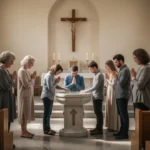
Baptism is the first sacrament and the gateway to the others. Water is poured over the person or the person is immersed in water while the minister baptizes in the name of the Father, Son, and Holy Spirit. Catholics believe Baptism forgives sin, including original sin, and gives the baptized person new life in Christ.
Baptism also makes a person a member of the Church and marks the person permanently as belonging to Christ. Because of this lasting spiritual character, a valid Baptism cannot be repeated. If there is a serious question about whether someone was baptized, the Church may use a conditional form rather than simply baptizing again.
Parents and godparents present an infant for Baptism and promise to help the child grow in the Catholic faith. An adult candidate makes the commitment personally. In both cases, Baptism points toward a life of conversion, prayer, worship, and service rather than functioning as a one-time event with no continuing responsibilities.
The ordinary minister of Baptism is a bishop, priest, or deacon, but in an emergency anyone may baptize if there is water, the intention to do what the Church does, and the proper baptismal formula. This provision reflects the Church’s concern that people should not be deprived of the sacrament because a priest is unavailable.
2. Confirmation strengthens baptismal grace
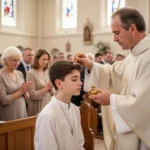
Confirmation completes and strengthens the grace received in Baptism. Through the anointing with sacred chrism and the laying on of hands, the bishop or authorized priest asks the Holy Spirit to strengthen the candidate. The rite is associated especially with the Spirit’s gifts, including wisdom, understanding, counsel, fortitude, knowledge, piety, and reverence for God.
Confirmation deepens a person’s relationship with Christ and gives a fuller share in the mission of the Church. It is not graduation from religious education. Rather, it calls the confirmed person to live as a more mature witness through prayer, moral choices, participation in worship, and service to others.
Like Baptism, Confirmation imprints a permanent spiritual character and is received only once. Candidates usually renew their baptismal promises, receive an anointing on the forehead, and are sent to practice the faith with greater courage. A sponsor supports the candidate and represents the continuing community of faith.
3. The Eucharist feeds Catholic life
The Eucharist is the sacrament Catholics celebrate at Mass. During the liturgy, bread and wine become, through the action of the Holy Spirit and the words of consecration, the Body and Blood of Christ. Catholics receive Christ sacramentally under the appearances of bread and wine and understand the Eucharist as the center and summit of Christian life.
The Eucharist makes present the Church’s memorial of Christ’s death and resurrection. “Memorial” here means more than remembering a past event. In Catholic worship, the saving mystery is sacramentally made present, and the Church joins itself to Christ’s offering to the Father.
Receiving Communion unites Catholics more deeply with Christ and with one another. It also calls them to become what they receive by practicing charity, forgiveness, and concern for people in need. Catholics are expected to approach Communion with faith and an awareness of serious sin; those conscious of mortal sin ordinarily seek Reconciliation before receiving.
First Communion is a child’s first reception of the Eucharist after preparation in Catholic teaching and participation in the sacramental life of the Church. The Eucharist itself, however, is not only for special occasions. Catholics are invited to participate in Mass regularly and to receive Communion when properly prepared.
The two sacraments of healing
Reconciliation and Anointing of the Sick address the wounds that affect human life. One restores a person’s relationship with God and the Church after sin; the other brings Christ’s presence, strength, and healing to people facing serious illness, frailty, or the possibility of death.
4. Reconciliation restores friendship with God
The Sacrament of Reconciliation—also called Confession or Penance—offers forgiveness for sins committed after Baptism. The penitent examines their conscience, confesses sins to a priest, expresses sorrow, receives a penance, and hears the priest pronounce absolution. Through this ministry, the Church announces and applies God’s forgiveness.
True repentance includes more than feeling guilty. It involves turning away from sin and intending to live differently. A person does not need to remember every minor fault perfectly, but serious sins should be confessed honestly in kind and number as far as reasonably possible.
The priest’s role is sacramental and pastoral. He listens, offers guidance, assigns a penance, and absolves the penitent in the name of Christ and the Church. Catholic priests are bound by the seal of confession, meaning they may not disclose what they learn in the sacrament.
Reconciliation repairs more than a private relationship with God. Serious sin damages communion with the Church and with other people, so sacramental forgiveness also restores the penitent to fuller participation in the community. A penance, such as prayer or a work of charity, is not a payment for forgiveness; it expresses a willingness to make amends and begin again.
5. Anointing of the Sick brings Christ’s care in illness
Anointing of the Sick is offered to Catholics who are seriously ill, weakened by old age, facing major surgery because of a serious condition, or experiencing a significant deterioration in health. A priest anoints the person’s forehead and hands with blessed oil and prays for the Holy Spirit’s strength, peace, and healing.
The sacrament may bring physical healing if that serves the person’s good, but physical recovery is not its only purpose. It can bring forgiveness of sins, courage, peace, union with Christ’s suffering, and strength to face illness. It may also prepare a person for the final passage from this life when death is near.
Anointing is not reserved exclusively for the last moments of life. Calling a priest earlier can allow the sick person to participate more fully in the rite and receive pastoral care without creating unnecessary fear. The sacrament can be received again if the person recovers and later becomes seriously ill again or if the same illness becomes more severe.
When a person is near death, the priest may also offer Viaticum, which is Holy Communion received as spiritual food for the journey from this life. Depending on the circumstances, prayers for the dying and the Apostolic Pardon may also be included in pastoral care.
The two sacraments at the service of communion
Holy Orders and Matrimony are called sacraments at the service of communion because they are directed toward the good of others and the building up of the Church. Both involve a public vocation and a lifelong commitment, although they serve the community in different ways.
6. Holy Orders appoints ministers for the Church
Holy Orders is the sacrament through which Christ’s mission is entrusted to bishops, priests, and deacons. These are the three degrees of the one sacrament. They are not three separate sacraments, but distinct forms of ordained ministry with different responsibilities.
Bishops receive the fullness of Holy Orders. They teach, govern, and sanctify the people entrusted to them and preserve communion with the pope and other bishops.
Priests share in the bishop’s ministry. They proclaim the Gospel, preside at the Eucharist, celebrate Reconciliation and Anointing of the Sick, and serve local Catholic communities.
Deacons are ordained for service. They may proclaim the Gospel, preach, baptize, witness marriages, lead certain prayers, and assist the bishop and priests in serving the community.
Ordination involves the laying on of hands and a prayer of consecration. The sacrament gives an enduring spiritual character, so ordination is not repeated. In the Latin Church, candidates for priesthood are generally chosen from among celibate men, while the permanent diaconate may include married men who meet the Church’s requirements. Eastern Catholic Churches have their own disciplines within Catholic communion.
Holy Orders does not make an ordained minister personally perfect. Clergy remain in need of conversion and accountability. The sacrament concerns Christ’s promise to act through the Church’s ordained ministry, while the minister is still responsible for living faithfully and serving with integrity.
7. Matrimony creates a covenant of married life
Matrimony is the sacrament in which a baptized man and a baptized woman establish a lifelong covenant of married love. In the Catholic understanding, the spouses confer the sacrament on each other through their free consent. A priest or deacon normally receives that consent on behalf of the Church, but the essential act is the couple’s exchange of vows.
Marriage unites the spouses in an exclusive and permanent partnership directed toward their good and toward the generation and education of children. Catholic teaching describes marital love as faithful, fruitful, and open to life. The couple’s shared life is meant to reflect Christ’s faithful love and to become a place where children learn faith, responsibility, forgiveness, and service.
A valid sacramental marriage requires free consent and the ability to make the commitment. Consent must not be forced, and the couple must understand that marriage involves permanence, fidelity, and openness to family life. Serious impediments or defects in consent can affect validity, which is why the Church normally requires preparation before the wedding.
Marriage is not simply a wedding ceremony. The wedding begins a vocation that is lived through ordinary decisions: caring for one another, resolving conflict, sharing prayer, welcoming children, managing resources responsibly, and remaining present through sickness and hardship. The sacramental grace of Matrimony is intended to support that daily vocation.
How the seven sacraments fit together
The sacraments are distinct, but they are not isolated religious events. Baptism opens the Christian life; Confirmation strengthens it; and the Eucharist continually nourishes it. Reconciliation restores a person after sin, while Anointing of the Sick offers grace in serious illness and vulnerability.
Holy Orders exists to serve the Church’s worship, teaching, and pastoral mission. Matrimony serves the communion of spouses, children, and the wider community. The seven sacraments therefore touch both personal holiness and the life of the entire Church.
They also express a Catholic view of human nature: God uses material things and human relationships to communicate spiritual grace. Water, oil, bread, wine, spoken forgiveness, physical touch, vows, and the laying on of hands all become meaningful within the Church’s sacramental worship.
Remember the pattern: Initiation gives new life, healing restores and strengthens, and the sacraments at the service of communion equip people to serve God and others through ordained ministry or married life.
Practical ways to prepare for the sacraments
Preparation depends on the sacrament and the person’s circumstances, but it should involve more than completing paperwork or attending a single class. Good preparation connects belief, prayer, community, and a willingness to live the grace received.
Ask the parish early. Requirements, schedules, sponsor rules, and preparation programs can differ among parishes and dioceses.
Learn what the sacrament signifies. Knowing the central prayers, signs, promises, and responsibilities helps you participate consciously.
Pray honestly. Bring hopes, doubts, fears, and areas needing healing to God rather than treating preparation as a performance.
Examine your intention. For Baptism, Confirmation, and Matrimony especially, consider what commitment you or your family is making beyond the ceremony.
Receive pastoral guidance. A priest, deacon, catechist, sponsor, or marriage-preparation team can help with questions that general information cannot answer.
Continue afterward. Regular Mass, prayer, Scripture, service, and participation in parish life help sacramental grace shape daily decisions.
Common mistakes about the seven sacraments
Several misunderstandings can make the sacraments seem like milestones that are completed and then left behind. Catholic teaching presents them as encounters with Christ that form a continuing way of life.
Calling Confirmation graduation: Confirmation strengthens a person for Christian witness; it does not mark the end of faith formation.
Treating Communion as a reward for being perfect: Catholics approach the Eucharist with reverence and proper preparation, but the sacrament is nourishment for people growing in holiness.
Waiting until the last minute for Anointing: The sacrament is for serious illness and should not be viewed only as an emergency rite at the point of death.
Assuming confession is only private advice: Reconciliation includes pastoral counsel, but its sacramental center is the confession of sin, repentance, and absolution.
Thinking a wedding automatically guarantees a valid marriage: Free consent, proper form, and the absence of impediments matter in Catholic marriage.
Confusing a sacramental with a sacrament: Holy water, medals, blessings, and candles can help direct people toward grace, but they are not among the seven sacraments.
Assuming every sacrament is received repeatedly: Baptism, Confirmation, and Holy Orders leave a permanent character and are not repeated.
How sacraments differ from sacramentals
Sacramentals include blessings, blessed objects, devotional practices, and certain actions authorized by the Church. Examples include holy water, the Sign of the Cross, medals, ashes, and blessings of people or homes. They prepare believers to receive grace and help sanctify ordinary situations, but they differ from the seven sacraments.
The sacraments were instituted by Christ and entrusted to the Church as central channels of sacramental grace. Sacramentals are established by the Church to support Christian devotion. Their effectiveness is not understood in exactly the same way as the sacraments, and using a blessed object is never a substitute for Baptism, the Eucharist, Reconciliation, or another sacrament.
Why the seven sacraments matter in everyday life
The sacraments connect faith with concrete moments: birth into a community, growth in responsibility, shared worship, moral failure, illness, marriage, and service. They remind Catholics that holiness is not limited to private feelings or exceptional experiences. God’s grace is sought and received through the ordinary life of the Church.
They also create a rhythm of belonging, healing, nourishment, and mission. A Catholic does not receive the sacraments simply to collect religious milestones. Each one asks for a response: living as a baptized person, witnessing after Confirmation, sharing in the Eucharist, returning to God through Reconciliation, accepting care in illness, serving through vocation, and keeping the covenant of marriage.
The seven sacraments therefore form a coherent pattern of Catholic life. They begin with God’s initiative, involve the faith of the Church and the individual, and send people back into the world with a deeper responsibility to love God and serve their neighbors.
Frequently asked questions
Are all seven sacraments received by every Catholic?
No. Every Catholic is called to receive Baptism, Confirmation, and the Eucharist, along with Reconciliation as needed and Anointing of the Sick when seriously ill. Holy Orders and Matrimony are particular vocations, so a Catholic may receive one, the other, or neither. A person does not need to receive every sacrament to live a faithful Catholic life.
Which sacraments can only be received once?
Baptism, Confirmation, and Holy Orders can each be received only once because they imprint a permanent spiritual character. This lasting mark signifies a person’s definitive belonging to Christ or, in the case of Holy Orders, a permanent configuration for ordained service. Reconciliation, Eucharist, Anointing of the Sick, and Matrimony may be received or celebrated repeatedly according to Catholic practice and circumstances.
Can a non-Catholic receive a Catholic sacrament?
The answer depends on the sacrament, the person’s baptismal status, and the circumstances. Catholic ministers may administer Baptism to an unbaptized person who freely seeks it and meets the requirements. Some baptized Christians may receive certain sacraments in exceptional situations. Anyone with a specific concern should speak directly with a Catholic priest.
Why are infants baptized if they cannot personally profess faith?
Catholic parents request infant Baptism because they want their child to receive new life in Christ and become part of the Church. Parents and godparents make the profession of faith and promise to raise the child in Catholic practice. As the child grows, personal faith and freely chosen participation are expected to develop through family life, instruction, prayer, and worship.













Leave a Reply