Catholic questions and answers: a clear guide to the faith
Catholic questions and answers: a clear guide to the faith
Catholic questions and answers usually begin with a few central concerns: What does the Church believe? Why do Catholics attend Mass? How do Scripture, Tradition, prayer, and the sacraments fit together? The clearest answers start with the person of Jesus Christ, whom Catholics recognize as the Son of God and the center of Christian life.
Catholic teaching is built around belief in one God in three Persons, the saving work of Christ, the guidance of the Holy Spirit, and the life of the Church. Catholics express these beliefs through the Creed, the sacraments, Scripture, prayer, moral action, and service to others.
What Catholics believe at the center of their faith
Catholicism is a Christian faith centered on the death and resurrection of Jesus. Catholics believe that God created humanity out of love, that human beings are wounded by sin, and that God offers reconciliation and new life through Christ.
The Church teaches that Jesus is both fully divine and fully human. His life, teachings, crucifixion, resurrection, and promise of the Holy Spirit shape Catholic worship and doctrine. Catholics do not see Christianity as only a set of ideas; they understand it as a relationship with God lived within a community.
The word Catholic means universal. It points to a Church that is intended for all peoples and cultures, while remaining united in faith and sacramental life. Catholic parishes may have very different customs, music, languages, or devotional traditions, but they share the same essential beliefs.
The shortest answer: Catholics seek to know, love, and follow Jesus Christ through faith, the sacraments, prayer, Scripture, the Church, and love of neighbor.
How Catholic belief is organized
When people ask broad Catholic questions, it helps to separate the faith into several connected areas. None stands alone. For example, the Eucharist is a sacrament, but it is also connected to Christ’s sacrifice, the Church’s worship, personal prayer, and service to the community.
Doctrine: what Catholics believe about God, Jesus, the Church, salvation, human dignity, and the world.
Worship: how Catholics praise God, especially through the Mass and the sacraments.
Prayer: how Catholics speak with God, listen for God’s guidance, and grow in trust.
Moral life: how faith shapes decisions, relationships, work, and treatment of vulnerable people.
Community: how Catholics live as members of the Church and serve others.
The Catechism of the Catholic Church presents Catholic teaching in four broad parts: the profession of faith, the celebration of Christian mystery, life in Christ, and Christian prayer. These categories provide a useful framework for learning without reducing the faith to a list of isolated answers.
What is the Catholic Church?
The Catholic Church is the worldwide community of Christians united in faith, worship, and sacramental life. Catholics believe Christ established the Church and entrusted it with continuing his mission of teaching, sanctifying, and serving the world.
According to Catholic teaching, the Church is both human and divine. It includes ordinary people who can fail, yet it is also guided by God’s grace. The Church’s holiness comes from Christ, even though individual Catholics are always called to conversion and improvement.
Catholics describe the Church with four traditional marks: one, holy, catholic, and apostolic. “One” refers to unity in faith and communion. “Holy” points to God’s action and the call to holiness. “Catholic” means universal, and “apostolic” refers to continuity with the apostles and their teaching.
What are the main Catholic beliefs?
The Nicene Creed, recited at Mass on Sundays and certain solemn celebrations, summarizes core Christian beliefs. It professes faith in one God, the Father, the Son, and the Holy Spirit; in Jesus Christ and his saving work; in the Church; in baptism; in forgiveness; in resurrection; and in eternal life.
A Catholic does not have to understand every theological question before beginning to practice the faith. Learning normally develops over time through worship, study, conversation, prayer, and experience of Christian community.
God is one: Catholics believe in one God who created and sustains all that exists.
God is Trinity: the Father, Son, and Holy Spirit are three distinct Persons in the one divine nature.
Jesus saves: Christ’s incarnation, death, and resurrection open the way to reconciliation with God.
The Holy Spirit gives life: the Spirit works in the Church and helps believers grow in faith and holiness.
The Church continues Christ’s mission: Catholics receive teaching, worship, and pastoral care through the Church.
Human life has dignity: every person is created in God’s image and deserves respect and protection.
History has a destination: Catholics believe in judgment, resurrection, and eternal life with God.
Why do Catholics attend Mass?
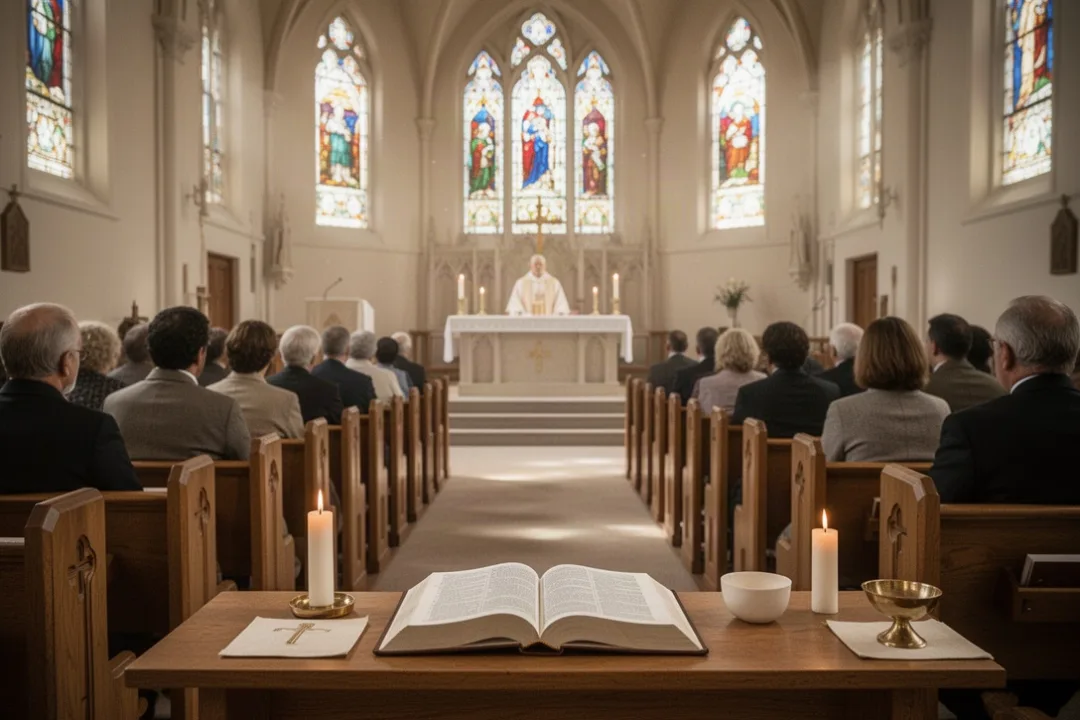
Catholics attend Mass because it is the Church’s principal act of worship and the celebration of the Eucharist. The Mass gathers the community to hear Scripture, give thanks to God, remember Christ’s saving work, and receive Christ in Holy Communion.
The word Eucharist comes from a Greek term associated with thanksgiving. During the Liturgy of the Eucharist, Catholics believe that bread and wine become the Body and Blood of Christ while retaining the appearances of bread and wine. This belief is called the Real Presence.
The Mass has two main parts: the Liturgy of the Word and the Liturgy of the Eucharist. Scripture is proclaimed and explained, prayers are offered, gifts are presented, and the faithful share in Communion when properly prepared.
Sunday Mass has a special place because Sunday commemorates Christ’s resurrection. Catholics are generally obliged to participate in Mass on Sundays and certain holy days of obligation, subject to legitimate reasons such as serious illness or the care of someone who needs help.
Practical point: Someone who is not Catholic, or who is not prepared to receive Communion, may still attend Mass reverently. At the time of Communion, that person may remain seated or follow local parish guidance about receiving a blessing.
What are the seven Catholic sacraments?
A sacrament is an effective sign of grace instituted by Christ and entrusted to the Church. Through the sacraments, Catholics believe God acts in a special and tangible way in the lives of believers.
Baptism: begins Christian life, frees a person from original sin, and makes the person a member of the Church.
Confirmation: strengthens baptismal grace and deepens the believer’s relationship with the Holy Spirit.
Eucharist: nourishes Catholics with Christ’s presence and unites the Church in worship.
Reconciliation: offers forgiveness of sins and restores communion with God and the Church.
Anointing of the Sick: brings Christ’s comfort, strength, and grace to those seriously ill or weakened by age.
Holy Orders: gives bishops, priests, and deacons a sacramental role in serving the Church.
Matrimony: joins a baptized man and woman in a covenant of faithful, lifelong love open to family life.
The sacraments are commonly grouped into three categories. Initiation includes Baptism, Confirmation, and the Eucharist. Healing includes Reconciliation and Anointing of the Sick. Service of communion includes Holy Orders and Matrimony.
What is Baptism, and why is it important?
Baptism is the first sacrament of Christian initiation. Through water and the invocation of the Father, Son, and Holy Spirit, a person is welcomed into the Church and begins a new life in Christ.
Catholics baptize infants because they believe God’s grace is a gift, not something a person must earn through intellectual understanding. Parents and godparents promise to help the child grow in faith. Adults who seek Baptism normally receive instruction and freely profess their faith before the sacrament.
Baptism does not remove a person’s freedom or guarantee that every later choice will be good. It gives a new spiritual identity and calls the baptized person to continue growing through prayer, moral living, worship, and participation in the Church.
Why do Catholics confess sins to a priest?
In the Sacrament of Reconciliation, a person confesses sins to a priest, expresses genuine sorrow, receives counsel and penance, and is given absolution. Catholics believe Christ entrusted the Church with a ministry of forgiveness and reconciliation.
Confession is not meant to replace personal prayer or direct conversation with God. Rather, it provides a sacramental encounter in which the penitent hears forgiveness proclaimed and is restored to communion with God and the Church.
A helpful confession includes honesty, contrition, and a desire to change. A person does not need dramatic language or a perfect explanation. The priest is there to help, and confessions are governed by a strict obligation of confidentiality.
Catholic practice distinguishes between mortal and venial sin. A mortal sin involves grave matter, full knowledge, and deliberate consent. Because circumstances can affect responsibility, people should avoid judging themselves or others hastily and may seek guidance from a priest.
How do Catholics pray?
Prayer is a living relationship with God, not merely the recitation of words. Catholics pray through praise, thanksgiving, repentance, petition, intercession, silence, and acts of love.
Some Catholic prayers are memorized and shared across the world, including the Lord’s Prayer, the Hail Mary, the Glory Be, and the Apostles’ Creed. Catholics also pray spontaneously, read Scripture slowly, sit in silence before the Blessed Sacrament, or use devotional practices such as the Rosary.
The Rosary is a meditative prayer centered on events in the lives of Jesus and Mary. Catholics do not worship Mary through the Rosary. They ask her to pray for them while contemplating Christ’s incarnation, ministry, suffering, resurrection, and glory.
A simple daily pattern can make prayer more consistent:
Speak honestly about gratitude, fear, sin, and the needs of others.
Remain quiet for a few moments and end with a familiar prayer.
Prayer does not always produce a strong emotion. Dryness, distraction, and uncertainty are common parts of spiritual life. Faithfulness can mean returning to prayer even when the experience feels ordinary or difficult.
How do Catholics use the Bible?
Catholics believe the Bible is the inspired word of God and an essential source for knowing God’s plan of salvation. Scripture is proclaimed at Mass, used in personal prayer, studied in groups, and interpreted within the life of the Church.
Catholics read the Bible together with Sacred Tradition and the teaching authority of the Church. Tradition means the living transmission of the Gospel, not simply a collection of old customs. The Church’s teaching office, called the Magisterium, serves the word of God rather than standing above it.
Readers should consider literary form, historical setting, the whole message of Scripture, and the unity of the faith. A poetic passage, a parable, a historical narrative, and a letter may communicate truth in different ways. Taking a single sentence out of context can lead to a distorted interpretation.
Good starting points include the Gospels, the Psalms, Acts of the Apostles, and selected New Testament letters. A Catholic Bible includes books that are not found in many Protestant editions, reflecting differences in the biblical canon among Christian traditions.
Why do Catholics honor Mary and the saints?
Catholics honor Mary because of her unique role as the mother of Jesus and her faithful response to God. They believe she was preserved from original sin by God’s grace and remained a model of discipleship. The Church gives Mary special honor, but worship belongs to God alone.
Saints are Christians recognized by the Church as having lived lives of exceptional holiness and now sharing in God’s glory. Catholics ask saints to pray for them, much as someone might ask a trusted Christian friend for prayer. This practice expresses belief in the communion of saints, the spiritual unity of the Church on earth, in purification, and in heaven.
Images, statues, medals, and icons can help direct attention toward Christ and the truths of faith. Catholics do not believe the material object is a god. Respect shown to a sacred image is intended to honor the person or reality represented.
What does Catholic teaching say about moral life?
Catholic moral teaching begins with the dignity of every human person and the call to love God and neighbor. The Ten Commandments, the Beatitudes, the teachings of Jesus, and the virtues provide guidance for forming a good life.
Conscience is not simply personal preference. It is the inner judgment by which a person recognizes the moral quality of an action. Catholics are expected to form conscience through Scripture, prayer, sound reasoning, the Church’s teaching, and honest attention to the effects of their choices.
Several principles shape Catholic moral decisions:
Human dignity: people must never be treated merely as tools or objects.
The common good: social arrangements should help people and communities flourish.
Solidarity: Christians are responsible for one another, especially those who suffer.
Subsidiarity: decisions should be made at the most local level capable of handling them well.
Stewardship: people are called to care for creation and use resources responsibly.
Mercy and justice: compassion does not cancel accountability, and justice does not eliminate the need for mercy.
Catholic moral reasoning considers the action itself, the intention, and the circumstances. A good intention cannot make an inherently wrong act good, while difficult circumstances may reduce a person’s responsibility. Specific questions about serious moral decisions deserve personal pastoral guidance rather than quick judgments.
What do Catholics believe about marriage and family?
Catholic marriage is a covenant in which a baptized man and woman freely give themselves to one another in a faithful, lifelong union. The marriage bond is ordered toward the good of the spouses and the generation and education of children.
Catholic family life is meant to be a school of love, forgiveness, responsibility, and faith. Parents have a primary role in teaching children to pray, practice compassion, participate in worship, and respect the dignity of every person.
The Church also recognizes that families experience divorce, infertility, abuse, addiction, bereavement, and other painful realities. Catholics are called to respond with truth, protection of the vulnerable, pastoral care, and compassion. Abuse is never justified by religious language or family authority.
How do Catholics serve their communities?
Faith becomes visible through works of mercy and practical service. Catholics care for people who are hungry, homeless, sick, imprisoned, grieving, lonely, or displaced. Service can happen through a parish, a Catholic charity, a hospital, a school, or quiet help offered to a neighbor.
The corporal works of mercy focus on concrete needs, such as feeding the hungry, visiting the sick, welcoming strangers, and burying the dead. The spiritual works of mercy include teaching, encouraging, correcting with care, forgiving, comforting, and praying for others.
Catholic social teaching also addresses work, poverty, migration, peace, the environment, government, and economic responsibility. It does not fit neatly into one political platform. Catholics are encouraged to protect life, defend human dignity, seek justice, and make prudent decisions in public life.
How can someone begin practicing Catholicism?
A person who is curious about Catholicism can begin by attending Mass, speaking with a priest or parish staff member, reading one of the Gospels, and joining a parish conversation or inquiry program. There is no requirement to pretend to understand everything or to hide difficult questions.
Adults who are not baptized, or who were baptized in another Christian community and want to explore full communion with the Catholic Church, may participate in the Order of Christian Initiation of Adults. The process includes learning, prayer, discernment, and gradual participation. It is not a pressure-based course or a promise that every participant must immediately become Catholic.
Before receiving any sacrament, a person should speak with the parish. Sacraments involve preparation and particular requirements, and a priest or trained minister can explain what applies to your circumstances.
Useful first steps include:
Attend a Sunday Mass and observe the prayers, readings, and gestures.
Introduce yourself to the priest or parish office after Mass.
Read the Gospel according to Mark or Luke.
Write down questions instead of expecting instant answers.
Learn about Baptism, the Eucharist, and Reconciliation.
Visit a parish more than once before forming an impression.
Ask how the parish supports people in need and protects children and vulnerable adults.
How can Catholics handle difficult questions?
Faith does not require avoiding hard subjects. Catholics regularly ask about suffering, unanswered prayer, the existence of God, Church history, moral teaching, different Christian traditions, and the failures of Church members. Honest questions can lead to deeper understanding when they are approached with humility and patience.
It helps to distinguish between official teaching, theological opinion, local custom, and an individual Catholic’s personal view. Not every statement made by a Catholic represents Church doctrine. When a question is serious or controversial, consult the Bible, the Catechism, a reliable Catholic resource, and a knowledgeable priest or theologian.
The Church also acknowledges sin and failure within its members. A Catholic response should neither deny wrongdoing nor assume that every criticism is fair. Seeking truth, protecting victims, supporting justice, and praying for conversion belong together.
For many people, Catholic faith grows through a combination of clear teaching and lived experience: praying with others, receiving the sacraments, serving neighbors, reading Scripture, and gradually learning to recognize God’s grace in ordinary life.
Frequently asked questions
Do Catholics believe they are the only people who can be saved?
Catholic teaching holds that salvation comes through Jesus Christ, while also teaching that God’s mercy is not limited by the visible boundaries of the Catholic Church. People who have not encountered the Gospel through no fault of their own are entrusted to God’s justice and mercy. Catholics are still called to share the Gospel and live faithfully rather than presume how God judges any individual.
Can a non-Catholic receive Communion at a Catholic Mass?
Ordinarily, Holy Communion is received by Catholics who are properly prepared and in a state of grace. Because Communion expresses full unity in faith and Church life, non-Catholics generally do not receive it. Rules can differ in particular circumstances, so visitors should ask a priest privately rather than rely on assumptions.
What is the difference between a Catholic priest and a deacon?
A priest can preside at Mass, hear confessions, anoint the sick, and celebrate other sacraments within his ministry. A deacon serves the Church through preaching, baptism, charity, and assisting at the altar, but he does not preside at the Eucharist or hear confessions. Deacons may be permanent or transitional before priestly ordination.
Do Catholics have to agree with every teaching before joining the Church?
People exploring Catholicism are not expected to have mastered every doctrine at the beginning. They should be open to learning, prayer, and honest discernment. Formal reception into the Church involves professing the Catholic faith, so unresolved questions should be discussed with parish leaders instead of concealed or dismissed.










Leave a Reply