Confirmation is the Catholic sacrament in which a baptized person is strengthened by the Holy Spirit and more closely united to the Church. Through prayer, the laying on of hands, and anointing with sacred chrism, the person receives a deeper sharing in the grace first given at Baptism. Confirmation completes, but does not replace, Baptism.
Along with Baptism and the Eucharist, Confirmation is one of the three sacraments of Christian initiation. It is not a graduation ceremony or merely a public statement of personal belief. The Church understands it as a real sacramental gift that strengthens a Christian for faithful worship, service, moral living, and witness to Jesus Christ.
The name Confirmation points to a strengthening or confirming of baptismal grace. Baptism begins a person’s life in Christ by cleansing from sin, making the person a member of the Church, and giving new birth through water and the Holy Spirit. Confirmation builds on that beginning and gives the baptized person a fuller share in the Holy Spirit’s work.
The sacrament also deepens a person’s relationship with the Church. A confirmed Catholic is more fully joined to the Church’s mission and is called to participate actively in its life. That mission includes prayer, learning the faith, serving people in need, defending human dignity, and sharing the Gospel through both words and actions.
Catholic teaching connects Confirmation with the events of Pentecost, when the Holy Spirit came upon the apostles and gave them courage to proclaim Christ. Before Pentecost, the apostles often acted with fear and uncertainty. After receiving the Spirit, they became public witnesses to Jesus, even when that witness brought hardship.
Confirmation does not mean that a person suddenly understands every teaching of the Church or will never struggle with doubt. It gives sacramental grace for the Christian life, but that grace must be welcomed and lived through prayer, freedom, discipline, and continued formation. The sacrament strengthens a person; it does not remove the need for daily conversion.
Core idea: Confirmation is not a Catholic coming-of-age ritual. It is a sacrament that strengthens the baptized person through the Holy Spirit and sends that person to live as a witness to Christ.
The sacrament also leaves a permanent spiritual mark, sometimes called an indelible character. Because of this lasting seal, a person may receive Confirmation only once. A Catholic who has already been validly confirmed does not repeat the sacrament, even if the person later returns to active practice or feels spiritually unprepared at the time of the original celebration.
What happens during the Confirmation rite
The exact order and surrounding customs can vary by parish and diocese, but the central actions of the sacrament remain consistent. The celebration normally takes place during Mass, although Confirmation may be celebrated in another appropriate liturgical setting. The bishop is the ordinary minister in the Latin Catholic Church, while a priest may confirm when authorized by Church law or delegated by the bishop.
The candidates are presented to the bishop or priest. In many celebrations, a pastor or another representative introduces them, and the candidates may renew the promises made for them at Baptism. This renewal expresses their intention to reject sin and live according to the Christian faith.
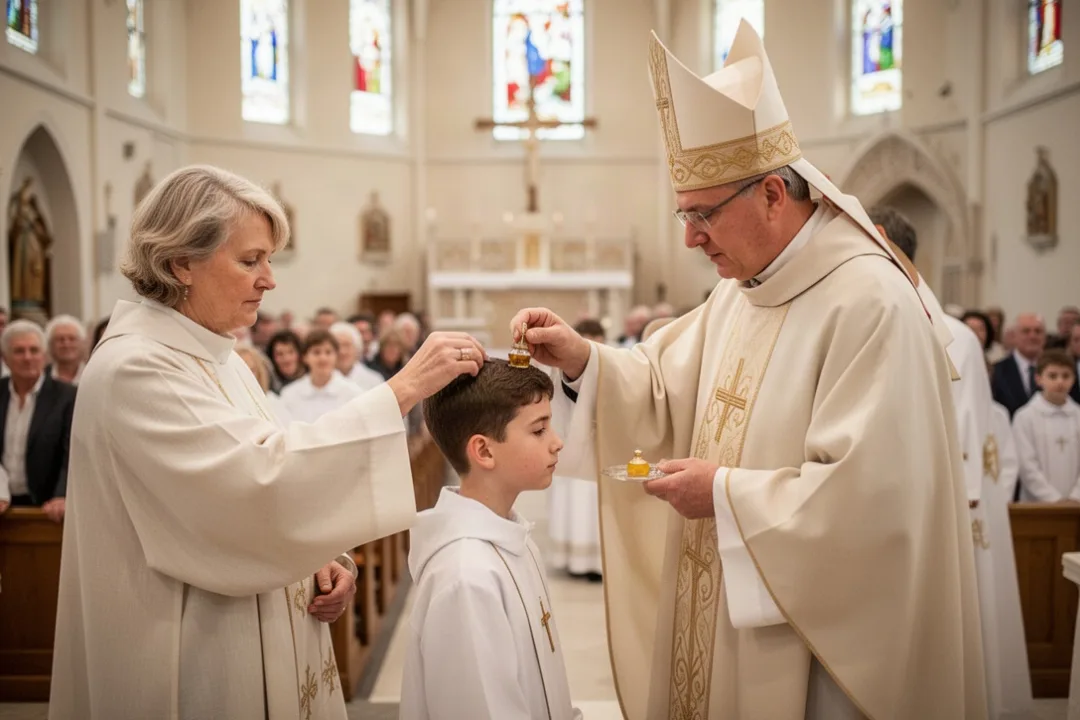
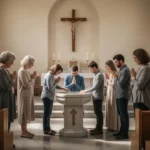
The minister then extends his hands over those who are to be confirmed and prays for the Holy Spirit to come upon them. This laying on of hands is an ancient Christian gesture associated with blessing, commissioning, healing, and the gift of the Spirit. It shows that Confirmation is received from God through the prayer and ministry of the Church.
The central visible sign is anointing with sacred chrism, a fragrant oil blessed or consecrated by the bishop. The minister anoints the candidate on the forehead with the sign of the cross and speaks the sacramental formula about being sealed with the gift of the Holy Spirit. The candidate responds with “Amen,” expressing faith and agreement.
The anointing is followed by a sign of peace between the minister and the newly confirmed person. This gesture points to communion with the bishop, the local Church, and the wider Christian community. Confirmation is therefore personal, but never private in the sense of being disconnected from the Church.
The main elements of the rite communicate different aspects of the sacrament:
The laying on of hands shows the Church’s prayer for the Holy Spirit.
The anointing with chrism signifies consecration, strengthening, healing, and belonging to Christ.
The sign of the cross identifies the confirmed person with Jesus and his saving mission.
The words of the minister identify the Holy Spirit as the gift received in the sacrament.
The sign of peace expresses unity with the Church and its shepherds.
The Eucharist often follows the Confirmation rite because the three sacraments of initiation are closely connected. The newly confirmed person continues to receive Christ in Holy Communion and takes part more fully in the Church’s worship. The sacrament is not complete simply because the ceremony has ended; its purpose unfolds through a Catholic’s ongoing life of faith.
Who receives Confirmation and how preparation works
Any baptized Catholic who has not yet been confirmed may be prepared to receive the sacrament. The person should be capable of understanding the basic meaning of Confirmation, freely desire to receive it, and be properly prepared. The required age is not identical everywhere, because bishops and dioceses establish local pastoral practice within the Church’s broader law and teaching.
In many dioceses in the United States, children or teenagers receive Confirmation during the middle-school or high-school years. Some communities confirm younger children, while adults may prepare through a parish program, the order of Christian initiation for adults, or another diocesan process. The timing may differ, but the sacrament itself is the same.
Preparation should form the whole person rather than provide only information to memorize. A good program helps candidates understand the Creed, Scripture, prayer, the sacraments, moral decision-making, the Church, and the meaning of discipleship. It also gives them opportunities to examine their habits, ask honest questions, and recognize where they need God’s help.
Typical preparation may include the following:
Regular participation in Sunday Mass and the parish community.
Prayer with Scripture and instruction about the Holy Spirit.
Review of Baptism, the Eucharist, Confirmation, and Reconciliation.
Discussion of Catholic beliefs and how they shape everyday choices.
Service to the parish or to people who are poor, sick, lonely, or vulnerable.
A retreat, interview, practice session, or meeting with parish leaders.
An opportunity to receive the Sacrament of Reconciliation before Confirmation.
Receiving Reconciliation beforehand is common because candidates are encouraged to approach Confirmation with a heart turned toward God. A person does not need to be spiritually perfect, but should not knowingly cling to serious sin while presenting himself or herself for the sacrament. The parish priest can explain what preparation is appropriate in a particular situation.
A sponsor supports the candidate before and after Confirmation. The sponsor is meant to be a practicing Catholic whose life offers a credible example of Christian discipleship, not simply a relative chosen for family tradition. The sponsor accompanies the candidate, prays for the person, and remains available as a source of encouragement and practical guidance.
Church requirements for a sponsor generally include being a Catholic who has received Baptism, Confirmation, and the Eucharist, is old enough to fulfill the role, and is living in a way consistent with the faith. A baptized Christian from another tradition may sometimes serve as a Christian witness alongside a Catholic sponsor, according to local rules. The parish should be consulted before a sponsor is formally selected.
Some candidates choose a Confirmation name, often the name of a saint or another holy Christian. This practice can express a desire to imitate that person’s virtues and ask for the saint’s prayers. It is a local custom rather than the essential matter of the sacrament, so choosing a new name is not universally required.
What gifts Confirmation gives through the Holy Spirit
Confirmation increases and deepens the grace received at Baptism. Catholic tradition describes several effects of the sacrament: a more firmly rooted relationship with God, a stronger union with Christ, a greater abundance of the Holy Spirit’s gifts, a closer connection to the Church, and greater strength to live and defend the faith.
The Church commonly speaks of the seven gifts of the Holy Spirit: wisdom, understanding, counsel, fortitude, knowledge, piety, and fear of the Lord. These are not seven supernatural abilities that make someone instantly wise or fearless. They are dispositions that help a Christian respond to God, judge situations in light of faith, and act with greater courage and fidelity.
How the seven gifts apply to ordinary life
Wisdom helps you see life and its priorities from God’s perspective.
Understanding helps you grasp the meaning of revealed faith more deeply.
Counsel helps you make sound moral choices when circumstances are difficult.
Fortitude strengthens you to do what is right despite fear, pressure, or suffering.
Knowledge helps you recognize how created things should be used in relationship to God.
Piety fosters reverence, trust, and a loving relationship with God.
Fear of the Lord means awe before God and a serious desire not to turn away from him.
Confirmation also gives the confirmed person a special strength to bear witness to Christ. Witness does not always mean preaching publicly or debating religion. It can mean remaining honest when dishonesty is rewarded, treating an unpopular person with dignity, forgiving someone, protecting the vulnerable, or explaining a Catholic belief calmly when asked.
The sacrament gives this strength within the life of the Church, not apart from it. The Holy Spirit works through Scripture, prayer, the Eucharist, Reconciliation, Christian friendship, wise guidance, and acts of service. A confirmed Catholic grows into the sacrament by using these ordinary means of grace rather than waiting for a dramatic spiritual experience.
Confirmation also gives a Christian a deeper responsibility for the Church’s mission. Adults, young people, parents, sponsors, religious communities, and parish leaders all have different ways to serve. The gift of the Spirit may lead one person toward teaching, another toward care for the sick, another toward advocacy for the poor, and another toward quiet faithfulness in family life.
Practical test: A fruitful Confirmation should lead toward deeper prayer, stronger participation in the Church, wiser moral choices, and greater willingness to serve. The sacrament is received once, but its mission continues throughout life.
How Confirmation relates to Baptism and the Eucharist
These three sacraments form one connected process of initiation, although Catholics may receive them at different ages and in different circumstances. Baptism gives new life in Christ, Confirmation strengthens and seals that life through the Holy Spirit, and the Eucharist continually nourishes the Christian through communion with Christ.
Baptism is the foundation. Through Baptism, a person becomes a Christian, is freed from original sin, and is welcomed into the Church. Confirmation cannot be received without Baptism because it presupposes and develops the new life that Baptism begins.
Confirmation is not a second Baptism. It does not erase additional sins or make a person “more saved” than someone who has been baptized but not yet confirmed. Instead, it gives a distinct sacramental grace for mature Christian witness and strengthens the baptized person’s participation in the Church’s mission.
The Eucharist is also different from Confirmation. Holy Communion unites Catholics with Christ and nourishes them repeatedly, which is why Catholics receive the Eucharist many times. Confirmation, by contrast, is received once and permanently marks the person with the Holy Spirit.
The order of these sacraments can differ. In the Latin Church, infants commonly receive Baptism first, followed later by Confirmation and First Communion. In many Eastern Catholic Churches, infants receive Baptism, Chrismation—which corresponds to Confirmation—and the Eucharist together. These differences reflect distinct traditions, not different beliefs about the importance of Christian initiation.
Confirmation also should not be confused with an emotional experience. A candidate may feel joyful, nervous, peaceful, distracted, or uncertain during the celebration. The sacrament’s effectiveness rests on Christ’s action through the Church, not on the intensity of a person’s feelings at that moment.
After Confirmation, the most useful question is not only “What did I receive?” but also “How will I respond?” The confirmed person is called to remain close to Christ and to let the Holy Spirit shape decisions, relationships, work, study, family life, and service.
Start with habits that make room for grace. Regular Sunday Mass, daily prayer, Scripture, confession when needed, and honest spiritual reflection give the sacrament room to bear fruit. These practices are not ways to earn Confirmation; they are ways of cooperating with the gift already received.
Witness also grows through ordinary relationships. A Catholic can practice patience at home, refuse gossip, make peace after conflict, welcome someone who is isolated, and speak respectfully about faith. Small acts of fidelity can show the character of Christian discipleship more convincingly than a public religious performance.
Service gives Confirmation a visible direction. Look for a need that is close enough to address consistently, such as helping at a food pantry, visiting an older person, mentoring a child, assisting at parish events, or supporting a community organization that serves people in poverty. The point is not to collect service hours but to develop a habit of love directed toward the good of others.
When questions or doubts arise, seek trustworthy guidance rather than treating them as proof that faith has failed. Speak with a priest, deacon, catechist, sponsor, or mature Catholic who can listen carefully and explain the Church’s teaching. A confirmed Christian is not expected to know everything, but is called to keep seeking truth with humility and courage.
Confirmation is therefore both a gift and a sending. The Holy Spirit strengthens the baptized person for communion with God and gives courage for service in the world. A Catholic lives that gift by staying close to the sacraments, practicing charity, learning the faith, and becoming a dependable witness to Christ in the places where life actually unfolds.
Frequently asked questions
Is Confirmation required for Catholics?
Confirmation completes Christian initiation and is strongly encouraged for baptized Catholics who have not received it. It is not a requirement for God to love someone or for Baptism to be valid. Circumstances such as illness, disability, or lack of access to preparation may affect timing. A parish priest can help determine the appropriate path for someone who has not yet been confirmed.
Can an adult receive Confirmation?
Yes. Adults who were baptized Catholic but never confirmed can usually prepare through a parish or diocesan adult formation process. The preparation may include learning Catholic teaching, attending Mass, receiving Reconciliation, and meeting with a priest or formation team. Adults baptized in another Christian community may follow a different process as they enter full communion with the Catholic Church.
What should I wear to Confirmation?
Wear respectful clothing suitable for a Sunday liturgy, since Confirmation is commonly celebrated during Mass. Requirements vary by parish, so follow the instructions provided by the church or school. Clothing does not make the sacrament valid, but modest, neat attire can reflect the dignity of worship without requiring a particular color, style, or expensive outfit.
Does Confirmation make someone an adult Catholic?
Confirmation does not automatically make a person legally or emotionally an adult, and it does not remove the need for continued learning. It gives sacramental strength for Christian witness and a deeper responsibility within the Church. A confirmed Catholic still grows through prayer, worship, moral choices, community life, and service at every stage of life.












Leave a Reply