The Roman Missal is the Catholic Church’s official book of prayers, instructions, and texts used to celebrate Mass in the Roman Rite.
It gives the priest and congregation the approved words and actions for the liturgy, from the opening greeting through the dismissal. The book also helps the Church celebrate the liturgical year, saints’ days, sacramental occasions, and special needs of the faithful in a consistent way.
The Roman Missal provides the texts for the parts of Mass that change according to the day or occasion. It includes the prayers said by the priest, the responses and acclamations said by the people, and rubrics that describe when the ministers stand, sit, bow, or perform another action.
Some portions of Mass remain the same from Sunday to Sunday. These are gathered in the Order of Mass, which includes the Introductory Rites, the Liturgy of the Word, the Liturgy of the Eucharist, and the Concluding Rites. Other parts change with the calendar, such as the opening prayer, prayer over the offerings, and prayer after Communion.
The Missal therefore serves two purposes at once. It is a liturgical guide for the priest and deacon, and it is an official collection of prayers that expresses the Church’s worship in the Roman Rite.
Key distinction: The Roman Missal contains the prayers and directions for celebrating Mass, while the Lectionary contains the Scripture readings proclaimed during Mass.
What the Roman Missal contains
The exact arrangement can vary slightly by edition and language, but a complete Roman Missal usually includes several major groups of texts. The book is organized so that a priest can find both the ordinary structure of Mass and the proper prayers for a particular day.
The Order of Mass: the fixed structure and texts used throughout the celebration.
The Proper of Seasons: prayers for Advent, Christmas, Lent, the Easter season, and Ordinary Time.
The Proper of Saints: prayers for memorials, feasts, and solemnities of saints and other celebrations.
The Common of Saints: sets of prayers used when a specific saint has no complete proper set or when a common category is appropriate.
Ritual Masses: Mass formularies connected with occasions such as baptism, confirmation, marriage, and ordination.
Masses for Various Needs and Occasions: prayers for circumstances such as peace, the sick, public needs, or particular pastoral situations.
Votive Masses: Mass texts chosen to honor a mystery of Christ, the Holy Spirit, the Virgin Mary, an angel, or a saint.
Masses for the Dead: texts for funerals and other celebrations praying for the deceased.
Prefaces: introductions to the Eucharistic Prayer that reflect the season or celebration.
Eucharistic Prayers: the central prayers of thanksgiving and consecration used during the Liturgy of the Eucharist.
Blessings and additional texts: approved prayers used in particular celebrations or circumstances.
Most editions also include a liturgical calendar or calendar references that help users locate celebrations. Some include musical notation, while others provide only the spoken texts. A large altar edition may contain extensive rubrics and ceremonial directions that are not included in a smaller personal or congregational book.
How the Order of Mass is organized
The Order of Mass gives the basic framework used at nearly every celebration. It does not usually provide every text needed for a particular Sunday or feast; instead, it works together with the proper sections of the Missal and the Lectionary.
The Introductory Rites
The Mass begins with the entrance, greeting, penitential act or another approved form, the Gloria when prescribed, and the collect. The collect is the opening prayer that gathers the intentions of the assembled community and directs them toward God.
The Roman Missal gives the exact form of the greeting, the possible penitential texts, the Gloria, and the rubrics that govern this part of the celebration. The collect changes according to the Sunday, feast, memorial, or other occasion.
The Liturgy of the Word
The readings are proclaimed from the Lectionary, not normally read directly from the Roman Missal. The Missal still supplies the structure for this portion of Mass, including the creed, the Universal Prayer, and directions concerning the homily and related rites.
The creed is used on Sundays and solemnities, subject to the liturgical norms. The Universal Prayer, often called the Prayer of the Faithful, is prepared according to the needs of the Church, the world, the local community, and those in difficulty.
The Liturgy of the Eucharist
This part begins with the preparation of the altar and the gifts. The Missal provides the prayer over the offerings, the preface, the Eucharistic Prayer, and the prayers surrounding Holy Communion.
The Eucharistic Prayer is the center of the celebration. It includes thanksgiving, the acclamation of the people, the invocation of the Holy Spirit, the institution narrative, the memorial acclamation, intercessions, and the final doxology. The Roman Missal contains multiple Eucharistic Prayers, each approved for particular liturgical use.
The Concluding Rites
After Communion, the priest says the prayer after Communion, which changes according to the celebration. The concluding portion may also include announcements, a blessing, and a dismissal.
The dismissal sends the assembly to live the Gospel beyond the church building. The Missal provides several forms of blessing and dismissal, including special options for certain seasons and celebrations.
How the changing parts of Mass are found
Readers often encounter terms such as Proper of Seasons, Proper of Saints, and Common of Saints without knowing how they work together. These sections are not competing versions of Mass. They provide different sets of prayers selected according to the day’s rank and celebration.
The Proper of Seasons follows the Church’s main cycle of worship. It begins with Advent, continues through Christmas, Lent, the Triduum, Easter, and Ordinary Time, and includes prayers for Sundays and major seasonal celebrations.
The Proper of Saints follows the calendar dates assigned to saints and other commemorations. A saint’s memorial may have its own opening prayer, prayer over the offerings, and prayer after Communion. Some celebrations also have their own preface or other special texts.
A Common supplies a suitable group of prayers for a category such as martyrs, pastors, virgins, or holy men and women. It may be used when the calendar calls for a celebration whose proper texts are limited or when the liturgical rules permit a common set.
Not every possible Mass can be celebrated on every day. The liturgical calendar establishes priorities, and the rubrics indicate when a Sunday, solemnity, feast, memorial, seasonal day, or optional celebration takes precedence. The priest or parish sacristan normally checks the calendar before selecting texts.
What the rubrics mean in the Roman Missal
Rubrics are the directions printed in the Missal that describe how the liturgy is celebrated. They may indicate when the priest says a prayer, when the congregation responds, when the ministers bow, or when a particular text is omitted.
Rubrics are not a script for every physical movement in exactly the same level of detail. They establish the Church’s required or permitted form while leaving room for legitimate local customs and pastoral judgment. Their purpose is to protect the integrity of the liturgy rather than to turn worship into a performance controlled by personal preference.
Words printed in a different color, smaller type, or italics may serve different functions depending on the edition. Some are spoken texts, some are directions, and some are optional alternatives. A priest using the book must distinguish the prayer itself from the instruction surrounding it.
The General Instruction of the Roman Missal, often abbreviated GIRM, explains the principles and detailed norms behind the celebration. It addresses the roles of the priest, deacon, altar servers, lectors, extraordinary ministers of Holy Communion, choir, and congregation, as well as the arrangement of the church and sacred vessels.
How the Roman Missal differs from related liturgical books
The Roman Missal is one book within a larger group of Catholic liturgical books. Knowing the differences prevents several common misunderstandings.
Roman Missal: contains the prayers, Eucharistic Prayers, propers, commons, and rubrics for Mass.
Lectionary: contains the biblical readings proclaimed during Mass, arranged according to the liturgical cycle.
Book of the Gospels: contains the Gospel readings and is often carried in procession or placed prominently on the altar.
Roman Pontifical: contains celebrations normally presided over by a bishop, such as confirmation and ordination.
Roman Ritual: contains rites and blessings that are not ordinarily part of the regular Sunday Order of Mass.
Liturgy of the Hours: contains the Church’s daily prayer at offices such as Morning Prayer and Evening Prayer.
Book of Blessings: provides approved forms for many blessings and related celebrations.
A parish may also provide a missalette or worship aid in the pews. This smaller publication may contain the Order of Mass, selected readings, hymns, and seasonal prayers, but it is not necessarily the complete Roman Missal. Its contents depend on the publisher and the period of use.
Why the Lectionary is not simply another name for the Missal
The confusion between these two books is understandable because both are used during Mass and both follow the liturgical calendar. Their contents, however, are different. The Lectionary is the primary source for the biblical readings, while the Missal is the primary source for the liturgical prayers.
On a Sunday, for example, the lector normally proclaims the first reading, psalm, second reading, and Gospel from the Lectionary. The priest or deacon uses the Roman Missal for the collect, creed, Eucharistic Prayer, prayer over the offerings, prayer after Communion, and other prescribed texts.
The Roman Missal may refer to a reading or provide an antiphon, but it does not replace the Lectionary. A parish that owns an altar Missal and a Lectionary needs both books to celebrate the complete liturgy according to the Roman Rite.
The Roman Missal in the United States
In the United States, Mass in English is celebrated using the approved English edition of the Roman Missal. The current English translation was introduced for parish use in Advent 2011 and is based on the third typical edition of the Roman Missal in Latin.
This edition restored or made more visible several features of the Latin source, including more formal phrasing, fuller references to Scripture and tradition, and a closer correspondence between the priest’s prayers and the congregation’s responses. One familiar example is the response to the priest’s greeting: the people answer, “And with your spirit,” rather than the wording used in the earlier English translation.
The United States edition also contains texts approved for the country, including national celebrations and adaptations authorized for use by the United States Conference of Catholic Bishops and confirmed by the Holy See. Other English-speaking countries may use different approved editions with their own calendars, saints’ celebrations, and adaptations.
Liturgical books are not interchangeable simply because they are written in the same language. A parish should use the edition approved for its territory and follow the current instructions from the competent Church authorities.
For parish use: If an older Missal has different wording from what is currently heard at Mass, rely on the edition approved for your country and the parish’s current liturgical guidance.
How the Roman Missal developed
The Missal developed from centuries of Christian worship rather than appearing as a single book at the beginning of the Church’s history. Early communities used separate books for prayers, Scripture readings, chants, and ceremonial directions. Over time, these materials were gathered and organized for more practical use.
During the Middle Ages, books containing the priest’s prayers became increasingly important as the priest’s role in celebrating Mass was presented in one volume. Printed editions helped standardize texts across regions, although local variations continued for many years.
Following the Council of Trent, the Roman Missal promulgated by Pope Pius V in 1570 established a more uniform form for the Roman Rite, with exceptions for certain ancient local uses. Later revisions adjusted the calendar, prayers, rubrics, and ceremonial directions.
The Second Vatican Council called for a renewal of the liturgy. The Roman Missal was revised after the council, and the reformed Roman Rite became the ordinary form used in most parishes. Further revisions produced later typical editions, including the third typical edition that underlies the current English translation used in the United States.
The historical development of the Missal shows why editions matter. A Roman Missal is not merely a devotional prayer book; it is an official liturgical book issued and approved by Church authority for a defined form and language.
How to read the Roman Missal during Mass
Using a complete Missal can feel difficult at first because the texts are arranged for many days and occasions rather than printed as one uninterrupted Sunday service. The basic method is to combine the fixed Order of Mass with the proper texts for the date.
Find the date in the liturgical calendar and identify the day’s rank, such as Sunday, solemnity, feast, or memorial.
Locate the proper section for the season or saint. The page may be in the Proper of Seasons, Proper of Saints, or another designated section.
Note the opening prayer, prayer over the offerings, prayer after Communion, and any special preface or Eucharistic Prayer instruction.
Turn to the Order of Mass for the fixed structure, including the creed, Eucharistic Prayer, and Communion rite.
Use the Lectionary for the day’s Scripture readings rather than searching for them in the Missal.
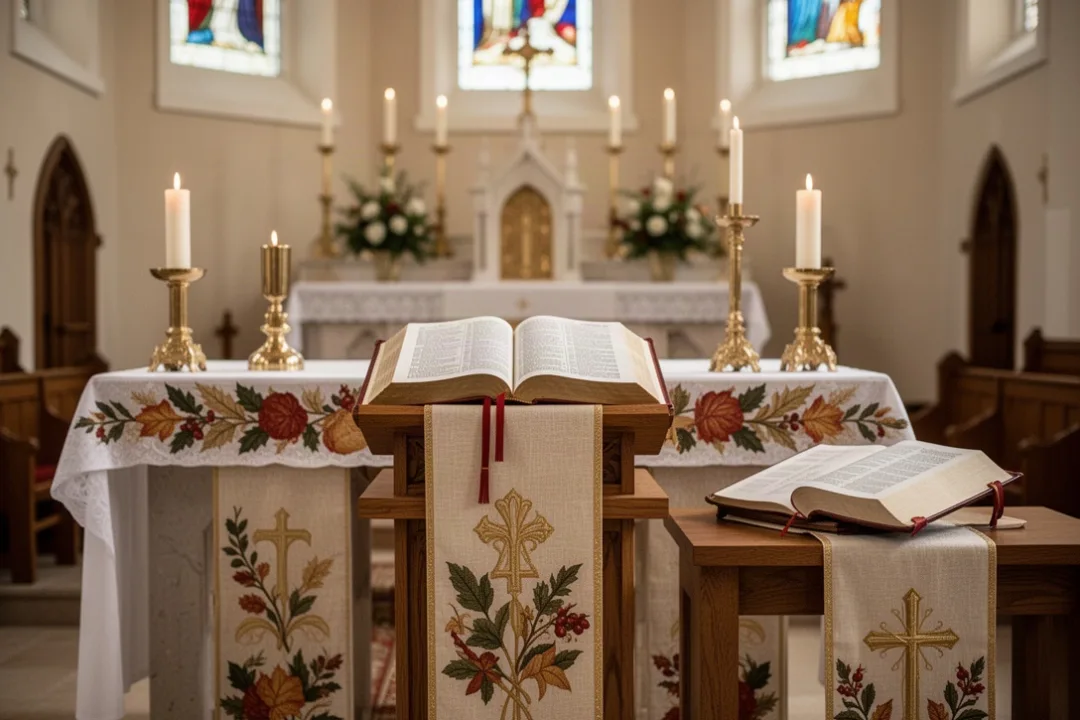
Many altar Missals include ribbons to mark the Order of Mass, the current season, and frequently used Eucharistic Prayers. A parish sacristan may also prepare the book before Mass by placing it at the correct page and checking the proper calendar entry.
Practical tips and common mistakes when using the Roman Missal
Careful preparation makes the Missal easier to use and helps the liturgy proceed without unnecessary pauses. The following habits are useful for priests, deacons, sacristans, servers, and anyone studying the structure of Mass.
Do not use the Lectionary as a substitute for the Missal. The books provide different parts of the liturgy.
Check the liturgical calendar first instead of choosing a saint’s memorial or votive Mass based only on personal preference.
Read the rubrics before Mass, especially when a seasonal rite, ritual Mass, funeral, wedding, or special celebration is involved.
Mark frequently used pages with ribbons, but avoid placing loose papers where they could obscure the printed instructions.
Distinguish optional texts from required texts by reading the surrounding directions rather than assuming every alternative may be used at any time.
Use the approved local edition and do not combine prayers from an older edition with the current Order of Mass.
Prepare for the correct liturgical year and date, since seasonal changes can alter the prayers and prefaces.
Do not add personal wording to official prayers unless the rubrics specifically allow an adaptation, introduction, or brief explanation.
Keep the book treated as a liturgical object, protecting it from spills, folded pages, and makeshift repairs.
One frequent mistake is opening the Missal to a saint’s proper and assuming that every text in that section must be used. The proper may contain alternatives, a common may be permitted, or the day’s higher-ranking celebration may take precedence.
Another mistake is treating the Missal as a personal prayer book during Mass. Personal prayer and meditation are valuable, but the Missal’s primary function is to support the Church’s public worship and the roles of those serving at the altar.
How priests and ministers prepare the Missal
Preparation usually begins with the parish calendar and the celebration being planned. The person preparing the book identifies the correct day, checks whether the celebration has special rites, and marks the appropriate prayers before the ministers enter the sanctuary.
The altar Missal may be placed on a stand, carried in procession, or brought to the altar at the proper time according to local practice and the rubrics. An altar server or another minister may carry or hold it when needed, while the priest uses it for the presidential prayers.
At a concelebrated Mass, preparation can require additional care because several priests may need the Eucharistic Prayer and other texts in view. Large-print editions, ribbons, page markers, and rehearsal are practical aids, but they should not cover the official wording or rubrics.
For weddings, funerals, baptisms, and other celebrations, the minister must consult the relevant ritual book as well as the Missal. Some rites include a Mass with special prayers, while others may take place outside Mass and follow a different liturgical book.
How the Roman Missal supports the congregation
The congregation does not need to own a complete Roman Missal to participate fully in Mass. The Church’s participation includes listening to the readings, responding to the priest, singing, praying, standing and kneeling at the appropriate times, and joining interiorly in the Eucharistic celebration.
A worship aid can help people follow the Order of Mass and respond at the right moments. It may also print the day’s readings or selected prayers, but participation does not depend on reading every word from a page.
Learning the structure of the Missal can still deepen your understanding. You begin to see why the prayers change with the seasons, how the Eucharistic Prayer relates to the rest of Mass, and why the Church gives special prominence to Sundays, solemnities, and the major celebrations of Christ’s life.
The Missal also reveals the connection between the local parish and the universal Church. A congregation in one parish celebrates with its own language and approved calendar, yet it participates in the same Roman Rite and in a common pattern of prayer shared across the world.
Where to find a Roman Missal for study or personal use
A complete altar Missal is usually available through Catholic bookstores, diocesan resources, or publishers of liturgical books. Before purchasing one, check the language, country, edition, and intended use. A book designed for a priest at the altar may be too large or specialized for personal study.
Personal daily Missals often arrange the Mass prayers and readings for each day in a convenient format. They can be useful for preparation, prayer, and learning the calendar, but they may not contain every rubric or every text found in the official altar edition.
When comparing editions, look for clear information about approval and publication. A reputable Catholic bookstore, parish office, diocesan liturgy office, or recognized Catholic publisher can help you identify the appropriate edition for use in the United States.
For serious study, the General Instruction of the Roman Missal is an essential companion. It explains why the Church celebrates Mass in a particular way and clarifies the responsibilities of the ministers and congregation.
Frequently asked questions
Is the Roman Missal the same as a Catholic Bible?
No. The Roman Missal is a liturgical book for celebrating Mass, not a complete Bible. It contains prayers, Eucharistic Prayers, instructions, and selected antiphons, while the Lectionary provides the Scripture readings proclaimed during Mass. A Bible includes the full collection of biblical books and is used for broader study and prayer.
Who is allowed to use the Roman Missal?
Anyone may study the Roman Missal, but its official liturgical use belongs to the ordained ministers and other ministers serving the celebration. The priest uses it for presidential prayers, while deacons, servers, sacristans, and others may prepare or hold it according to their roles. Congregations commonly use smaller worship aids instead.
Why do the words of Mass differ between older and newer Missals?
The Church periodically revises its liturgical books and their translations. The current English edition used in the United States was introduced in 2011 and follows the third typical edition of the Roman Missal in Latin. Earlier English editions used different translations and are not the current standard for parish celebrations.
Can a priest choose any prayer from the Roman Missal?
No. The Missal includes alternatives, but they are governed by rubrics and the liturgical calendar. The day’s celebration determines which proper texts apply, and some Eucharistic Prayers or votive Masses have specific conditions for use. Priests should follow the approved edition and the Church’s liturgical norms rather than selecting texts arbitrarily.










Leave a Reply