Eucharistic prayer: Meaning, parts, and purpose at Mass
Eucharistic prayer: Meaning, parts, and purpose at Mass
The Eucharistic Prayer is the central prayer of the Catholic Mass, in which the priest gives thanks to God and asks the Holy Spirit to sanctify the bread and wine for communion.
The Eucharistic Prayer begins after the preparation of the gifts and continues through the great “Amen” before the Lord’s Prayer. It is not simply one prayer among many. The Church considers it the heart of the liturgy of the Eucharist, because it gathers praise, remembrance, offering, and intercession around Christ’s presence.
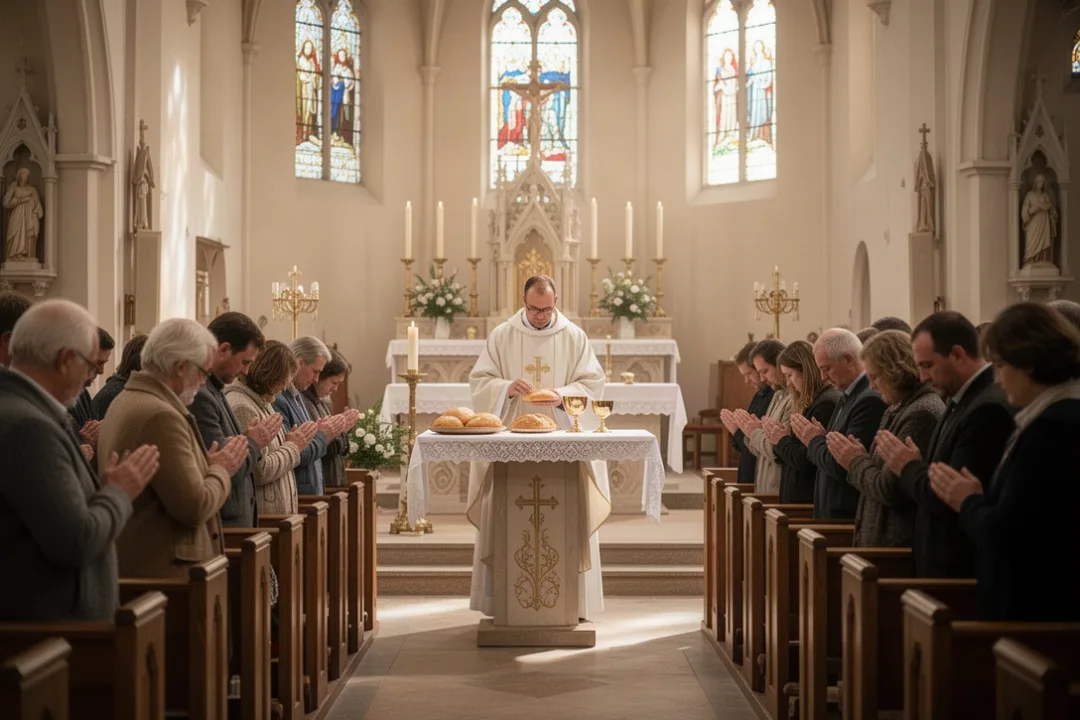
The priest proclaims the prayer in the name of the whole assembled Church. The congregation does not watch passively while something happens at the altar. Through listening, singing, standing, kneeling where customary, and responding, the people join their worship to the prayer. The priest has a distinct liturgical role, while the baptized faithful offer their own participation as members of Christ’s Body.
In the Roman Catholic tradition, the Eucharistic Prayer asks God to make the bread and wine holy and to make the people who receive them more deeply united in Christ. Catholics believe that, through the action of the Holy Spirit and the words of Christ, the bread and wine become the Body and Blood of Christ. The visible forms remain bread and wine, but their sacramental reality is changed.
Central idea: The Eucharistic Prayer is both thanksgiving to the Father and the Church’s sacramental remembrance of Jesus Christ’s saving death and resurrection.
The word Eucharist comes from a Greek word associated with thanksgiving. That meaning shapes the entire prayer. The Church gives thanks for creation, salvation, Christ’s self-giving, and the hope of eternal life. The prayer also looks outward, asking God to bless the living, remember the dead, and bring the whole Church into unity.
“Remembrance” has a deeper meaning here than recalling a past event. In biblical worship, a memorial makes God’s saving work present to the worshiping community in a sacramental way. The Mass does not repeat Christ’s sacrifice as though Calvary had to happen again. Instead, the one sacrifice of Christ is made sacramentally present, and the Church is drawn into its offering.
How the main parts of the Eucharistic Prayer unfold
Although the wording varies among the approved Eucharistic Prayers, their basic movement is recognizable. Each part contributes to a single act of worship rather than functioning as an unrelated collection of phrases.
The preface and the Sanctus
The Eucharistic Prayer begins with the preface dialogue. The priest invites the people to lift their hearts and give thanks, and the congregation responds. The priest then presents a particular reason for praise, which may reflect the season, feast, Sunday, or theme of the celebration.
The preface leads into the Sanctus, often called the “Holy, Holy, Holy.” This acclamation joins the worship of the earthly assembly with the worship of the angels and saints. Its biblical imagery is drawn especially from Isaiah 6 and Revelation 4, where heavenly beings praise God’s holiness.
The Sanctus marks a change in attention. The congregation has praised God for his works, and now the prayer moves toward the solemn invocation and remembrance at the center of the Eucharistic celebration.
The epiclesis asks for the Holy Spirit’s action
The epiclesis is an invocation of the Holy Spirit. The priest extends his hands over the gifts or uses another prescribed gesture while asking God to sanctify them. This prayer expresses that the Eucharist is God’s work, not a human achievement.
The epiclesis also has a second dimension. In the Eucharistic Prayers of the Roman rite, the Spirit is invoked not only in relation to the gifts but also in relation to the people. The goal of communion is not merely to receive consecrated elements; it is to become a more faithful, unified people shaped by Christ’s love.
The institution narrative and consecration
The priest then recounts what Jesus did at the Last Supper. This section is called the institution narrative. It includes Christ’s actions over the bread and wine and his command that his disciples continue this memorial.
At the consecration, the priest speaks the words handed down in the Church’s liturgical tradition and elevates the consecrated host and chalice. Catholics respond with faith and worship. The words should not be treated as a private formula that works independently of the entire liturgy. They belong within the prayer of thanksgiving, the Church’s faith, and the action of the Holy Spirit.
The Gospel accounts of the Last Supper are found in Matthew 26, Mark 14, and Luke 22. Saint Paul also presents an early account in 1 Corinthians 11. These passages connect the Eucharist with Christ’s self-offering, the new covenant, and the Church’s continuing proclamation of his death and resurrection.
The memorial acclamation and anamnesis
After the consecration, the people make a memorial acclamation. The congregation proclaims its faith in Christ’s death, resurrection, and future coming. The exact wording depends on the approved form used in the celebration.
The prayer then continues with the anamnesis, a formal remembrance of Christ’s passion, resurrection, and ascension. The Church recalls these events as the foundation of its worship and presents the Eucharist as participation in the mystery of salvation.
The offering, intercessions, and doxology
The Church’s offering is not separate from Christ’s offering. The Eucharistic Prayer presents the Church as offering the sacrificial victim to the Father and asks that the faithful also be transformed into people who live in self-giving love. This is why participation cannot be reduced to watching the priest perform a sacred action.
The prayer includes intercessions for the Church, the pope, the local bishop, the clergy, the faithful, and the whole human family. It also remembers the dead and asks that they share in the fullness of life with God. These names and petitions show that the Mass is never only a private devotion for the people physically present.
The prayer concludes with the final doxology, in which glory is given to God through Christ, with Christ, and in Christ. The people answer with the great Amen. This response is not a casual confirmation. It is the congregation’s solemn assent to everything the Eucharistic Prayer has proclaimed and offered.
Preface: thanksgiving and praise for God’s saving work.
Sanctus: the assembly joins the praise of heaven.
Epiclesis: the Holy Spirit is invoked over the gifts and the people.
Institution narrative: Christ’s action at the Last Supper is proclaimed.
Anamnesis and offering: the Church remembers and participates in Christ’s saving mystery.
Intercessions and doxology: the Church prays for the living and dead and gives glory to God.
Why the Eucharistic Prayer is connected to Scripture
The prayer’s language and structure come from the Bible’s understanding of worship, covenant, sacrifice, blessing, and thanksgiving. It is especially shaped by the Last Supper accounts and by Saint Paul’s teaching about the bread and cup in 1 Corinthians 10 and 11.
Jesus’ actions at the Last Supper follow a pattern found in Jewish meal blessings: he takes bread, gives thanks, breaks it, and gives it to the disciples. The Eucharistic liturgy carries this pattern forward while interpreting it through Christ’s death and resurrection. The Church receives the meal as a sacramental participation in the new covenant.
The prayer also reflects the biblical language of offering. In the Old Testament, sacrifices express worship, thanksgiving, repentance, and covenant fellowship. Christian faith understands Christ as the definitive offering, not one sacrifice among many. The Eucharist makes this one offering present sacramentally and forms the Church as a people who offer their lives to God.
Creation: God is praised as the source of life and every good gift.
Redemption: Christ’s death and resurrection are remembered as God’s saving action.
Covenant: The Eucharist is connected with the new covenant established through Christ.
Unity: The one bread and one cup signify the Church’s communion.
Hope: The prayer points toward resurrection and the coming fulfillment of God’s kingdom.
The Eucharistic Prayer is therefore both ancient and present. It does not merely preserve a historical ceremony. It interprets the Church’s worship through Scripture and teaches the congregation how to understand the sacrament it celebrates.
How the congregation participates in the prayer
The priest speaks the central text, but the entire assembly participates in the Eucharistic Prayer. Some responses are spoken or sung by everyone, including the dialogue before the preface, the Sanctus, the memorial acclamation, and the great Amen. Other forms of participation are interior: attentive listening, repentance, thanksgiving, faith, and offering your daily life to God.
You do not need to understand every sentence immediately to participate well. It helps to follow the movement of the prayer and recognize what the Church is doing at each stage. The priest is giving thanks, invoking the Spirit, proclaiming Christ’s saving action, offering the sacrifice, interceding for the Church, and leading the people into praise.
Posture can also support prayer. Local custom and the rubrics of the Roman Missal determine when the congregation stands, kneels, or sits. These postures are bodily expressions of reverence, but they should not become a source of judgment toward people whose health, age, culture, or local practice differs.
The most significant response is the great Amen at the end. Saying or singing it attentively means accepting the prayer as your own prayer with the whole Church. If your parish sings the Amen, joining the song can help make the congregation’s shared assent audible and unmistakable.
Practical way to pray: During the Eucharistic Prayer, place your attention on three movements: thanking God, remembering Christ’s saving work, and offering your life in communion with him and the Church.
Distractions are normal, especially during a long liturgy. When your attention wanders, return to a short phrase such as “thank you,” “remember your Church,” or “make us one.” You can also quietly unite a person, concern, or responsibility to the offering being made.
Why there are several Eucharistic Prayers
The Roman Missal contains several Eucharistic Prayers because the Church’s single faith can be expressed through different approved forms. The Roman Canon, also known as Eucharistic Prayer I, has a long history in the Roman rite. Other prayers provide different emphases and patterns of intercession while retaining the essential structure of Eucharistic worship.
Eucharistic Prayer II is relatively concise and is frequently used when the celebration does not call for a more specific form. Eucharistic Prayer III has a strong sense of the Church gathered in unity and often suits Sundays and feasts. Eucharistic Prayer IV presents a broad account of salvation history, from creation through Christ’s work and the Church’s hope.
There are also Eucharistic Prayers for particular needs and circumstances, including themes related to reconciliation and the Church’s unity. Their use depends on the liturgical norms and circumstances for which they were approved. A priest does not freely rewrite the Eucharistic Prayer or substitute personal words, because the text belongs to the Church’s public worship.
Other Christian traditions use related but differently structured prayers. Eastern Catholic and Eastern Orthodox Churches generally call the central prayer the Divine Liturgy’s anaphora. Anglican, Lutheran, and other liturgical churches may use different names, texts, and teachings concerning Christ’s presence. The shared pattern of thanksgiving and remembrance should not hide real differences in theology and practice.
The variety of prayers serves the unity of the Church rather than weakening it. Each approved Eucharistic Prayer leads the assembly toward the same central mystery: the Father is praised, Christ’s saving work is remembered, the Spirit is invoked, the Church is gathered, and the faithful are sent to live what they have celebrated.
What the Eucharistic Prayer should change in daily life
The Eucharistic Prayer reaches beyond the sanctuary. Because it remembers Christ’s self-giving, it challenges Christians to reject a faith limited to private comfort. Communion calls you toward forgiveness, generosity, patience, service, and concern for people who are neglected or suffering.
The prayer’s intercessions also widen your attention. The Church prays for leaders, communities, the sick, the poor, the dead, and the whole world. Bringing those concerns into the liturgy can change how you see your responsibilities after Mass. A person who has prayed for peace, mercy, and unity is sent to practice those gifts in ordinary relationships.
The offering of the Eucharist can include the week you have lived: work completed, family care, grief, decisions, failures, service, and hopes. These things do not replace Christ’s sacrifice, but they can be united with it. The sacrament teaches that daily faithfulness can become an offering when it is joined to love of God and neighbor.
The dismissal sends the assembly into the world with a task rather than ending the meaning of worship. You receive the Eucharist so that Christ’s life may shape your own. The prayer’s movement from thanksgiving to communion and mission gives the entire Mass a practical direction.
When you hear the Eucharistic Prayer, listen for the answer to three questions: What is God doing?What is the Church remembering?How am I being called to live? Those questions can turn familiar words into a more attentive act of prayer.
Frequently asked questions
Is the Eucharistic Prayer the same as the whole Mass?
No. The Eucharistic Prayer is the central portion of the Liturgy of the Eucharist, but the Mass also includes the introductory rites, Liturgy of the Word, Communion rites, and concluding rites. It begins after the gifts are prepared and ends with the great Amen. The broader Mass surrounds it with Scripture, preaching, prayer, communion, and sending forth.
Who may say the Eucharistic Prayer?
In the Roman Catholic Mass, the priest presiding at the celebration proclaims the Eucharistic Prayer. The congregation participates through responses, acclamations, posture, listening, and interior prayer. A deacon or layperson does not replace the priest in proclaiming this prayer, although other ministers have important roles before, during, and after the Eucharistic liturgy.
Why do Catholics kneel during parts of the Eucharistic Prayer?
Kneeling is a traditional bodily expression of adoration and reverence, especially during the consecration. The exact posture varies according to local norms, parish custom, physical ability, and cultural practice. Someone who cannot kneel can participate fully while standing or sitting respectfully. The spiritual participation of the congregation matters more than forcing an uncomfortable posture.
Can a priest change the words of the Eucharistic Prayer?
The Eucharistic Prayer is an official text of the Church’s liturgy, so a priest is not free to rewrite it according to personal preference. Approved variations may be selected when the liturgical rules allow them, and certain adaptations exist for particular celebrations. Keeping the authorized text protects the unity of worship across parishes and generations.










Leave a Reply