Vincent Ferrer: Life, teachings, feast day, and legacy
Vincent Ferrer: Life, teachings, feast day, and legacy
Vincent Ferrer was a 14th-century Spanish Dominican friar, preacher, and missionary best known for traveling across Europe and calling people to repentance. Born in Valencia in 1350, he preached in marketplaces, churches, and public squares, attracted enormous crowds, and became closely involved in the political and religious crises of his time.
He is honored as a saint of the Catholic Church, with a feast day on April 5. His life combined intense preaching, service to the poor, theological study, diplomacy, and reported miracles. It also reflects the tensions of medieval Europe, including religious conflict, pressure placed on Jewish communities, and the division caused by the Western Schism.
Vincent Ferrer was born in Valencia, in the Crown of Aragon, around the middle of the 14th century. His family was Christian, and he entered the Order of Preachers, commonly known as the Dominicans, while still young. The Dominicans emphasized preaching, education, prayer, and theological study, all of which shaped Vincent’s public ministry.
He was ordained a priest and became known for his command of theology and Scripture. For a period, he taught and wrote, but his reputation eventually grew far beyond academic settings. He developed into an itinerant preacher who spent years traveling from place to place, often on foot, accompanied by fellow religious and translators.
Vincent’s public message focused on repentance, moral reform, the mercy of God, and preparation for judgment. His preaching style was urgent and dramatic by modern standards. He wanted listeners to change their lives rather than merely admire his learning, and accounts describe people confessing, reconciling with enemies, returning stolen property, or abandoning harmful conduct after hearing him.
At a glance: Vincent Ferrer was a Valencian Dominican friar, a renowned European preacher, a participant in the politics of the Western Schism, and a canonized saint whose legacy includes both major spiritual influence and serious historical complexities.
Vincent Ferrer’s early life and Dominican formation
Valencia was a prosperous Mediterranean city with connections to different languages, cultures, and religious communities. Vincent grew up in a setting where preaching and public religious life were highly visible. His early attraction to the Dominicans gave him a disciplined framework for prayer, study, community life, and preaching.
As a Dominican, Vincent received a demanding education in philosophy and theology. The order’s tradition encouraged preachers to understand Christian teaching carefully and communicate it clearly. This training helps explain why later descriptions of Vincent portray him as both a forceful speaker and a serious theologian.
His early religious life was not limited to public performance. Dominican spirituality included the regular rhythm of the liturgy, private prayer, fasting, intellectual work, and concern for ordinary people. Vincent’s later preaching drew on that combination: he presented demanding moral teaching, but he also emphasized confession, forgiveness, and the possibility of returning to God.
His career developed during a period marked by war, disease, political rivalry, and religious uncertainty. The Black Death and its continuing effects had left many communities traumatized. The Western Schism had divided the Catholic Church between rival claimants to the papacy. These conditions created a receptive audience for preachers who promised spiritual clarity and urged people to reform their lives.
How Vincent Ferrer became a traveling preacher
Vincent’s preaching ministry expanded across the Iberian Peninsula and into parts of France, Italy, and other regions of Western Europe. He usually traveled with companions rather than working alone. His team could include other religious, helpers, and interpreters, since the communities he visited did not all speak the same language.
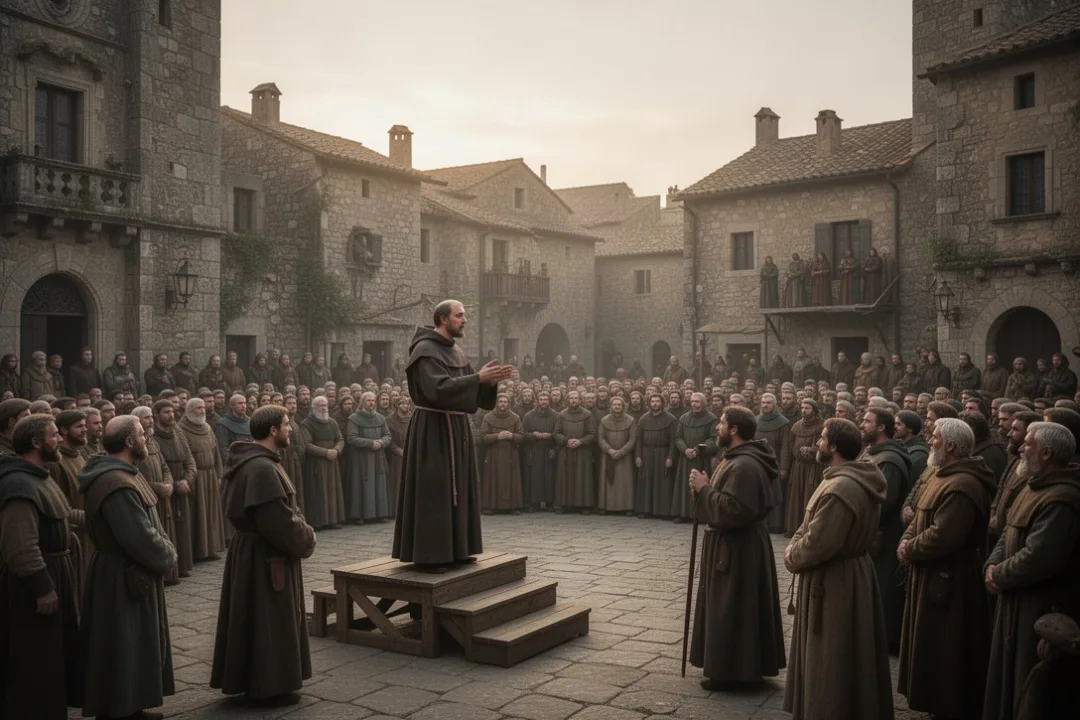
Accounts of his missions describe large crowds gathering outside churches or in open spaces. He preached in a direct style, addressing sin, judgment, family conflict, dishonesty, sexual misconduct, exploitation, and failures of Christian practice. His sermons were intended to lead to concrete action, not simply to provide theological information.
Several features help explain the reach of his ministry:
Plain moral application: He connected theological ideas to behavior in homes, markets, courts, and workplaces.
Strong emotional appeal: He spoke about death, judgment, mercy, and conversion with exceptional urgency.
Organized missions: Companions helped manage travel, translation, confession, and contact with local communities.
Public visibility: His preaching took place in settings where large numbers of people could hear him without formal admission to a church.
Reputation for holiness: Stories of austerity, prayer, miracles, and personal discipline strengthened his authority among supporters.
Vincent also preached to people who lived outside ordinary Christian practice. He addressed Jews and Muslims as well as Christians, reflecting the religious landscape of medieval Iberia and the regions he visited. That part of his ministry must be understood in its historical setting, but it should not be romanticized: medieval missionary activity often operated alongside social pressure and unequal treatment.
Vincent’s preaching centered on the Christian call to conversion of life. In his view, repentance was not a vague feeling of regret. It involved acknowledging wrongdoing, seeking forgiveness, repairing harm where possible, and changing conduct. His sermons frequently connected private morality with public justice.
He warned wealthy and powerful people against exploiting the poor. He criticized dishonesty in trade and urged people who had taken advantage of others to make restitution. He also challenged family and community conflicts, asking listeners to forgive, reconcile, and restore relationships when they had been damaged.
Another major theme was preparation for death and divine judgment. Medieval preaching often used vivid descriptions of the consequences of sin, and Vincent was known for doing so with particular intensity. His purpose, as presented in accounts of his ministry, was not fear for its own sake. Fear was meant to awaken conscience and lead people toward God’s mercy.
His message can be broken down into several recurring concerns:
Turn away from serious wrongdoing. Conversion required more than outward religious identity.
Return what was stolen or gained unjustly. Repentance included practical repair.
Reconcile with other people. Hatred, vengeance, and ongoing conflict were spiritual matters.
Practice charity. Religious devotion had to be visible in treatment of the poor and vulnerable.
Prepare for death. Life was temporary, and moral decisions had lasting significance.
Trust divine mercy. Judgment was serious, but forgiveness remained possible through sincere conversion.
Vincent did not present Christianity as a private belief detached from daily conduct. His preaching addressed the whole community. Merchants, officials, clergy, laborers, parents, and householders were all expected to examine how their choices affected other people.
Vincent Ferrer and the Western Schism
The Western Schism lasted from 1378 to 1417, when rival papal claimants and their supporters divided the Catholic Church. The conflict was not simply a dispute between individual church leaders. It affected political alliances, religious obedience, and the confidence of ordinary believers.
Vincent became connected to the Avignon papacy and served as a theological adviser to Benedict XIII, also known as Pedro de Luna. Vincent initially supported Benedict’s claim to the papacy. His involvement brought him into a world of negotiations, competing obediences, and efforts to resolve a crisis that had become both ecclesiastical and political.
Over time, Vincent became convinced that the schism needed to end, even though his relationship with Benedict XIII remained difficult. He urged the ruler of the Crown of Aragon, Ferdinand of Antequera, and others to pursue a solution that would restore unity. In the end, Benedict XIII refused to step aside and was treated as an antipope after the Council of Constance helped bring the schism to an end.
Vincent’s role is often simplified into the story of a saint who helped end the schism, but the reality was more complicated. He was deeply involved in the crisis, and his positions changed as the situation developed. His political influence came from his reputation as a preacher and spiritual authority, but his actions also placed him within the limitations and conflicts of medieval church politics.
Vincent Ferrer and the Compromise of Caspe
After the death of King Martin of Aragon in 1410, the Crown of Aragon faced a succession crisis. Several candidates had claims to the throne, and choosing one through conflict could have caused a civil war. Representatives from the kingdoms and territories involved met to evaluate the competing claims in what became known as the Compromise of Caspe.
Vincent Ferrer was one of the delegates who took part in the process. In 1412, the representatives selected Ferdinand of Antequera, a member of the Castilian Trastámara dynasty, as the next ruler. Vincent publicly supported the decision and announced it at Caspe.
His participation shows that Vincent was more than a preacher who stayed apart from public affairs. He could be consulted on questions of succession, legitimacy, and political stability. At the same time, his involvement illustrates how closely religion and government were connected in medieval Europe. A prominent friar could exercise considerable influence in matters that modern societies usually separate from religious ministry.
Vincent Ferrer’s approach to Jewish and Muslim communities
Vincent preached to Jewish and Muslim communities as part of his missionary work. Some people converted to Christianity, and later tradition associated him with conversions among Jewish communities in Spain and elsewhere. His preaching must be placed within a society where religious identity shaped legal status, political rights, and access to institutions.
Modern readers should distinguish between voluntary religious conversion and conversion influenced by fear, pressure, discrimination, or the threat of violence. Medieval sources do not always describe these circumstances with the clarity a modern reader would expect. Reports that celebrate large numbers of conversions may also reflect the religious assumptions and political interests of the people who recorded them.
Vincent has been associated by historians with an atmosphere of anti-Jewish preaching, especially during a period in which Jewish communities faced severe restrictions and attacks. It would be inaccurate to describe his legacy only in terms of personal devotion while ignoring the harm that religious hostility could cause. His canonization reflects the judgment of the Catholic Church about his holiness and missionary activity; it does not remove the need for critical historical evaluation.
This issue matters because studying a medieval saint requires two forms of attention at once. You can understand why contemporaries admired Vincent’s prayer, preaching, and charitable work while also recognizing that some religious movements of the period contributed to coercion and persecution.
Miracles associated with Vincent Ferrer
Stories about Vincent include healing, the raising of the dead, multiplication of food, and other extraordinary events. Such accounts were common in medieval biographies of saints and played an important role in the process by which a holy person’s reputation was preserved and examined.
These stories should be read in the context of Vincent’s canonization. The Church investigated claims about his life and miracles according to the procedures of the time. For believers, the miracles point to divine action through a faithful servant. For historians, the accounts also reveal what communities admired: compassion for the sick, concern for the hungry, confidence in prayer, and the belief that holiness could affect public life.
Not every story has the same historical certainty. Some were recorded long after the event, some passed through oral tradition, and some may use symbolic patterns familiar from other saintly biographies. A careful account can acknowledge the importance of the miracle tradition without presenting every detail as independently verified fact.
Reading miracle stories carefully: Ask what the source actually claims, when it was written, and what the story communicates about Vincent’s reputation. Religious meaning and historical evidence are related, but they are not identical questions.
Vincent Ferrer’s death and canonization
Vincent died in Vannes, Brittany, in 1419. He had continued preaching and traveling late in life, even though his ministry had taken him through difficult conditions and demanding journeys. His burial place became associated with devotion, and accounts of his holiness continued to spread after his death.
He was canonized by Pope Callixtus III in 1455. Canonization formally recognized Vincent as a saint of the Catholic Church and encouraged public devotion to him. His feast day is observed on April 5, the date traditionally associated with his death.
As with many medieval saints, the canonization process involved testimony about his character, religious practice, preaching, and miracles. The resulting image emphasized his fidelity to the Dominican vocation, his zeal for evangelization, his austerity, and his influence on people from different social classes.
His title as a Doctor of the Church should not be used for Vincent Ferrer. The Catholic Church has not given him that designation. He is honored as a saint and Dominican preacher, but “Doctor of the Church” refers to a specific official title granted to saints whose teaching has particular importance for the wider Church.
Vincent Ferrer’s feast day and patronage
Vincent Ferrer’s feast day is April 5. Churches and communities that honor him may celebrate with Mass, preaching, processions, devotional prayers, or local festivals. The form of the observance varies by region, especially in places with strong Dominican or Valencian connections.
He is especially associated with preachers, missionaries, and Dominican spirituality. Popular traditions also connect him with builders, plumbers, fishermen, and people seeking help with certain illnesses or difficulties. Patronage lists can vary by country and devotional tradition, so a local parish or diocesan calendar may use a different emphasis.
In Valencia, devotion to Vincent remains particularly significant. Religious celebrations, artistic representations, and local customs preserve his memory as a native son who became known across Europe. His image often shows him wearing the white habit and black cloak of a Dominican, sometimes with a finger raised in preaching or with a symbolic flame or trumpet connected to his proclamation.
Vincent Ferrer’s legacy has several distinct parts. He was an unusually effective preacher who understood how to communicate moral and religious teaching to large audiences. He was also an influential public figure who took part in a papal crisis and a major succession settlement.
His legacy is not limited to admiration. The social consequences of medieval preaching deserve careful attention, particularly when preaching encouraged hostility toward religious minorities. A responsible account neither erases these problems nor reduces Vincent’s entire life to one feature.
Four questions can help make sense of his historical importance:
What did he contribute to preaching? He joined theological training with direct, practical appeals for moral change.
How did he influence public affairs? His reputation gave him a role in efforts to resolve the Western Schism and the Aragonese succession crisis.
Why did people regard him as holy? They pointed to prayer, discipline, charity, preaching, reported miracles, and the changes attributed to his ministry.
What requires criticism? His connection with religious pressure and anti-Jewish hostility must be examined as part of the historical record.
For Catholics, Vincent can be a model of missionary zeal, disciplined prayer, and the insistence that faith should affect behavior. For historians, he offers a window into the religious, political, and social tensions of late medieval Europe. For general readers, his life shows how a preacher could become a major international figure before modern communications existed.
What Vincent Ferrer can teach about medieval preaching
Vincent’s career demonstrates that medieval preaching was a coordinated public activity, not simply an individual standing at a pulpit. Travel, translation, hospitality, local invitations, church support, and the work of companions all helped a mission succeed.
It also shows why preaching mattered so much in a society where many people encountered formal religious teaching primarily through spoken sermons, religious festivals, confession, and visual art. A gifted preacher could shape personal behavior, local customs, political loyalties, and attitudes toward other communities.
The strongest part of Vincent’s approach was his demand for visible moral action. He did not treat repentance as complete when someone felt sorrow. He connected religious change with restitution, reconciliation, generosity, and a different pattern of life.
That emphasis remains one reason his memory has endured. His historical setting was very different from yours, and some aspects of his ministry are deeply troubling by modern standards. Yet his insistence that religious conviction should influence how people handle money, power, conflict, and responsibility continues to explain his importance.
Frequently asked questions
Was Vincent Ferrer a priest?
Yes. Vincent Ferrer was a Dominican friar and Catholic priest. He entered the Dominican Order as a young man, studied theology, and was ordained. His priestly ministry included preaching, hearing confessions, spiritual guidance, and participation in missionary journeys across Europe. His formation within the Order of Preachers strongly shaped both his theological teaching and his public style.
When is Saint Vincent Ferrer’s feast day?
Saint Vincent Ferrer’s feast day is April 5, the date traditionally associated with his death in 1419. Observances may include Masses, processions, sermons, and local devotional celebrations. The most prominent traditions are found in Valencia and in communities connected with the Dominican Order.
Did Vincent Ferrer help end the Western Schism?
Vincent Ferrer was involved in the Western Schism and initially supported Benedict XIII, the Avignon claimant. Later, he urged action to restore unity when the dispute continued. He did not single-handedly end the schism, but his influence, preaching, and political relationships made him an important participant in the wider effort to resolve it.
Why is Vincent Ferrer’s legacy controversial?
His legacy is controversial because his missionary preaching occurred in a period of discrimination and persecution against Jewish communities. Reports of conversions may involve unequal social conditions or pressure, not only free religious choice. His spiritual influence and charitable reputation can be studied alongside the harmful consequences associated with religious hostility in his historical setting.













Leave a Reply