St. Louise de Marillac was a French Catholic leader, educator, and organizer who co-founded the Daughters of Charity with St. Vincent de Paul. She helped create a new form of religious service in which women lived and worked among people who were poor, sick, orphaned, imprisoned, or displaced.
Her life combined deep prayer with careful administration and direct service. Catholics remember her especially on March 15, her feast day, and look to her as a model of compassionate action, patient leadership, and practical care for vulnerable neighbors.
Louise de Marillac was born in Paris in 1591 into a well-connected French family. Her father, Louis de Marillac, served in public life and belonged to the nobility. Louise’s mother died when she was very young, and her father died while she was still a child. These early losses shaped her experience of dependence, grief, and the need for reliable care.
As a young woman, Louise wanted to dedicate herself entirely to religious life. She sought admission to a Capuchin community but was not accepted, probably because of her health. Instead, she married Antoine Le Gras in 1613. Their son, Michel, was born the following year. Louise cared for her family while continuing to search for the form of service to which she believed God was calling her.
Antoine became seriously ill, and Louise nursed him for several years before his death in 1625. Widowhood brought financial and emotional responsibilities, but it also gave her greater freedom to pursue organized service. Her own experiences of illness, bereavement, and family duty helped her understand the complicated needs of people who required more than occasional charity.
A useful way to understand Louise: she was not only a charitable visitor. She was also a planner, trainer, writer, recruiter, and community leader who built systems that allowed compassionate service to continue.
How Louise discovered her vocation to serve
Louise experienced a decisive spiritual moment on Pentecost in 1623. During prayer in a church in Paris, she received what she understood as an interior illumination about her future. She came to believe that she would eventually live in community, serve others, and have a spiritual director who could guide her.
At the time, she did not yet know how that calling would unfold. She continued to pray, care for her son, and seek direction. In 1625, she began a close spiritual relationship with Vincent de Paul, a priest already known for his work with rural families and people living in poverty.
Vincent initially advised Louise through letters and conversations. Their partnership developed slowly. Louise brought education, organizational ability, emotional insight, and determination. Vincent brought pastoral experience, a broad network of priests and laypeople, and a practical understanding of how local communities could respond to poverty.
Their work grew from the Confraternities of Charity, groups of laywomen who cared for sick people and assisted families in need. Vincent helped establish these groups in parishes, while Louise visited them, evaluated their work, prepared instructions, and encouraged cooperation. She saw that good intentions were not enough: volunteers needed training, clear responsibilities, supplies, and spiritual support.
Why the Daughters of Charity were different
In seventeenth-century France, women who entered religious life generally joined enclosed communities. Louise and Vincent developed another model for women who wanted to serve people directly. The women who gathered around Louise were not meant to remain behind convent walls. They would go to homes, hospitals, schools, and places where suffering was visible.
The Daughters of Charity began taking shape in 1633. Louise formed and trained the early members in her home, while Vincent helped guide the new community. The sisters lived simply, prayed together, learned practical skills, and served under the direction of local and community leaders.
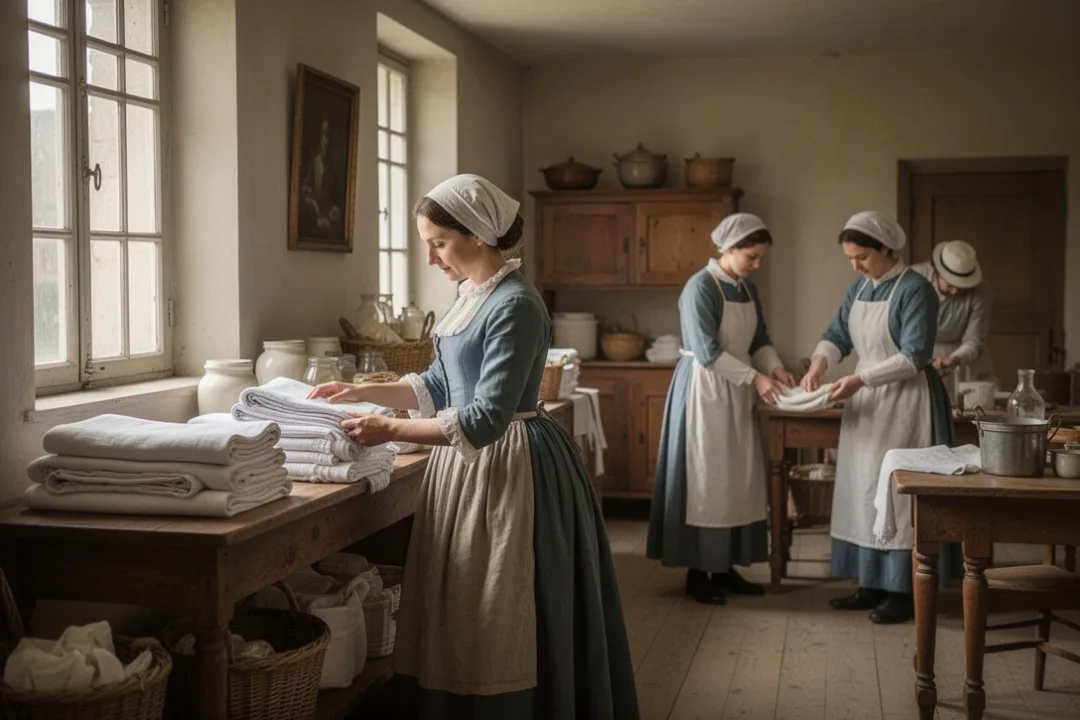
Their vocation was deliberately connected to ordinary life. Instead of wearing the elaborate habit associated with some enclosed orders, the sisters adopted the clothing of working women in their region. Their recognizable dress later included the familiar cornette, a broad, wing-shaped head covering. The clothing expressed their purpose: they were to be available for service in the streets and neighborhoods.
The community’s work included visiting the sick, caring for abandoned children, teaching girls, assisting prisoners, supporting people affected by war, and helping in hospitals. The sisters did not treat charity as a single act of giving. They addressed physical needs, education, spiritual care, and human dignity together.
What St. Louise accomplished through organized charity
Louise’s influence came partly from the number of people she served, but also from the structure she created. She wrote rules, letters, conferences, and instructions for the sisters. These materials helped communities in different places share a common identity while responding to local circumstances.
Her leadership involved many unglamorous tasks. She had to recruit suitable candidates, assess their health and character, arrange travel, manage finances, communicate with benefactors, and resolve disagreements. She also had to protect the sisters from exhaustion and make sure that service remained connected to prayer rather than becoming mere social labor.
The Daughters of Charity became involved in major institutions of care. In Paris, they served at the Hôtel-Dieu, one of the city’s important hospitals, and in other hospitals and charitable foundations. They also helped care for children who had been abandoned. Louise worked with others to develop ways of receiving, feeding, educating, and placing these children with foster families or other caregivers.
War and political instability created additional demands. Poor families were displaced, food supplies were uncertain, and disease spread easily. Louise organized relief efforts and encouraged the sisters to act with both urgency and prudence. Her example shows that compassion needs logistics: food must be obtained, medicine delivered, records kept, and workers supported.
Health care: visiting sick people in their homes and serving in hospitals.
Child welfare: caring for abandoned infants and supporting children without stable families.
Education: teaching children and preparing young women for useful work.
Prison ministry: assisting prisoners and people facing harsh living conditions.
Emergency relief: distributing food, clothing, and other necessities during conflict and famine.
Community formation: training women to combine prayer, discipline, and direct service.
Louise’s partnership with Vincent de Paul
Louise and Vincent had different temperaments and gifts. Louise could be exacting, reflective, and deeply aware of the details surrounding a person’s suffering. Vincent was known for his ability to communicate with large groups and encourage people to act. Their collaboration worked because each supported what the other lacked.
They did not always agree immediately. Louise sometimes wanted faster action or clearer decisions, while Vincent could take a more patient and gradual approach. Their correspondence shows a relationship shaped by trust, candor, and shared mission rather than by identical personalities.
Vincent served as a major spiritual guide for Louise, but Louise was not simply an assistant carrying out his plans. She made important decisions, traveled to inspect communities, corrected problems, and shaped the identity of the Daughters of Charity. Her leadership was especially significant because the organization depended on the preparation and judgment of women serving in difficult conditions.
Together, they helped establish a lasting partnership between spiritual formation and social service. Their work influenced later Catholic approaches to hospitals, schools, parish charity, and organized assistance for people living on the margins.
Louise de Marillac’s spiritual outlook
Louise’s spirituality was grounded in the life of Jesus Christ, especially his attention to people who were overlooked. She believed that service to a person in need was not separate from prayer. Caring for the sick, feeding a hungry child, and listening to a distressed family could all become expressions of faith.
Her spirituality also took suffering seriously without treating suffering as an excuse for passivity. Louise knew that illness, poverty, widowhood, and rejection could cause real fear and exhaustion. She encouraged the sisters to respond with patience, humility, and courage, while also using practical judgment to improve the conditions around them.
Prayer, for Louise, supported action rather than replacing it. The sisters prayed together, reflected on their work, and tried to recognize Christ in the people they served. At the same time, they were expected to wash wounds, teach lessons, prepare meals, keep accounts, and follow through on promises.
Her approach can be described through several closely connected values:
Presence: staying near people in distress instead of offering help from a distance.
Respect: treating each person as someone with worth, not as a problem to manage.
Discretion: protecting privacy and responding to individual circumstances.
Reliability: making service consistent rather than dependent on momentary emotion.
Collaboration: working with families, parishes, civic authorities, and other caregivers.
Prayerful reflection: learning from experience and asking how service could become more faithful and effective.
Common mistakes when learning about St. Louise de Marillac
Louise is sometimes reduced to a gentle image of charitable work, but that picture misses the discipline and complexity of her contribution. Understanding her accurately means looking beyond statues, inspirational quotations, or a general statement that she “helped the poor.”
Confusing her with Vincent de Paul: they worked together, but Louise had her own biography, authority, and leadership role.
Calling her a nun in the usual enclosed sense: the Daughters of Charity developed a distinct vocation of active service outside a cloister.
Ignoring her family life: her marriage, motherhood, widowhood, and care for her son were part of her vocational development.
Describing charity as only personal kindness: Louise also built training programs, communities, procedures, and networks.
Assuming she served only in hospitals: her work included education, child welfare, prisons, home visits, and emergency relief.
Overlooking her difficulties: grief, ill health, uncertainty, disagreement, and fatigue were part of her story.
Separating prayer from social action: her spirituality joined contemplation with concrete responsibility for neighbors.
For reflection: when you think about Louise’s example, ask not only “Whom can I help?” but also “What practical structure would make that help dependable, respectful, and sustainable?”
How St. Louise de Marillac is honored today
The Catholic Church canonized Louise in 1934. She is honored as a saint, and her feast is celebrated on March 15. She is also recognized as a co-founder of the Daughters of Charity, alongside Vincent de Paul.
Her legacy continues through communities and organizations connected with the Vincentian family. Daughters of Charity have served in hospitals, schools, shelters, missions, and social-service programs in many countries. The exact form of their work varies by place, but the central commitment remains direct service to people who are poor or vulnerable.
Louise is often named as a patron of social workers. That association reflects her combination of compassion and professional attention to people’s circumstances. She did not assume that every family needed the same solution. She encouraged careful observation, personal contact, training, and cooperation.
Her legacy also matters beyond specifically Catholic settings. Anyone involved in nursing, education, community organizing, foster care, social work, or nonprofit administration can recognize the value of her approach. She showed that caring relationships become more effective when supported by good preparation, shared responsibility, and thoughtful leadership.
What you can learn from Louise’s example
Louise offers a model for people who want to help but are unsure how to begin. Her life suggests that meaningful service does not require waiting for perfect conditions. It begins by paying attention to a real need and then finding the people, skills, and resources required to respond responsibly.
She also demonstrates the importance of combining personal compassion with institutional thinking. Visiting one sick neighbor matters. Creating a trained group that can visit many sick neighbors, keep appointments, obtain supplies, and protect each person’s dignity can extend that care much further.
Her example may be especially useful when service becomes tiring. Louise did not treat exhaustion as proof of holiness or effectiveness. Prayer, community, delegation, and clear organization helped the people around her continue their work without losing sight of the people they served.
A practical way to apply her example is to use these steps:
Identify a specific need: focus on a person or situation rather than an abstract problem.
Listen before acting: ask what kind of help is wanted and what barriers already exist.
Work with others: involve local organizations, families, professionals, or faith communities.
Define responsibilities: decide who will provide transportation, food, visits, paperwork, or follow-up.
Protect dignity and privacy: avoid treating people as publicity, projects, or objects of pity.
Review the results: notice what worked, what caused harm, and what should change.
Build continuity: create a routine or system so assistance does not disappear after one generous effort.
Why St. Louise de Marillac remains relevant
Louise lived in a very different society, but many needs she encountered remain recognizable: children without stable care, families facing illness, people confined in institutions, poverty intensified by conflict, and volunteers who need training. Her response was neither sentimental nor detached. She treated people as neighbors and service as a responsibility requiring skill.
Her life also broadens the way people understand leadership. Louise led through letters, instruction, travel, correction, encouragement, and daily example. She did not need to dominate a room to influence an organization. Her authority grew from competence, fidelity, and close attention to real human needs.
For Catholics, St. Louise de Marillac represents a union of love of God and love of neighbor. For anyone interested in humane community work, she represents a practical principle: compassion becomes durable when it is organized around the dignity, safety, and actual circumstances of the people receiving care.
Simple ways to remember St. Louise de Marillac
You can remember Louise by learning about the Daughters of Charity, observing her feast day, or praying for people who work in health care and social services. You might also support a local organization that provides food, housing, medical care, education, or assistance to families in crisis.
A more personal observance could involve visiting someone who is isolated, writing a note to a caregiver, volunteering consistently rather than once, or reviewing whether a charitable project treats recipients with respect. These actions reflect Louise’s preference for steady, attentive service over admiration that never becomes action.
Her story ultimately points to a form of holiness that is both contemplative and practical. St. Louise de Marillac prayed deeply, endured personal loss, raised a child, managed difficult responsibilities, and helped build an international community devoted to service. Her legacy remains clear: see the person, understand the need, and organize care that can last.
Frequently asked questions
What is St. Louise de Marillac best known for?
St. Louise de Marillac is best known for co-founding the Daughters of Charity with St. Vincent de Paul. She helped develop a community of women who served outside enclosed convents, caring for sick people, abandoned children, prisoners, students, and families experiencing poverty.
When is St. Louise de Marillac’s feast day?
The Catholic Church celebrates St. Louise de Marillac’s feast day on March 15. The date recalls the anniversary of her death in 1660 and provides an occasion to remember her service, writings, leadership, and partnership with St. Vincent de Paul.
Was St. Louise de Marillac married?
Yes. Louise married Antoine Le Gras in 1613, and they had a son named Michel. Antoine became seriously ill and died in 1625. Her experiences as a wife, mother, and widow influenced the compassionate and practical way she later approached service.
What can social workers learn from St. Louise de Marillac?
Social workers can find in Louise an example of combining empathy with organization. She emphasized listening, individualized care, reliable follow-up, collaboration, training, and respect for dignity. Her work also shows why effective service requires systems that support both clients and caregivers.














Leave a Reply