Saint Rose Philippine Duchesne: Life, mission, and legacy
Saint Rose Philippine Duchesne: Life, mission, and legacy
Who was Saint Rose Philippine Duchesne, and why is her name connected with both France and the American frontier? She was a French religious sister who devoted her life to prayer, education, and service. In 1818, at age 49, she crossed the Atlantic to help establish the Society of the Sacred Heart in the United States.
Duchesne did not arrive with an easy assignment. She and her companions faced a new language, limited resources, long travel, and scattered communities. She helped create schools for girls, supported religious communities, and spent her later years seeking opportunities to serve Native American people. The Catholic Church canonized her in 1988.
Saint Rose Philippine Duchesne was born on August 29, 1769, in Grenoble, France. Her family was Catholic and financially comfortable, but her decision to enter religious life developed in a period of major political and religious upheaval. As a young woman, she felt drawn to a life centered on prayer, discipline, and service.
She entered the Visitation convent in Grenoble in 1788. Her religious community was soon disrupted by the French Revolution. Religious houses were suppressed, and the sisters were forced to leave their convent. Duchesne returned to her family home, where she continued serving people in need as circumstances allowed.
After the revolutionary period, she worked to restore religious life in Grenoble. In 1804, she joined the newly formed Society of the Sacred Heart, founded by Saint Madeleine Sophie Barat. The society focused especially on the education of girls and the formation of women religious.
Duchesne remained connected to that mission for the rest of her life. Her path eventually led far beyond France, where she would become known for her perseverance in the developing communities of the United States.
Why Rose Philippine Duchesne went to the United States
In the early nineteenth century, Catholic communities in the United States were growing, but priests, schools, and religious communities were unevenly distributed. Bishop Louis William Valentine DuBourg invited the Society of the Sacred Heart to establish schools in the Louisiana Territory. Duchesne believed the invitation offered a way to expand Catholic education and serve communities with few institutions.
She sailed for America in 1818 with four other sisters. The trip was long and demanding, and the group arrived in New Orleans before traveling upriver to the St. Louis area. Their first permanent foundation was established at St. Charles, Missouri.
The move required much more than changing countries. Duchesne had to work through unfamiliar customs, severe weather, financial limitations, and communication difficulties. The sisters had to organize households, teach students, maintain their religious practice, and respond to the needs of families in a frontier setting.
A useful distinction: Duchesne was not a missionary in the narrow sense of traveling alone from place to place. Her work combined religious education, community building, prayer, and practical service, with a particular concern for children and young women.
What Saint Rose Philippine Duchesne did in Missouri
At St. Charles, Duchesne helped establish the first school of the Society of the Sacred Heart in the United States. The school served girls and became part of a larger educational effort that eventually spread through several American communities.
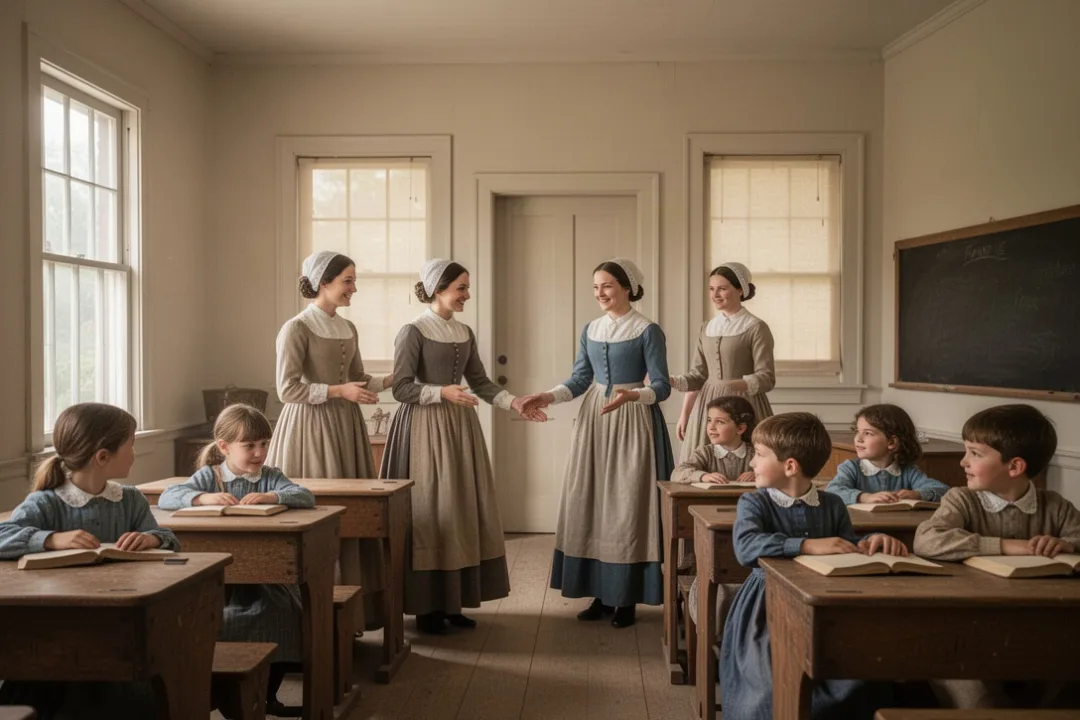
Education was central to the society’s mission. Students learned academic subjects within a Catholic setting, while the sisters developed a stable community life around teaching and prayer. In a frontier region, a school could also become a place where families found structure, care, and a connection to the wider Church.
Duchesne’s responsibilities changed as new foundations were created. She served in leadership roles and helped guide the society’s expansion. Her work included decisions about staffing, travel, finances, buildings, and the daily needs of students. Such tasks may seem ordinary, but they required considerable endurance in communities with few roads and limited communication.
Her leadership was not defined by comfort or visible success. Some foundations struggled, and plans did not always develop as expected. She continued to work within the limits of her health and circumstances, trusting that steady service mattered even when results were difficult to measure.
How her prayer shaped her reputation
Duchesne was known for a deep life of prayer. Accounts of her religious life describe long periods of silence, devotion before the Eucharist, and a willingness to accept hidden work. She was sometimes called “Woman Who Prays Always” by members of the Potawatomi community she served.
The phrase reflects the way people remembered her, but it should not be treated as a simple slogan. Duchesne’s prayer was connected to concrete responsibilities: caring for students, supporting other sisters, learning from difficult situations, and remaining faithful when she could not see an immediate outcome.
Her spirituality emphasized perseverance rather than personal recognition. She did not become famous because she led a large public campaign or wrote a major theological work. Her influence grew through the ordinary practices of prayer, teaching, obedience, and patient presence.
Her example joins contemplative prayer with practical service: time spent in silence did not remove her from the needs of the people around her.
For Catholics who look to the saints for guidance, this balance is one of her most approachable qualities. Duchesne’s example suggests that prayer can shape how you teach, manage a household, care for others, or continue a difficult responsibility.
Saint Rose Philippine Duchesne and Native American ministry
Duchesne had a strong desire to serve Native American people. In 1821, she visited the area around Florissant, Missouri, where she encountered Indigenous people, and she continued to hope for a mission among them. Her opportunity came later in life, when she joined the mission at Sugar Creek in Kansas in 1841.
She was then in her seventies and had already spent decades in religious and educational work. Her time at Sugar Creek was brief, lasting only a few months, partly because of her age and health. Even so, the visit held deep personal meaning for her because it answered a long-standing desire to serve in that setting.
Descriptions of this mission should be approached with historical care. Duchesne’s work took place within the nineteenth-century Catholic mission system and the broader expansion of the United States, which brought profound disruption, displacement, and loss to Native communities. Admiring her personal dedication does not require ignoring that wider history.
The Potawatomi people she encountered had their own culture, leadership, faith traditions, and experience of forced removal. A responsible account recognizes both the sincerity of Duchesne’s desire to serve and the unequal colonial conditions surrounding the mission. Her nickname is meaningful as a record of how some people remembered her, but it does not erase the complexity of the relationship between missionaries and Native communities.
Why she returned from Sugar Creek
Duchesne’s health and age limited her ability to remain at Sugar Creek. After a short period, she returned to St. Charles. She did not spend years directing the mission there, and it would be inaccurate to present her as its long-term administrator.
Her brief presence still mattered to her own spiritual story. She had carried the hope of serving Native Americans for many years, and the opportunity came only late in life. The experience illustrates a recurring feature of her biography: her plans were often constrained by circumstances, but she continued to respond to the opportunities available to her.
After returning to St. Charles, she lived more quietly. Other sisters carried much of the active leadership, while Duchesne devoted herself to prayer and the community’s life. She died on November 18, 1852, in St. Charles, Missouri.
What the Catholic Church teaches about her sainthood
The Catholic Church recognizes Duchesne as a saint because it judged her life to show heroic Christian virtue and accepted her as a model of holiness. She was beatified in 1940 and canonized by Pope John Paul II on July 3, 1988.
Her liturgical memorial is celebrated on November 18, the anniversary of her death. In Catholic tradition, the date of a saint’s death is often observed as a heavenly birthday, because it marks the completion of earthly life and entrance into eternal life.
Canonization does not mean that every decision a saint made must be copied or that historical circumstances should be overlooked. It means the Church presents that person as a trustworthy example of Christian discipleship. For Duchesne, the central themes include faithfulness, courage, education, prayer, and service across cultural and geographic boundaries.
People may ask for her intercession when they need help with perseverance, teaching, religious vocation, missionary work, or the patient care of others. She is especially relevant to educators and members of the Society of the Sacred Heart, whose communities continue her educational and spiritual tradition.
What her legacy looks like today
Duchesne’s legacy continues through schools, communities, prayer groups, and historical sites associated with the Society of the Sacred Heart. The Academy of the Sacred Heart in St. Charles preserves the memory of the early foundation, and the Shrine of Saint Philippine Duchesne is associated with the site where she lived and worked.
Her influence also extends through the educational tradition she helped establish in the United States. The Society of the Sacred Heart later founded schools in other parts of the country, continuing an emphasis on the education of girls and young women. The exact form of that mission has developed over time, but its connection to formation, service, and spiritual growth remains important.
Her story has particular relevance for people who work in education. She shows that teaching is not limited to delivering information. It can include forming habits of responsibility, helping young people recognize their dignity, and building institutions that serve families for generations.
Her legacy also speaks to people whose work appears hidden. Duchesne spent much of her life managing difficult practical details rather than receiving public recognition. Her canonization places value on the steady labor that keeps a community alive.
Practical ways to learn from Saint Rose Philippine Duchesne
You do not need to copy the exact circumstances of a nineteenth-century missionary to draw something useful from her life. Her example can be considered through ordinary choices involving prayer, education, service, and persistence.
Set aside regular quiet time. Duchesne’s prayer life reminds you that silence can be a real form of work, especially when your responsibilities are demanding.
Serve through your actual skills. Her mission included teaching, organizing, encouraging, and caring for people. Your own contribution may begin with the abilities you already use.
Support education. Volunteer at a school, mentor a student, assist a library, or encourage a young person’s growth in a practical way.
Learn history before praising missionary work. Read Indigenous perspectives and study the effects of removal, colonization, and mission systems alongside biographies of missionaries.
Accept gradual progress. Duchesne often worked with limited resources and incomplete results. Faithful work may develop slowly.
Ask for intercession thoughtfully. You might pray for teachers, children, religious communities, people facing displacement, or the wisdom to serve without assuming you know everything.
These practices keep her legacy connected to real life. They also prevent sainthood from becoming a distant ideal with no practical meaning. Duchesne’s example is most useful when it encourages humility, responsibility, and attention to people who may be overlooked.
Common mistakes when explaining her life
Several oversimplifications can make a biography of Duchesne misleading. Accurate details matter because her life crossed national, religious, and cultural boundaries.
Calling her an American by birth: She was born in France and became a missionary and religious leader in the United States.
Saying she founded every Sacred Heart school in America: She helped establish the society’s first American foundation and supported its expansion, but the work involved many sisters and communities.
Describing Sugar Creek as her lifelong mission: She visited the mission in 1841 and remained there only briefly because of her age and health.
Ignoring the French Revolution: Her early religious life was interrupted when religious communities were suppressed, a disruption that shaped her later perseverance.
Romanticizing missionary history: Her sincerity and dedication should be considered alongside the colonial pressures and harms experienced by Native peoples.
Treating prayer as withdrawal from responsibility: Her contemplative life supported practical work rather than replacing it.
For a balanced description: Say that Duchesne was a French-born Catholic religious sister who helped establish Sacred Heart education in the United States, served at Sugar Creek briefly, and became known for persistent prayer and service.
A prayer associated with Duchesne can begin with a simple request for faithfulness in the responsibility directly in front of you. You might pray for the patience to teach well, the humility to listen before acting, or the courage to continue serving when the results are not visible.
You can also reflect on the different stages of her life. Consider the young woman whose convent was disrupted, the sister who crossed an ocean at middle age, the educator who helped build new schools, and the older woman whose long-held hope for mission work was fulfilled only briefly.
Scripture can accompany this reflection without requiring a lengthy devotional routine. Read or pray with passages about service, perseverance, wisdom, or welcoming the stranger, using a Bible translation you trust. References such as Matthew 25:31–46, Galatians 6:9, and 1 Corinthians 12:4–7 can prompt reflection on caring for others, continuing good work, and using different gifts for the common good.
A short prayer might be: “Saint Rose Philippine Duchesne, help me remain faithful in prayer, attentive to those I serve, and humble enough to learn from the people I meet. Pray that educators, children, families, and communities facing hardship receive wise and compassionate care. Amen.”
What makes Saint Rose Philippine Duchesne remembered
Duchesne is remembered because her life brought together qualities that are often separated: contemplation and action, European roots and American mission, formal education and personal care, long preparation and brief opportunities. She faced interruptions without abandoning her vocation.
Her story is not a claim that every mission succeeded exactly as planned. It is a record of a woman who continued to serve amid political upheaval, cultural difference, illness, limited transportation, and institutional uncertainty. The most enduring lesson is her willingness to remain faithful while learning how to work within circumstances she could not control.
For Catholics, she offers a model of holiness rooted in prayer and service. For educators, she represents the lasting influence of schools and mentors. For anyone studying religious history, she provides a life that must be understood with both admiration for personal commitment and honesty about the complicated world in which that commitment operated.
Frequently asked questions
When is Saint Rose Philippine Duchesne’s feast day?
Saint Rose Philippine Duchesne’s feast day is November 18, the day she died in 1852. Catholic communities may remember her through Mass, prayer, educational programs, or service activities. The date also provides an opportunity to learn about the Society of the Sacred Heart and its history of educating girls and young women in France, the United States, and other countries.
Where did Saint Rose Philippine Duchesne serve in the United States?
She served primarily in Missouri, especially at St. Charles, Florissant, and other early Sacred Heart foundations in the region. In 1841, she also went to the Potawatomi mission at Sugar Creek in present-day Kansas. Because of her age and health, she remained there only a short time before returning to St. Charles.
What does “Woman Who Prays Always” mean?
“Woman Who Prays Always” is a name associated with how Potawatomi people remembered Duchesne during her mission experience. It points to her reputation for constant prayer and silence. The phrase should be understood in its historical context and does not mean she spent her entire life separated from practical work, teaching, leadership, or community responsibilities.
Was Saint Rose Philippine Duchesne French or American?
She was French by birth, born in Grenoble in 1769. She became a religious missionary and educator in the United States after arriving in 1818. Her life therefore belongs to both French Catholic history and the early history of the Society of the Sacred Heart in America, but she should not be described as American-born.















Leave a Reply