American saints: Catholic figures and their lasting legacy
American saints: Catholic figures and their lasting legacy
American saints are men and women recognized by the Catholic Church for lives of heroic holiness connected with the United States.
Some were born in the country, while others arrived as immigrants or missionaries and spent their most important years serving people here. Their stories include education, health care, ministry to immigrants, Native American history, racial justice, religious freedom, and care for the poor. They also show that American Catholic life has been shaped by people from many cultures and historical periods.
The phrase can mean different things. In a strict sense, it may refer to saints born in the United States. In a broader sense, it includes saints who lived, worked, died, or carried out major missions in what is now the United States. That broader meaning is useful because several important American saints were immigrants rather than native-born citizens.
The central distinction: A saint does not have to be born in the United States to be considered an American saint. Connection to the country may come through ministry, martyrdom, religious communities, or long-term service.
The Catholic Church does not use one single official category called “American saints.” Instead, a person is formally recognized as a saint through the universal canonization process, while historians, dioceses, and Catholic organizations describe the person’s connection to the United States.
A saint may be associated with America in several ways:
Birth: The person was born in one of the United States, as Elizabeth Ann Seton, Kateri Tekakwitha, Katharine Drexel, and Solanus Casey were.
Immigration: The person came from another country and built a lasting ministry in the United States, as Frances Xavier Cabrini did.
Missionary service: The person traveled to North America to preach, establish schools, serve Native communities, or support frontier Catholics.
Martyrdom: The person died for the faith in territory that is now part of the United States or in closely connected regions.
Institution building: The person founded schools, hospitals, parishes, religious communities, or social programs that continued after their death.
This broader approach also prevents a misleading picture of American Catholic history. The country’s Catholic tradition was not created by one ethnic group or one generation. It grew through Native peoples, European missionaries, immigrants, religious sisters, diocesan priests, converts, and lay families.
The first American-born saint: Elizabeth Ann Seton
Elizabeth Ann Seton is widely recognized as the first person born in the United States to be canonized by the Catholic Church. Born in New York in 1774, she grew up in an Episcopalian family and later became Catholic after a period of grief, financial hardship, and spiritual searching.
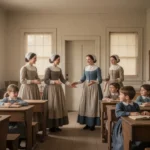
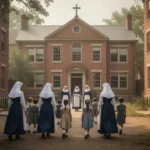
Seton entered the Catholic Church as an adult and eventually founded the American branch of the Sisters of Charity. At Emmitsburg, Maryland, she helped establish a school for girls and developed a religious community devoted to education and service. Her work helped shape the American Catholic school system.
Her life also included painful losses. She became a widow while still young and had to care for her children during difficult financial circumstances. Those experiences made her ministry especially attentive to widows, children, families, and people living with uncertainty.
Seton was canonized in 1975. Catholics often turn to her as a patron of Catholic schools, widows, and those seeking steadiness during family hardship. Her example is not limited to institutional achievements. It also reflects the daily work of prayer, parenting, teaching, and adapting faithfully to circumstances she did not choose.
John Neumann and the growth of Catholic schools
John Neumann was born in what is now the Czech Republic and came to the United States after preparing for the priesthood. He served immigrant Catholics in several languages and later became the fourth bishop of Philadelphia.
As bishop, Neumann supported the rapid development of parish schools. He understood that Catholic families needed more than Sunday worship. They needed places where children could receive religious instruction, learn basic academic subjects, and remain connected to their communities despite the pressures of immigration and poverty.
Neumann belonged to the Redemptorists, a religious congregation known for preaching and serving ordinary parishioners. His ministry involved travel, organization, preaching, and personal contact with people who often lived far from established Catholic institutions.
He was canonized in 1977 and became the first American bishop to receive that recognition. His feast day is observed on January 5. He is especially associated with immigrants, Catholic education, parish life, and perseverance in demanding ministry.
Kateri Tekakwitha and the Native Catholic experience
Kateri Tekakwitha was born in 1656 in what is now New York State to a Mohawk father and an Algonquin mother. She was baptized as a young woman and faced opposition from some members of her community because of her Christian faith.
After moving to the Indigenous Catholic community at Kahnawake, near present-day Montreal, she lived a life marked by prayer, work, fasting, and care for others. She died at a young age, but devotion to her spread widely among Catholics in North America.
Kateri was canonized in 2012 as the first Indigenous person from North America to be recognized as a saint by the Catholic Church. She is sometimes called the “Lily of the Mohawks,” although respectful attention to her full historical identity matters more than any single devotional title.
Her story should be approached with care. It belongs to a period of colonization, epidemic disease, cultural disruption, and conflict among European powers and Native nations. Honoring Kateri does not require ignoring those realities. Instead, her life invites reflection on Indigenous Catholic identity, conscience, cultural survival, and the complicated history of missions.
Katharine Drexel served Black and Native communities
Katharine Drexel was born into a wealthy Philadelphia family in 1858. Her family’s resources could have allowed her to live comfortably, but encounters with poverty and racial injustice led her toward a life of religious service.
She founded the Sisters of the Blessed Sacrament, a community dedicated especially to the education and pastoral care of Black and Native American people. The sisters established schools and missions in parts of the country where children often had limited access to education and Catholic institutions.
Drexel’s ministry addressed structural disadvantages rather than treating charity as a temporary response to individual need. She used inherited wealth to support schools, teachers, buildings, and long-term programs. One major result of her work was the founding of Xavier University of Louisiana, a historically Black Catholic university.
Canonized in 2000, Drexel is associated with racial justice, education, philanthropy, and the dignity of communities neglected by public and religious institutions. Her example also raises questions that remain relevant: How should resources be used? Who has access to quality education? What does solidarity require when inequality is built into society?
Frances Xavier Cabrini became a patron of immigrants
Frances Xavier Cabrini was born in Italy and founded the Missionary Sisters of the Sacred Heart of Jesus. Pope Leo XIII encouraged her to direct her missionary work toward the United States, where large numbers of Italian immigrants faced poverty, discrimination, language barriers, and weak access to health care and education.
Cabrini arrived in New York in 1889 and built a network of schools, orphanages, and hospitals. She was not simply providing emergency aid. She created institutions that could serve immigrant families over time and trained religious sisters to continue that work.
Her accomplishments are striking because she faced skepticism about her plans, limited resources, and the practical difficulties of expanding across a large country. She traveled extensively and negotiated with church leaders, donors, public officials, and local communities.
Cabrini was canonized in 1946 and became the first U.S. citizen to be canonized, having become a naturalized citizen late in life. She is the patron saint of immigrants. Her story highlights the value of welcoming newcomers while also recognizing the concrete needs that accompany migration: language instruction, medical care, housing, schooling, and spiritual community.
Saints who served beyond the original colonies
Some saints connected with the United States lived during periods when modern state boundaries did not exist. Their missions took place in French, Spanish, or Indigenous territories that later became part of the country. Historical labels therefore require care.
Junípero Serra and the California missions
Junípero Serra was a Spanish Franciscan who founded and led missions in California during the eighteenth century. He worked to expand Catholic institutions along the coast and was canonized in 2015.
Serra’s legacy is deeply contested. Supporters point to his missionary commitment and advocacy for Native people in some disputes with colonial authorities. Critics emphasize the coercive systems, forced labor, disease, cultural destruction, and loss of freedom associated with the California mission system. A responsible account must acknowledge both the religious goals claimed by the missions and the suffering experienced by Indigenous communities.
The North American Martyrs
The North American Martyrs were eight Jesuit missionaries and lay associates who were killed during the seventeenth century while serving in territories of present-day Canada and the northeastern United States. Their canonization recognizes their deaths as martyrdom, but their lives unfolded within complex conflicts involving European colonial powers and Native nations.
Isaac Jogues, René Goupil, Jean de Lalande, Jean de Brébeuf, Gabriel Lalemant, Antoine Daniel, Charles Garnier, and Noël Chabanel are remembered together. They are especially associated with missionary sacrifice, but their history should not be separated from the wider realities of colonization, diplomacy, warfare, and cultural encounter.
Rose Philippine Duchesne and education on the frontier
Rose Philippine Duchesne was born in France and joined the Society of the Sacred Heart. In the early nineteenth century, she came to the United States and helped establish schools for girls, including institutions in frontier areas.
She worked in Missouri and sought to serve Native American people, though her direct missionary success among the Potawatomi was limited. Her willingness to undertake difficult travel and unfamiliar work earned her the nickname “Woman Who Prays Always” among the Potawatomi community.
Duchesne was canonized in 1988. Her life illustrates how religious women often played a major role in building schools, convents, orphanages, and social networks in places where Catholic infrastructure was still developing. It also reminds readers to distinguish between a person’s intentions and the broader effects of missionary and colonial systems.
Marianne Cope and care for people with Hansen’s disease
Marianne Cope was born in Germany and immigrated to the United States as a child. She entered religious life with the Sisters of Saint Francis and became involved in hospital administration and health care in New York.
Later, she traveled to Hawaii to serve people with Hansen’s disease, historically called leprosy. She followed the work of Damien of Molokai, a Belgian priest who had devoted himself to people isolated because of the disease. Cope and the sisters cared for patients, improved living conditions, supported children, and created a more humane community on Molokai.
Canonized in 2012, Cope is remembered for practical compassion in a setting where fear and stigma could easily overpower human concern. Her ministry included nursing, management, education, and emotional support. It demonstrates that holiness may involve building safe systems of care, not only performing visibly religious acts.
Damien of Molokai and the meaning of service
Damien of Molokai, also known as Saint Damien de Veuster, was born in Belgium and became a priest of the Congregation of the Sacred Hearts of Jesus and Mary. He went to Hawaii and eventually served the isolated settlement at Kalaupapa on the island of Molokai.
Damien lived among people with Hansen’s disease rather than serving them from a distant administrative role. He helped organize worship, housing, funerals, agriculture, and public improvements. After contracting the disease himself, he continued working until his death.
He was canonized in 2009. His example is often presented as a model of solidarity with people rejected by society. At the same time, modern readers should avoid romanticizing illness or suffering. His life is best understood through the practical dignity he defended: people needed community, medical attention, spiritual care, decent homes, and respect.
Solanus Casey and ordinary faithfulness
Solanus Casey was born in Wisconsin in 1870 and became a Capuchin Franciscan friar. Because of academic difficulties during seminary, he was ordained as a simplex priest, a priest with limited faculties for preaching and hearing confessions at that time.
He served as a porter, or welcoming doorkeeper, at Capuchin friaries in New York and Detroit. People came to him for prayer, practical advice, encouragement, and help with illness or hardship. His ministry shows how a person can become widely trusted through listening, hospitality, humility, and consistent presence.
Casey was beatified in 2017 and canonized in 2017? No: he has not been canonized. He was declared Venerable in 1995 and beatified in 2017. Catholics may call him Blessed Solanus Casey, but calling him Saint Solanus would be inaccurate unless the Church formally canonizes him in the future.
Use the right title: “Saint” is reserved for people formally canonized by the Catholic Church. A person who is beatified should be called “Blessed,” while “Venerable” describes an earlier stage in the process.
How the Catholic Church recognizes a saint
Canonization is a formal investigation, not simply a popular vote or a statement that someone was admirable. The process normally begins at the diocesan level, often years after a person’s death, when a bishop or another authorized petitioner asks that the person’s life be examined.
Servant of God: An official inquiry begins into the person’s life, writings, reputation for holiness, and possible miracles.
Venerable: The Church recognizes that the person lived the virtues of faith, hope, and charity to an exceptional degree, or died as a martyr.
Blessed: Beatification permits limited public veneration. For a non-martyr, a miracle attributed to the person’s intercession is generally required.
Saint: Canonization extends public veneration to the universal Church. A further recognized miracle is generally required for a non-martyr.
The process includes testimony, historical research, medical review of alleged healings, and examination by Vatican authorities. The pope makes the final declaration. Canonization does not mean the person was flawless in every personality trait or historical circumstance. It means the Church judges the person worthy of universal veneration and presents that life as a model of Christian holiness.
Common mistakes when learning about American saints
Assuming every saint was born in the United States: Cabrini, Serra, Duchesne, Cope, Damien, and Neumann were born elsewhere.
Confusing beatification with canonization: Blessed Solanus Casey is not yet a canonized saint.
Ignoring Native history: Stories about missions should include Indigenous perspectives, disease, land loss, coercion, and cultural disruption.
Treating sainthood as celebrity: A saint’s importance is connected to holiness and witness, not fame or institutional power.
Reducing service to a single theme: Many saints combined prayer with schools, hospitals, advocacy, administration, fundraising, and direct care.
Using outdated language uncritically: Historical sources may use terms for disease, race, or Indigenous identity that are no longer respectful.
Assuming all American saints share one political message: Their lives arose in different centuries and social systems, so their teachings need historical interpretation.
Ways to learn from American saints today
You can study these figures through a parish, school, historical society, religious community, or diocesan website. Start with a primary question rather than trying to memorize a long list: What need did this person recognize, and how did the person respond?
For example, Seton and Neumann invite reflection on education. Cabrini raises questions about immigrant welcome. Drexel points toward racial justice and access to schooling. Cope and Damien show what sustained health care can look like when fear isolates vulnerable people. Kateri’s story calls for respectful attention to Native Catholic communities and Indigenous history.
Practical ways to explore their witness include:
Visit a shrine, basilica, mission, school, or hospital associated with a saint.
Read a reliable biography alongside historical material about the period.
Learn how a saint’s community serves people now, not only what the founder did in the past.
Pray using the saint’s feast day while avoiding claims that go beyond documented evidence.
Compare the saint’s ideals with the needs of your own parish or neighborhood.
A strong study method combines devotional reading and historical honesty. Admiration should not require ignoring harm, and criticism should not require dismissing every act of service. The most useful question is often how faith, power, culture, and responsibility interacted in a particular life.
Why American saints remain relevant
American saints are relevant because their communities faced problems that still appear in new forms: migration, unequal education, racial exclusion, inadequate health care, loneliness, discrimination, and the treatment of some people as burdens rather than neighbors.
Their lives also broaden the meaning of religious leadership. Some were bishops or founders, but others worked as teachers, nurses, porters, parish priests, or caregivers. Many built institutions that outlasted them, yet their influence often began with small acts of attention to people who were overlooked.
They also complicate any simple definition of “American.” The Catholic tradition in the United States includes Native peoples, immigrants, converts, missionaries, enslaved and free Black Catholics, religious women, and families from many nations. The saints connected with this country reflect that plural, contested, and evolving history.
For that reason, learning about American saints is not only an exercise in naming canonized Catholics. It is a way to examine how communities respond to suffering, how institutions are built, and how a person’s spiritual convictions become visible through service to others.
Frequently asked questions
Who was the first American-born Catholic saint?
Elizabeth Ann Seton was the first person born in the United States to be canonized by the Catholic Church. Born in New York in 1774, she became Catholic as an adult, founded the Sisters of Charity, and helped establish Catholic education in the United States. She was canonized in 1975 and is associated with schools, widows, families, and religious education.
Is Frances Xavier Cabrini considered an American saint?
Yes. Cabrini was born in Italy, but she became a U.S. citizen and spent much of her ministry serving immigrants in the United States. She founded schools, orphanages, and hospitals and was canonized in 1946. She is commonly known as the patron saint of immigrants and represents the important role immigrant religious leaders played in American Catholic life.
How many American saints are there?
The number depends on the definition. A narrow count includes only people born in the United States, while a broader count includes missionaries, immigrants, and others whose major ministries took place here. The list also changes if saints connected with Canada, Hawaii, California’s mission era, or North American martyrdom are included, so no single number fits every use of the phrase.
Is Solanus Casey a canonized saint?
No. Solanus Casey was declared Venerable and later beatified in 2017, so the accurate title is Blessed Solanus Casey. Beatification allows limited public veneration under specified circumstances, while canonization extends recognition to the universal Church. His cause remains distinct from those of Catholics who have formally been declared saints.












Leave a Reply