St. Julie Billiart was a French Catholic educator, religious sister, and founder of the Sisters of Notre Dame de Namur. Born in 1751, she dedicated her life to teaching the faith and educating children who were poor or excluded from opportunity.
She lived through severe illness, religious persecution during the French Revolution, and years of uncertainty before helping establish a new religious congregation. The Catholic Church canonized her in 1969, and her feast day is celebrated on February 8.
St. Julie Billiart was born Marie-Rose-Julie Billiart on July 12, 1751, in Cuvilly, a small village in northern France. She was the fifth of seven children in a family that valued Catholic faith, hard work, and practical service. Her father ran a small business, and Julie grew up with a close understanding of the daily pressures faced by ordinary families.
Her religious sensitivity appeared early. As a child, she learned the catechism quickly and began helping others understand Christian teaching. She reportedly organized informal lessons for local children, especially those who had limited access to schooling. For Julie, education was never only the transfer of information; it was a way to help people recognize their dignity and live with hope.
She did not enter a convent as a young woman. Instead, she remained closely connected to her family and village while serving people around her. Her work included teaching children, visiting the sick, and helping families in difficulty. She developed a spirituality centered on trust in God, compassion, and an active response to the needs of the community.
That combination of prayer and practical action shaped her later mission. Julie was deeply contemplative, but she was not withdrawn from the problems of her time. Her life shows how religious vocation can develop through ordinary responsibilities before taking a more formal shape.
At the center of Julie’s vocation: She believed education should strengthen the whole person—faith, character, intelligence, and the ability to serve others.
Her importance also comes from the way she responded to limitations. Long periods of illness prevented her from living the kind of active life she had once imagined, yet those years became a time of prayer, spiritual guidance, and preparation. When circumstances changed, she was ready to act decisively.
How illness shaped Julie Billiart’s spiritual life
When Julie was in her early twenties, a violent incident involving her family caused a profound physical and emotional crisis. Afterward, she experienced serious paralysis and spent many years unable to walk. The exact medical explanation is not clear by modern standards, and it would be misleading to reduce her condition to a simple diagnosis.
Her illness lasted for roughly two decades. During that time, she depended on others for much of her care and could not participate freely in ordinary parish or community life. Such restrictions would have been difficult for anyone, particularly for a woman whose gifts were strongly directed toward teaching and personal service.
Julie responded through prayer and spiritual companionship. She welcomed people who needed counsel, encouraged those facing hardship, and continued to teach the Christian faith whenever circumstances allowed. Her room became a place where people sought guidance, even while she herself faced pain, uncertainty, and physical dependence.
Her experience did not lead her to treat suffering as valuable simply because it was suffering. Instead, she learned to live faithfully within circumstances she could not immediately change. That distinction remains important: Julie’s spirituality was not passive resignation. It was a disciplined trust that left room for courage, action, and service.
During this period, she was influenced by the spiritual tradition of the Society of Jesus, particularly its emphasis on discernment, prayer, and finding practical ways to serve God. She also developed a strong devotion to the Sacred Heart of Jesus. Her faith was personal and warm, but it was also demanding: it called her to make decisions for the good of others rather than protect her own comfort.
A major change came when Julie met Françoise Blin de Bourdon, a woman from a noble family who shared her concern for education and the poor. Their friendship became a partnership. Françoise offered organizational ability, social connections, and practical support; Julie brought a deep spiritual vision and a gift for forming people in faith.
Julie’s health eventually improved enough for her to walk again. Her recovery did not erase the years of disability or make them irrelevant. Instead, those years had shaped her patience, attentiveness, and ability to understand people who felt powerless. Her later work with students and religious sisters carried the marks of someone who knew dependence from personal experience.
Illness taught her patience: She had to accept help and wait through a long period of uncertainty.
Prayer kept her mission alive: She continued guiding others even when physical activity was impossible.
Friendship expanded her reach: Her partnership with Françoise made organized educational work possible.
Recovery brought responsibility: Improved health allowed her to serve more publicly, not simply return to private life.
What the French Revolution meant for St. Julie Billiart
Julie’s adult life unfolded during a period of intense political and religious upheaval. The French Revolution, which began in 1789, brought sweeping changes to government, society, and the relationship between the state and the Catholic Church. Religious communities were dissolved, church property was confiscated, and priests who would not accept revolutionary control faced serious danger.
These events directly affected Julie. She had to remain hidden or move from place to place because of her association with faithful priests and her continued religious activity. Her physical disability made travel especially difficult, while the danger of arrest made ordinary pastoral work impossible. She and those helping her had to balance secrecy, hospitality, prayer, and concern for people whose spiritual leaders had been removed.
During this period, Julie helped preserve Catholic life in quiet ways. She supported families, encouraged priests in hiding, and continued forming people in Christian practice. Her ministry did not always look like public preaching or institutional leadership. Often it involved protecting a small community of faith under conditions where public religious identity could bring punishment.
The Revolution also exposed the weakness of an educational system that left many children without reliable instruction. When schools connected to religious communities disappeared, the poor suffered particularly. Julie’s later focus on education grew from this experience, but her response was not driven only by nostalgia for the past. She recognized the need for a flexible form of religious education that could adapt to changing social conditions.
These years tested her discernment. She had to distinguish between fear and prudence, between preserving a tradition and finding new ways to express it. Her choices show a leader who valued the Church’s mission but understood that methods might need to change.
Julie’s response to persecution was not to abandon her faith or wait for perfect conditions; she continued serving people through the opportunities that remained.
After the worst revolutionary dangers had passed, Julie was able to work more openly. The experience had clarified her priorities. She wanted to form women who could teach effectively, live a serious spiritual life, and respond to the educational needs of children across different regions.
How St. Julie Billiart founded the Sisters of Notre Dame de Namur
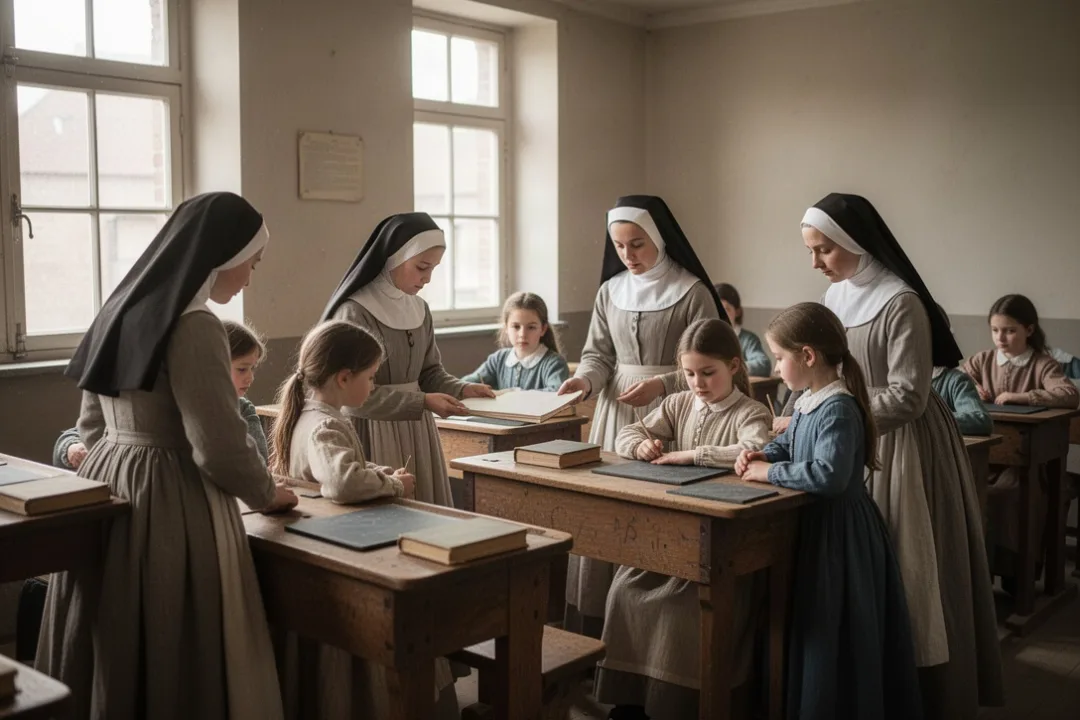
In 1804, Julie Billiart and Françoise Blin de Bourdon founded the Sisters of Notre Dame de Namur. The congregation began in Amiens, France, with a mission focused on Christian education, especially for girls and children from families with limited means.
The founders did not envision a community devoted only to one school or one town. They wanted to prepare women for a mobile and practical apostolate. A sister might teach in a city school, work with children in a rural area, instruct students in religion, or help establish a new community where educational resources were scarce.
Julie’s approach to formation was demanding but personal. She expected the sisters to develop a strong prayer life, sound judgment, emotional maturity, and practical teaching skills. She encouraged them to meet people where they were rather than impose a rigid style that ignored local circumstances.
The congregation’s name expressed its purpose. “Notre Dame” refers to the Virgin Mary, while “Namur” identifies the city in present-day Belgium that became central to the congregation’s development. The community’s work soon expanded beyond France, and Namur became an important base for its educational mission.
Julie’s leadership was notable because she formed people rather than trying to control every detail. She trusted capable women with real responsibility and helped them understand the principles behind their work. This allowed the congregation to grow while maintaining a recognizable identity.
What the sisters were meant to do
Teach the Catholic faith: Religious education was central, but it was connected to daily moral and community life.
Educate girls: The congregation supported the intellectual and spiritual development of girls at a time when their educational opportunities were often restricted.
Serve poor communities: Schools were meant to reach children who might otherwise receive little formal instruction.
Train future teachers: The sisters learned methods that enabled them to establish and sustain schools in different settings.
Combine prayer with action: Classroom work, community life, and personal devotion were treated as parts of one vocation.
The congregation grew despite internal tensions and external pressure. Religious communities often face difficult questions when they expand: who has authority, how rules should be interpreted, and how much local communities should be allowed to adapt. Julie’s final years included conflict within the congregation, particularly concerning leadership and governance.
These disputes were painful. They also reveal that sanctity does not remove ordinary human problems from an institution. Julie had to exercise authority while trying to preserve unity, protect the mission, and remain faithful to the principles that had guided the foundation.
In 1816, after years of intense work, illness, travel, and leadership, Julie returned to Namur. She died there on April 8, 1816. The congregation continued expanding after her death and eventually established communities and schools in many parts of the world.
Her founding principle in practice: A school could be both academically serious and spiritually grounded, with special care for children whose families had fewer resources.
What St. Julie Billiart taught about education and faith
Julie’s educational vision was broader than memorizing religious formulas. She wanted students to develop an informed conscience, the ability to distinguish right from wrong, and the confidence to take responsibility for their lives. Instruction in reading, writing, and other subjects belonged with formation in honesty, compassion, discipline, and service.
She also understood that children do not all learn in the same way. A teacher must pay attention to a student’s circumstances, temperament, abilities, and obstacles. This does not mean lowering expectations. It means using patience and practical wisdom so that each child has a genuine opportunity to grow.
Her commitment to girls’ education was especially significant. In many communities of her era, girls were expected to receive limited formal schooling. Julie and the sisters supported their intellectual development and prepared some students for roles as teachers, caregivers, and responsible members of their communities.
Her methods reflected several enduring principles:
Begin with the person in front of you. Effective teaching considers the student’s real needs instead of treating a class as an abstract group.
Make faith practical. Religious belief should influence choices, relationships, work, and treatment of vulnerable people.
Use education to widen participation. Schools should not serve only those who already possess social or financial advantages.
Form teachers carefully. A teacher’s character and judgment affect students as much as technical knowledge does.
Adapt without abandoning purpose. Methods may change with culture and circumstance while the commitment to human dignity remains steady.
Julie did not separate compassion from standards. She wanted students to be treated with kindness, but she also believed that education should call them toward responsibility. Her vision avoided both harshness and indifference: the teacher guides firmly while recognizing the student’s worth.
Her own disability likely deepened this approach. Someone who has relied on others for years may notice more readily how shame, impatience, or neglect can affect a person. Julie’s care for the poor and sick was not an abstract social concern. It was expressed through close attention to individuals.
For teachers today, her legacy can be applied in ordinary ways. It may mean making time for a student who is falling behind, treating families with respect, creating a classroom where girls and boys are taken seriously, or connecting academic learning with ethical responsibility. Her example does not prescribe one teaching technique; it offers a way of seeing the student.
St. Julie Billiart’s sainthood, feast day, and continuing legacy
The Church recognized Julie’s holiness through a formal process that led to her canonization by Pope Paul VI in 1969. Canonization does not mean that a saint lived without difficulty or made no mistakes. It means the Church proposes that the person lived with heroic Christian virtue and may be honored as an example and intercessor.
Her feast day, February 8, gives communities an annual opportunity to remember her work. Schools connected with the Sisters of Notre Dame de Namur often mark the day through prayer, service, lessons about her life, or activities related to education and social responsibility.
Julie is particularly associated with educators, students, people facing illness, and those working with the poor. These associations arise naturally from her life: she taught children, endured long-term disability, founded a teaching congregation, and consistently placed marginalized people at the heart of her mission.
Her legacy is visible in the continued work of the Sisters of Notre Dame de Namur. The congregation has served in schools, parishes, retreat settings, social programs, and other ministries in different countries. The specific forms of service vary by place, but the original concern remains recognizable: education should help people live with dignity and contribute to the common good.
Julie can also speak to people who feel that illness, political instability, or limited resources have interrupted their plans. Her life does not promise that obstacles will disappear. It shows that a vocation can take shape gradually and that periods of weakness may still contain meaningful work, relationships, and preparation.
Her story is not only about personal perseverance. The most significant part of her legacy is communal. Julie worked with Françoise, formed other women, relied on supporters, and built an institution that could continue after her death. Her example therefore points beyond individual achievement toward shared mission, careful formation, and service that outlasts one person.
Remembering St. Julie Billiart today means asking practical questions. Who is being left without a good education? Which students need patient attention rather than quick judgment? How can faith become visible through service? Her life suggests that the answers begin with close attention to real people and the courage to build something useful for them.
Frequently asked questions
What is St. Julie Billiart the patron saint of?
St. Julie Billiart is especially associated with educators, teachers, students, people who are sick, and those who serve people experiencing poverty. These connections reflect her long illness, her work teaching children, and her founding of the Sisters of Notre Dame de Namur. She is also remembered by religious communities and schools that continue her educational mission.
When is St. Julie Billiart’s feast day?
St. Julie Billiart’s feast day is February 8. Schools, parishes, and members of the Sisters of Notre Dame de Namur may commemorate the date with prayer, educational activities, service projects, or reflections on her commitment to children and people in need.
Where did St. Julie Billiart live?
Julie was born in Cuvilly, France, and spent much of her early life in that region. The French Revolution forced her to move or remain hidden at different times. She later worked in Amiens and spent her final years in Namur, in present-day Belgium, where she died in 1816.
Why did St. Julie Billiart found a religious congregation?
Julie founded the Sisters of Notre Dame de Namur with Françoise Blin de Bourdon to provide Christian education, particularly for girls and children from poor families. They also wanted to prepare women who could teach in different communities and adapt the congregation’s mission to local needs.

















Leave a Reply