Louis and Zélie Martin: A guide to their family and faith
Louis and Zélie Martin: A guide to their family and faith
If you have heard Louis and Zélie Martin described as the parents of Saint Thérèse of Lisieux, you may wonder why the Church honors them in their own right. The answer is found in the way they lived marriage, work, parenthood, and suffering: not as separate parts of life, but as places where they could love God and serve other people.
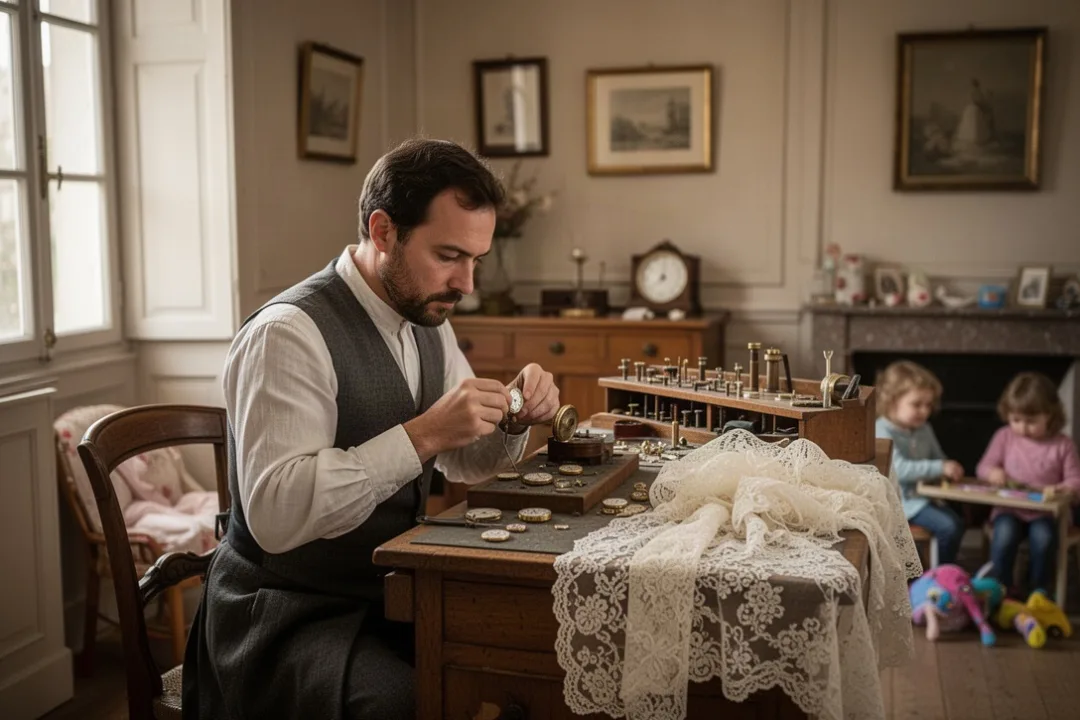
Louis Martin was a watchmaker, and Zélie Martin was a lace maker and business owner in nineteenth-century France. They married in 1858, raised five daughters who survived infancy, endured the deaths of four other children, and faced serious illness and financial pressure. Their holiness was expressed through ordinary responsibilities carried out with extraordinary trust.
Louis Martin was born in Bordeaux, France, in 1823 and later lived in Alençon. He trained as a watchmaker and eventually operated his own business. He was known for a serious prayer life, generosity, love of quiet, and willingness to help people who were poor or vulnerable.
Zélie Guérin was born in Gandelain in 1831 and grew up in a Catholic family. She learned the craft of Alençon lace, a highly skilled form of needle lace, and built a successful enterprise that employed other workers. Her business required practical judgment, organization, correspondence, and attention to the financial needs of the women who worked with her.
Louis and Zélie first considered religious life, but neither entered a religious community. They met in Alençon and married on July 13, 1858. Their marriage began with a strong desire to belong completely to God, but their understanding of married life developed as they came to see family life itself as a path of vocation.
The central point: Louis and Zélie were not honored because their family avoided hardship. They are remembered because they sought God within work, marriage, grief, illness, and the daily care of children.
Louis and Zélie Martin’s family in historical context
The Martins lived during a period when French Catholic family life was shaped by parish worship, social duties, inherited customs, and a strong awareness of mortality. Infant and childhood deaths were tragically common, and families often had to combine faith with practical courage in the face of illness.
Louis and Zélie had nine children in all. Four died at a young age, while five daughters reached adulthood: Marie, Pauline, Léonie, Céline, and Thérèse. Their letters and family history show deep grief alongside a persistent belief that their children ultimately belonged to God.
The best-known of the five daughters is Thérèse Martin, who became Saint Thérèse of Lisieux, the Carmelite nun and author associated with the “little way.” Her autobiography and later biographies helped bring wider attention to her parents, but Louis and Zélie’s own correspondence reveals a broader family story involving each daughter’s personality, education, health, and vocation.
The Martins were not wealthy aristocrats or public religious leaders. They were members of the French middle class who worked for a living, maintained a home, participated in parish life, and tried to make wise decisions for their children. That setting is central to understanding why their example speaks so directly to parents and spouses.
How to understand Louis and Zélie Martin step by step
A useful way to study the Martins is to move from the facts of their lives to the habits that shaped those facts. Their example becomes clearer when you consider several connected areas rather than reducing them to a single family virtue.
Start with their marriage. Ask how they treated one another, made decisions, and shared responsibility rather than viewing them only as individual saints.
Look at their work. Their businesses were sources of income, but also places where honesty, fairness, patience, and concern for employees could be practiced.
Consider their parenting. Their daughters received affection and discipline, religious instruction and practical preparation for adult life.
Include their losses. The deaths of their children and Zélie’s cancer are not side details; they show how their faith was tested.
Notice their ordinary routines. Prayer, Sunday Mass, correspondence, household duties, hospitality, and acts of charity formed the setting of their spiritual life.
Apply the example carefully. Their family lived in a particular time and culture, so the goal is to imitate their virtues, not reproduce every historical custom.
This approach also prevents a common misunderstanding. Louis and Zélie were not presented as people who never struggled, disagreed, or felt sorrow. Their sanctity means that they repeatedly directed their choices toward faithfulness, love, and responsibility, including when circumstances were painful.
How Louis and Zélie lived their marriage
The Martins’ marriage is significant because they treated their relationship as a genuine spiritual vocation. They did not see marriage as a lesser alternative to religious life. Instead, they learned to pursue holiness through mutual affection, shared sacrifice, and the practical work of building a household.
Accounts of their relationship describe a couple who loved one another deeply and worked together through demanding responsibilities. Louis supported Zélie’s lace business, while Zélie respected Louis’s personality and habits. They made room for prayer and personal interests, yet their family life required them to adapt continually.
Their example does not suggest that a good marriage has no tension or fatigue. A household with many children, a demanding business, and repeated bereavement would inevitably involve pressure. What stands out is their commitment to charity within the relationship: treating the other person as someone to serve and honor rather than as an obstacle.
For couples today, their witness can be translated into concrete practices:
Discuss money and work with honesty rather than leaving practical burdens to one spouse.
Protect time for prayer, rest, and conversation when schedules become crowded.
Speak about children as persons with distinct callings, not as projects meant to fulfill parental expectations.
Make room for generosity without neglecting the legitimate needs of the household.
Respond to illness and disappointment as shared experiences, even when each spouse carries them differently.
Louis and Zélie also show that marital holiness includes affection. Their letters indicate warmth, longing, tenderness, and concern for one another when they were apart. Their faith did not make their relationship distant or merely formal; it gave their love a larger purpose and a source of endurance.
What their work reveals about Christian responsibility
Zélie’s career is especially important because it complicates narrow ideas about the Martins as a secluded devotional family. She was a capable professional who managed orders, trained workers, handled clients, and dealt with the quality and delivery of lace. Her business required both craftsmanship and business judgment.
Her work also involved moral responsibility. She had to consider the livelihoods of the women who depended on her orders, meet deadlines, and maintain trust with customers. The spiritual lesson is not simply that work can be “offered up.” It is that professional competence and ethical treatment of others are part of a Christian vocation.
Louis’s watchmaking demanded patience, precision, and concentration. His trade was not glamorous, but it required reliable service and technical skill. He also had interests outside business, including fishing and a love of quiet. These details matter because they show a person whose spiritual life existed alongside ordinary human preferences.
The Martins’ working example can help you examine your own job without separating faith from conduct. Useful questions include:
Do you keep promises when doing so costs time or money?
Do you treat coworkers, employees, and customers with dignity?
Do you pursue excellence without making achievement your identity?
Do you recognize the needs of people affected by your decisions?
Do you allow work to serve family and community, rather than consuming every part of life?
The Martins did not eliminate the tension between earning a living and caring for family. They managed that tension through cooperation and sacrifice. Their story gives married people permission to regard household finances, business decisions, and professional relationships as areas where moral choices genuinely matter.
How Louis and Zélie raised their children
The Martins’ five daughters who reached adulthood all entered religious life. That fact can make their household appear unlike most families, but it should not be used to create an unrealistic standard. The parents did not treat their children as possessions or force them into a predetermined public image.
Instead, they tried to form their daughters in faith while recognizing their individual temperaments. The girls received religious instruction, affection, discipline, education, and practical preparation for responsibility. Family life included shared prayer and worship, but also illness, sibling relationships, work, play, and ordinary household concerns.
Louis and Zélie’s parenting was shaped by a strong sense that children are entrusted to parents rather than owned by them. That conviction helped them release their daughters to different vocations, even when separation was emotionally painful. Their role was to guide and support, not to control every decision.
Parents can draw several practical lessons from this pattern:
Teach faith through routine. Regular prayer and worship matter, but so do the tone of conversations and the way adults respond to setbacks.
Give children real responsibility. Age-appropriate work teaches service, patience, and awareness of other people’s needs.
Correct without humiliation. Discipline should form judgment and character rather than simply enforce adult power.
Recognize differences. Children in one household may need different kinds of encouragement, boundaries, and reassurance.
Release control gradually. Mature parenting prepares children to make responsible choices before they leave home.
The Martins’ family should not be used to judge parents whose children choose different paths. Their witness concerns faithful formation and loving freedom, not a guaranteed outcome. Children remain distinct persons, and holiness cannot be measured by whether a family produces a particular number of religious vocations.
Loss shaped the Martins’ family from its earliest years. Four of their children died young, and each death brought real grief. Their faith did not require them to pretend that these losses were easy or that sorrow was a sign of spiritual failure.
Zélie also faced serious illness. She developed breast cancer and died on August 28, 1877, at the age of 45. By then, the disease had caused considerable suffering, and the family had to confront the practical and emotional consequences of her declining health.
After Zélie’s death, Louis moved with his daughters to Lisieux so they could be near the Guérin family. This relocation gave the children support while Louis carried the responsibilities of a widowed father. His later years included further suffering, including serious mental and physical health problems, and he died in 1894.
For grief and illness: The Martins’ example does not promise that prayer will remove pain. It shows how faith can coexist with mourning, medical care, family support, and the need to receive help from others.
Their response to suffering included both spiritual trust and practical action. They sought treatment, relied on relatives, arranged care, and made decisions for their children. This combination matters: Christian endurance is not passive acceptance of every circumstance, and asking for help is not a failure of faith.
For someone grieving today, the Martins may be helpful precisely because their story is not sentimental. They knew that prayer could include fear, exhaustion, and tears. Their lives suggest that you can bring unresolved pain to God while still taking the next necessary step: calling a doctor, accepting a meal, caring for a child, or asking a trusted person to listen.
Why the Catholic Church canonized Louis and Zélie Martin
Louis and Zélie were beatified in 2008 and canonized by Pope Francis on October 18, 2015. Their canonization recognized them as a married couple whose holiness was lived together in family and professional life.
They are often described as the first married couple canonized together as a couple who were not martyrs. That distinction highlights the particular importance of their witness, while avoiding the idea that marriage is the only setting in which they are remembered. The Church honors them individually and together.
Canonization does not mean that every personal preference, historical practice, or family decision becomes a universal rule. It means that the Church proposes their lives as examples of Christian virtue and believes they are with God. Their story is therefore interpreted through enduring qualities such as faith, hope, charity, courage, justice, and perseverance.
Their feast is celebrated together on July 12 in the Roman Catholic calendar. Louis and Zélie are also connected with the patronage and spiritual concerns of married couples, parents, families, and people seeking holiness in ordinary work. Catholics may ask for their intercession, while Christians from other traditions may study their example without sharing every Catholic practice.
What Louis and Zélie Martin teach about ordinary holiness
The Martins’ significance is not limited to their family connection with Saint Thérèse. They offer a picture of holiness that is woven through a normal schedule: earning income, managing a home, caring for children, attending church, writing letters, visiting relatives, and responding to illness.
They also correct two opposite assumptions. The first is that holiness requires a dramatic public mission. Their lives show that hidden fidelity can have lasting spiritual importance. The second is that ordinary life is automatically holy simply because it is ordinary. The Martins worked at becoming patient, generous, truthful, and attentive; their responsibilities became a path through deliberate choices.
Holiness is relational. Their spiritual life was expressed in the way they treated a spouse, children, workers, neighbors, and relatives.
Holiness includes competence. Good intentions did not replace the need to run a business, meet obligations, and make careful decisions.
Holiness can include sorrow. Grief and illness did not erase their relationship with God or make their lives spiritually meaningless.
Holiness respects vocation. Their daughters were guided toward freedom and responsibility rather than treated as extensions of parental ambition.
Holiness grows through repetition. Small acts become significant when they are chosen faithfully over many years.
This perspective can be particularly useful if your life feels too busy or ordinary for serious spiritual practice. The Martins would not direct you away from your responsibilities before you could begin. They would point you toward the next act of love already in front of you: listening carefully, doing honest work, forgiving a spouse, caring for a sick relative, or praying when you feel distracted.
How to pray with the example of Louis and Zélie Martin
You do not need specialized knowledge to use their lives as a subject of prayer. Begin with one concrete area of your own life rather than trying to imitate everything at once. Their spirituality is most helpful when it leads to honest examination and practical action.
Name your responsibility. Identify the relationship, task, or difficulty that currently requires patience.
Ask for a particular virtue. You might seek gentleness in marriage, honesty at work, courage in illness, or wisdom in parenting.
Bring the situation to prayer. Speak plainly about fear, resentment, grief, fatigue, or uncertainty.
Choose one act of charity. Send the message, apologize, prepare the meal, keep the promise, or make the appointment.
Review the day without harshness. Notice where you acted with love and where you need to begin again.
You can also read about the Martins alongside passages that reflect their concerns, such as the call to faithful service in the Gospels, the household virtues discussed in Ephesians 5 and Colossians 3, or the patient endurance described in James 1. These references should lead to reflection rather than become slogans detached from the realities of family life.
A simple prayer might ask for the grace to love your family without possessiveness, to work without dishonesty, to suffer without isolation, and to trust God without neglecting practical duties. You may address Louis and Zélie together or ask for their intercession in a specific concern involving marriage, children, work, grief, or illness.
What their story does not mean
A balanced view of Louis and Zélie Martin avoids turning them into a flawless family portrait. Their children had different personalities and struggles, and the family lived within the limitations of its historical setting. Admiring their virtues does not require pretending that every detail of nineteenth-century family life should be copied today.
Their story also does not mean that every parent should expect children to enter religious life, that every spouse must run a business, or that suffering should be endured without professional help. Nor does it suggest that financial success proves spiritual maturity. Zélie’s business was valuable because she exercised responsibility and concern for others, not because commercial achievement is itself a sign of sanctity.
Finally, Louis and Zélie should not be used to pressure struggling families into silence. Their example supports honest conversation, shared burdens, medical care, community assistance, and compassion for human limits. The lasting lesson is faithful love within real circumstances, not an idealized image that leaves no room for weakness.
For many readers, Louis and Zélie Martin become most understandable when their lives are brought close to home. A spouse who keeps showing up, a parent who cares for a sick child, a worker who acts honestly, or a grieving person who accepts support is already standing near the kind of daily faithfulness they practiced. Their legacy is not remote perfection; it is the possibility of seeking holiness through the people and duties entrusted to you.
Frequently asked questions
Were Louis and Zélie Martin both saints?
Yes. The Catholic Church canonized Louis Martin and Zélie Guérin Martin together on October 18, 2015. They are honored both as individual Christians and as a married couple whose shared vocation was lived through family responsibilities, work, prayer, illness, and loss. Their daughter Thérèse, Saint Thérèse of Lisieux, is also a canonized saint.
How many children did Louis and Zélie Martin have?
They had nine children in total. Four died during childhood, while five daughters survived to adulthood: Marie, Pauline, Léonie, Céline, and Thérèse. All five later entered religious life, although their different personalities and experiences remain an important part of the family’s story.
What kind of work did Louis and Zélie Martin do?
Louis was a watchmaker who operated his own business. Zélie was a skilled maker and manager of Alençon lace, a demanding form of needle lace. She ran a professional enterprise involving clients and workers, making her an example of how business responsibilities and Christian ethics can be connected.
When is the feast day of Louis and Zélie Martin?
The joint feast of Saints Louis and Zélie Martin is celebrated on July 12 in the Roman Catholic calendar. Their feast gives particular attention to their marriage and family life, while their individual stories also include their work, personal spirituality, illnesses, bereavements, and responsibilities as parents.

















Leave a Reply