Mary, sister of Martha, is Mary of Bethany, the woman who appears in the Gospel accounts alongside her sister Martha and their brother Lazarus. She is known for sitting at Jesus’ feet to listen, grieving openly when Lazarus died, and anointing Jesus with costly perfume before his death.
She is not the same person as Mary Magdalene, Mary the mother of Jesus, or the unnamed woman in every other anointing account. The clearest passages about her are Luke 10:38–42, John 11, and John 12:1–8. Together, they present Mary as a devoted disciple whose faith is expressed through attentive listening, honest sorrow, and sacrificial worship.
Mary of Bethany was Martha’s sister and Lazarus’s sibling
Mary lived in Bethany, a village near Jerusalem, with her sister Martha and their brother Lazarus. The Gospel of John describes Jesus as having a close relationship with these three siblings, saying that he loved Martha, Mary, and Lazarus (John 11:5). Their home seems to have been a place where Jesus and his disciples could receive hospitality during their travels.
The family becomes especially important in John 11, when Lazarus becomes seriously ill and dies. The sisters send word to Jesus, but he does not arrive before Lazarus has been in the tomb for several days. This delay creates the setting for one of the Gospel’s most significant signs: Jesus raises Lazarus and reveals his authority over death.
Mary’s identity is sometimes confused because the New Testament mentions several women named Mary. The name was common in first-century Jewish society, and the Gospel writers distinguish these women by their family relationships, hometowns, or companions.
Mary of Bethany is the sister of Martha and Lazarus.
Mary Magdalene is associated with Magdala and appears prominently in the resurrection accounts.
Mary, the mother of Jesus, appears in the birth narratives and other scenes connected with Jesus’ family.
Other women named Mary are identified by their husbands, children, or communities.
John directly connects Mary of Bethany with the perfume poured on Jesus’ feet in John 12. That identification helps distinguish her from other women who anoint Jesus in accounts with different details. The Gospel writers may be describing separate events, so the accounts should not automatically be combined into one story.
Keep the identities separate: The Bible gives no reason to identify Mary of Bethany with Mary Magdalene. They are presented as different women with different roles in the Gospel narratives.
Mary chose to listen at Jesus’ feet
Luke 10:38–42 introduces Mary and Martha through an ordinary visit. Martha welcomes Jesus into the home and becomes occupied with the practical work of serving. Mary, meanwhile, sits at Jesus’ feet and listens to what he is saying.
When Martha asks Jesus to tell Mary to help her, Jesus responds by recognizing Martha’s anxiety and many responsibilities. He says that Mary has chosen what is better, meaning that her attentive response to his teaching should not be taken away from her. The passage is not a condemnation of hospitality or household work. It contrasts divided attention and anxious concern with Mary’s deliberate focus on Jesus.
Sitting at a teacher’s feet was also a recognized posture of learning. In Acts 22:3, Paul describes himself as having been educated at the feet of Gamaliel, using language associated with formal discipleship. Luke’s portrayal therefore gives Mary more than a moment of private devotion: it presents her as someone who places herself in the position of a learner.
That detail matters because women in the ancient world often carried major responsibilities for household care and hospitality. Mary’s choice to listen shows that she is not treated merely as a background character or servant. Jesus affirms her right to receive instruction and to give his words her full attention.
What Jesus’ response to Martha does and does not mean
The scene should not be reduced to a simple rule that serving is bad and listening is good. Martha’s welcome is generous, and practical service can be an expression of love. The problem in the passage is her distress and resentment, which have begun to control the moment and shape how she views her sister.
Mary’s example is not an excuse to ignore responsibilities. It shows the value of making room for attentive discipleship rather than allowing duties, even good duties, to crowd out the person being welcomed. Martha’s concern is real, but Jesus redirects her from anxious comparison toward the one thing that deserves priority in that moment.
Readers may also notice that Mary does not speak in Luke’s scene. Her posture communicates her response: she receives Jesus’ teaching. The narrative gives her a quiet but significant form of agency because she chooses where to place her attention and is publicly affirmed for that choice.
Mary grieved for Lazarus and met Jesus in sorrow
Mary’s next major appearance is in John 11. After Lazarus dies, Martha goes out to meet Jesus while Mary remains at home. Martha speaks with Jesus first and expresses both grief and belief: she knows that Lazarus would not have died if Jesus had been present, yet she also trusts that God will respond to Jesus.
Jesus then asks for Mary. When she hears that the Teacher is calling for her, she quickly goes to him. Mary falls at Jesus’ feet and repeats the same painful concern Martha had expressed: if Jesus had arrived earlier, Lazarus would not have died.
Mary’s words are brief, but they are not detached. She approaches Jesus with trust mixed with anguish. Her faith does not prevent her from naming what appears to have gone wrong. The scene makes room for a disciple to believe in Jesus while also mourning deeply and asking why he did not come sooner.
When Jesus sees Mary and the people with her weeping, he is deeply moved. John then records that Jesus weeps before going to Lazarus’s tomb (John 11:33–35). The passage does not portray grief as a failure of faith. Instead, it shows Jesus entering into the sorrow of the family and the community before performing the sign.
Jesus calls Lazarus out of the tomb, and Lazarus emerges alive, still wrapped in burial cloths. The miracle points beyond the family’s immediate relief. It supports Jesus’ claim that he is the resurrection and the life, a claim explained in the conversation with Martha before Mary arrives.
Mary’s role in this chapter is therefore different from Martha’s, but neither sister is presented as more valuable than the other. Martha speaks a substantial confession of faith, while Mary’s grief leads to an encounter that reveals Jesus’ compassion. Their different responses show that discipleship can include clear theological conviction and wordless, physical sorrow.
Mary hears that Jesus is calling for her and responds without delay.
She comes to Jesus in the middle of public mourning.
She falls at his feet, the same place associated with her listening in Luke 10.
Her grief moves Jesus and becomes part of the setting for Lazarus’s restoration.
The repeated image of Mary at Jesus’ feet connects the two stories. In Luke, she sits there to learn. In John 11, she falls there to grieve. The posture is not a rigid religious technique; it expresses a relationship in which Mary turns toward Jesus both when she is receiving his words and when she is overwhelmed by loss.
Mary anointed Jesus with costly perfume
John 12:1–8 places Mary, Martha, Lazarus, and Jesus together again in Bethany. The meal takes place shortly before Jesus’ final Passover in Jerusalem, after Lazarus has been raised. Martha serves, Lazarus reclines at the table, and Mary performs an unexpected act of devotion.
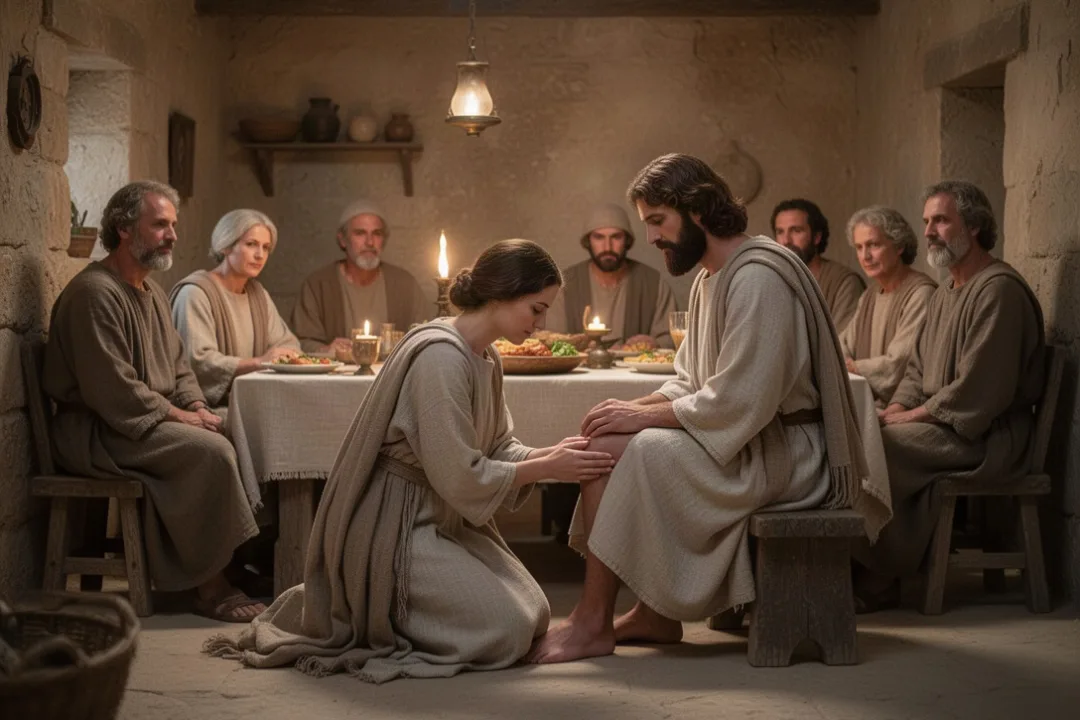
Mary takes a large amount of expensive perfume made from pure nard, anoints Jesus’ feet, and wipes them with her hair. John says that the fragrance fills the house. The act is intimate, costly, and socially striking, especially because loosening one’s hair in public could attract attention and because touching another person’s feet placed Mary in a position of humility.
Judas Iscariot objects to the expense. In John’s account, he argues that the perfume could have been sold and the money given to the poor. Jesus defends Mary, telling Judas to leave her alone and explaining that she has kept the perfume for the day of his burial. His words connect her action with the death that is approaching.
Mary may not have understood every detail of what was about to happen, but the narrative presents her action as deeply fitting. She gives Jesus something valuable at a time when others are questioning, plotting, or preparing to abandon him. Her worship recognizes the importance of the moment even before the full meaning of Jesus’ death becomes clear.
Matthew 26:6–13 and Mark 14:3–9 also describe a woman anointing Jesus with expensive perfume at Bethany. Those accounts do not name the woman, while John identifies her as Mary. Because the settings and details are not identical in every Gospel, it is wise to say that John explicitly names Mary in his account rather than insisting that every anointing story must be the same event.
Why the anointing matters: Mary’s gift is not valuable merely because it is expensive. It expresses love, humility, and recognition that Jesus is approaching death, while his response protects her from being dismissed as wasteful.
Mary’s action and the poor
Jesus’ defense of Mary is sometimes misunderstood as a rejection of caring for poor people. That is not what the passage says. His response addresses the specific timing and meaning of her act, while the wider biblical witness consistently calls God’s people to generosity and concern for those in need.
The issue is that Judas interprets Mary’s action only as a financial loss. Jesus interprets it as a significant act of love connected with his burial. Both material generosity and personal devotion matter, but one should not be used casually to condemn the other.
Mary’s action also anticipates the care normally given to a body after death. In the Gospel story, Jesus will soon be arrested and crucified, leaving little opportunity for his followers to complete every burial custom. John presents Mary’s anointing as a meaningful preparation for the death that Jesus has repeatedly foretold.
What Mary of Bethany teaches about discipleship
Mary’s three Gospel scenes form a coherent portrait. She is a listener who receives Jesus’ teaching, a mourner who brings her pain directly to him, and a worshiper who gives generously when his death is near. These are not three unrelated personality traits. They show different ways a disciple may respond to Jesus across changing circumstances.
Her listening challenges the assumption that devotion must always be measured by visible activity. She is not praised for producing more, managing more, or proving her usefulness. She is praised for recognizing that Jesus’ presence and teaching deserve her undivided attention.
Her grief challenges the idea that strong faith requires emotional composure. Mary does not hide behind polished language. She falls at Jesus’ feet and tells him what his absence has meant to her. Her sorrow becomes part of the story rather than an obstacle that must be removed before faith can begin.
Her anointing challenges the habit of evaluating every act of love only by its apparent efficiency. Mary’s gift has a practical cost, but Jesus sees its spiritual meaning. Her devotion is personal and embodied: she touches his feet, uses her hair, and fills the house with fragrance.
Mary is also a useful reminder that the Bible does not always present discipleship in one style. Martha serves; Mary listens. Martha speaks directly with Jesus; Mary expresses herself through tears and action. Both sisters matter to the story, and the Gospel does not require every faithful person to respond in exactly the same way.
Receive before rushing: Mary makes space to hear Jesus instead of allowing immediate demands to control her.
Bring grief honestly: She approaches Jesus without pretending that Lazarus’s death does not hurt.
Give with discernment: Her costly gift is offered at a decisive moment, not for public recognition.
Stay near Jesus: In each account, she turns toward him rather than withdrawing from him.
Her example does not mean that every Christian must imitate the exact outward form of her actions. Most people will not sit in the same ancient household, anoint someone with nard, or experience the same family crisis. The enduring pattern is her willingness to give Jesus her attention, her sorrow, and her most valuable offering.
How Mary differs from Mary Magdalene and other biblical Marys
Confusion about Mary of Bethany often comes from combining separate women into one. The New Testament does not identify Mary of Bethany with Mary Magdalene. Mary Magdalene is a follower of Jesus from whom several demons were cast out, according to Luke 8:1–3, and she becomes a central witness to the empty tomb and the risen Jesus in the resurrection narratives.
Mary of Bethany is associated with Martha, Lazarus, and Bethany. Mary Magdalene is associated with Magdala and the group of women who supported Jesus’ ministry and witnessed his crucifixion and burial. Both are devoted followers, but the Gospel accounts give them different histories and different narrative roles.
Mary of Bethany is also not Mary the mother of Jesus. The mother of Jesus appears in the birth accounts, at Cana, at the cross, and in the early Christian community. Her relationship to Jesus is maternal, while Mary of Bethany is a friend and disciple from Bethany.
Luke 7:36–50 describes an unnamed sinful woman who anoints Jesus’ feet in the house of a Pharisee. That passage takes place in a different setting and emphasizes forgiveness. It should not be automatically identified with Mary of Bethany’s anointing in John 12.
A careful reading allows each woman to remain visible as the person the Gospel writers present. Mary of Bethany does not need to be merged with other women to become important. Her own story already gives her a distinctive place: she listens to Jesus, mourns before him, and honors him with costly love.
For readers seeking the main references, these passages provide the clearest path:
Luke 10:38–42: Mary listens at Jesus’ feet while Martha serves and becomes anxious.
John 11: Mary mourns Lazarus, meets Jesus, and witnesses the raising of her brother.
John 12:1–8: Mary anoints Jesus’ feet with costly nard at Bethany.
Matthew 26:6–13 and Mark 14:3–9: A related Bethany anointing account names the woman differently or leaves her unnamed.
Read together, these passages show why Mary of Bethany remains memorable. She is not famous because she gives long speeches or leads a public movement. She is remembered because her attention, tears, and generosity consistently turn toward Jesus at moments when his presence matters most.
Frequently asked questions
Is Mary of Bethany the same person as Mary Magdalene?
No. The Gospels present them as different women. Mary of Bethany is identified through her siblings Martha and Lazarus and her home in Bethany. Mary Magdalene is associated with Magdala and is especially prominent among the women who witnessed Jesus’ crucifixion, burial, and resurrection appearances.
What was Mary doing while Martha served?
Mary was sitting at Jesus’ feet and listening to his teaching, according to Luke 10:38–42. Jesus affirmed her choice when Martha asked him to make Mary help with the preparations. The passage addresses anxious distraction rather than condemning hospitality, work, or practical service.
Why did Mary pour expensive perfume on Jesus?
In John 12, Mary used costly nard to anoint Jesus’ feet shortly before his death. Jesus defended her action and connected it with preparation for his burial. The gesture expressed humility, love, and recognition of the seriousness of the moment, rather than simple extravagance.
Did Mary of Bethany become a leader in the early church?
The New Testament does not provide a later biography of Mary of Bethany or describe her leadership after Jesus’ resurrection. It records three significant encounters in Bethany, but information about her later life, death, and ministry is not given in the biblical text.














Leave a Reply