Camillus de Lellis founded a religious order devoted to caring for sick people with both medical skill and compassionate presence. A former soldier who struggled with gambling and poverty, he became a Catholic priest, hospital reformer, and lasting symbol of Christian healthcare.
Camillus de Lellis was an Italian Catholic priest who lived from 1550 to 1614. He is best known as the founder of the Ministers of the Sick, also called the Camillians, a religious community established to serve people who were ill, dying, or affected by epidemics.
His importance comes from more than founding a religious order. Camillus helped change how Christian communities understood hospital care. He insisted that patients deserved attention to their physical needs, emotional distress, and spiritual concerns. For him, caring for someone who was sick was not a secondary task; it was a direct act of service to Christ.
The Catholic Church recognizes Camillus as a patron saint of the sick, hospitals, nurses, and healthcare workers. His liturgical memorial is generally observed on July 18. He is also remembered for his personal connection to illness: a chronic leg wound shaped his life and gave him firsthand knowledge of pain, dependence, and the loneliness that can accompany hospitalization.
Central idea: Camillus believed that care should be offered with competence, patience, and reverence for the dignity of every patient, especially those who were poor or near death.
Camillus de Lellis’s early life in Italy
Camillus was born on November 25, 1550, in Bucchianico, a town in the Abruzzo region of Italy. His father, Giovanni de Lellis, served as a military officer, and his family background exposed Camillus to the unsettled life of soldiers and campaigns. His mother died when he was young, and he did not grow up with the stable family life that might have guided his early adulthood.
As a young man, Camillus followed his father into military service. He served as a soldier and experienced the rough conditions associated with sixteenth-century armies. His early years were marked by restlessness, gambling, and financial hardship. He had little direction and often made choices that placed him in increasingly difficult circumstances.
One physical problem would affect the rest of his life. Camillus developed a serious wound or ulcer on his leg, probably during his military years. The condition became chronic and required treatment at the Hospital of Saint James for Incurables in Rome. The hospital cared for people with long-term and difficult illnesses, including patients who were poor and had limited options elsewhere.
At first, Camillus entered the hospital as a patient. He later found work there as a servant or attendant. His conduct was not immediately reliable, however, and he was dismissed after problems connected with gambling and discipline. That failure became one of several moments that forced him to face the direction of his life.
Camillus’s early history matters because his later ministry did not come from an abstract interest in healthcare. He knew the experience of being injured, rejected, financially vulnerable, and dependent on others. His work among the sick grew from a personal conversion that included both spiritual change and practical knowledge of hospital life.
How illness and conversion changed his direction
Camillus tried to join the Capuchin Franciscans, drawn by their religious life and commitment to poverty. His leg condition prevented him from remaining with them, but the attempt helped turn his attention toward a life of prayer and service. He eventually returned to the Hospital of Saint James, where he worked with greater seriousness and began to understand care for patients as a religious vocation.
A major influence during this period was Philip Neri, the Roman priest and spiritual guide who became Camillus’s confessor. Neri encouraged him to pursue education and priestly formation rather than remain only as a hospital worker. Under this guidance, Camillus studied, prepared for ordination, and developed a clearer sense of how his earlier suffering could become a source of service.
Camillus was ordained a priest in 1584. His vocation did not lead him away from the hospital. Instead, priesthood gave him a wider responsibility within it. He preached, heard confessions, visited patients, and worked to improve the daily conduct of attendants. He also began gathering men who shared his concern for neglected patients.
His conversion should not be reduced to a simple story of instant reform. Camillus continued to deal with a painful leg condition and the practical demands of organizing a new ministry. His life shows a gradual transformation: the habits that once harmed him were redirected into discipline, prayer, leadership, and service.
Camillus’s ministry treated the suffering person as someone to be served with the care one would offer to Christ.
This way of thinking shaped his instructions to fellow workers. A patient was not merely a case, a bed number, or a source of labor. Each person had a name, a history, fears, and needs that required attention. The approach was especially significant in an era when poor and contagious patients could be ignored or treated as burdens.
What Camillus changed in hospital care
Hospitals in Camillus’s time were often places of charity, but they did not always provide consistent standards of care. Staffing could be unreliable, sanitation was limited by the knowledge of the period, and poor patients were vulnerable to neglect. Camillus responded by focusing on the behavior and formation of caregivers.
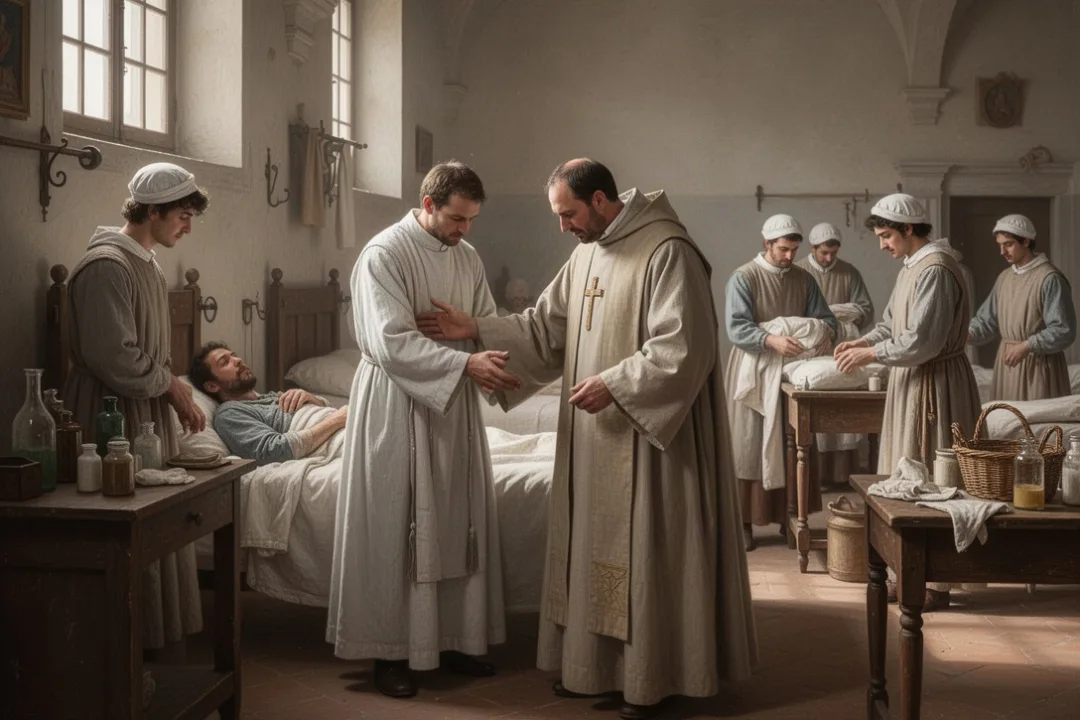
He taught that a caregiver needed more than goodwill. Attendants had to be dependable, respectful, and attentive to practical needs such as cleanliness, food, clothing, bedding, and communication. Camillus encouraged workers to serve patients patiently, including people who were difficult, frightened, confused, or close to death.
His reforms were spiritual and organizational at the same time. Members of his community prayed with patients and helped them prepare for death, but they also cleaned wounds, changed bedding, carried patients, and assisted with ordinary bodily needs. The combination was unusual in its seriousness: physical care and spiritual care belonged together.
Camillus also placed strong emphasis on serving people who had no money. His ministry did not depend on a patient’s social status or ability to pay. The sick poor, prisoners, soldiers, and people affected by epidemics all fell within the concern of the community he founded.
The group’s work extended beyond established hospitals. Camillus and his companions visited people in their homes and responded to emergencies in Rome. They accompanied military forces and went into areas affected by outbreaks of disease. These assignments exposed members to real danger, but the community regarded service during epidemics as part of its vocation rather than an optional activity.
Respect: Speak to patients as persons, not as problems to be managed.
Presence: Remain with people who are frightened, isolated, or dying.
Practical help: Attend to food, clothing, hygiene, bedding, mobility, and other daily needs.
Equality: Serve poor and wealthy patients with the same basic dignity.
Courage: Accept difficult assignments when illness or disaster leaves people without care.
Camillus did not possess modern medical knowledge, and his work should not be judged as if he practiced contemporary nursing. His contribution was different. He helped establish a disciplined culture of organized, compassionate bedside service at a time when hospital care was often inconsistent.
How the Camillian order began
Camillus formed a community known first as the Company of the Ministers of the Sick. The group developed from the companions who worked with him in Rome. They shared prayer, religious discipline, and direct service to patients. Over time, the community became a recognized religious institute.
The members became known for wearing a red cross on their habit. This symbol identified their ministry and represented their dedication to sick people. It predates the modern International Red Cross movement; the two are not the same organization. In Camillus’s setting, the red cross marked a religious community committed to healthcare and mercy.
The Church formally approved the community as a religious order in 1591. Its full ecclesial identity is often expressed in English as the Order of Clerks Regular, Ministers to the Sick. The Camillians made caring for the sick a central form of religious service, giving the work a stable structure that could continue beyond Camillus’s own lifetime.
Camillus served as the order’s superior and helped establish communities in different Italian cities. The members cared for patients in hospitals and responded to public crises. Their responsibilities could include transporting the sick, preparing patients for the sacraments, assisting at the bedside, and remaining with those who had no family to help them.
The order’s growth required more than inspiration. Camillus had to guide members, maintain standards, handle disagreements, secure resources, and preserve the original purpose of the community. His leadership combined personal example with practical administration. He expected members to care for the whole patient, not simply perform religious ceremonies.
Historical clarification: Camillus’s red cross is associated with his order’s habit and ministry, but it should not be confused with the symbol or organization of the modern Red Cross.
Camillus de Lellis during epidemics and war
Serving the sick in the late sixteenth and early seventeenth centuries involved serious exposure to infection. Hospitals lacked antibiotics, modern isolation systems, advanced protective equipment, and many treatments now taken for granted. Epidemics could spread quickly, and caregivers often faced illness with limited protection.
Camillus nevertheless sent himself and his companions where the need was greatest. They cared for people during outbreaks, helped in crowded hospitals, and assisted soldiers and civilians affected by war. Some members of the community died while serving patients. Their work demonstrated that compassion involved accepting risk without abandoning prudence or responsibility.
His response to epidemics was not reckless disregard for health. The community organized its work, assigned responsibilities, and maintained a shared discipline. Camillus understood that caregivers needed enough order and support to continue serving. The lesson remains relevant: courage in healthcare is not the same as ignoring danger.
Camillus also recognized that people at the end of life required special attention. He wanted patients to receive companionship rather than die alone. His ministry included prayer and the sacraments, but it also included ordinary acts such as listening, adjusting a patient’s position, bringing water, and comforting anxious relatives.
Camillus’s spiritual vision of caring for the sick
Camillus’s spirituality centered on the presence of Christ in suffering people. He encouraged his companions to approach patients with the reverence they would show in a sacred place. This did not mean romanticizing illness or pretending that pain was easy. It meant refusing to let illness erase a person’s dignity.
His approach also challenged caregivers to examine their motives. Service was not supposed to be a way to gain praise, authority, or emotional satisfaction. It required patience when a patient could not express gratitude, cooperation, or improvement. A caregiver’s value was not measured by visible success alone.
Camillus paid attention to the small details of human care. He understood that a patient can feel exposed and powerless when dependent on strangers. Clean clothing, privacy, gentle speech, and a calm manner could restore a measure of dignity even when an illness could not be cured.
His religious language reflected the Catholic culture of his period, but many of the underlying principles can be understood broadly. Compassionate presence, respect for vulnerable people, careful service, and solidarity with the poor remain meaningful in hospitals, nursing homes, hospice programs, and home healthcare.
Camillus also recognized that caregivers themselves need support. A person who constantly encounters pain and death can become exhausted or emotionally numb. Shared prayer, community life, rest, clear responsibilities, and mutual encouragement helped his companions continue their work without treating burnout as a personal moral failure.
Camillus de Lellis’s death and canonization
Camillus died in Rome on July 14, 1614. His chronic leg condition had remained part of his life for decades, and his final years included serious illness. By the time of his death, the community he founded had become an established force in Catholic healthcare ministry.
The Church beatified Camillus in 1742 and canonized him in 1746 under Pope Benedict XIV. Canonization formally recognized his sanctity and made him a model for the universal Church. His feast day is observed on July 18, while July 14 remains associated with the anniversary of his death in some historical and local contexts.
He is commonly invoked by people facing illness and by those who care for them. Hospitals, nursing communities, chaplaincies, and Catholic healthcare institutions may look to him as a patron. His image often includes the red cross associated with the Camillian order, connecting his identity with direct service to the sick.
What Camillus de Lellis means for healthcare workers today
Camillus cannot provide a modern clinical protocol, and his historical setting was very different from a contemporary hospital. His lasting value lies in the ethical attitude behind his work. He reminds caregivers that technical treatment should not replace human attention.
His example encourages healthcare workers to see the patient as more than a diagnosis. A person receiving treatment may also be worried about family, employment, finances, pain, religious questions, or loss of independence. Attending to those concerns may require collaboration with nurses, physicians, social workers, chaplains, aides, and family caregivers.
Camillus’s work also speaks to people who are not healthcare professionals. Family members, volunteers, pastoral visitors, and friends often provide the presence that patients remember most. They may not be able to change the medical outcome, but they can reduce isolation and protect the person’s sense of worth.
His legacy can be put into practice through habits such as:
Ask what the sick person needs instead of assuming.
Protect privacy during personal care and difficult conversations.
Use the person’s preferred name and speak directly to them.
Listen without forcing reassurance or minimizing fear.
Offer practical help, such as transportation, meals, errands, or a quiet visit.
Respect religious and cultural preferences while avoiding pressure.
Recognize when professional medical, mental health, or hospice support is needed.
Common mistakes when learning about Camillus de Lellis
Several misunderstandings can obscure the significance of Camillus’s life. Keeping the historical details clear makes his contribution easier to understand.
Confusing him with a modern medical professional: Camillus was a priest and religious founder, not a physician working with contemporary clinical methods.
Reducing his work to prayer alone: He prayed with patients, but he also cleaned, carried, fed, clothed, and accompanied them.
Ignoring his troubled youth: His gambling and failures are part of the story because his later vocation developed through conversion and persistence.
Assuming the red cross refers to the modern Red Cross: The symbol belonged to the Camillian religious community and has a different historical origin.
Portraying service as fearlessness: Camillus valued courage, but organized care and responsible conduct were also essential.
Forgetting the poor: His ministry was especially concerned with people who lacked money, family support, or social influence.
These distinctions matter because Camillus’s legacy is not based on a flawless early life or a romantic picture of suffering. It is based on the way he transformed personal weakness into a durable commitment to the vulnerable. His story combines conversion, institutional reform, and patient-centered care.
How to observe the feast of Camillus de Lellis
People who want to honor Camillus on July 18 can do so through prayer, learning, or direct service. A parish might pray for patients and healthcare workers, while a family might visit someone who is homebound or recovering. A hospital ministry could recognize staff members who provide steady and compassionate care.
Practical observance does not require a large ceremony. You might write to a nurse, bring a meal to a caregiver, volunteer with a hospice organization after completing its training, or spend unhurried time with an isolated person. The action should reflect Camillus’s central concern: the sick person should not be left alone or treated as a burden.
For Catholics, the day may also include attending Mass, asking for Camillus’s intercession, or reading about the Camillian tradition. People from other backgrounds can still appreciate his emphasis on dignity, presence, and service. His example remains accessible because it begins with a basic human question: how should we treat someone who is weak, afraid, or dependent on our care?
Frequently asked questions
What is Camillus de Lellis best known for?
Camillus de Lellis is best known for founding the Ministers of the Sick, a Catholic religious order dedicated to serving people who are ill. He also helped improve hospital care by emphasizing practical assistance, respectful treatment, spiritual support, and special concern for poor or dying patients.
Why is Camillus de Lellis the patron saint of nurses?
The Church associates Camillus with nurses and caregivers because he organized a community whose members served patients directly in hospitals, homes, military settings, and during epidemics. His example highlights bedside presence, compassion, discipline, and attention to the dignity of people who depend on others.
What was the red cross associated with Camillus de Lellis?
The red cross was the identifying symbol worn by members of the Camillian order. It represented their commitment to serving the sick and predates the modern International Red Cross movement. The two have separate histories, purposes, and organizations.
When is the feast day of Camillus de Lellis?
Camillus de Lellis is generally celebrated liturgically on July 18. He died on July 14, 1614, so that date also appears in historical references to his death. Churches, religious communities, and healthcare institutions may observe his memory with prayer, worship, or acts of service.













Leave a Reply