Last rites prayer for Christians: what to say and expect
Last rites prayer for Christians: what to say and expect
When someone you love is dying, you may wonder, “What prayer should I say?” or “How do I ask a pastor or priest to come?” The answer depends on the person’s Christian tradition. In Catholic usage, last rites usually refers to several prayers and sacraments offered near death, especially Reconciliation, Anointing of the Sick, and Holy Communion as Viaticum. Other Christian churches may offer bedside prayer, Communion, confession, anointing, or a blessing without using the phrase “last rites.”
You do not need perfect words. A quiet presence, a gentle prayer, and a timely call to the person’s priest, pastor, chaplain, or other spiritual leader can provide meaningful support. If the person is conscious, let them guide the conversation as much as possible. If they cannot respond, pray respectfully and follow the family’s and faith community’s wishes.
Last rites is not one universal Christian prayer. It is a broad expression most strongly associated with Catholic pastoral care at the end of life. The rites may be celebrated separately or together, depending on the person’s condition, wishes, and access to a priest.
In Catholic teaching, the Anointing of the Sick is not reserved only for the final moments of life. It may be given to people who are seriously ill, facing major surgery, weakened by age, or experiencing a significant worsening of an illness. Its purpose is prayer for strength, peace, healing according to God’s will, and spiritual support.
Reconciliation, or confession, may be offered when the person is able and wishes to receive it. A priest may also give a general prayer of forgiveness or absolution in circumstances where a detailed confession is not possible. The exact form depends on the person’s condition and the priest’s pastoral judgment.
Viaticum means spiritual food for the final passage from this life. When a Catholic who is dying can receive Holy Communion, it may be offered as Viaticum. If swallowing is difficult or impossible, the priest or chaplain may use another appropriate form of prayer and pastoral care.
A priest may also offer a commendation of the dying, which entrusts the person to God’s mercy and asks for comfort, forgiveness, and peaceful passage. In some situations, a priest may give an apostolic pardon after confession or as part of prayers for the dying. It is a Catholic spiritual blessing, not a promise that death will occur immediately.
Remember: “Last rites” is commonly used as a general phrase, but the actual Catholic care may include several distinct sacraments and prayers. Calling a priest early gives the person more choices and avoids waiting until communication or swallowing becomes difficult.
How Catholic last rites prayers support a dying person
The prayers used near death address the whole person: body, conscience, relationships, and hope in God. They are not meant to pressure someone into accepting death or to suggest that medical treatment should stop. A person may receive the Anointing of the Sick while continuing treatment, and the sacrament may be given to someone who expects recovery.
The prayers may ask for forgiveness and reconciliation, especially if the person carries guilt, regret, or unresolved pain. They may also ask for courage during suffering, peace in fear, wisdom for family members, and trust in God’s care. A priest will normally adapt the words and pace to the person’s energy and ability to respond.
For a conscious person, the most helpful approach is usually gentle and direct. You might say, “Would you like me to call your priest?” or “Would prayer help right now?” This respects the person’s wishes instead of assuming that every Christian wants the same ritual.
If the person is unconscious, prayer can still be appropriate when it reflects their faith and known preferences. Speak in a calm voice, avoid arguing about doctrine, and do not treat a lack of response as evidence that the person cannot hear. Some families find comfort in reading familiar prayers, playing quiet sacred music, or simply holding the person’s hand.
A Christian prayer to say beside someone who is dying
The following is a Christian bedside prayer written in original words. It is suitable for personal prayer when a clergy member is not immediately available. It does not replace a sacrament, confession, or the official ministry of a priest or pastor.
Merciful God, stay close to your servant N. in this hour. Give peace to their heart, relief from fear, and strength for each moment. Surround them with your love, forgive what needs forgiveness, and receive their life with compassion. Comfort everyone who is present, guide the medical team, and keep us faithful to hope and love. Through Christ, amen.
Use the person’s name where “N.” appears. If the person is awake, you can ask whether there is something specific they want included, such as peace, forgiveness, healing, reconciliation with family, or freedom from fear. A short prayer may be more comfortable than a long one when breathing is difficult or the person is exhausted.
You can also pray in a way that reflects the Christian tradition the person knows. For example, Catholics may want the Our Father, Hail Mary, or Act of Contrition, while many Protestants may prefer a spontaneous prayer, a familiar hymn, or a prayer based on a favorite passage. Orthodox Christians may ask their priest for the appropriate service of Holy Unction and prayers for the sick.
Do not feel obliged to fill every silence. Silence can be prayer, especially when the person is near death. Sitting quietly, breathing slowly, and remaining physically present may communicate more love than a series of spoken phrases.
What to do when a Catholic family member requests last rites
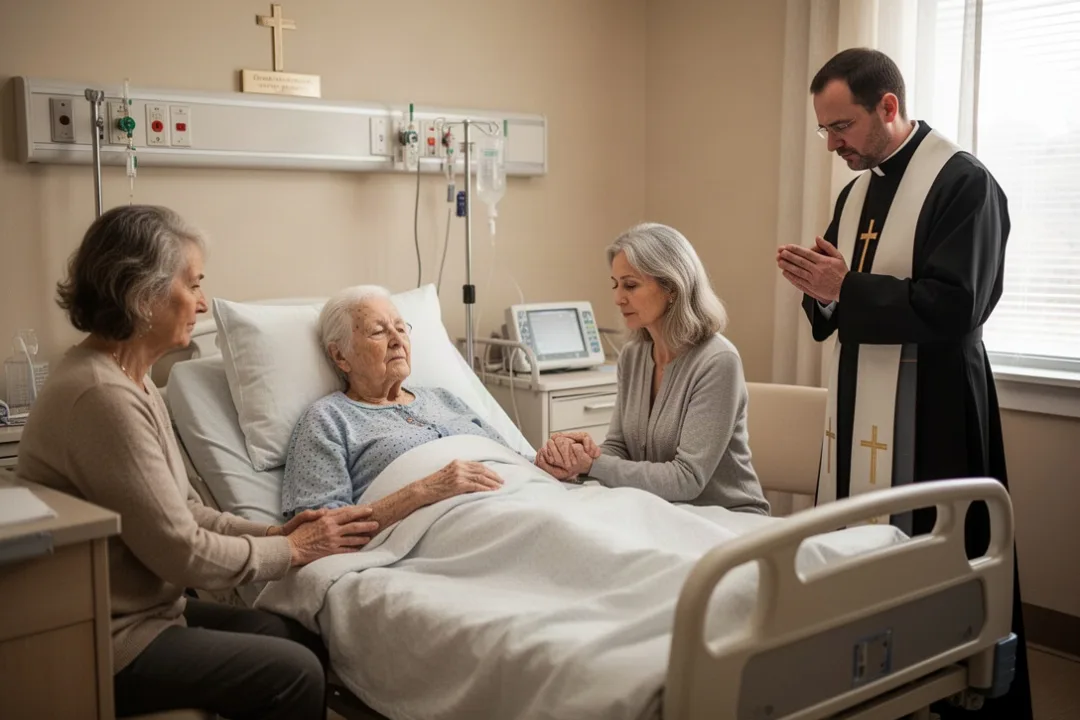
Contact the person’s parish office, priest, hospital chaplain, or hospice spiritual-care provider as soon as possible. If the person is in a hospital, tell the nurse that the patient wants a Catholic priest. Hospitals often have a chaplain or a process for contacting a local parish, but staff may need clear information about the request.
When you call, explain that the person is seriously ill or near death and ask for a visit for the Sacrament of the Anointing of the Sick. Give the person’s name, location, room number, medical condition if relevant, and whether they can speak, swallow, or receive Communion. Mention if death appears imminent so the priest can judge the urgency.
If the person has a regular parish, call that parish first when practical. If it is after hours, use the parish’s emergency number or contact the hospital chaplain. A priest may not be available immediately, but the request should still be made without delay.
Before the visit, ask the person what they want. They may want confession, Communion, a family member present, privacy, or only a short prayer. Some people are anxious about confession or believe they must remember every sin perfectly. You can reassure them that the priest will guide the conversation and that the sacrament is intended to bring mercy and peace, not distress.
During the visit, keep the room calm. Turn off unnecessary television, make space near the bed, and tell the priest about any practical limits. If the person cannot communicate, the priest can determine which prayers and sacraments are appropriate. Family members may participate quietly unless the person or priest asks for privacy.
How other Christian churches may pray at the end of life
Christians outside the Catholic Church may not use the term last rites, and their practices vary widely. Anglican and Episcopal clergy may offer prayers for the dying, confession, anointing, Holy Communion, and commendation. Lutheran, Methodist, Presbyterian, Baptist, and other Protestant pastors may offer bedside prayer, Scripture readings in their own words, Communion, baptism when appropriate, or a final blessing.
Eastern Orthodox Christians have their own sacramental and liturgical practices, including Holy Unction. The priest will determine what is appropriate based on the person’s condition, the local church’s practice, and whether the person can participate. Orthodox families should contact their parish priest rather than relying on a generic Catholic or Protestant formula.
Some evangelical churches focus on prayer for healing, comfort, surrender, and trust in Christ. A pastor may invite family members to pray around the bed, anoint the person with oil, or read from a preferred portion of Scripture without using a formal “last rites” service.
Some Christians have no clergy nearby, belong to a small congregation, or have not attended church recently. That does not prevent loved ones from praying. A simple prayer of comfort and trust can be offered by anyone, while the family continues trying to reach the appropriate spiritual leader.
Ask the person’s tradition: Find out which church or denomination they identify with.
Contact the right minister: Call a priest, pastor, chaplain, or Orthodox priest rather than assuming one service fits all.
Respect the person’s wishes: Prayer should comfort and support, not coerce.
Use familiar practices: Include a known hymn, prayer, devotional, or church ritual if the person wants it.
Keep medical care separate: Spiritual prayer can accompany medical treatment and hospice care.
Practical tips and common mistakes when praying with the dying
Families often worry that they will say the wrong thing. Most problems come not from imperfect wording but from speaking too much, making promises, or overlooking the person’s wishes. A quiet, respectful approach is usually best.
Practical ways to make prayer more supportive
Ask permission when the person can answer. Say, “Would you like me to pray with you?” rather than beginning without warning.
Keep the prayer brief. One or two minutes may be enough, especially if the person is short of breath, sedated, or in pain.
Use a calm voice. Speak slowly, identify yourself, and avoid crowding the bed.
Name concrete needs. Pray for relief from pain, peace, reconciliation, courage, and support for caregivers.
Leave room for silence. Do not rush to speak after saying amen.
Follow up with clergy. If the person requests a sacrament, call the appropriate church as soon as possible.
Common mistakes to avoid
Do not announce that death is coming simply because you are asking for a priest. The Anointing of the Sick is not limited to the final minutes.
Do not promise a particular physical outcome. Prayer can ask for healing without assuring the person that they will recover.
Do not suggest that suffering proves weak faith. Illness and pain are not evidence that God has abandoned someone.
Do not force confession or Communion. Sacraments and religious acts should be offered respectfully and received freely when the person is able.
Do not stop prescribed medical care because a prayer or sacrament has been offered. Speak with the medical team about treatment decisions.
Do not argue with other family members about which wording is correct. Keep attention on the person’s comfort and wishes.
Do not wait for a crisis if the person has already asked for pastoral care. Earlier contact usually allows more meaningful participation.
For urgent situations: If someone is actively dying, call emergency medical services when needed and ask hospital or hospice staff to contact the person’s clergy. Spiritual care and medical care can be requested at the same time.
Prayers and words that may help during a bedside visit
A prayer does not have to mention death directly. If the person is frightened, you might pray for steadiness, comfort, and freedom from panic. If they are worried about family, pray for reconciliation and peace among those who will remain. If they are experiencing pain, ask for relief and for compassionate attention from caregivers.
These short phrases can be spoken before or after a longer prayer:
“God is near to you, and you are not alone.”
“May you be held in peace and surrounded by love.”
“We are here with you, and we will stay with you.”
“May God give you comfort and receive you with mercy.”
“You do not need to find perfect words; we can be quiet together.”
Use care with statements such as “Everything happens for a reason” or “God needed another angel.” These phrases may be intended as comfort, but they can sound dismissive or confusing. Acknowledge the person’s actual experience instead: “This is hard,” “I am sorry you are hurting,” or “I am here with you.”
If the person wants to pray but cannot speak, invite them to respond with a hand squeeze, nod, or blink if they have the strength. Do not assume a response is required. The person may simply listen while you pray, and their silence should be treated with dignity.
How hospice and hospital chaplains can help
Chaplains are trained to support people of many faiths and those who are unsure about religion. They can listen, contact clergy, help family members understand religious customs, and offer prayers appropriate to the person’s beliefs. A chaplain does not replace the person’s own priest or pastor when a specific sacrament is requested, but can often provide immediate support.
Hospice teams may ask about the person’s religious affiliation, preferred clergy, sacred objects, and prayer practices when care begins. Sharing this information early prevents confusion during an emergency. If the person has a living will, health care directive, or documented spiritual preference, tell the care team and keep a copy available.
Medical staff can also help create a peaceful setting for prayer. They may adjust interruptions, manage pain and breathing symptoms, and explain when the person is too tired to participate. Spiritual care works best when family, clergy, hospice, and medical professionals communicate respectfully.
When the person cannot receive Communion or speak
A person may be unable to receive Communion because of unconsciousness, swallowing problems, nausea, a medical device, or another condition. This does not mean that spiritual care is no longer possible. A priest or chaplain can offer prayer, anointing, a blessing, or commendation according to the tradition and circumstances.
Do not place food, liquid, oil, religious objects, or anything else in the person’s mouth without permission from medical staff. Aspiration can be dangerous. If the person has a rosary, cross, prayer book, or other sacred item, it may be placed nearby or held by a family member if that is safe and welcome.
When the person is unconscious, speak naturally and respectfully. Introduce yourself, explain who is present, and tell them that the priest or pastor has arrived. Then allow the clergy member to lead. Loved ones can join in familiar responses or remain silent, depending on the person’s condition and the family’s wishes.
What to pray after death
After a Christian dies, families may continue praying at the bedside. The words may ask God to receive the person with mercy, comfort those who mourn, and help loved ones care for one another. A pastor, priest, chaplain, or funeral director can explain the customs of the person’s church and help arrange a funeral or memorial service.
One simple prayer is: “God of mercy, receive N. into your care. Thank you for the love shared in this life. Bring comfort to everyone who grieves, and give us strength for the days ahead. Amen.” Adapt it to the person’s name and faith tradition.
There is no requirement to say a long prayer immediately. Grief may make words difficult. Quiet presence, tears, and gratitude can all be part of prayer. Give the family time, and ask clergy for guidance if religious customs or decisions feel overwhelming.
Finding the right Christian prayer for your situation
The most appropriate prayer depends on the person’s denomination, spiritual wishes, medical condition, and relationship with the people present. A Catholic may specifically want a priest and the sacraments of the Church. A Protestant may want a pastor, spontaneous prayer, or Communion. An Orthodox Christian may need the service and guidance of an Orthodox priest.
If you are uncertain, begin with a respectful question: “What would bring you comfort right now?” Then contact the person’s church or a chaplain. You do not need to settle every theological question before offering kindness. Pray in plain language, protect the person’s dignity, and make room for the spiritual care they have asked to receive.
Frequently asked questions
Is the Anointing of the Sick only for someone who is about to die?
No. In Catholic practice, the Anointing of the Sick may be given to someone with a serious illness, advanced age, or a major medical procedure. It can be received more than once when a condition worsens or another serious illness develops. Asking for the sacrament does not necessarily mean that death is expected soon.
Can a family member give Catholic last rites?
A family member can pray with the dying person and ask God for comfort, forgiveness, and peace, but only an authorized priest administers the Catholic sacraments associated with last rites. If a priest cannot arrive, family prayer is still valuable. A hospital chaplain or parish may also help contact clergy quickly.
What if the dying person is not religious but the family is Christian?
Ask what the person wants before offering religious prayer whenever possible. You can provide quiet companionship, listen, or pray privately without imposing a ritual. If the person is unable to communicate, consider their known beliefs and preferences. A chaplain can support both the patient and family without pressuring either.
Should I call a priest before the person enters hospice?
Yes, if the person wants Catholic pastoral care, early contact is helpful. The priest can discuss confession, Anointing of the Sick, Communion, and the person’s wishes while they are still able to participate. Hospice staff can also record the preferred parish and help arrange visits as the illness progresses.












Leave a Reply