The Paschal candle is a large candle used in the most important celebrations of the Catholic liturgical year. It is especially associated with the Easter Vigil, the nighttime service that celebrates Jesus’ resurrection, but its meaning continues well beyond that one liturgy.
A Catholic parish usually prepares or receives one new Paschal candle for each Easter season. The candle is often taller and thicker than ordinary sanctuary candles, allowing it to burn during solemn services and remain visible in a large church. Its size is practical, but its appearance also shows that it has a distinctive liturgical role.
The candle points to Jesus as the light of the world. Its flame recalls the resurrection: Christ, who died, is alive, and his life is stronger than darkness and death. The candle therefore serves as a visible sign of Christian hope rather than merely a decorative object.
Essential meaning: The Paschal candle is not simply an Easter decoration. It is a liturgical symbol of Christ’s presence, especially his risen and victorious life.
How the Paschal candle appears during the Easter Vigil
The Easter Vigil begins in darkness, or at least in subdued light, after sunset on Holy Saturday. This setting gives the candle’s flame a clear visual meaning. The darkness recalls humanity’s need for salvation, while the new flame points toward the light brought by Christ’s resurrection.
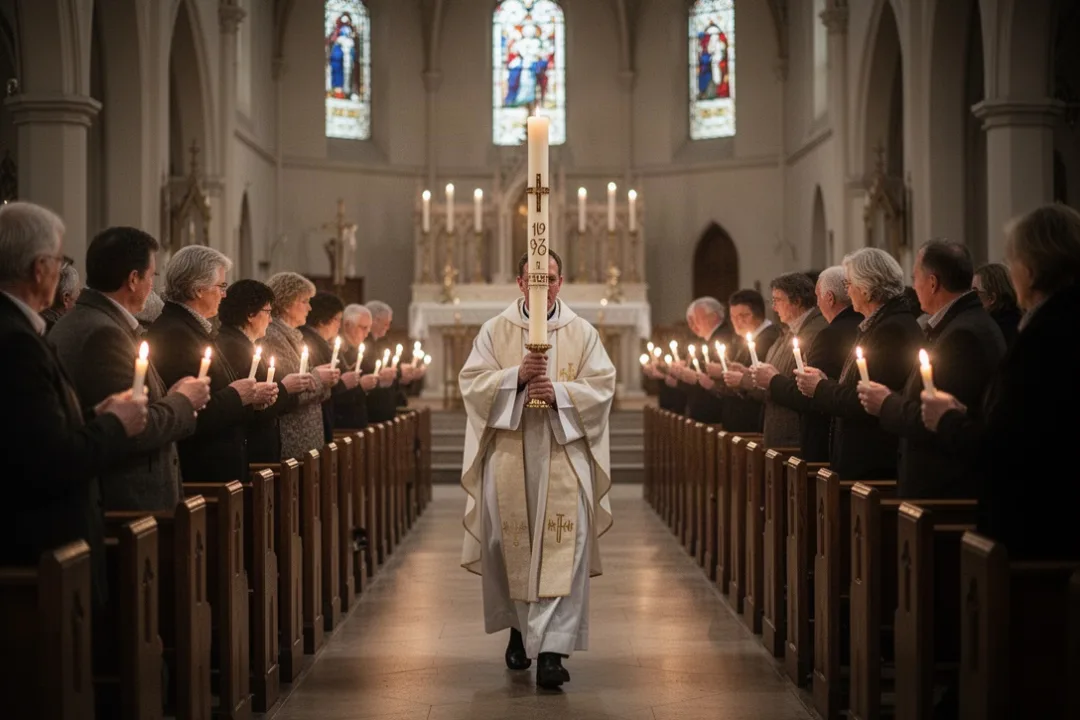
The priest or deacon normally prepares the fire outside the church. From that fire, the Paschal candle is lit. The exact arrangement can vary by parish, but the central action remains the same: the candle enters the church as a sign that Christ leads his people from darkness into light.
As the candle is carried in procession, the minister may stop at several points and lift it for the congregation to see. The people respond with an acclamation recognizing Christ as the light. Members of the congregation then light their own candles from the Paschal candle, allowing the flame to spread through the church.
This movement from one flame to many has a practical and theological meaning. Christians do not create the light independently; they receive it from Christ and share it with others. The growing brightness also makes the change from darkness to celebration visible to everyone present.
What happens when the candle reaches the sanctuary
Once the procession reaches the front of the church, the Paschal candle is placed in a prominent stand. It remains there while the deacon or cantor proclaims the Easter Proclamation, traditionally known as the Exsultet.
The proclamation praises God for the saving work celebrated at Easter and interprets the candle as a sign of Christ. It may refer to the candle as an offering of praise and connect its flame with the victory of life over death. The text is sung or spoken as part of the Vigil’s opening movement into joyful celebration.
The candle is then present during the readings and the celebration of the sacraments that commonly take place at the Easter Vigil. These may include Baptism and Confirmation for catechumens and candidates who have prepared to enter fully into the Catholic Church.
How a Catholic church prepares the Easter candle
The candle is usually prepared before or during the beginning of the Easter Vigil. The priest or another minister marks it with several traditional symbols. Local practice can differ, and not every parish presents every detail in exactly the same way.
A cross is marked on the candle. This identifies the candle with Christ’s death and resurrection. The cross is not separated from the resurrection message; it shows that the risen Christ is the same Christ who gave his life.
The Greek letters Alpha and Omega may be added. Alpha is the first letter of the Greek alphabet, and Omega is the last. Together, they express that Christ is the beginning and the end, the Lord of all time.
The current year is marked. The year shows that the Church celebrates Christ’s living presence in a particular time, not only as a memory of a past event.
Incense grains may be inserted into the candle. Traditionally, five grains are placed in the cross to recall the wounds of Jesus. Some candles use decorative studs or another arrangement to represent them.
The candle is lit from the new fire. This connects the physical flame with the new beginning proclaimed at Easter.
These actions help the congregation see the candle as something that has been prepared for worship. They also connect several truths at once: Christ’s cross, his resurrection, his lordship over time, and the continuing life of the Church.
What the symbols on the candle mean
The cross
The cross is the central mark on the Paschal candle. It makes clear that Catholic Easter is not a celebration of resurrection detached from the Passion. The Church proclaims that Jesus passed through suffering and death before rising again.
For worshipers, the cross can also express the Christian understanding of suffering. It does not promise that believers will avoid hardship. Instead, it points to the hope that suffering and death do not have the final word for those united with Christ.
Alpha and Omega
The Greek letters Alpha and Omega are placed above and below, or at opposite ends of, the cross on many Paschal candles. Their meaning comes from the biblical image of God as the beginning and the end, applied in Christian worship to Christ.
The letters remind the congregation that Easter is more than one date on a calendar. Christ is understood as Lord of the whole course of history: its beginning, its fulfillment, and every moment between them. The image can be especially meaningful when the current year is marked beside the letters.
The year
The current year is usually written on the candle, sometimes split around the cross. The practice connects the eternal message of Easter with the people gathered in a particular place and time.
When a parish replaces the candle the following Easter, the change is not meant to suggest that Christ’s presence has ended. Instead, the new candle marks another season of the Church’s worship and another year in which the resurrection is proclaimed.
The incense grains and the five wounds
Many Paschal candles include five small inserts arranged in the shape of a cross. These are traditionally understood to represent the five wounds of Christ. They may be described as incense grains because frankincense or another aromatic substance has been used in this symbolic action.
The practice emphasizes the connection between the crucified body of Jesus and the risen Christ. The candle’s flame does not erase the wounds; it proclaims that the wounded Christ has conquered death. A parish may use a candle with pre-made inserts rather than performing the insertion visibly during the Vigil.
How the candle is used during the Easter season
After the Easter Vigil, the Paschal candle remains in a prominent place in the sanctuary. It is generally positioned near the ambo, where Scripture is proclaimed, or near the altar, depending on the church’s arrangement and local liturgical practice.
The candle is normally lit for celebrations during the Easter season, including Sunday Masses. Its presence keeps the resurrection message visible throughout the weeks after Easter Sunday. The season is not treated as a single day of celebration that ends immediately; the Church continues to celebrate Christ’s resurrection through Pentecost.
The candle may be especially visible during solemn liturgies. It can stand near the ambo while the readings are proclaimed, reinforcing the connection between the light of Christ and the Word of God. It may also be placed in another suitable location when the church’s layout makes that more practical.
After Pentecost, the Paschal candle usually moves from its prominent Easter position to a location near the baptismal font. This change reflects its continuing relationship to Baptism. The candle is not removed because Easter has become irrelevant; rather, its use shifts toward the sacraments that give people a share in Christ’s death and resurrection.
At a Catholic baptism, the Paschal candle is often placed near the font. After the newly baptized person receives the baptismal candle, that smaller candle is lit from the Paschal candle or from another flame that originated from it.
The action shows that the baptized person receives Christian life from Christ. The candle given to the person is not a symbol of personal achievement or self-generated goodness. It represents a life illuminated by Christ and a calling to let that light be seen through faith and charity.
Parents and godparents commonly take responsibility for helping a child’s baptismal light remain meaningful in daily life. In an adult baptism, the newly baptized person hears the same call personally. The symbolism therefore points beyond the ceremony toward a continuing life of discipleship.
The Paschal candle’s place near the baptismal font also makes a connection between Easter and Christian initiation. According to Catholic teaching, Baptism unites a person sacramentally with Christ’s death and resurrection. The candle gives that theological connection a visible form.
Why the candle is used at Catholic funerals
The Paschal candle is also used at Catholic funerals, usually near the casket or urn during the funeral liturgy. Its presence recalls the person’s Baptism and the Christian hope of resurrection.
At the beginning of the funeral liturgy, the priest may sprinkle the casket or urn with holy water and place a white pall over it. These actions refer back to Baptism. The Paschal candle stands nearby as a sign that the baptized person’s life and death are understood in relation to Christ’s death and resurrection.
The candle does not mean that grief is ignored. Catholic funeral worship makes room for sorrow, prayer, remembrance, and the pain of separation. At the same time, the candle proclaims that death is not regarded as the final defeat for a person who has died in Christ.
Using the same candle at Baptism and at a funeral creates a powerful beginning-and-ending connection. The flame that welcomed a person into the sacramental life of the Church is present again when the Church commends that person to God. This is one reason the Paschal candle may be among the most recognizable symbols in a Catholic parish.
At a funeral: The Paschal candle primarily recalls Baptism and the hope of resurrection. It is not a memorial candle chosen only for sentimental reasons.
How the Easter candle differs from ordinary church candles
Catholic churches use several kinds of candles, and their meanings overlap without being identical. Candles on or near the altar can honor the sacred action of the Mass and signify reverence. Votive candles may accompany personal prayer. Sanctuary lamps have their own relationship to the reserved Eucharist.
The Paschal candle is distinguished by its size, markings, placement, and seasonal use. It is prepared specifically for Easter and carries symbols that ordinary altar candles generally do not have. Its flame is also used to light baptismal candles, which gives it a direct role in Christian initiation.
A candle near a statue or shrine may express a person’s prayer and devotion. The Paschal candle, by contrast, belongs to the Church’s public liturgy. It is not normally intended for people to light casually or for individual devotional use.
Paschal candle: Represents the risen Christ and is used at Easter, Baptism, and funerals.
Altar candles: Accompany the celebration of Mass and other liturgical services.
Votive candles: Support personal prayer and devotional practices.
Sanctuary lamp: Signals the presence of the reserved Blessed Sacrament when used for that purpose.
What the candle means for someone attending Mass
If you see the Paschal candle burning near the front of the church during the Easter season, you can understand it as a visible proclamation: Christ is risen, and his life remains present to the Church. Its flame can help direct attention to the central message of the liturgical season.
During the Easter Vigil, watch how the candle changes the atmosphere of the church. It begins as a single light in darkness, then shares its flame with the congregation. That movement offers a simple picture of Christian faith: received from Christ, carried by the community, and made visible through worship and life.
At a baptism, notice the relationship between the large Paschal candle and the smaller baptismal candle. At a funeral, notice how the same symbol carries the hope of resurrection into a moment of mourning. These different settings show that the candle is connected to the entire Christian life, not only to Easter Sunday.
You do not need to know every ceremonial detail to appreciate its meaning. The key is to recognize the candle as a sign of Christ’s risen life, Christian Baptism, and hope beyond death.
Common questions about the Catholic Easter candle
Is the Easter candle lit only on Easter Sunday?
No. The Paschal candle is introduced at the Easter Vigil and normally remains in use throughout the Easter season. It is ordinarily lit for celebrations during that season, especially solemn liturgies. After Pentecost, it is commonly placed near the baptismal font and used at baptisms and funerals. A parish’s exact placement and ceremonial practice may vary.
Can a Catholic take the Paschal candle home?
Generally, no. The Paschal candle belongs to the parish and is a liturgical object used in worship. It is not a household devotional candle, and its size and construction make it unsuitable for ordinary home use. Families may receive smaller baptismal candles or other devotional candles, but those are distinct from the parish’s Paschal candle.
Why does the priest write the year on the candle?
Marking the year connects the Church’s timeless proclamation of Christ’s resurrection with the specific community celebrating it now. The date does not imply that Christ is present only in that year. It shows that the Gospel is proclaimed in every generation and that the parish is living its faith in a particular historical moment.
Does every Catholic church use exactly the same Easter candle symbols?
No. The main meaning is consistent, but the design can differ. Many candles show a cross, Alpha, Omega, and the current year, while some also include symbols of Christ’s wounds or other approved artwork. The candle’s size, color, stand, and placement may also reflect local custom, church architecture, and the parish’s available resources.
Frequently asked questions
Why is the Paschal candle so large?
Its large size makes the candle visible during processions and celebrations in a large church. It also allows the parish to use the candle over the Easter season and at baptisms and funerals. The size is not itself the source of the candle’s holiness, but it supports its public liturgical role and distinguishes it from ordinary devotional candles.
What happens to the old Paschal candle?
When a parish receives a new candle for the next Easter season, the previous one is no longer the principal Paschal candle. Parish practice for the old candle can vary. It may be respectfully retired, used for another appropriate purpose, or handled according to local church guidance. It should not normally be treated as an ordinary household candle.
Why do people light their small candles from the Paschal candle?
The shared flame symbolizes receiving Christ’s light and carrying it into the Christian community and the world. During the Easter Vigil, the action also creates a striking movement from darkness to brightness. The smaller candle is not considered equal to the Paschal candle in liturgical status; it represents each person’s participation in the light first represented by Christ.
Is the Paschal candle used in every Catholic funeral?
It is commonly used in Catholic funeral liturgies, especially when the funeral takes place in a church, but exact arrangements can depend on the parish and the type of service. It is generally placed near the casket or urn to recall the deceased person’s Baptism and the Church’s hope in Christ’s resurrection.











Leave a Reply