Are you setting up an Advent wreath at home and wondering which candles belong in it, when to light them, or how a Catholic family should pray with it? A Catholic Advent wreath is a circle of evergreen branches holding four candles, traditionally three violet candles and one rose candle. Families light one additional candle on each Sunday of Advent as they prepare spiritually for Christmas.
The wreath is more than seasonal decoration. Its shape, greenery, candles, and gradual increase of light all point toward Jesus Christ as the light of the world. You can use a store-bought wreath, make one from safe materials, or place four candles around a simple centerpiece. What matters most is that the wreath supports prayer and helps your household observe Advent as a season of hope, preparation, and watchfulness.
The Advent wreath developed as a Christian custom before becoming a familiar part of Catholic homes and churches. It is not a required object for observing Advent, and there is no single design that every Catholic family must use. Its value comes from the way it gives a visible form to the Church’s movement through the four Sundays before Christmas.
The wreath is usually made in a circular shape. A circle has no beginning or end, which can remind Christians of God’s enduring love and everlasting life. The ring also creates a place where the candles can be arranged clearly, allowing the growing light to become more noticeable each week.
Evergreen branches are common because they remain green through winter. They can suggest hope, life, and God’s faithfulness during a season when many trees appear bare. Holly, pine, fir, cedar, and other long-lasting greenery may be used, although artificial branches are perfectly suitable when allergies, pets, children, or fire safety make fresh greenery impractical.
The candles express the approach of Christ’s birth. On the first Sunday, one candle burns. On the second Sunday, two burn; on the third, three; and on the fourth, all four are lit. The increasing light does not mean that Jesus becomes more present over time. Instead, it represents the Church’s growing anticipation as Christmas draws near.
The central meaning: The wreath helps your household wait actively for Christ through prayer, repentance, charity, and attention to the needs of other people—not simply by counting down to December 25.
Some Catholic wreaths also include a fifth candle in the center. This white Christ candle is usually lit at Christmas, especially on Christmas Day, to mark the celebration of Christ’s birth. It is optional, and a wreath does not become less Catholic if it has only the four Advent candles.
Which candles belong on a Catholic Advent wreath
The traditional Catholic arrangement uses three violet candles and one rose candle. Violet, sometimes called purple, is associated with Advent’s themes of prayerful preparation and repentance. Rose represents joy, particularly on the Third Sunday of Advent, known as Gaudete Sunday.
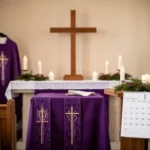
Many churches use violet vestments during Advent, with rose permitted on the Third Sunday. The wreath’s colors generally reflect that liturgical practice. However, candle colors may differ from parish to parish, and some families use four white or red candles because those colors are locally customary or easier to find. The spiritual meaning of the wreath does not depend on perfect color matching.
First Sunday: Light the first violet candle, often associated with hope.
Second Sunday: Keep the first candle burning and add the second violet candle, often associated with peace.
Third Sunday: Light the first two candles and add the rose candle, expressing joy.
Fourth Sunday: Light all four candles as Christmas approaches, often emphasizing love or the nearness of Christ.
The names assigned to the candles—hope, peace, joy, and love—are popular devotional associations rather than a required Catholic formula. A parish or family may assign different themes, such as faithfulness, repentance, expectation, or light. You can choose themes that help your household pray without treating them as official Church rules.
Place the rose candle wherever it looks balanced and safe. Some people put it in front, while others place it on one side. The important point is that the rose candle is lit on the Third Sunday of Advent, not on the first Sunday or throughout the entire week before it.
If you include a center Christ candle, leave it unlit during Advent and light it at Christmas. Some families continue using it through the Christmas season. Others remove the wreath after Christmas or keep it in place until the Feast of the Baptism of the Lord. Either practice can work if it suits your household and parish custom.
How to set up and bless a Catholic Advent wreath
Set the wreath on a stable, heat-resistant surface where everyone can see it during prayer. A dining table, prayer corner, mantel, or small stand can work well. Keep it away from curtains, books, paper decorations, holiday greenery that dries quickly, and any place where a child or pet could pull it down.
Use four candleholders if the wreath does not already have secure holders. Fresh evergreen branches should be kept away from candle flames, and dry branches should be replaced. If you want the appearance of real candles without an open flame, battery-operated candles can be used for family prayer, especially when young children or pets are present.
A parish priest or deacon may bless the wreath, particularly near the beginning of Advent. Catholic families can also pray a blessing at home. A blessing is not a magic treatment for an object; it is a prayer asking God to help the people who use the wreath observe Advent faithfully.
The Book of Blessings contains a Catholic rite for blessing an Advent wreath. A priest or deacon can use the Church’s approved form, and a layperson may lead a suitable household prayer according to the guidance of the local parish or diocese. If your parish distributes a printed blessing, use that text rather than combining several formal rites.
A simple home service can follow this pattern:
Gather everyone around the wreath and make the Sign of the Cross.
Read a short passage from the Sunday readings or another appropriate Scripture reference.
Spend a moment in silence and name one intention for the week.
Light the correct number of candles.
Pray for patience, repentance, hope, and readiness to welcome Christ.
End with the Lord’s Prayer, another familiar Catholic prayer, or a spontaneous prayer.
You do not need a priest present to make the wreath part of your family’s prayer. The household leader can say, “Lord God, bless this wreath and bless our family as we prepare for the birth of Jesus. Help us grow in faith, hope, love, and generous service. May the light of these candles remind us to welcome Christ and share his light with others. Amen.” This is a devotional prayer, not a replacement for the Church’s official blessing when a parish blessing is desired.
Some families bring the wreath to church to be blessed. Others ask a priest to bless it after Mass or during a parish Advent gathering. Contact the parish office first because practices and schedules vary.
How to pray with the wreath each week
A wreath becomes meaningful through regular use. Many families light it during Sunday dinner, while others gather for a short prayer before breakfast, bedtime, or a weekly religious education activity. Keep the service simple enough that you can repeat it every week without turning it into another demanding holiday task.
Begin by observing the day’s Advent candle count. On the First Sunday, light one candle; on the Second Sunday, light two; on the Third Sunday, light three including the rose candle; and on the Fourth Sunday, light all four. If your family prays on another day, use the number of candles assigned to the most recent Sunday.
Choose a reading connected with Advent rather than treating the wreath as a substitute for Scripture or the Mass. The Sunday Lectionary readings are a natural choice. You can also read a brief Gospel passage about the Annunciation, the birth of Jesus, John the Baptist’s call to repentance, Mary’s visit to Elizabeth, or the expectation of the Messiah. Refer to the passage by citation and explain its message in your own words.
Adoration: Praise God for his holiness, mercy, and faithfulness.
Confession: Acknowledge ways the household has been impatient, selfish, dishonest, or inattentive to others.
Intercession: Pray for people who are sick, grieving, lonely, poor, displaced, or separated from family.
Mission: Choose one concrete act of love to carry out before the next Sunday.
The final part keeps the wreath from becoming only a decorative countdown. A family might call someone who is alone, donate food, visit a neighbor, forgive an old offense, write a note of encouragement, or make time for a person who has been overlooked. These actions connect Advent prayer with Christian charity.
Children can take part without needing to lead a long prayer. One child can light the candle with an adult, another can read the Scripture reference, and another can name people who need prayer. Young children can draw a picture of light, hope, or the Nativity and place it near the wreath.
A short service might sound like this: “God of hope, as we light these candles, prepare our hearts for the coming of Christ. Help us notice people who need kindness, speak truthfully, forgive quickly, and make room for prayer. We pray for our family and for everyone who is waiting for healing or peace. Amen.” You can adapt the wording to your family’s needs.
Advent is also a good time to include the Sacrament of Reconciliation. The wreath itself does not forgive sins, but its themes of preparation and conversion can remind Catholics to examine their lives and seek the sacramental help offered by the Church. Use the wreath as a prompt for a real change in behavior, not as a replacement for confession, Mass, or the works of mercy.
How Advent wreath customs fit Catholic worship
The wreath supports the Church’s liturgical season but does not replace the Sunday Eucharist. Advent begins on the Sunday nearest the Feast of Saint Andrew the Apostle, which is November 30, and includes the four Sundays before Christmas. The exact length of the season varies because Christmas falls on different days of the week.
The Sunday Mass readings and prayers provide the primary structure for Catholic Advent. A household wreath can help you continue that preparation at home, but it should remain connected to the parish community. Listening to the readings at Mass, attending according to the Church’s schedule, and joining parish opportunities for prayer give the home custom a wider ecclesial setting.
Advent has a distinctive character that combines hopeful expectation and conversion. Catholics prepare to celebrate Christ’s first coming at Bethlehem while also looking toward his promised return. That is why Advent prayer can mention both the Nativity and the need to remain spiritually awake.
The wreath should not be confused with the Christmas tree or a Nativity scene. Each has a different devotional role. The wreath marks the weeks of Advent through light; a Nativity scene presents the mystery of Christ’s birth; and a Christmas tree is a cultural or devotional decoration whose meaning varies by family. You can use all three, but none is required for a Catholic celebration.
Likewise, there is no universal Catholic requirement that each candle be named after a particular virtue or tied to a particular biblical character. Those practices can be helpful, especially for children, but they are optional. Keep the focus on Christ, prayer, repentance, and love of neighbor.
Safety reminder: Never leave lit candles unattended. An adult should light and extinguish them, and artificial candles are a wise choice when supervision, mobility, pets, or children make open flames unsafe.
Some Catholics worry that using the “wrong” color or a homemade wreath makes their observance invalid. It does not. A wreath with four safe candles, including four white candles if that is what you have, can still serve its purpose. Reverence, consistency, and prayer matter more than a display that exactly matches a church sanctuary.
Choose a routine your household can sustain. A five-minute prayer every Sunday is better than an elaborate ceremony that happens once and is abandoned. Decide in advance who will gather the family, who will light the candles, and where the wreath will be placed.
Keep the decoration restrained if you want the candles to remain the visual focus. A ring of greenery, four holders, and perhaps a simple ribbon are enough. Avoid placing ornaments, loose paper, dried flowers, or flammable fabric close to the flames.
If members of your household follow different schedules, leave the wreath in its prayer location and gather at the most convenient time. The candles do not need to be lit at sunrise, before Mass, or at a particular hour. What matters is observing the proper Sunday sequence and praying attentively.
For a household with a baby, a child who cannot sit still, or a family member with limited vision, use flameless candles and describe what is happening aloud. For someone with a candle allergy or respiratory sensitivity, the wreath can use greenery and unlit battery candles. Inclusion is more important than preserving a particular visual style.
You can connect each week with one practical household decision:
First week: Choose one source of anxiety to place in prayer and one person to encourage.
Second week: Repair a disagreement or make a peaceful response where conflict has become habitual.
Third week: Share a joyful act of hospitality, gratitude, or generosity.
Fourth week: Make space for worship and for someone who may otherwise be left out of the celebration.
Keep expectations realistic. Advent can include work deadlines, school events, illness, travel, and grief. If you miss a Sunday prayer, simply resume the custom at the next opportunity. Do not light extra candles to “catch up,” and do not treat the wreath as a test of religious performance.
The strongest tradition is one that helps people become more attentive to God and more generous toward one another. A Catholic Advent wreath offers a quiet visual reminder: the light grows, Christmas approaches, and your preparation is meant to shape the way you live now.
Frequently asked questions
Can I use a Catholic Advent wreath if I do not have purple candles?
Yes. Purple and rose candles reflect common Catholic practice, but they are not what makes a wreath valid or useful. Four white candles, red candles, or flameless candles can serve the same devotional purpose. If possible, explain the traditional colors to your family while using the safe and available materials you have.
Should the Advent wreath be blessed by a priest?
A priest or deacon can bless the wreath using the Church’s rite, and many parishes offer this near the start of Advent. A household may also pray over the wreath at home. The blessing is a prayer for the people using it, not a requirement before the wreath can be included in family prayer.
When should the white Christ candle be lit?
If your wreath includes a center white candle, light it at Christmas, usually beginning with Christmas Eve or Christmas Day according to your family’s custom. It represents Christ and is separate from the four Advent candles. A wreath does not need a fifth candle, so omitting it is entirely acceptable.
Can I leave the Advent wreath out after Christmas?
You may keep it in place during the Christmas season if it remains safe and fresh. Some families remove it after Christmas Day, while others use the center candle through the season and take the wreath down after the Feast of the Baptism of the Lord. Local parish customs can offer a helpful guide.














Leave a Reply