Marian consecration: Meaning, preparation, and daily practice
Marian consecration: Meaning, preparation, and daily practice
You may be wondering whether Marian consecration means praying to Mary instead of Jesus, making a permanent promise, or following a complicated religious program. In Catholic practice, it means entrusting yourself more fully to Jesus Christ through Mary, asking her to help you receive, imitate, and serve her Son.
The devotion usually includes a period of prayer and spiritual preparation, followed by a personal act of consecration. It is not a sacrament, and the Catholic Church does not require one universal formula or schedule. The value of the practice comes from a sincere desire for conversion, discipleship, and deeper union with Christ, not from completing a particular number of pages or prayers mechanically.
What Marian consecration means in Catholic devotion
To consecrate something is to set it apart for a sacred purpose. In Marian consecration, you offer your life, choices, prayers, work, relationships, and spiritual growth to God, while asking Mary to help you live as a faithful disciple of Jesus.
Many Catholics describe this as consecration to Jesus through Mary. Mary is not treated as a goddess, and this devotion does not replace worship of God. Catholic worship belongs to the Trinity; Marian devotion is an expression of honor, trust, imitation, and filial love directed toward the woman who gave birth to Jesus and remained his faithful disciple.
The devotion is commonly associated with St. Louis de Montfort, whose writings encouraged Christians to give themselves to Christ through Mary. Other modern programs present the same general purpose with different prayers, readings, and emphases. Some focus on total consecration, while others emphasize entrustment, imitation, spiritual motherhood, or living the Gospel with Mary as a guide.
Central idea: Marian consecration is not a way to bypass Jesus. It is a deliberate way of placing your whole Christian life in the care of Mary so that she can lead you more faithfully to her Son.
How Marian consecration differs from worship and sacramental life
Confusion often comes from the word consecration. In Catholic theology, God alone receives adoration. Mary may be honored as the mother of Jesus and a model of discipleship, but she is not worshiped, treated as divine, or placed on the same level as Christ.
A person who makes a Marian consecration is also not creating a new sacrament or entering a religious order. There is usually no legal contract, required membership, or special status. The act is a personal devotion that can support ordinary Christian life, including Sunday Mass, confession, Scripture, prayer, service, and moral responsibility.
Healthy Marian devotion should make these practices stronger rather than weaken them. If a particular approach encourages you to ignore the teachings of the Church, neglect your duties, or treat a private prayer as more important than the Eucharist, it has been misunderstood or badly applied.
Worship: adoration given to God alone.
Marian devotion: honor and loving imitation directed toward Mary as the mother of Jesus.
Consecration: a personal offering of your life to God, made with Mary’s help and example.
Sacramental life: the public and sacramental life of the Church, including the Eucharist and reconciliation.
Why Catholics make a Marian consecration
People approach this devotion for different reasons. Some want a more focused prayer life after a period of spiritual dryness. Others are preparing for a baptism, confirmation, marriage, religious vocation, or significant change in their responsibilities. Many simply want to learn from Mary’s humility, courage, patience, and attentiveness to God.
Mary’s place in the Gospel gives the devotion its shape. She receives God’s call, accepts a difficult mission, brings Christ to others, remains present in suffering, and directs attention away from herself and toward him. A Marian consecration asks you to adopt that same pattern of receptive and active faith.
The practice can also help you identify areas of your life that you usually keep separate from prayer. Offering your schedule, finances, ambitions, family concerns, physical limitations, and private habits to God turns consecration into something more concrete than a special prayer said once.
People often seek this devotion to develop:
A steadier habit of daily prayer.
Greater trust in God during uncertainty or suffering.
A more attentive relationship with Scripture and the liturgy.
Freedom from self-centered habits and compulsive control.
A stronger desire to serve family, parish, neighbors, and people in need.
A clearer understanding of Mary as a model of Christian discipleship.
How the common 33-day preparation works
The most familiar format is a 33-day preparation, often connected with the tradition of St. Louis de Montfort. The number points to the years traditionally associated with Christ’s earthly life, although different books organize the days in different ways. One program may assign a short reading and prayer each day, while another may include the Rosary, Scripture meditation, journaling, and a particular litany.
There is no single mandatory structure for every Catholic who wants to make this devotion. Before beginning, read the instructions for the method you have chosen. Do not combine several programs carelessly if doing so makes prayer burdensome or confusing.
Step 1: Choose a sound preparation method
Begin with a trustworthy Catholic resource or guidance from a priest, deacon, religious sister, or experienced parish leader. A good method should keep Jesus at the center, present Mary in agreement with Catholic teaching, and encourage growth in virtue rather than fear or superstition.
Common approaches include the preparation associated with St. Louis de Montfort, modern 33-day programs that draw on several saints, and simpler parish-based periods of prayer. You do not need to select the most demanding option. The best method is one you can undertake honestly and complete with attention.
Step 2: Select a consecration date
Many people choose a Marian feast day or another meaningful date. Counting backward according to the program’s directions helps establish when to begin. Others choose a date connected with baptism, a family anniversary, a retreat, or a personal season of renewal.
The date can give your preparation purpose, but it does not make the consecration more effective by itself. If illness, work, family responsibilities, or a missed day disrupts your schedule, continue calmly or consult the directions of your chosen program. Grace is not a reward for perfect scheduling.
Step 3: Establish a manageable daily routine
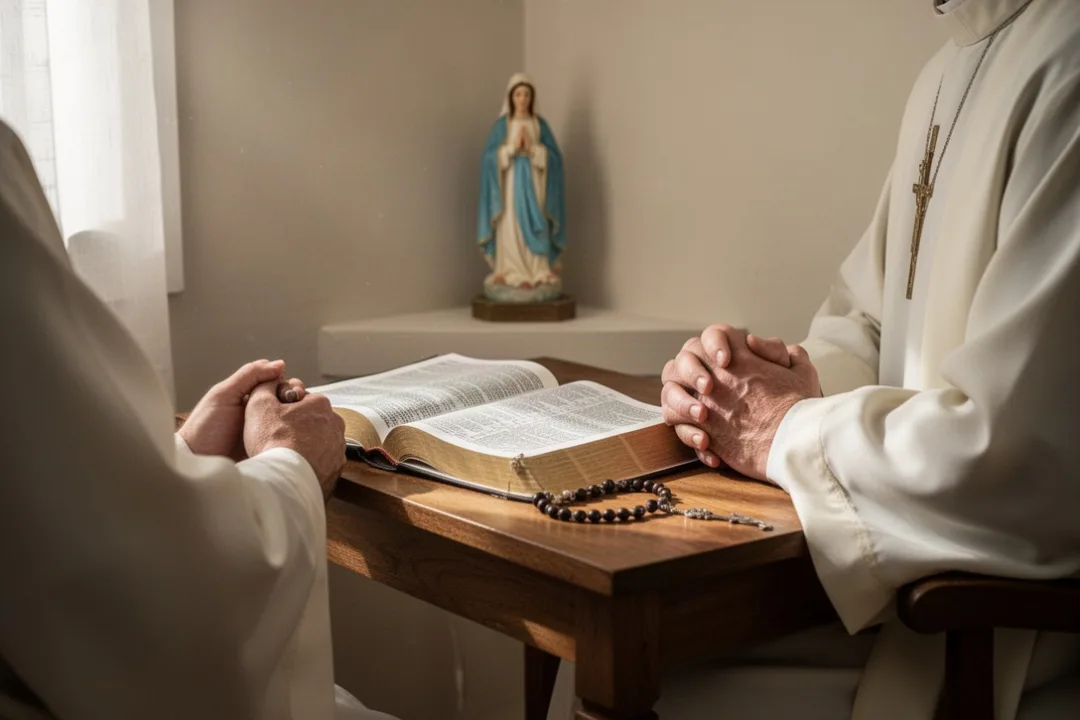
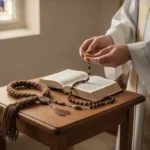
Choose a regular time and place. A quiet corner, a Bible, a devotional book, and a rosary may be enough. Some people pray in the morning before work; others use an evening routine after family responsibilities are finished.
Keep the daily practice realistic. A short, attentive period of prayer is more useful than an ambitious plan that produces anxiety and is abandoned after a few days. If you already have a prayer routine, add the preparation to it rather than building a completely separate schedule.
Step 4: Examine your life honestly
Preparation commonly includes repentance and self-examination. Consider how you use time, money, speech, attention, and authority. Ask where pride, resentment, impurity, dishonesty, laziness, fear, or excessive dependence on approval may be affecting your relationship with God and other people.
This examination is not meant to produce despair. Mary’s example leads toward truthful trust: seeing sin clearly, receiving mercy, and taking the next faithful step. If serious sin weighs on your conscience, sacramental confession can be an appropriate part of preparation for a Catholic.
Step 5: Pray with Mary’s virtues in view
Rather than treating Mary as an abstract ideal, focus on particular virtues shown in her life. Her humility does not mean passivity or low self-worth. Her obedience includes courage. Her silence is not indifference. Her care for others is not the same as controlling their choices.
Choose one virtue each day or week and connect it to a concrete action. For example, patience may mean listening before correcting someone; humility may mean accepting an unrecognized task; trust may mean praying before making a decision instead of acting immediately from fear.
Step 6: Include Scripture and the sacraments
Scripture keeps Marian devotion connected to God’s revelation. Gospel scenes involving Mary can be read slowly and prayed with, including the annunciation, the visitation, the birth of Jesus, the presentation in the Temple, the wedding at Cana, and Mary’s presence near the cross. Refer to the passages directly rather than treating private impressions as equal to Scripture.
Participation in Sunday Mass remains central. Depending on your circumstances, confession, Eucharistic adoration, spiritual direction, or a retreat may also help. These practices are not decorations added to the preparation; they help place the devotion within the wider life of the Church.
Step 7: Make the act of consecration
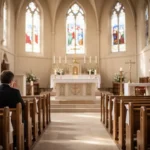
On the chosen day, attend Mass if possible and spend time in prayer. Some people make the act after receiving Communion, while others do so privately at home or in a church. Follow the wording recommended by your preparation method, or use a sound prayer that expresses your intention clearly.
The act usually includes an offering of your body, soul, possessions, relationships, merits, present circumstances, and future hopes to God. It may also express a desire to imitate Mary, belong more completely to Christ, and cooperate with God’s grace. Read the prayer slowly enough to understand what you are saying.
Practical safeguard: Do not promise what you do not understand. If a prayer uses strong language about giving Mary your merits, possessions, or spiritual life, ask a qualified Catholic guide how the words are understood before making the act.
Step 8: Continue with a simple rule of life
The consecration becomes meaningful through the ordinary days that follow. You might renew your intention briefly each morning, pray a decade of the Rosary, say a short Marian prayer, or pause before major decisions to ask how a faithful disciple would respond.
Do not measure the devotion by emotional experiences. Some people feel peaceful during the preparation; others feel distracted, dry, or challenged. The lasting signs are usually more practical: greater honesty, patience, willingness to forgive, faithfulness to duties, and renewed attention to Jesus.
A preparation program may ask you to use the Rosary, a litany, a Marian hymn, the Angelus, or another traditional prayer. These forms can help because repetition settles the mind and gives structure to reflection. They are aids, not magical formulas.
If you are new to Marian prayer, begin with a manageable form. You could pray one decade of the Rosary while reflecting on a Gospel scene, or say a brief prayer asking Mary to help you follow Jesus with greater trust. Over time, you can add more if the practice supports genuine attention.
Prayer can include four simple movements:
Adoration: recognize God as the source and goal of your life.
Repentance: acknowledge where you have resisted love, truth, or obedience.
Entrustment: place a particular concern, person, or decision in God’s care.
Mission: ask for strength to serve someone concretely that day.
You may also use a journal. Write one sentence about what stood out in prayer, one area that needs conversion, and one action you intend to take. This prevents the preparation from becoming only an intellectual exercise.
How to understand the “through Mary” language
The phrase through Mary can sound confusing if it is taken to mean that Jesus is inaccessible without her. Catholic teaching does not require that conclusion. Catholics can pray directly to God, and Christ is the one mediator of salvation in a unique and central sense.
The phrase refers to Mary’s role as the mother of Jesus and a model of cooperation with grace. Just as a person may learn faith, prayer, or generosity through the example and care of another Christian, a Catholic may deliberately receive Mary’s help and example while remaining directed toward Christ.
Mary’s cooperation is always dependent on God’s grace. She does not compete with Jesus or add something missing from his saving work. The devotion becomes distorted when Mary is imagined as a rival power, a substitute for the Church, or a way to avoid responsibility for personal choices.
“Do whatever he tells you.”
That short line from Mary at Cana, recorded in John 2:5, captures the proper direction of Marian devotion. Her role is not to draw attention away from Christ but to point people toward faithful response to him.
What a Marian consecration asks you to change
A consecration is more than a devotional identity or a special title you use for yourself. It asks how your choices reflect the person you have offered to God. The changes may be quiet and ordinary: speaking truthfully, keeping a promise, setting a healthy boundary, returning to prayer, or serving someone without recognition.
It can be helpful to review several areas of life after the preparation:
Prayer: Do you make regular time for God, even when your feelings are absent?
Relationships: Are you willing to forgive, listen, apologize, and tell the truth with charity?
Work: Do you carry out responsibilities carefully rather than seeking only praise?
Possessions: Are money and material goods serving your vocation, or controlling your attention?
Suffering: Can you bring pain to Christ without pretending that it is easy or meaningless?
Service: Does your devotion lead you toward practical concern for other people?
These questions are not a test for earning Mary’s favor. They help translate a spiritual intention into a pattern of life. A consecration that never affects conduct remains only a memorable ceremony.
Common mistakes that weaken the devotion
One mistake is treating the preparation as a spiritual achievement. Completing every reading may be useful, but it does not make a person holier by itself. Another is expecting constant consolation or a dramatic sign that the consecration has “worked.” Christian growth is often gradual and hidden.
A second mistake is replacing the Gospel with private messages, predictions, or extraordinary claims. Marian apparitions and reported experiences require careful discernment, and private devotion should never become a substitute for Scripture, the sacraments, or sound moral judgment.
A third mistake is using Mary devotion to avoid direct responsibility. Asking for Mary’s help does not remove the need to make a difficult apology, seek professional care, address an addiction, protect someone from harm, or obtain practical counsel. Prayer and responsible action belong together.
Do not treat a devotional object, medal, image, or prayer card as a lucky charm.
Do not assume that missing a day cancels the entire preparation.
Do not judge another Catholic’s faith because they use a different Marian devotion.
Do not make promises involving money, health, relationships, or vocation without wise counsel.
Do not let private devotion replace Mass, confession, Scripture, or duties toward others.
How to live Marian consecration after the ceremony
After the consecration, choose a few practices that you can sustain. A brief morning offering, regular Rosary, weekly Gospel meditation, and monthly confession may be appropriate, but your plan should fit your state in life. Parents, students, workers, caregivers, and people with health limitations may need different rhythms.
One useful pattern is to begin each morning with a simple offering of the day to God. During the day, repeat a short prayer when you face temptation, fear, or impatience. At night, review where you received grace, where you failed to love, and what repair or change is needed tomorrow.
You can also mark the anniversary without turning it into a superstition. Attend Mass, renew the act if your chosen method recommends it, read a Gospel passage, or thank God for specific ways you have grown. If the devotion has become burdensome, simplify it while preserving its central purpose.
Mary’s example is especially relevant in ordinary service. Notice the people who need practical help, make room for another person’s weakness, and bring Christ’s presence into places where faith may not be discussed openly. Consecration is lived through charity, not only through private prayer.
When to seek guidance before making the act
A priest or qualified spiritual director can be helpful if you are unsure about the wording, have scrupulosity, are recovering from religious trauma, or feel pressured by a group to make promises quickly. Guidance is also wise if the devotion is creating fear, obsessive behavior, conflict with family duties, or distrust of ordinary Church life.
People discerning a vocation, marriage, or major life decision should not use consecration as a method for forcing a particular outcome. Entrust the decision to God, gather reliable information, seek counsel, and consider the practical consequences. Mary’s example includes receptivity, but it also includes courage, perseverance, and real participation in the demands of life.
The healthiest approach is both reverent and free. You may begin slowly, ask questions, change methods, or postpone the formal act until you understand it. A genuine offering to God should be made with faith, freedom, and a sound conscience, not panic.
What Marian consecration can become over time
At first, the devotion may feel like a structured prayer project. Over time, it can become a way of seeing your entire life as belonging to God. Work, family decisions, suffering, friendships, and service are no longer separated from prayer; they become places where you practice trust and love.
The deepest fruit is not a special feeling or a claim to spiritual status. It is a more faithful response to Christ, shaped by Mary’s humility and courage. If your devotion helps you pray more honestly, receive the sacraments more fruitfully, serve others more generously, and turn away from sin, it is serving its proper purpose.
You can begin with a clear question: What part of my life have I not yet placed in God’s care? Bring that answer to prayer, ask Mary to help you follow Jesus there, and take one concrete step that expresses the offering.
Frequently asked questions
Do I have to complete exactly 33 days to make a Marian consecration?
No. Thirty-three days is a widely used preparation format, especially in traditions connected with St. Louis de Montfort, but it is not a universal requirement. Other Catholic programs use different schedules, and a priest may recommend a simpler approach. The essential elements are a sincere offering to God, devotion directed toward Christ, and a desire to live with Mary’s example and help.
Can non-Catholics make a Marian consecration?
Marian consecration is specifically rooted in Catholic devotion and teaching, so Catholics generally understand it within the Church’s sacramental and prayer life. Christians from other traditions may appreciate Mary’s example, but they should not feel pressured to adopt a practice that conflicts with their convictions. Anyone exploring it should learn what the prayers mean rather than repeating words without understanding them.
Is a Marian consecration a permanent promise?
It is normally a serious personal act of devotion, but it is not a vow in the same sense as a religious vow or formal promise made by members of a religious institute. The exact language varies by prayer. Read it carefully, ask questions about difficult phrases, and avoid making commitments you do not understand or cannot responsibly keep.
What if I miss prayers after making the consecration?
Missing a prayer does not cancel the consecration or mean that God has rejected you. Resume your routine without panic, and simplify it if necessary. The purpose is steady growth in faith and charity, not perfect performance. If missed prayers lead to intense fear or compulsive repetition, speak with a priest and consider help for scrupulosity or anxiety.












Leave a Reply