If you have heard the Christmas story many times, you may still wonder why it includes such a disturbing episode: the massacre of the innocents. The phrase refers to Matthew’s account of King Herod ordering the deaths of young boys in and around Bethlehem after learning that Jesus had been born there.
The story appears only in Matthew 2:13–18. Matthew says that wise men from the east visited Jerusalem looking for the newborn “king of the Jews.” Herod treated the child as a political threat, secretly learned when the star had appeared, and then ordered the killing of boys in Bethlehem who were within the relevant age range.
Joseph, Mary, and Jesus escaped because Joseph was warned in a dream. They went to Egypt until Herod died. Matthew presents the event as both a historical act of royal violence and a fulfillment of Scripture, connecting Jesus’ life with Israel’s earlier experiences of oppression, exile, and deliverance.
What the massacre of the innocents means in Matthew
Matthew’s wording focuses on “all the boys” in Bethlehem and its surrounding area who were two years old or younger. The account does not give a precise number, and it does not describe a massacre across the entire region of Judea. The setting is the small town of Bethlehem and the nearby territory under Herod’s authority.
The victims are called “the innocents” because they are children who have done nothing to deserve death. They are not presented as followers of Jesus or as people who understood the political conflict. Their innocence highlights the cruelty of Herod’s fear and ambition, not a moral judgment against them.
Matthew’s narrative moves quickly between danger and protection. The wise men do not return to Herod after being warned in a dream, and Joseph receives a separate warning to take Mary and Jesus to Egypt. The family’s escape does not prevent the violence against the other children, which gives the story its painful force.
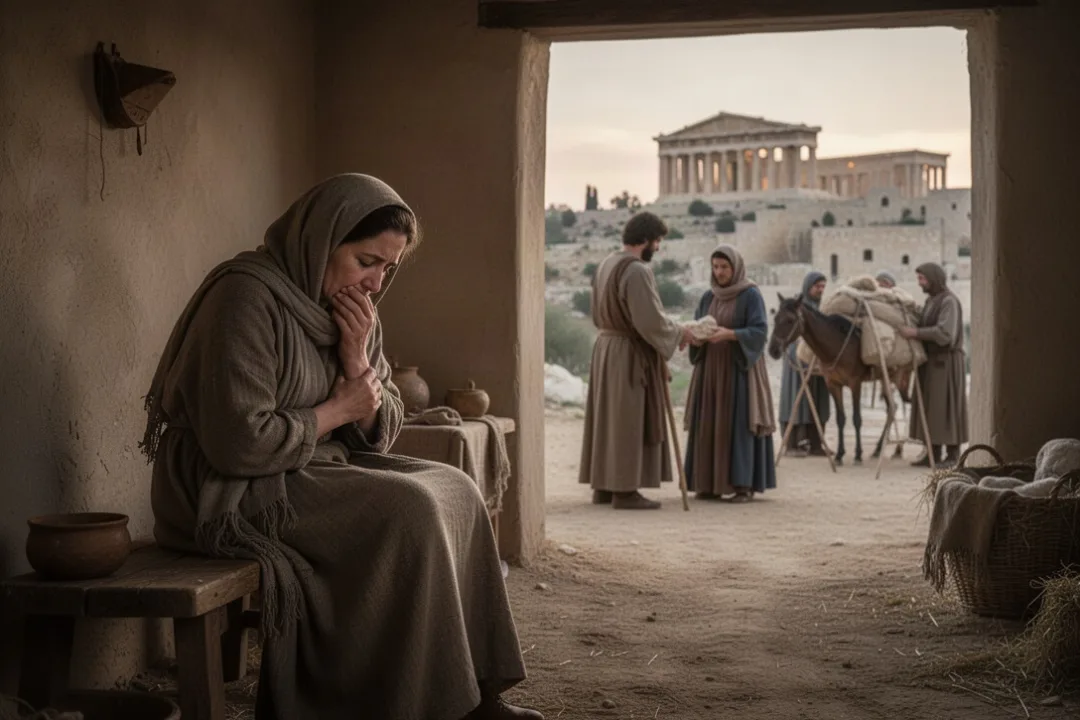
The passage also uses language associated with Rachel mourning her children. Matthew refers to Jeremiah 31:15, where Rachel symbolizes the mothers of Israel grieving because their descendants have been taken away. Matthew applies that image to Bethlehem’s mourning mothers, while the larger context of Jeremiah also points toward eventual restoration and hope.
The central point: Matthew is not saying the children deserved their fate or that their deaths were a necessary moral payment. He portrays them as victims of a ruler who uses power to protect his own position.
The episode therefore has two levels of meaning. At the narrative level, it explains why Jesus leaves Bethlehem and later comes from Egypt. At the theological level, it places Jesus within the story of Israel: like Moses, he is threatened by a ruler who fears a possible deliverer, and like Israel, he is associated with Egypt before returning.
Who Herod was and why he feared a newborn child
Herod the Great ruled Judea and surrounding territories under Roman authority from 37 to 4 BCE. He was an effective builder and administrator, but ancient accounts also portray him as suspicious, politically ruthless, and willing to eliminate perceived rivals. His position depended on maintaining Roman favor and suppressing challenges to his rule.
Matthew’s description of Herod’s response fits that broader portrait. The wise men ask about a child born as “king of the Jews,” a title that would sound politically dangerous to a ruler already holding that title in practice. Herod first presents himself as interested in worshiping the child, but Matthew reveals that his real aim is to destroy him.
The wise men’s arrival also matters because they are foreign visitors, not members of Jesus’ own community. They recognize significance in the child’s birth, while Jerusalem’s ruling authorities react with fear. Matthew uses this contrast to show that the threat is understood by outsiders and ignored or resisted by people close to power.
Herod’s order is calculated rather than random. He asks when the star appeared and uses that information to set the age limit for the children. The detail suggests an attempt to remove the child he cannot identify individually. It also explains why Matthew describes boys up to two years old rather than infants alone.
Herod’s death is the turning point in the story. Joseph is told that those seeking the child’s life have died, so the family can leave Egypt. Matthew then explains that they settle in Galilee rather than returning to Judea, because another member of Herod’s family rules there. The political danger has changed, but it has not disappeared entirely.
Ancient rulers could use violence against their own households and political circles, so Herod’s brutality is not implausible in general. Still, the Gospel’s account should be distinguished from what can be independently confirmed. Matthew is the only surviving ancient source that directly reports this particular order.
What historians can and cannot establish
Readers often ask whether the massacre definitely happened. The most careful answer separates several questions: whether Herod was capable of such an act, whether Bethlehem had enough children for the event to leave a large historical record, and whether Matthew’s account preserves an event that other writers simply did not mention.
Herod’s reputation makes the story historically possible. The Jewish historian Josephus, writing later, records several examples of Herod ordering executions or acting violently against suspected rivals. Josephus does not mention the killing of Bethlehem’s children, however, and that silence has led some scholars to question the episode’s historicity.
Silence alone cannot settle the matter. Bethlehem was a small settlement, and a local killing of young children could have been overlooked by writers who were concentrating on Herod’s major political actions. On the other hand, Matthew shapes his account around theological patterns found in Israel’s Scriptures, so some scholars understand the passage primarily as a literary and theological presentation of Jesus’ identity.
Matthew’s use of Scripture does not automatically mean that he invented the event. Ancient Jewish writers often interpreted events through earlier biblical patterns, seeing recurring relationships between Israel’s past and the present. A historical event could be narrated in a way that also presents its theological meaning.
The likely number of victims is another area where caution is needed. Later Christian traditions sometimes speak of thousands or even tens of thousands of children, but Matthew supplies no number. Because Bethlehem was small, modern estimates generally assume a much smaller group, though no exact figure can be established from the text.
What Matthew states: Herod ordered the deaths of boys aged two and under in Bethlehem and its vicinity.
What other ancient sources state: Herod was capable of severe political violence, but they do not independently describe this specific event.
What remains uncertain: the number of victims, the precise extent of the affected area, and how the event should be weighed historically.
What should be avoided: treating later numerical traditions as if they came from Matthew’s Gospel.
The best reading therefore avoids two opposite mistakes. It is too strong to claim that the episode is independently proven in every detail. It is also too strong to dismiss it simply because Josephus does not mention it. Historical judgments should recognize both the limits of the evidence and the political setting Matthew describes.
How the story connects Jesus with Moses and Israel
Matthew’s opening chapters repeatedly present Jesus’ life as a continuation of Israel’s story. The massacre of the innocents is especially close to the account of Pharaoh’s order in Exodus, where male Hebrew infants are threatened. Moses survives because he is hidden and later becomes the leader who brings Israel out of slavery.
The resemblance between the two stories is deliberate. In both accounts, a ruler fears a future deliverer and attacks vulnerable children. In both, the threatened child survives through the courage and obedience of others. Matthew also has Jesus come out of Egypt, echoing Israel’s own departure from that land.
This does not mean Matthew presents Jesus as merely another Moses. The Gospel develops the pattern in a new direction. Jesus is not only a child rescued from a tyrant; he becomes the central figure through whom Matthew understands God’s purposes for Israel and the nations.
The reference to Jeremiah adds another layer. Rachel, associated with Bethlehem and the people of Israel, represents mothers grieving over children who have been lost. Matthew draws attention to the unbearable reality of the mourning, but the surrounding biblical passage also includes the promise that grief will not have the last word.
That connection should not be used to soften the violence. Biblical fulfillment language is sometimes misunderstood as though the deaths were desirable because they appear in a divine plan. Matthew’s presentation does not require that conclusion. The quotation gives the tragedy a place within Israel’s Scriptures; it does not turn the suffering children into expendable objects.
Matthew presents the child’s rescue alongside the mothers’ grief, refusing to make the danger disappear simply because Jesus survives.
The story also prepares readers for a recurring theme in Matthew: God’s reign challenges abusive human power. Herod has a palace, political influence, and armed authority, yet he cannot control the child’s future. The contrast is not a claim that worldly violence causes no harm. The children die, and the Gospel leaves that grief visible.
Why Christians remember the Holy Innocents
Many Christian communities commemorate the victims as the Holy Innocents or the Holy Innocent Martyrs. The observance is commonly associated with the Christmas season, though the date and customs vary among Christian traditions. The focus is not on the children’s ability to make a conscious confession of faith but on their suffering because of their association with Christ.
In Western Christianity, the feast is commonly observed on December 28. Other churches follow different calendars or place the commemoration on another date. Local worship practices may include prayers for children, grieving families, victims of violence, and people who are powerless before political or military force.
The word “martyr” can raise theological questions because Matthew does not say that the children chose to die or publicly identified themselves as believers. Christian tradition uses the term in a distinctive sense: they died because a ruler was trying to destroy Christ. Their witness is therefore understood as unintentional and embodied in their suffering, not as a spoken act of courage.
Art and music have often depicted the scene, but representations differ greatly in tone. Some emphasize grieving mothers; others show soldiers, fleeing families, or Herod’s troubled court. Responsible presentations should avoid turning the children’s deaths into decorative background. The victims should remain people, not merely symbols of a religious theme.
The commemoration can also create an uncomfortable tension within the Christmas season. Celebrations of birth, light, and joy are placed beside a story of state violence against children. That tension is part of Matthew’s message: the arrival of hope does not mean that suffering has already vanished from the world.
When teaching or discussing the passage: name the victims, acknowledge the grief, and avoid claiming a precise death toll that the Gospel does not provide.
What the massacre of the innocents asks readers to consider today
The story continues to speak to readers who are trying to understand violence against children, forced migration, and the abuse of political power. Matthew shows a family becoming refugees because a ruler wants to eliminate a perceived threat. The journey to Egypt is not an abstract spiritual image; it is a flight from danger.
That does not mean every modern crisis is identical to the Gospel narrative. Careful application avoids using the passage as a slogan or attaching it casually to a current event. Its enduring questions are more basic: Who is treated as disposable? What happens when leaders protect power at the expense of vulnerable people? Who is willing to shelter those in danger?
Joseph’s role is also significant. He receives warnings, listens, and acts quickly to protect Mary and Jesus. Matthew does not portray him as defeating Herod through force. His faithfulness takes the form of practical protection, movement, and care for a family placed at risk.
The wise men likewise learn that obedience to a ruler is not always morally right. After their warning, they return home by another route rather than carrying Herod’s information back to him. Their decision shows that recognizing authority does not require cooperating with a violent plan.
For readers dealing with grief, the passage may be difficult precisely because it offers no easy explanation for the children’s deaths. It does not say that the mothers should be grateful for the suffering or that the tragedy was insignificant. The lament remains part of the story, alongside the promise that evil does not have unlimited authority.
A responsible response to the passage includes both honest lament and concrete concern for vulnerable people. That may mean supporting families displaced by conflict, resisting dehumanizing language, protecting children from abuse, or making space for people whose grief does not fit a cheerful religious season.
Matthew’s story begins with a ruler who tries to preserve his throne by killing children, but it does not end with Herod’s power. The threatened child survives, returns from exile, and grows into the central figure of the Gospel. The survival of Jesus does not erase the massacre; instead, the narrative keeps the victims’ mourning beside the hope it proclaims.
Frequently asked questions
Does the Bible say how many children Herod killed?
No. Matthew describes the age range and location but gives no number. Later traditions greatly expanded the scale, yet those figures are not found in the Gospel. Since Bethlehem was a small community, historians generally treat the number as uncertain and likely far lower than some later legendary accounts suggest.
Is the massacre of the innocents mentioned in every Gospel?
No. The episode appears only in Matthew, specifically in Matthew 2:16–18. Mark, Luke, and John begin their accounts differently and do not describe Herod’s order. Luke does include Jesus’ presentation at the temple and the family’s later life in Nazareth, but it does not mention a flight to Egypt or the slaughter in Bethlehem.
Why is Herod called “the Great” if he was so cruel?
“The Great” refers mainly to his political importance, large building projects, and long reign, not to moral character. Herod expanded and renovated major sites and governed effectively in some respects, while ancient sources also describe executions, suspicion, and ruthless efforts to secure his position. The title does not excuse or soften those actions.
Why does Matthew connect the event with Rachel?
Rachel is used in Jeremiah as a poetic figure for Israel’s mothers mourning children lost through national disaster. Matthew applies that image to the grief in Bethlehem. The reference acknowledges the mothers’ anguish while also drawing on Jeremiah’s wider theme of restoration. It does not suggest that the children’s deaths were deserved or insignificant.











Leave a Reply